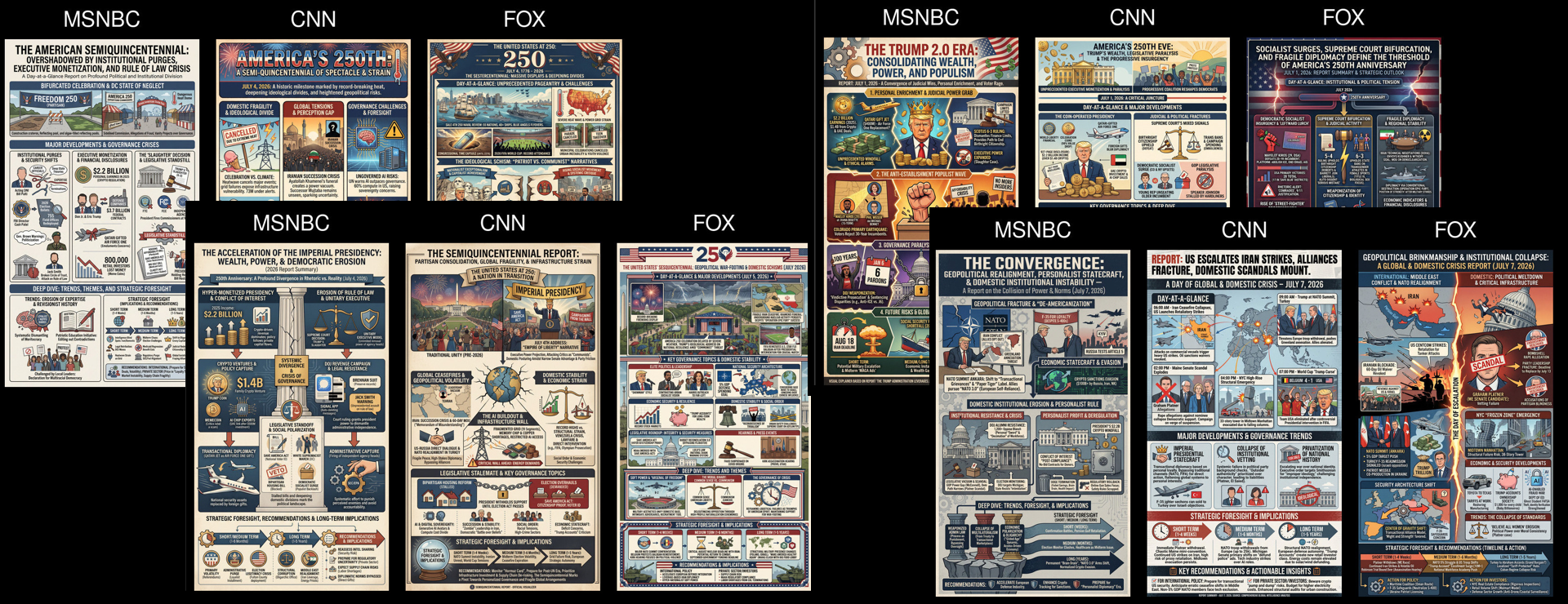
Earlier today we created an infographic montage depicting the parallel visions of America portrayed on CNN, MSNOW and Fox News over the past week, vividly visualizing the differences in their stories, narratives and framings. What would it look like to dive a bit deeper into the differences and similarities across these three media universes over the past two days? Here we take our Media Trends reports for the three channels for July 6th and 7th and ask Gemini to compare the six reports and examine how each channel covered America and the world over that 48-hour period. Only the Media Trends reports were used for this analysis, so only trends, themes and patterns identified in those reports were used for this analysis and thus coverage on the three channels not discussed in the Media Trends reports is not considered in the analyses below. No data was used to train or tune any model.
Let's start with Gemini 3.1 Pro High Thinking + Search Grounding and ask it to deeply analyze the three channels over the last two days using the following prompt:
Attached are a set of PDF daily reports that each deeply analyze the trends, themes and overarching narratives of CNN, MSNOW and Fox News over the last two days.
I want you to read them all very carefully and deeply and examine and analyze the similarities and differences in their coverage, from what stories they covered to their narratives to how they framed and presented their coverage.
Explain in detail your hypotheses for the major differences in their coverage.
How would you best describe their parallel coverage universes over the past two days?
You can see the resulting report below:
The results of even this quick comparative analysis are quite strong, especially given that it took less than 30 seconds to complete. What would the same prompt and analysis look like through the eyes of Gemini Deep Research Extended Thinking, given tens of minutes and far more computational resources to complete? Once again, using the same prompt and same six Media Trends reports:
Unlike the brief bulleted findings of Gemini 3.1 Pro, this analysis is written like a professional thinktank research report. The opening executive introduction alone says it all and illustrates the tremendous potential of applying Deep Research to these Media Trends reports to explore the macro-level themes, trends and parallel narrative universes of the American media landscape:
Parallel Epistemologies: A Comparative Analysis of Narrative Divergence Across U.S. Cable News (July 6-7, 2026)
Executive Introduction: The Architecture of Fractured Realities
The contemporary American media landscape has evolved beyond the traditional confines of mere partisan bias; it has fractured into structurally distinct, non-overlapping epistemological ecosystems. An exhaustive analysis of the daily television news coverage provided by CNN, MSNOW (formerly MSNBC), and Fox News over the highly volatile forty-eight-hour period of July 6 and July 7, 2026, reveals a profound sociological and political phenomenon. These broadcast networks do not merely offer different interpretations of a shared, objective reality; they actively construct parallel coverage universes, selecting entirely different sets of facts, prioritizing divergent existential threats, and utilizing entirely distinct narrative frameworks to contextualize the state of the nation and the world.
During this specific 48-hour analytical window, the United States stood at a historic, deeply polarized, and highly sensitive juncture. The nation had just concluded its 250th-anniversary celebrations against a backdrop of intense domestic polarization, including controversial white nationalist marches in the capital and deep, systemic institutional crises across multiple branches of the federal government. Internationally, the established global geopolitical architecture faced severe, potentially permanent stress tests. These included a high-stakes North Atlantic Treaty Organization (NATO) summit in Ankara, Turkey, the sudden and violent collapse of a fragile 60-day ceasefire with the Islamic Republic of Iran, and an unprecedented, highly personalized executive intervention by the U.S. President into the independent disciplinary governance of international sports. Furthermore, massive, generational shifts in domestic economic policy, primarily encapsulated by the launch of the state-seeded "Trump Accounts" for children, and ongoing, vicious legal warfare dominated the domestic legislative and judicial dockets.
However, a viewer consuming only one of these three cable networks would emerge with a fundamentally different, completely isolated understanding of the state of the world, the nature of the American presidency, and the trajectory of democratic institutions. What is reported as a catastrophic corruption scandal on one network is entirely omitted from another; what is hailed as a triumph of economic nationalism on one channel is framed as a desperate, destabilizing ploy on another. This report delivers an exhaustive, granular comparative analysis of these three networks based on specialized thematic data. It systematically dissects their specific coverage patterns, framing techniques, legislative focuses, and narrative construction, providing robust, extensively detailed hypotheses explaining the structural, economic, and ideological imperatives driving these profound epistemological divergences.