
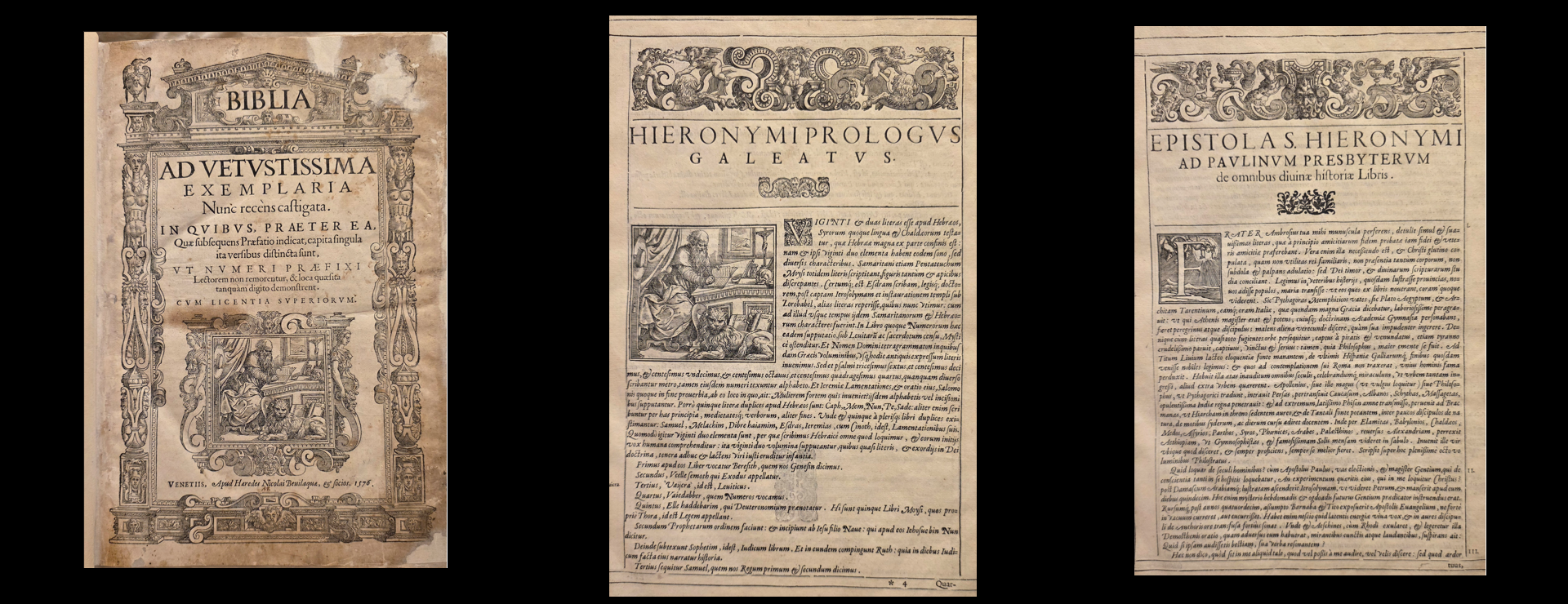
Some books become literal embodiments of pivotal historical moments. For the first thousand years after the Bible was translated into Latin in the late 4th century, all copies of the Jerome Vulgate were copied by hand (a scribe would make a new Bible by literally reading and hand-copying another Bible onto sheets of vellum that were then bound to become a new Bible, which might be copied again by another scribe, etc), meaning that by the time Gutenberg printed his Bible, there were an infinite number of tiny differences amongst all the copies of the Bible in circulation due to human error and other differences. In essence, there was no longer one authoritative copy of the Bible, as scribes copied other scribes and their errors and changes propogated. Gutenberg didn't seek to "correct" the Bible back to its original translation, he merely sought to mass produce identical copies of a single manuscript copy or set of copies that existed at the time.
In contrast, this rare 1576 folio Bevilacqua Bible is a lavishly illustrated Venetian printing of the Louvain Vulgate, with a preface from Johannes Hentenius himself and containing more than 600 stunning woodcuts copying Renaissance masters like Hans Holbein and Bernard Salomon. The Louvain Bible attempted to do exactly what Gutenberg did not: correct the Latin Bible back to its original Jerome roots to make a single authoritative translation that could then be mass produced using the printing press. The Louvain acted as the defacto standardized Latin translation of the Bible post-Council of Trent and was the base text used for numerous vernacular language translations over the coming decades until the Sixtine Vulgate in 1590.
This 1576 Bevilacqua thus captures a pivotal moment in Bible printing history: a copy of the Louvain text representing the concerted effort enabled by the printing press to correct a thousand years of copying errors and other deviations to develop a single authoritative Latin edition of the Bible that was restored closely to its original Jerome roots and available for mass exact duplication by the printing press, printed just 14 years before the Sixtine Vulgate changed the text once again.
Given the importance of the introductory text, what of a reader who encounters this book in a rare books archive and wishes to engage with the text, but doesn't speak Latin? What would it look like to snap photos of the first few pages with a cellphone and ask Gemini to translate them in their entirety into English? Below we can see just how powerful Gemini is as a tool for unlocking and engaging with historical texts.
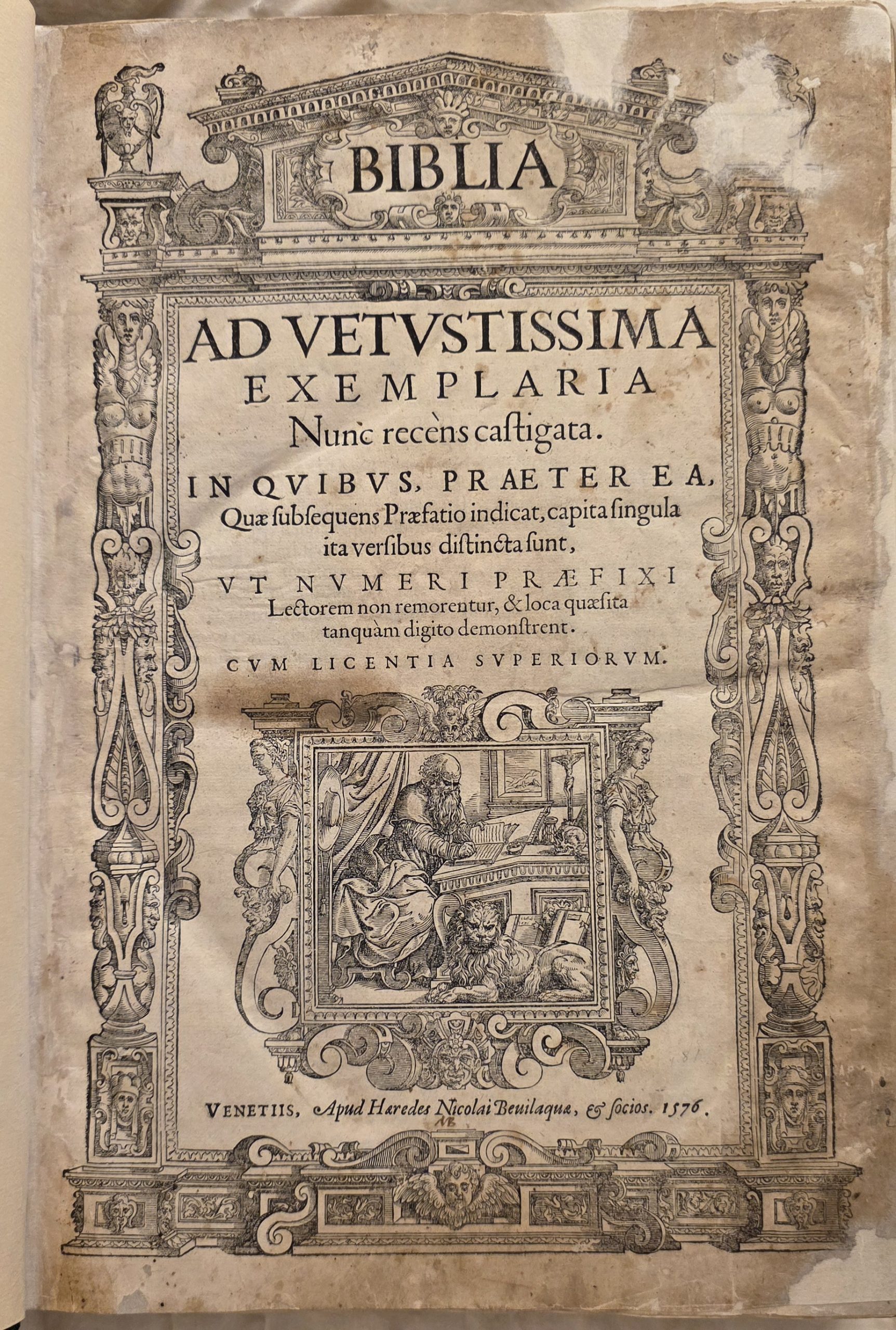
THE BIBLE
ACCORDING TO THE OLDEST COPIES
Now recently corrected.
IN WHICH, BESIDES THOSE THINGS,
Which the following Preface indicates, individual chapters are so divided into verses,
THAT THE PREFIXED NUMBERS
do not delay the Reader, and point out the sought locations as if with a finger.
WITH THE PERMISSION OF THE SUPERIORS.
VENICE, At the heirs of Nicolas Bevilacqua, and partners. 1576.
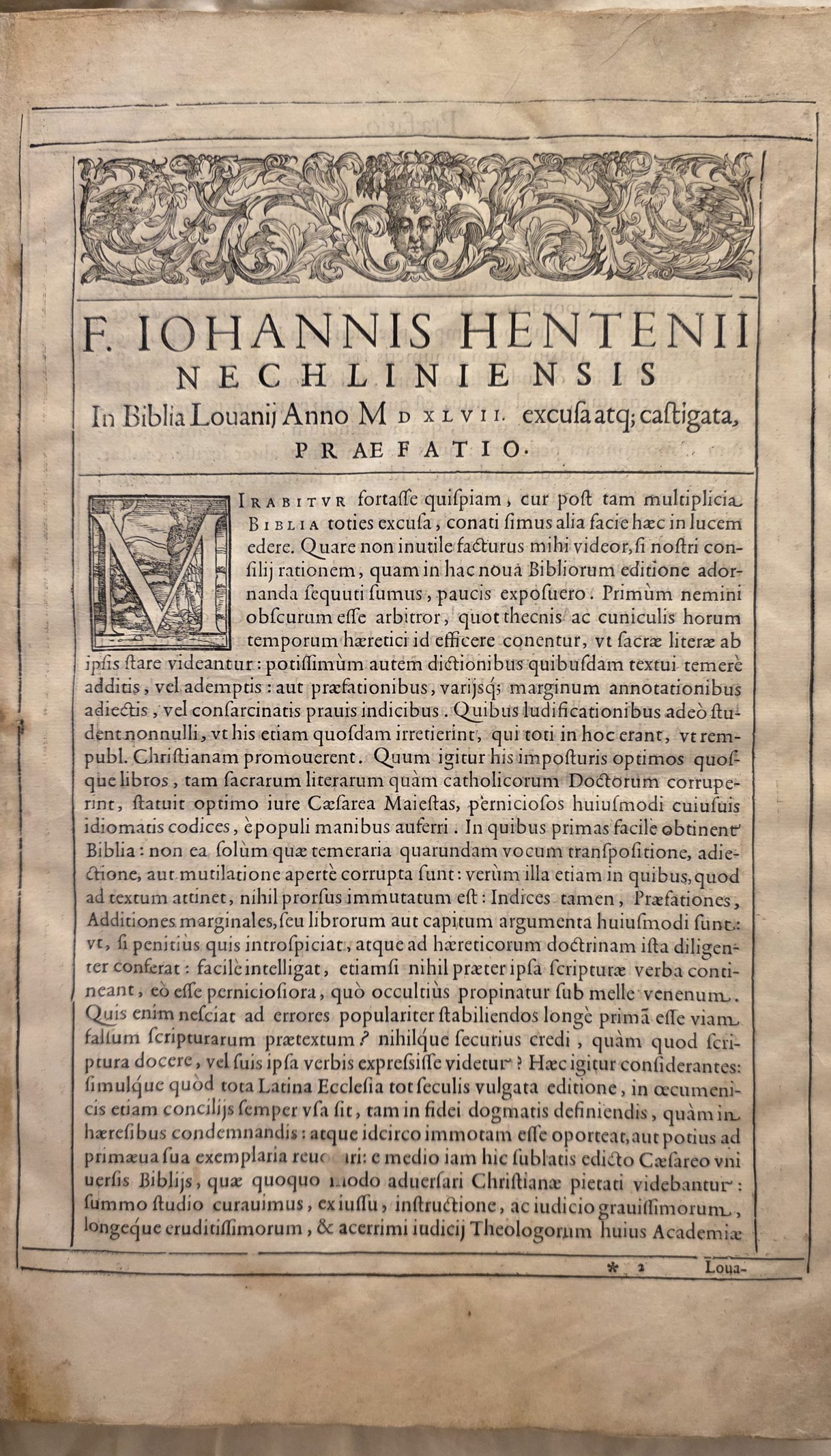
PREFACE OF FRIAR JOHANNES HENTENIUS OF MECHELEN
To the Bible printed and corrected at Leuven in the Year 1547.
Perhaps someone will wonder why, after so many multiple Bibles printed so many times, we have attempted to bring these to light in another appearance. Therefore, I think I will do something not useless, if I explain in a few words the reasoning of our plan, which we followed in preparing this new edition of the Bibles. First, I judge it is obscure to no one by how many tricks and machinations the heretics of these times attempt to bring it about that the sacred letters seem to stand on their side: but most especially by adding or taking away certain words rashly to the text: or by adding prefaces and various marginal annotations, or by patching together depraved indexes. By which mockeries some are so eager, that by these they have ensnared even some who were entirely devoted to this, that they might promote the Christian republic. When therefore by these impostures they corrupted all the best books, both of sacred letters and of Catholic Doctors, the Imperial Majesty decreed with the best right that pernicious books of this kind in any language be removed from the hands of the people. Among which Bibles easily hold the first place: not only those which are openly corrupted by the rash transposition, addition, or mutilation of certain words: but even those in which, as far as the text is concerned, nothing at all has been changed: yet the Indexes, Prefaces, marginal Additions, or arguments of the books or chapters are of such a kind: that, if anyone looks into them more deeply, and diligently compares those things with the doctrine of the heretics: he would easily understand that, even if they contain nothing besides the very words of scripture, they are all the more pernicious, the more secretly poison is served under honey. For who does not know that the very foremost way to popularly establish errors is a false pretext of the scriptures? and that nothing is believed more securely than what scripture seems to teach, or to have expressed in its own words? Considering these things therefore: and at the same time that the whole Latin Church for so many centuries has always used the Vulgate edition, even in ecumenical councils, both in defining dogmas of faith and in condemning heresies: and therefore it ought to be immovable, or rather recalled to its primeval copies: with all Bibles which seemed in any way whatsoever to oppose Christian piety having already been removed from the midst here by Imperial edict: we took care with the utmost zeal, by the command, instruction, and judgment of the most grave, and by far most erudite, and keenly judging Theologians of this Academy
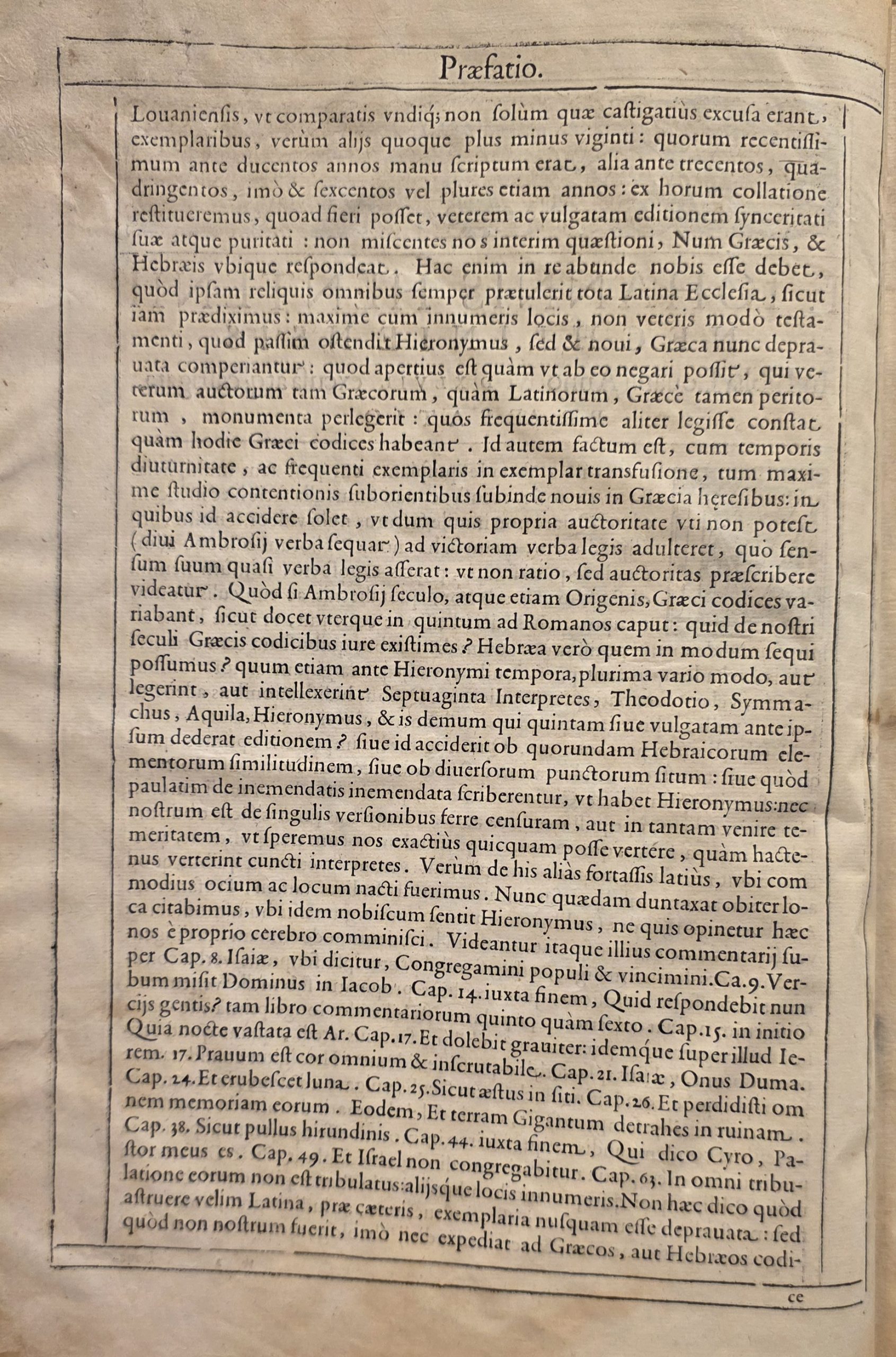
Preface.
of Leuven, that, having gathered from everywhere not only the copies which had been printed more correctly, but also about twenty others: the most recent of which was written by hand two hundred years ago, others three hundred, four hundred, indeed even six hundred or even more years ago: from the collation of these we should restore, as far as could be done, the old and Vulgate edition to its sincerity and purity: not entangling ourselves meanwhile in the question, Whether it everywhere corresponds to the Greek and Hebrew. For in this matter it ought to be abundantly sufficient for us, that the whole Latin Church has always preferred it to all the rest, as we have already said beforehand: especially since in innumerable places, not only of the Old Testament, which Jerome shows everywhere, but also of the New, the Greek is now found to be corrupted: which is more obvious than can be denied by him who has read through the monuments of the ancient authors, both Greek and Latin, yet skilled in Greek: whom it is certain very frequently read otherwise than the Greek codices have today. Now this was done, both by the length of time, and the frequent pouring over of copy into copy, but most especially by the zeal for contention with new heresies constantly arising in Greece: in which it usually happens, that while someone cannot use his own authority (I will follow the words of Saint Ambrose) he adulterates the words of the law for victory, by which he may assert his own sense as if it were the words of the law: so that not reason, but authority seems to prescribe. But if in the century of Ambrose, and even of Origen, the Greek codices varied, as both teach on the fifth chapter to the Romans: what should you rightly think of the Greek codices of our century? But in what way can we follow the Hebrew? since even before the times of Jerome, the Seventy Interpreters, Theodotion, Symmachus, Aquila, Jerome, and he finally who had given the fifth or vulgate edition before him, either read or understood very many things in a varied manner? whether this happened on account of the similarity of certain Hebrew letters, or on account of the differing placement of points: or because gradually uncorrected things were written from uncorrected ones, as Jerome has it: nor is it our task to pass judgment on individual versions, or to arrive at such great rashness, that we hope we can translate anything more exactly, than all interpreters have translated up to now. But concerning these things elsewhere perhaps more broadly, when we have obtained more convenient leisure and place. Now we will only cite in passing certain places, where Jerome feels the same as we do, lest anyone think we are devising these things from our own brain. Let his commentaries therefore be seen upon Chapter 8 of Isaiah, where it is said, "Gather together, O peoples, and be overcome." Ch. 9. "The Lord sent a word into Jacob." Chap. 14. near the end, "What shall be answered to the messengers of the nation?" both in the fifth and sixth book of commentaries. Chap. 15. at the beginning "Because in the night Ar is laid waste." Chap. 17. "And he shall grieve heavily": and the same upon that of Jeremiah 17. "The heart of all is perverse and unsearchable." Chap. 21. of Isaiah, "The burden of Dumah." Chap. 24. "And the moon shall blush." Chap. 25. "As heat in drought." Chap. 26. "And thou hast destroyed all memory of them." In the same, "And thou shalt pull down the land of the Giants into ruin." Chap. 38. "Like the young of a swallow." Chap. 44. near the end, "Who say to Cyrus, Thou art my shepherd." Chap. 49. "And Israel shall not be gathered." Chap. 63. "In all their tribulation he was not troubled": and in innumerable other places. I do not say these things because I wish to assert that the Latin copies, above the rest, are nowhere corrupted: but because it was not our task, nay rather it is not expedient to [correct them] according to the Greek, or Hebrew codi-
Preface.
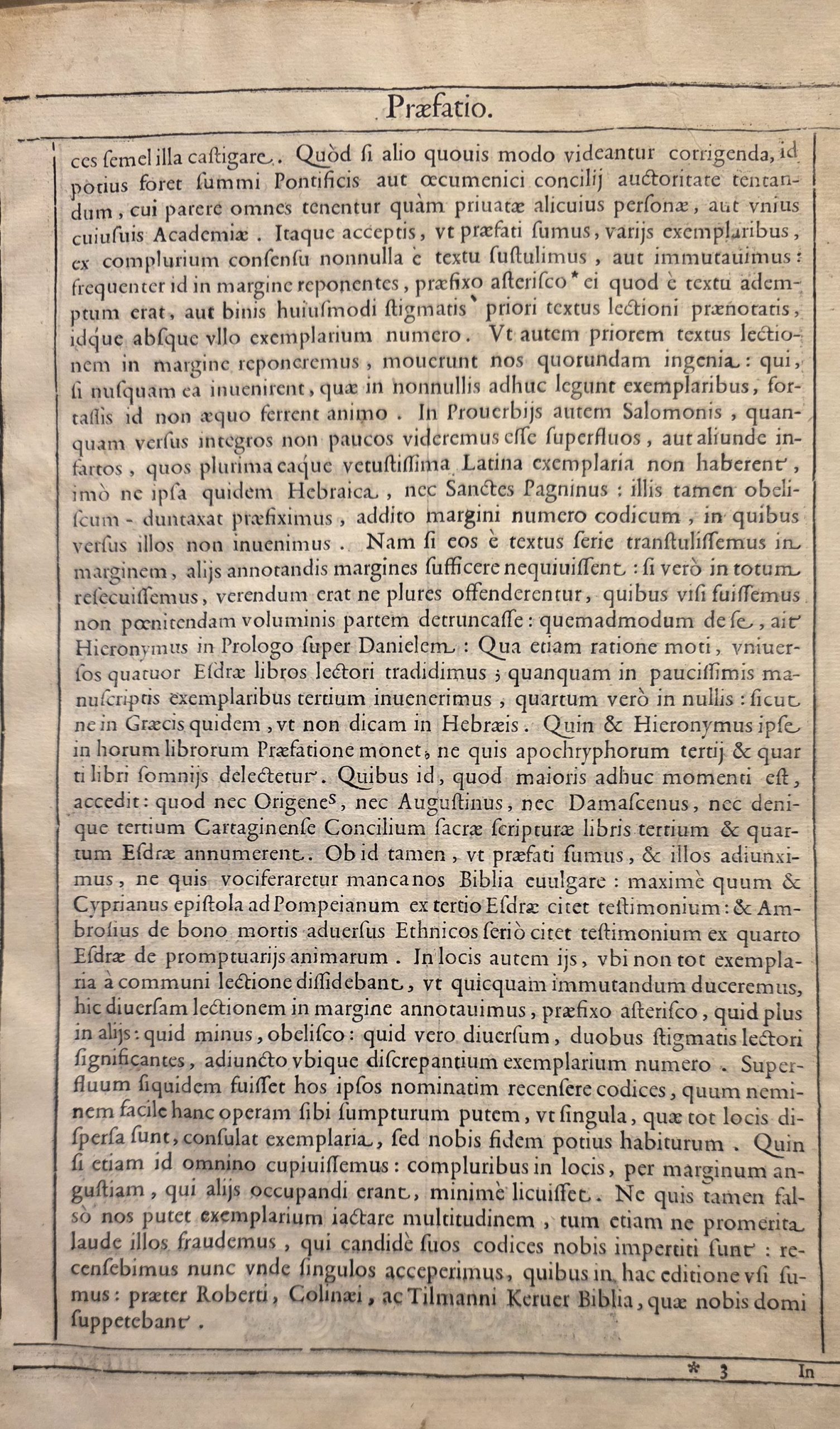
-ces once and for all to correct them. But if they seem to need correcting in any other way, that should rather be attempted by the authority of the Supreme Pontiff or of an ecumenical council, whom everyone is bound to obey, than of any private person, or of any single Academy. Therefore, having received, as we said before, various copies, by the consensus of several we have removed or changed some things from the text: frequently restoring it in the margin, with an asterisk * prefixed to that which was taken away from the text, or with two marks of this kind " prefixed to the former reading of the text, and that without any number of copies. But that we should put back the former reading of the text in the margin, the dispositions of certain people moved us: who, if they nowhere found those things which they still read in some copies, perhaps would not bear it with an equable mind. In the Proverbs of Solomon, however, although we saw not a few whole verses to be superfluous, or inserted from elsewhere, which very many and those the oldest Latin copies did not have, indeed not even the Hebrew themselves, nor Santes Pagnino: nevertheless we only prefixed an obelisk [dagger] – to them, adding to the margin the number of the codices in which we did not find those verses. For if we had transferred them from the series of the text into the margin, the margins would have been unable to suffice for annotating other things: but if we had cut them out entirely, it was to be feared lest many be offended, to whom we would have seemed to have truncated a not regrettable part of the volume: just as Jerome says of himself in the Prologue upon Daniel: Moved also by which reason, we have handed over all four books of Esdras to the reader; although we found the third in very few manuscript copies, but the fourth in none: just as not even in the Greek, not to speak of the Hebrew. Nay and Jerome himself in the Preface of these books warns, lest anyone be delighted by the dreams of the apocryphal third and fourth book. To which is added that which is of still greater moment: that neither Origen, nor Augustine, nor Damascene, nor finally the third Council of Carthage numbered the third and fourth of Esdras among the books of sacred scripture. For that reason however, as we said before, we have also adjoined them, lest anyone cry out that we are publishing a maimed Bible: especially since Cyprian in his epistle to Pompeianus cites a testimony from the third of Esdras: and Ambrose on the good of death against the Pagans seriously cites a testimony from the fourth of Esdras concerning the storehouses of souls. In those places, however, where not so many copies disagreed from the common reading, that we considered anything should be changed, here we annotated the different reading in the margin, signifying to the reader what is more in others with a prefixed asterisk, what is less, with an obelisk: but what is different, with two marks, adding everywhere the number of disagreeing copies. For it would have been superfluous to recount these very codices by name, since I think no one would easily take up this labor for himself, to consult individual copies, which are scattered in so many places, but rather will have faith in us. Furthermore, even if we had entirely desired it: in many places, due to the narrowness of the margins, which were to be occupied by other things, it would have been by no means permitted. Lest anyone, however, falsely think that we boast of a multitude of copies, and also lest we defraud of their deserved praise those who candidly shared their codices with us: we will now recount from where we received each one, which we used in this edition: besides the Bibles of Robertus [Estienne], Colinaeus, and Thielman Kerver, which were available to us at home.
Preface.
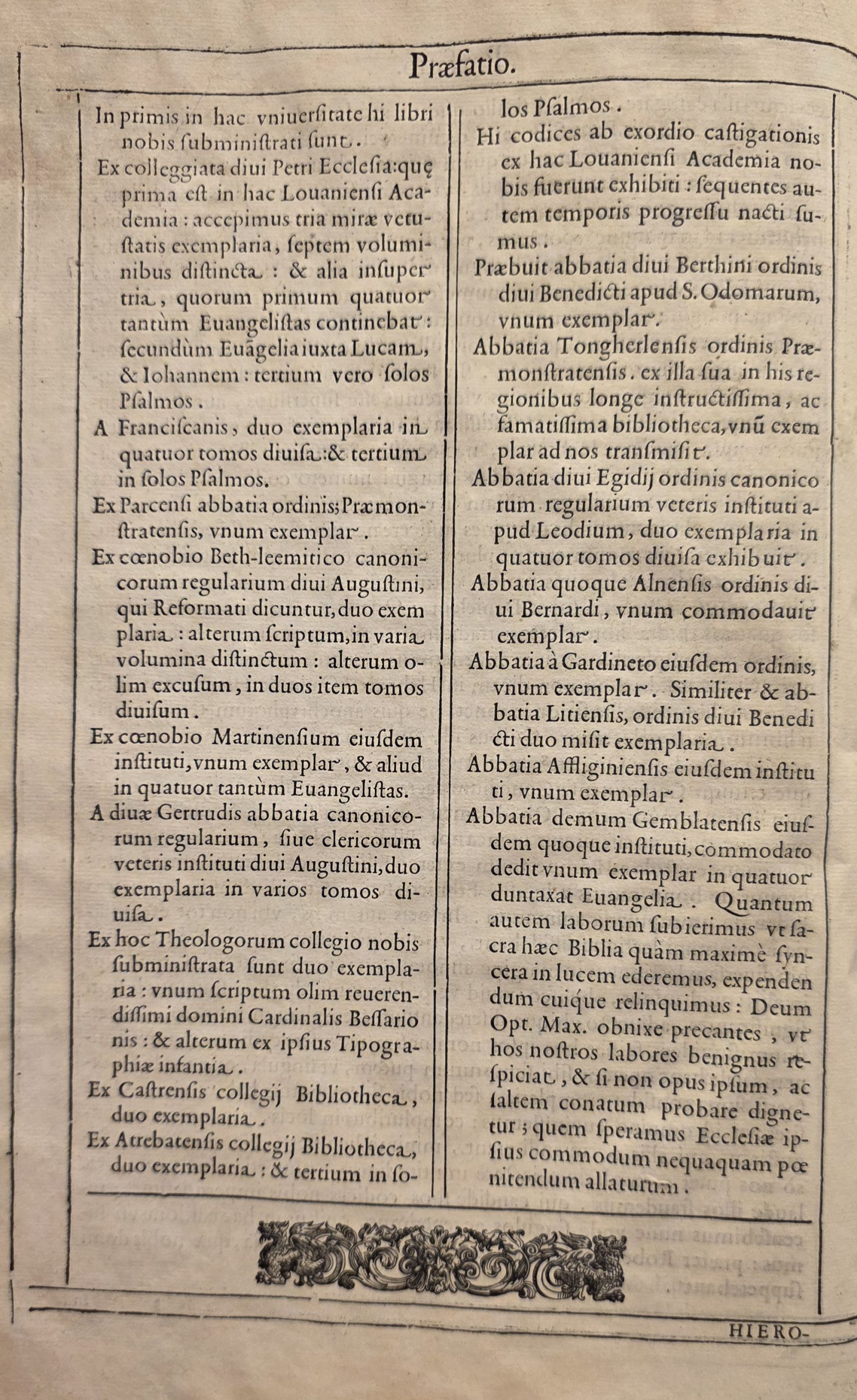
First of all, in this university these books were supplied to us.
From the collegiate Church of Saint Peter: which is the first in this Academy of Leuven: we received three copies of wondrous antiquity, divided into seven volumes: and three others besides, the first of which contained only the four Evangelists: the second the Gospels according to Luke and John: but the third only the Psalms.
From the Franciscans, two copies divided into four tomes: and a third into only the Psalms.
From the abbey of Parc of the Premonstratensian order, one copy.
From the Bethlehemite monastery of the regular canons of Saint Augustine, who are called Reformed, two copies: one handwritten, divided into various volumes: the other formerly printed, likewise divided into two tomes.
From the monastery of the Martinensians of the same institute, one copy, and another into only the four Evangelists.
From the abbey of Saint Gertrude of the regular canons, or clerics of the old institute of Saint Augustine, two copies divided into various tomes.
From this college of Theologians two copies were supplied to us: one written formerly belonging to the most reverend lord Cardinal Bessarion: and the other from the infancy of Typography itself.
From the Library of the College of Castres, two copies.
From the Library of the College of Arras, two copies: and a third into only the Psalms.
These codices were presented to us from the beginning of the correction from this Academy of Leuven: but the following ones we obtained as time progressed.
The abbey of Saint Bertin of the order of Saint Benedict at Saint-Omer provided one copy.
The Abbey of Tongerlo of the Premonstratensian order, from that library of theirs which is by far the best equipped and most famous in these regions, transmitted one copy to us.
The Abbey of Saint Giles of the order of regular canons of the old institute at Liège, exhibited two copies divided into four tomes.
The Abbey also of Aulne of the order of Saint Bernard, lent one copy.
The Abbey of Jardinet of the same order, one copy. Similarly also the Abbey of Liessies, of the order of Saint Benedict, sent two copies.
The Abbey of Affligem of the same institute, one copy.
Finally the Abbey of Gembloux also of the same institute, gave on loan one copy in only the four Evangelists.
But how much labor we underwent that we might bring to light these Holy Bibles as sincere as possible, we leave to everyone to weigh: earnestly praying to the Best and Greatest God, that He may kindly look upon these our labors, and if not the work itself, may deign to approve at least the attempt; which we hope will bring a by no means regrettable benefit to His Church.
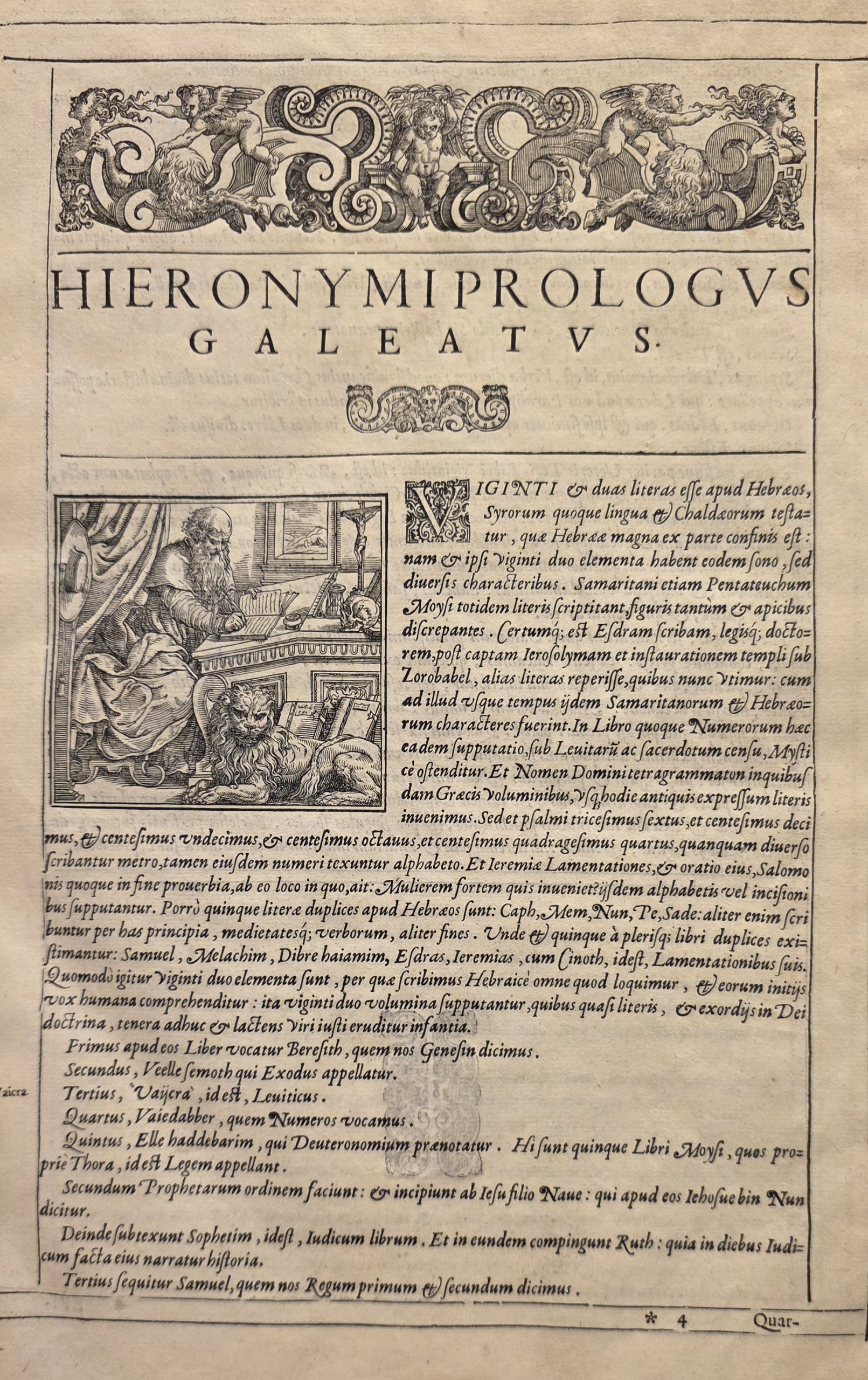
JEROME'S HELMETED PROLOGUE.
That there are twenty-two letters among the Hebrews, is witnessed also by the language of the Syrians and Chaldeans, which is in large part closely related to the Hebrew: for they themselves also have twenty-two elements with the same sound, but with different characters. The Samaritans also write the Pentateuch of Moses with the same number of letters, differing only in figures and strokes. And it is certain that Esdras the scribe and doctor of the law, after the taking of Jerusalem and the restoration of the temple under Zerubbabel, found other letters, which we now use: since up to that time the characters of the Samaritans and the Hebrews were the same. Also in the Book of Numbers this same computation is mystically shown, under the census of the Levites and priests. And the tetragrammaton Name of the Lord in certain Greek volumes, even to this day we find expressed in ancient letters. But also the thirty-sixth psalm, and the one hundred and tenth, and the one hundred and eleventh, and the one hundred and eighth [119th in Hebrew], and the one hundred and forty-fourth, although they are written in different meter, nevertheless are woven with an alphabet of the same number. And the Lamentations of Jeremiah, and his prayer, also the proverbs of Solomon at the end, from that place in which he says: "Who shall find a valiant woman?" are computed by the same alphabets or divisions. Furthermore, there are five double letters among the Hebrews: Caph, Mem, Nun, Pe, Sade: for beginnings and middles of words are written one way by these, ends another way. Whence also five books are esteemed double by most: Samuel, Kings (Melachim), Chronicles (Dibre haiamim), Esdras, Jeremiah with Cinoth, that is, his Lamentations. Therefore just as there are twenty-two elements, by which we write in Hebrew everything that we speak, and by their beginnings the human voice is comprehended: so twenty-two volumes are computed, by which, as if by letters and rudiments in the doctrine of God, the still tender and nursing infancy of the just man is instructed.
The first Book among them is called Beresith, which we call Genesis.
The second, Veelle semoth which is named Exodus.
The third, Vaïcra, that is, Leviticus.
The fourth, Vaiedabber, which we call Numbers.
The fifth, Elle haddebarim, which is titled Deuteronomy. These are the five Books of Moses, which they properly call Thora, that is the Law.
The second order they make of the Prophets: and they begin from Jesus the son of Nave: who is called among them Joshua bin Nun.
Then they subjoin Sophetim, that is, the book of Judges. And into the same they bind Ruth: because the history of her deeds is narrated in the days of the Judges.
Third follows Samuel, which we call the first and second of Kings.
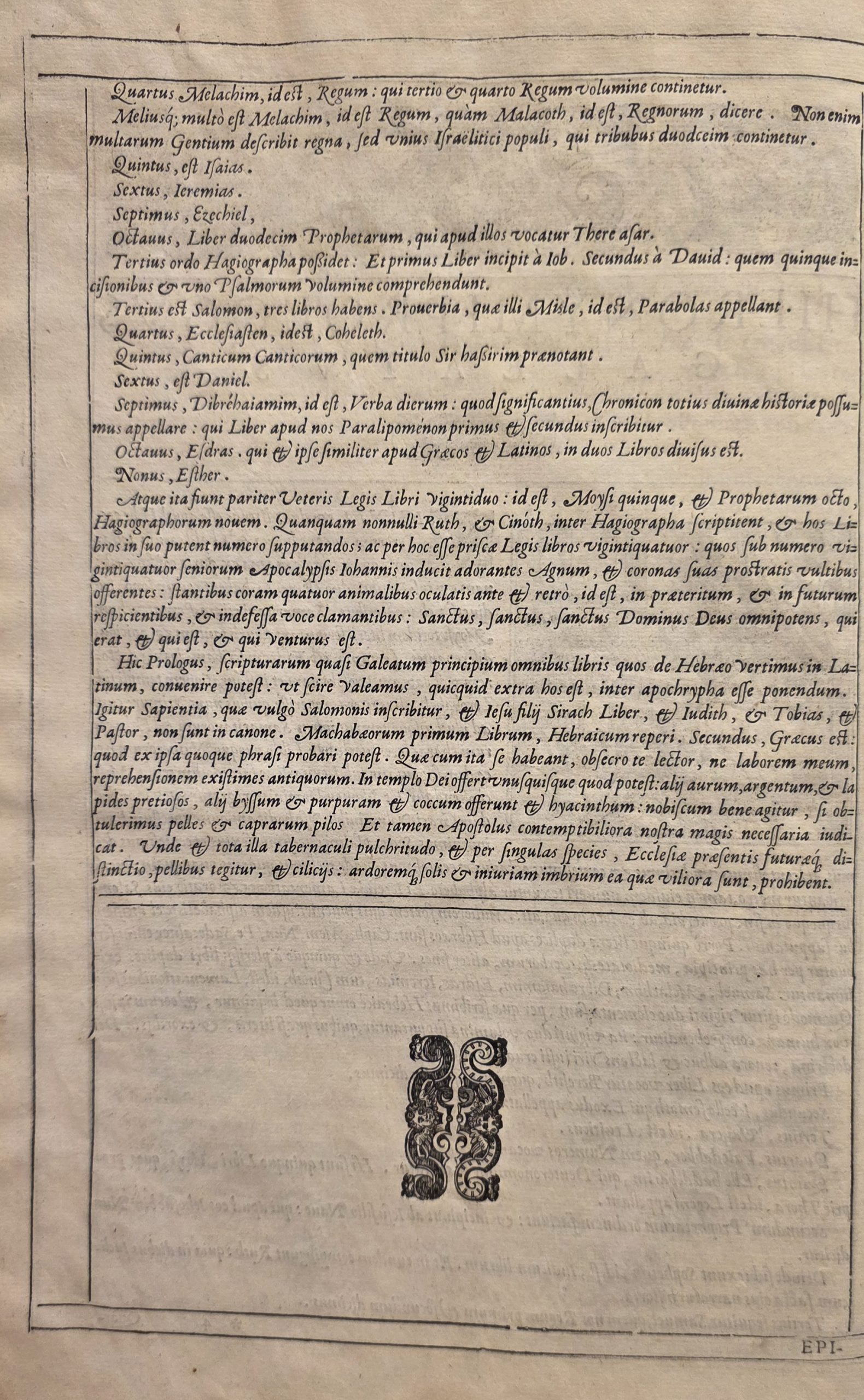
The fourth is Melachim, that is, of Kings: which is contained in the third and fourth volume of Kings. And it is much better to say Melachim, that is of Kings, than Malacoth, that is, of Kingdoms. For it does not describe the kingdoms of many Nations, but of one Israelite people, which is contained in twelve tribes.
The fifth, is Isaiah.
The sixth, Jeremiah.
The seventh, Ezekiel.
The eighth, the Book of the twelve Prophets, which among them is called There asar.
The third order possesses the Hagiographa: And the first Book begins from Job. The second from David: which they comprehend in five divisions and one volume of Psalms.
The third is Solomon, having three books. Proverbs, which they call Misle, that is, Parables.
The fourth, Ecclesiastes, that is, Coheleth.
The fifth, Song of Songs, which they title Sir hassirim.
The sixth, is Daniel.
The seventh, Dibre haiamim, that is, Words of days: which we may more significantly call the Chronicle of the whole divine history: which Book is inscribed among us as the first and second of Paralipomenon (Chronicles).
The eighth, Esdras. which itself also is similarly divided into two Books among the Greeks and Latins.
The ninth, Esther.
And thus there are equally twenty-two Books of the Old Law: that is, five of Moses, and eight of the Prophets, nine of the Hagiographa. Although some write Ruth, and Cinoth (Lamentations) among the Hagiographa, and think these Books should be computed in their own number; and therefore that there are twenty-four books of the ancient Law: which the Apocalypse of John introduces under the number of the twenty-four elders adoring the Lamb, and offering their crowns with prostrate faces: while there stand before them four living creatures eyed before and behind, that is, looking back to the past, and to the future, and crying out with untiring voice: Holy, holy, holy Lord God almighty, who was, and who is, and who is to come.
This Prologue, as a Helmeted beginning of the Scriptures, can apply to all the books which we translate from Hebrew into Latin: so that we may be able to know, that whatever is outside of these, is to be placed among the apocrypha. Therefore Wisdom, which is commonly ascribed to Solomon, and the Book of Jesus the son of Sirach, and Judith, and Tobias, and the Shepherd, are not in the canon. The first Book of the Machabees, I found to be Hebrew. The second, is Greek: which can be proven from its very phrasing as well. Since these things are so, I beseech you reader, do not consider my labor to be a reprehension of the ancients. In the temple of God everyone offers what he can: some offer gold, silver, and precious stones, others offer fine linen and purple and scarlet and hyacinth: it goes well with us, if we have offered skins and goats' hair. And yet the Apostle judges our more contemptible parts to be more necessary. Whence also all that beauty of the tabernacle, and the distinction through individual forms of the present and future Church, is covered with skins, and haircloths: and those things which are of less value, ward off the heat of the sun and the injury of the rains.
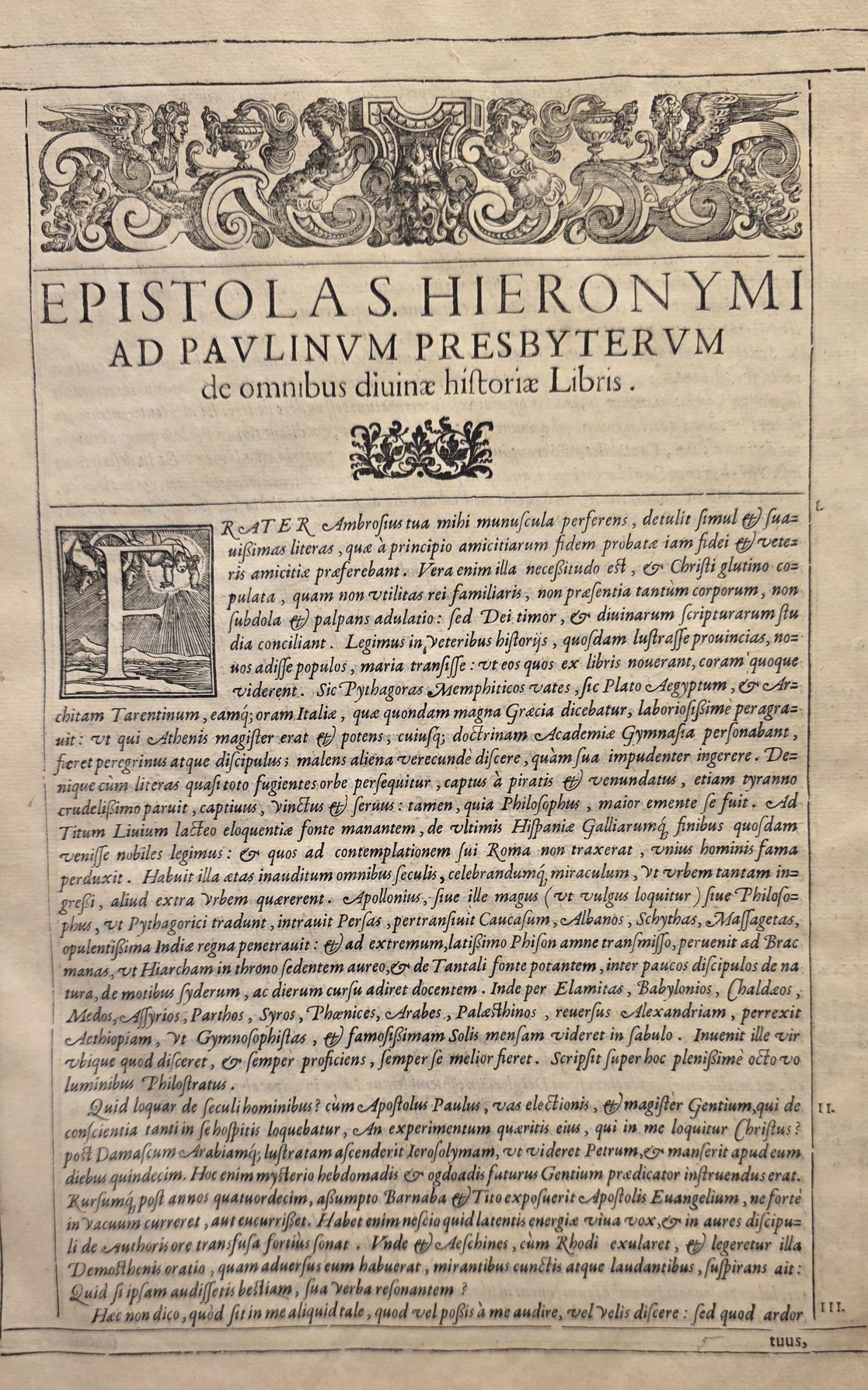
EPISTLE OF ST. JEROME TO PAULINUS THE PRESBYTER concerning all the Books of divine history.
BROTHER Ambrose, bringing your little gifts to me, delivered at the same time also most sweet letters, which from the beginning of friendships carried the pledge of an already proven faith and of old friendship. For that is a true necessity [bond], and coupled with the glue of Christ, which not the utility of household affairs, not the presence of bodies alone, not deceitful and caressing adulation: but the fear of God, and the studies of the divine scriptures conciliate. We read in ancient histories, that certain men traversed provinces, approached new peoples, crossed seas: so that they might see face to face those whom they knew from books. Thus Pythagoras [visited] the Memphitic seers, thus Plato most laboriously traversed Egypt, and Archytas of Tarentum, and that coast of Italy which was once called Magna Graecia: so that he who was a master and powerful in Athens, and whose doctrine the Gymnasia of the Academy resounded with, might become a pilgrim and a disciple: preferring to learn other people's things modestly, than to shamelessly thrust forward his own. Finally, when he pursued letters fleeing as if through the whole world, captured by pirates and sold, he even obeyed a most cruel tyrant, a captive, bound and a slave: yet, because he was a Philosopher, he was greater than him who bought him. To Titus Livy, flowing with a milky fount of eloquence, we read that certain noblemen came from the furthest bounds of Spain and the Gauls: and those whom Rome had not drawn to the contemplation of itself, the fame of one man led there. That age held a miracle unheard of in all centuries, and to be celebrated, that having entered so great a city, they sought something else outside the city. Apollonius, whether that magician (as the vulgar speak) or Philosopher, as the Pythagoreans hand down, entered the Persians, crossed the Caucasus, the Albanians, the Scythians, the Massagetae, penetrated the most opulent kingdoms of India: and at the end, having crossed the most broad river Pishon, arrived at the Brahmans, so that he might approach Iarchas sitting on a golden throne, and drinking from the font of Tantalus, teaching among a few disciples about nature, about the motions of the stars, and the course of days. Then through the Elamites, Babylonians, Chaldeans, Medes, Assyrians, Parthians, Syrians, Phoenicians, Arabs, Palestinians, having returned to Alexandria, he proceeded to Ethiopia, so that he might see the Gymnosophists, and the most famous table of the Sun in the sand. That man found everywhere something to learn, and always advancing, always became better than himself. Philostratus wrote very fully upon this in eight volumes.
Why should I speak of the men of the world? since the Apostle Paul, the vessel of election, and master of the Gentiles, who spoke from the conscience of so great a guest in himself, "Do you seek a proof of Christ who speaks in me?" after traversing Damascus and Arabia, ascended to Jerusalem, that he might see Peter, and he remained with him for fifteen days. For by this mystery of the heptad and ogdoad [seven and eight] the future preacher of the Gentiles was to be instructed. And again after fourteen years, taking Barnabas and Titus, he expounded the Gospel to the Apostles, lest by chance he should run, or had run in vain. For the living voice has I know not what of hidden energy, and poured from the mouth of the Author into the ears of the disciple, sounds more strongly. Whence also Aeschines, when he was in exile at Rhodes, and that oration of Demosthenes was read, which he had held against him, with everyone wondering and praising, sighing said: What if you had heard the beast himself, resounding his own words?
I do not say these things, because there is in me any such thing, which you could either hear from me, or wish to learn: but because your ardor,
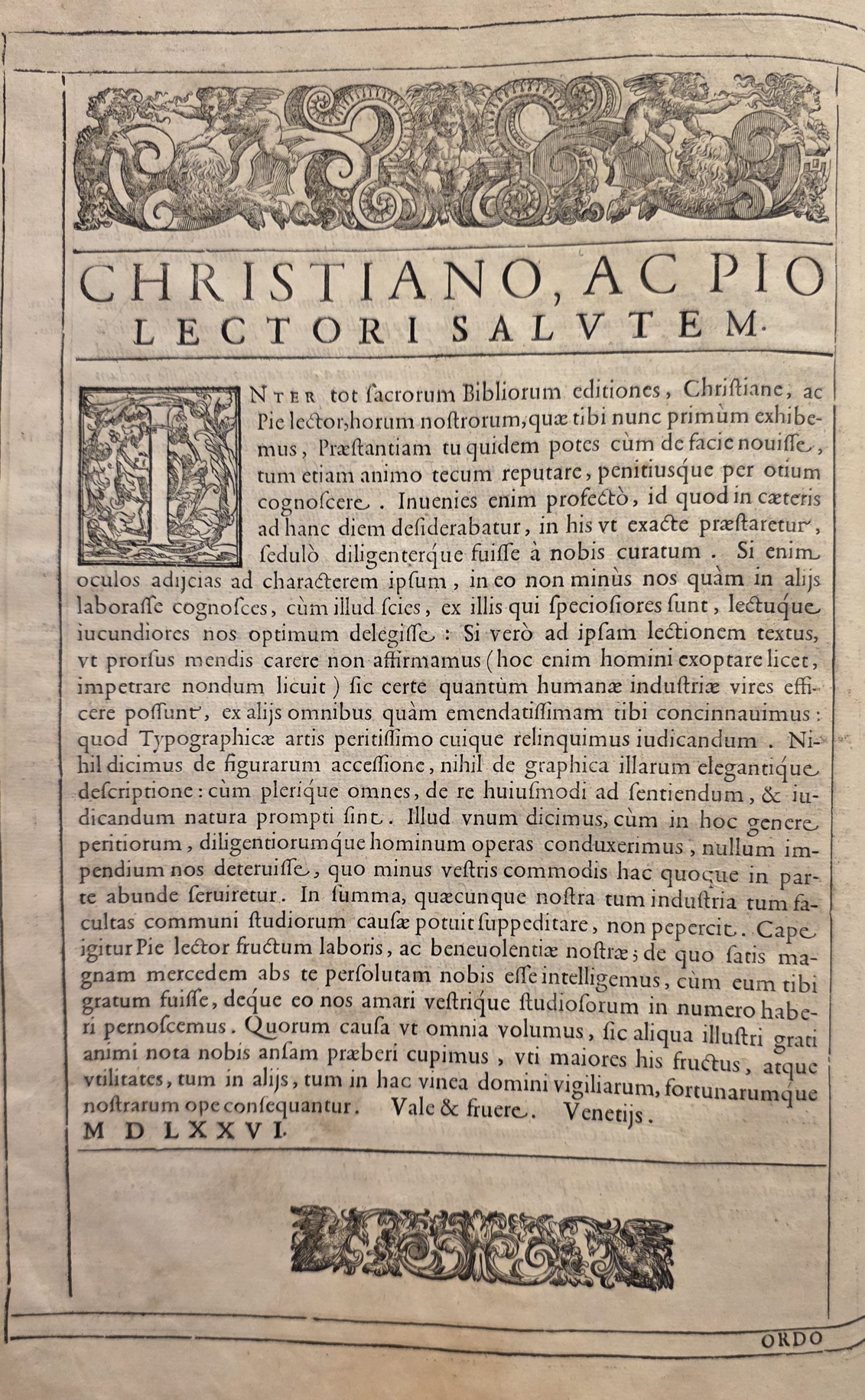
TO THE CHRISTIAN AND PIOUS READER, GREETINGS.
Among so many editions of the Holy Bibles, Christian and Pious reader, you can indeed recognize the excellence of these of ours, which we now present to you for the first time, both by knowing it at first sight, and also by considering it in your mind, and by examining it more deeply at your leisure. For you will certainly find that what was desired in other editions up to this day, has been carefully and diligently attended to by us, so that it might be exactly provided in these. For if you cast your eyes upon the character (typeface) itself, you will recognize that we have labored no less in it than in other matters, when you know that from those which are more beautiful and more pleasant to read, we have chosen the best: But if [you look] to the reading of the text itself, while we do not affirm it to be entirely free from errors (for it is permitted for a man to desire this, but not yet allowed to achieve it), yet certainly, as much as the powers of human industry can effect, we have put together for you the most corrected one out of all others: which we leave to be judged by anyone most skilled in the Typographic art. We say nothing of the addition of figures (illustrations), nothing of their graphic elegance and depiction: since almost everyone is naturally prompt to feel and judge concerning a matter of this kind. We say this one thing: since we have hired the labor of the more skilled and diligent men in this field, no expense has deterred us from serving your interests abundantly in this part as well. In short, whatever our industry and resources could supply for the common cause of studies, we have not spared. Take therefore, Pious reader, the fruit of our labor and goodwill; for which we will understand that a sufficiently great reward has been paid to us by you, when we learn that it has been pleasing to you, and that for it we are loved and counted among the number of your scholars. For whose sake as we wish all things, so we desire that an opportunity be provided to us by some clear mark of a grateful mind, so that they may obtain greater fruits and benefits than these, both in other things, and in this vineyard of the Lord, by the help of our watchfulness and fortunes. Farewell and enjoy. Venice. 1576.