Earlier this year we definitively proved for the first time that both the paper and parchment William Stone Declaration of Independence prints were made from the same copperplate currently on display at NARA. A lingering question regards the differing plate marks on the parchment and paper copies and how they could derive from the same copperplate if the surface area of the copperplate is different between them. Of course, the most obvious answer is that parchment is highly responsive to environmental conditions and can extensively shrink, expand and deform three dimensionally in response to changing humidity, whereas paper prints deform far more minimally. How might Gemini help us compare two institutional prints of the Stone Declaration from the copperplate?
To answer this question, we acquired high resolution imagery of two institutionally-owned copies of the Stone Declaration, one an original print parchment and one a Peter Force print on thin wove tracing paper. These two particular copies have very strong plate marks, making it easy to crop the images to the plate boundaries. First we manually cropped the two images into PhotoShop by zooming in and carefully manually adjusting the image boundaries to the plate marks. Then we tested whether Gemini could have done this for us automatically using the following prompt. Indeed, Gemini cropped the image to the EXACT margins we did:
Examine this photograph of a copperplate intaglio print carefully.
Look extremely carefully at the margins for the depression and/or ink haze indicating the edges of the copperplate.
Crop the image to contain ONLY the area printed by the copperplate itself.
The parchment copy we examined had severe cockling (rippling due to environmental changes over the years) while the paper copy had been pressed flat under glass for imaging. Thankfully, the parchment's cockling is minimal at the top left and both bottom corners, allowing us to directly compare those three corners and confirm that the distance from the outermost text boundary and the plate mark is absolutely identical between the paper and parchments.
We first asked Gemini to compare the two images and it wrote a series of Python scripts and pages of image analysis code that performed a pixel-level differencing:
Accounting for cockling of the parchment, are these two copies perfectly registered across the entire image?
Any major differences?
Our parchment image had been filmed under raking light, making it uniquely possible to construct a displacement map. Note that we never asked Gemini to do this in our prompt above, but yet we can see in its thinking process, one of the first steps it took was to compute a distortion displacement map:
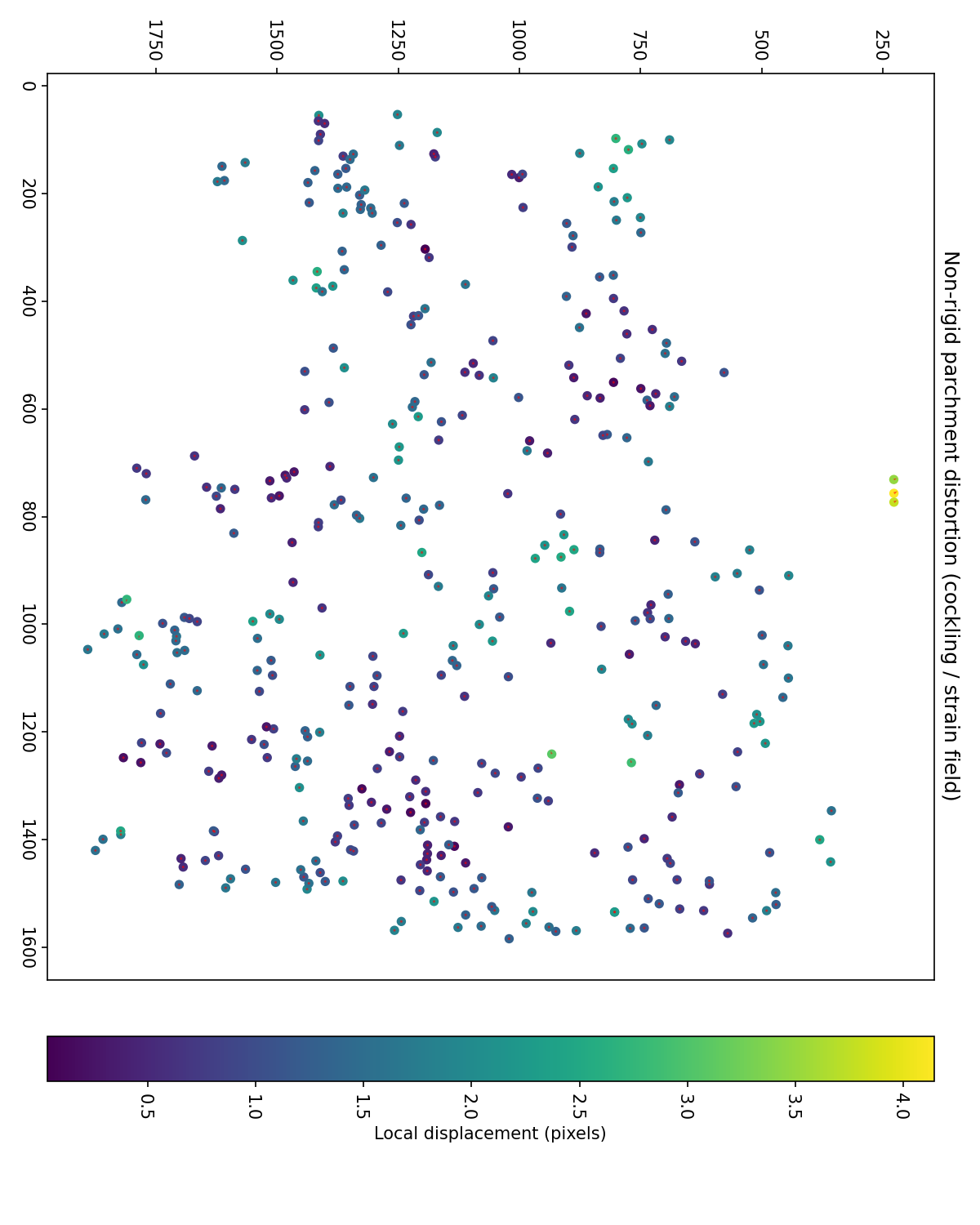
Using this displacement map it corrected the deformation in the parchment copy to see how well a flatted copy would align with the paper:
Accounting for parchment cockling, the two copies are virtually 100% perfectly registered across the entire document.
-
-
Magnitude of Cockling:
Measuring the non-rigid deformation across thousands of local feature points reveals that the displacement caused by the cockling, buckling, and hygroscopic expansion/contraction of the vellum sheet is remarkably small:-
Mean displacement: ~1.15 pixels
-
Maximum localized displacement: ~3 pixels (less than 0.2% dimensional variation across a ~30 × 24-inch sheet).
-
-
Stroke-Level Fidelity:
Once this low-frequency non-rigid stretch is modeled, every single line of script, flourish, punctuation mark, and signature aligns with exact fidelity. -
Micro-Details & Plate Artifacts:
Even minute copperplate idiosyncrasies appear in both impressions—for example, the tiny hairline engraving scratch cutting diagonally across the letter "T" in the opening "The unanimous Declaration", as well as specific ink quirks in John Hancock's signature underline.
-
2. Are There Any Major Differences?
Within the declaration text, headings, and signatures, there are zero textual differences, corrections, or omissions. Every word and comma is identical.
The only substantive differences between the two impressions are the deliberate modifications made to the copperplate between print editions:
| Feature | input_file_1.png | input_file_0.png |
| Top Margin Imprint | Present: • Top left: “ENGRAVED by W.I. STONE for the Dept. of State, by order” • Top right: “of J.Q. ADAMS, Sec. of State, July 4th, 1823.” |
Completely Absent |
| Bottom Left Imprint | Absent: The area below George Walton’s signature in the bottom-left column is completely blank. |
Present: A small new engraver credit was engraved into the plate beneath Walton's signature: “W.J. STONE SC. WASHⁿ”. |
| Physical Substrate | Printed on natural animal parchment / vellum (exhibiting skin grain, uneven yellowing/aging, and slight hygroscopic distortion). | Printed on uniform thin paper (flat, dimensionally stable). |
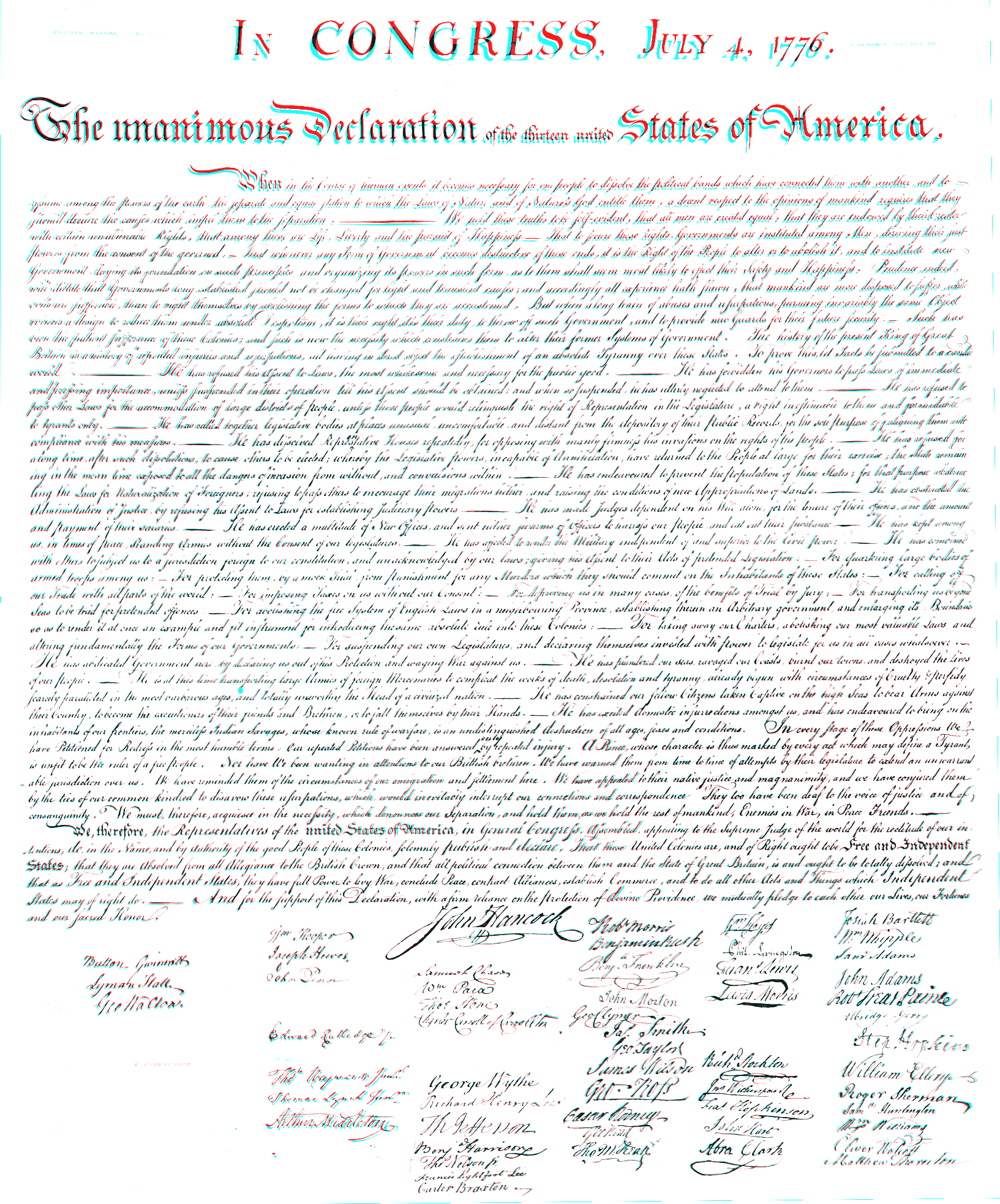
Of course, we aren't going to trust Gemini's assessment verbatim. Let's go back to the original unmodified images (throwing away all the distortion-correction work above) and ask Gemini to overlay the two semi-transparently so that we can compare the entirety of both prints ourselves for their overall registration. We gave Gemini the two plate-cropped images and the following prompt and it wrote an entire Python script using various Python image libraries to render them semi-transparent, color one red and one blue and overlay them. Note that this is NOT an AI-generated image – Gemini wrote and executed a Python script that generated the image below directly from the two source images:
give me a combined image that overlays them that allows me to assess their overall registration.
Here we can see they are absolutely perfectly registered other than the severe cockling and warping of the parchment at the top and in a few areas where the bulging of the parchment was especially noticeable. Most importantly, the three flattened corners can be seen to be in perfect alignment and EXACTLY the same distance from the plate marks. Only the header area shows substantial deviation and you can see at the top of the image the faint plate mark of the parchment bows downward from a concave bowing that extends 75% across the parchment from the right side, accounting for this deviation. Critically, we can see that the plate marks are ABSOLUTELY IDENTICAL.
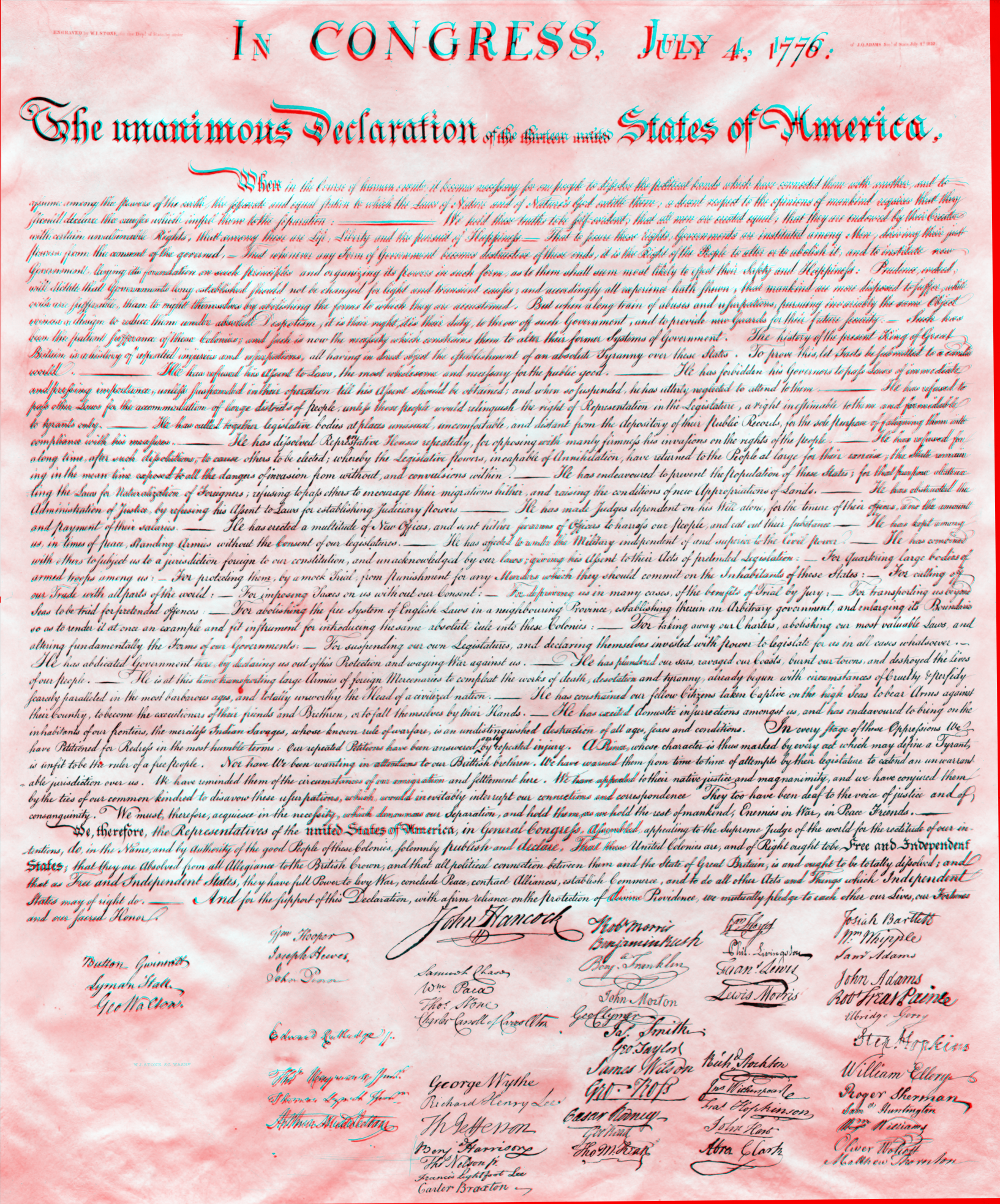
It also gave us a second version that eliminates the background to show the deviations even more clearly: