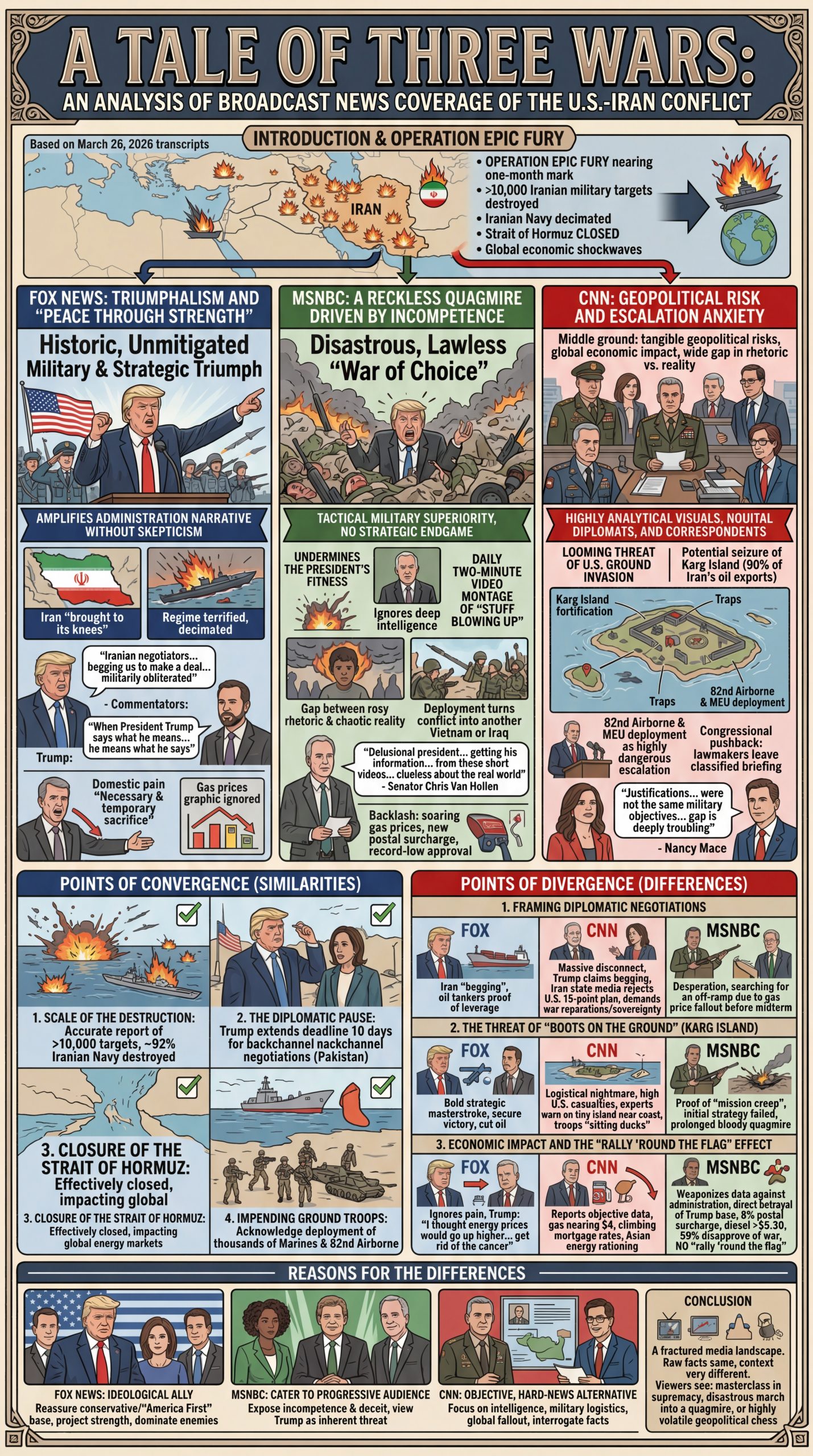
What does Gemini 3.1 Pro High Thinking have to say when asked to compare and contrast yesterday's coverage of the Iran conflict across CNN, MSNOW and Fox News? Only the public enterprise Gemini API was used and no data was used to train or tune any model.
Attached are the transcripts for three television news channels.
Ignore all advertising and non-news content and identify ONLY the parts related to the conflict with Iran and write a 1-5 page deeply reasoned analysis that compares and contrasts the three channels' coverage of the conflict with Iran from the attached transcripts.
Identify the key themes of each channel's coverage and provide a detailed breakdown of where their coverage is similar and where it diverges and explain the most likely reasons for their differences.
Integrate key quotes from the transcripts into your report.
A Tale of Three Wars: An Analysis of Broadcast News Coverage of the U.S.-Iran Conflict
Introduction
Based on the transcripts from March 26, 2026, the United States is deeply entrenched in a major military conflict with Iran, dubbed "Operation Epic Fury." Nearing the one-month mark, the war has resulted in the destruction of over 10,000 Iranian military targets, the decimation of the Iranian Navy, the closure of the Strait of Hormuz, and global economic shockwaves. However, an analysis of the coverage across three major cable news networks—Fox News, MSNBC, and CNN—reveals three fundamentally different wars being broadcast to the American public. Driven by partisan alignments and distinct editorial philosophies, the networks diverge sharply in their framing of the administration’s military strategy, diplomatic progress, and the domestic fallout of the conflict.
Key Themes by Channel
Fox News: Triumphalism and "Peace Through Strength"
Fox News frames Operation Epic Fury as a historic, unmitigated military and strategic triumph orchestrated by a strong, resolute Commander-in-Chief. The network’s coverage focuses heavily on the sheer scale of the devastation inflicted upon Iran’s military apparatus, portraying the Iranian regime as terrified, decimated, and entirely at the mercy of the United States.
The network amplifies the administration’s narrative without skepticism. A frequent refrain across Fox News programming is the assertion that Iran has been brought to its knees. Quotes from President Trump are featured prominently and treated as objective reality, particularly his claim that "the Iranian negotiators are very different and strange. They are begging us to make a deal, which they should be doing since they have been militarily obliterated with zero chance of a comeback." Fox commentators echo this sentiment, stating, "If you don't think, if you're an Iranian leader and you don't understand by now that when President Trump says what he means, he means what he says… you're probably not going to be around much longer." Furthermore, Fox frames the domestic economic pain, such as rising gas prices, as a necessary and temporary sacrifice for the ultimate eradication of a global terror threat.
MSNBC: A Reckless Quagmire Driven by Incompetence
In stark contrast, MSNBC’s coverage frames the war as a disastrous, lawless "war of choice" manufactured by an incompetent administration. The network’s central theme is that the White House possesses tactical military superiority but absolutely no strategic endgame. MSNBC focuses heavily on the human toll, the lack of transparency with Congress, and the domestic economic catastrophe the war has triggered.
MSNBC dedicates significant airtime to reporting that undermines the President's fitness to lead the conflict. The network heavily highlights an NBC News report that Trump is ignoring deep intelligence and instead receiving a daily two-minute video montage of "stuff blowing up" to keep his attention. As Senator Chris Van Hollen states on the network, "We have a delusional president who is getting his information… from these short videos… he appears to be clueless about the real-world situation on the ground." MSNBC also emphasizes the backlash from the American public, pointing to soaring gas prices, a new postal surcharge, and record-low approval ratings. A common theme is the gap between the administration’s rosy rhetoric and the chaotic reality, with guests warning that any deployment of ground troops would turn the conflict into another Vietnam or Iraq.
CNN: Geopolitical Risk and Escalation Anxiety
CNN occupies a middle ground, focusing heavily on the tangible geopolitical risks, the global economic impact, and the widening gap between the White House's rhetoric and the reality on the ground. CNN’s coverage is highly analytical, frequently bringing in military generals, international diplomats, and foreign correspondents to assess the tactical realities of the war.
A major theme for CNN is the looming threat of a U.S. ground invasion, specifically the potential seizure of Karg Island, which handles 90% of Iran's oil exports. CNN reports that "Iran has begun fortifying Karg Island, laying traps and positioning military personnel and air defenses," treating the potential deployment of the 82nd Airborne and Marine Expeditionary Units as a highly dangerous escalation. CNN is also the most focused on congressional pushback, frequently highlighting the bipartisan frustration of lawmakers leaving classified intelligence briefings. CNN repeatedly features Republican Representative Nancy Mace's quote: "The justifications presented to the American public for the war in Iran were not the same military objectives we were briefed today… this gap is deeply troubling."
Points of Convergence (Similarities)
Despite their vast editorial differences, all three networks converge on a few undeniable factual realities of the conflict:
-
- The Scale of the Destruction: All three networks accurately report the administration’s claim that over 10,000 Iranian targets have been struck and that roughly 92% of the Iranian Navy has been destroyed.
- The Diplomatic Pause: All three channels report on President Trump's decision to extend a deadline to pause strikes on Iranian energy facilities by 10 days to allow for backchannel negotiations, reportedly taking place in Pakistan.
- The Closure of the Strait of Hormuz: Every network acknowledges that the Strait of Hormuz is effectively closed, severely impacting global energy markets.
- Impending Ground Troops: All three networks acknowledge the deployment of thousands of U.S. Marines and the 82nd Airborne Division to the region, though they interpret the purpose of these troops differently.
Points of Divergence (Differences)
1. Framing the Diplomatic Negotiations
-
- Fox News accepts the administration's premise that Iran is "begging" for a deal out of sheer desperation. They highlight a "gift" from Iran—allowing a few oil tankers to pass through the Strait of Hormuz—as proof of American leverage.
- CNN points out the massive disconnect between U.S. and Iranian demands. They note that while Trump claims Iran is begging, Iranian state media and officials are publicly rejecting the U.S.'s 15-point peace plan and issuing their own maximalist demands, including war reparations and total sovereignty over the Strait of Hormuz.
- MSNBC frames the diplomatic backchanneling not as a sign of American leverage, but of American desperation. They cite reports that Trump is terrified of the political fallout of rising gas prices ahead of the midterm elections and is frantically searching for an off-ramp.
2. The Threat of "Boots on the Ground" (Karg Island)
-
- Fox News discusses the potential invasion of Karg Island as a bold, strategic masterstroke that would secure American victory by cutting off Iran's oil supply.
- CNN treats the potential invasion of Karg Island as a logistical nightmare with a high probability of severe U.S. casualties. They interview military experts who warn that occupying a tiny island just 20 miles off the Iranian coast would leave American troops as sitting ducks to constant drone and missile fire.
- MSNBC views the deployment of the 82nd Airborne as proof of "mission creep." They argue that moving from airstrikes to ground forces proves the initial strategy failed and will inevitably result in a prolonged, bloody quagmire.
3. Economic Impact and the "Rally 'Round the Flag" Effect
-
- Fox News largely ignores the economic pain felt by everyday Americans. When gas prices are brought up, Fox anchors and guests frame it as a minor inconvenience, with the President explicitly stating, "I thought the energy prices, oil price would go up higher… it didn't matter to me, short term, what we had to do is get rid of the cancer."
- CNN reports heavily on the objective data of the economic fallout, noting that gas is nearing $4 a gallon, mortgage rates are climbing, and Asian countries are implementing emergency energy rationing.
- MSNBC weaponizes the economic data against the administration, framing it as a direct betrayal of Trump's working-class base. They highlight the 8% postal surcharge and diesel prices topping $5.30 a gallon, emphasizing that the president has failed to generate a "rally 'round the flag" effect, as evidenced by polling showing 59% of Americans disapprove of the war.
Reasons for the Differences
The profound divergence in coverage stems directly from the networks' differing target audiences and established partisan loyalties.
Fox News operates as an ideological ally to the Trump administration. Its coverage is designed to reassure a conservative, "America First" base that the President is projecting strength and dominating America's enemies on the world stage. Any domestic pain or allied hesitation (such as Trump's condemnation of NATO as a "paper tiger") is framed not as an administration failure, but as proof of American exceptionalism and the necessity of acting unilaterally.
MSNBC caters to a progressive audience that views Donald Trump as an inherent threat to domestic and global stability. Therefore, their editorial prerogative is to find the angle that exposes the administration's incompetence and deceit. By focusing on the "stuff blowing up" video montages and the lack of a coherent endgame, MSNBC seeks to validate its audience's belief that the President is dangerously unfit to command the military.
CNN positions itself as the objective, hard-news alternative, focusing heavily on intelligence, military logistics, and global fallout. CNN's coverage is driven by a desire to interrogate the facts on the ground. When the administration claims Iran is eager to negotiate, CNN goes to its foreign correspondents in Tel Aviv and the Middle East to find out what the Iranians and Israelis are actually saying.
Conclusion
The transcripts from March 26, 2026, reveal a fractured American media landscape attempting to process a major global conflict in real-time. While the raw facts of the war—bombs dropped, troops deployed, straits closed—remain the same across all three channels, the context provided to the viewer could not be more different. Depending on which channel an American tunes into, they are either witnessing a masterclass in definitive military supremacy, a disastrously short-sighted march into an endless Middle Eastern quagmire, or a highly volatile geopolitical chess match teetering on the edge of massive regional escalation.
And let's ask for an infographic:
Create a large illustrated explainer poster designed to be printed on a large-format poster printer and hung up on the wall that narrates the attached briefing as a single large poster that can be printed and hung on a wall that outlines all of the core details. It should cover all of its key details.