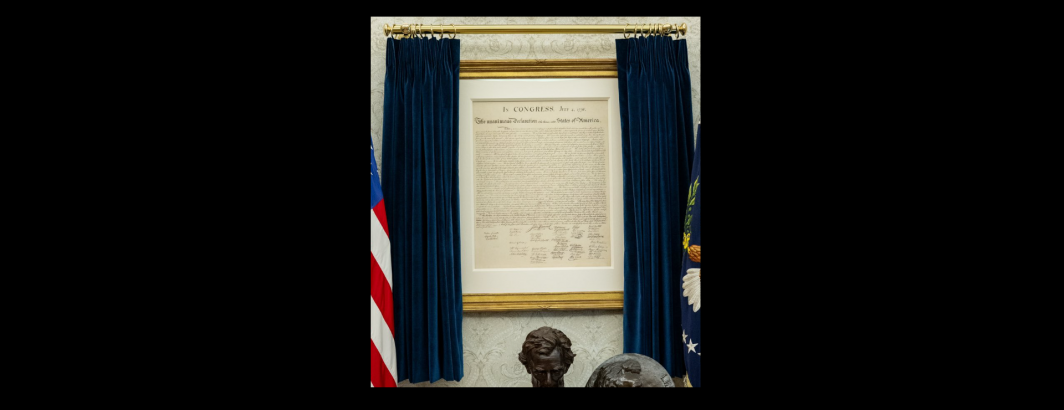
In the course of some recent research using different AI models to compile a list of America 250th celebrations across the nation, excerpts from the same National Archives (NARA) press release consistently surfaced as a definitive answer from the authoritative US Government source of record on the Declaration of Independence claiming that one of 50 engraved copies of the Stone facsimile of the Declaration of Independence was being exhibited as part of the "Freedom Plane" tour. The problem? The information published by NARA in its press release is wrong. Yet because it came from a source the models and their underlying grounding services had been taught to use as "truth", its incorrect information yielded wrong results, pointing to the limits of search-based grounding in AI models.
NARA's official January 20, 2026 press release about the "Freedom Plane National Tour" (following the 1976 Freedom Train tour) claims that the exhibition includes "one of only about 50 known engraved copies of the Declaration of Independence, printed from a copperplate of the original. Commissioned by John Quincy Adams and made by engraver William J. Stone, the engraving captured the size, text, lettering, and signatures of the original document."
The problem with this statement is that the Stone copperplate was actually used to print as many 4,201 copies of the Declaration. The first 201 were printed on parchment, of which roughly 50 are known to survive today. However, in 1833, Peter Force commissioned William Stone to make as many as 4,000 additional printings onto thin tracing paper. Potentially hundreds of these Force/Stone prints survive to present and are the ones most commonly seen at auction as historical exact facsimiles.
Thus, NARA's statement is missing the critical clarification that there are 50 known *parchment* copies surviving, but there are far more copies on tracing paper printed from the same copperplate. Unfortunately, news outlets and other information sources continue to republish NARA's original release as-is, including an article published earlier today repeating the "50 copies" claim.
This simple example offers a critical reminder why simply pointing AI models to "authoritative" online sources, even definitive US Government websites, is not a magic solution to incorrect information making its way into their outputs and that models must be able to reconcile (perhaps by pointing out discrepancies) conflicting information, rather than merely deferring to government sources.