The Visscher Royal-sized Bible was both an artistic and technical tour-de-force for its era: a collection of 130 stunning Biblical copperplate double-page engravings from the 1600's measuring nearly two feet by a foot and a half each. Just a few complete copies survive today, including the copy here, bound into a 1672 Swart KJV, that is known to contain 117 of the plates. This particular copy is in an intriguing modified state in which the long-form textual captions that originally appeared beneath each image had been broken from the copperplates, leaving some images with no captions at all and others with only sentence-long captions. The Visscher Royal series itself lacks any form of table of contents and the only known inventory is a historical stock list from 1680 that lists the then-available plates using brief colloquial descriptions of a few words each and lists them in a wildly different order than how they appear in this copy.
We were tasked with taking all 116 engravings, connecting each to its corresponding entry in the stock list (to determine which are missing) and to examine each image in detail to compile its artist, engraver and publisher information, transcribe and translate all text found anywhere in the image (in multiple languages) and compile it all into a final table. Imagine having a directory of 116 cellphone snaps of historical engravings and having to figure out which of 130 table of contents entries just a few words long each corresponds to! It turns out Gemini 3.1 Pro was able to do all of this and more, given just the stock inventory list and cellphone photos of each engraving!
To begin, we went through the Swart KJV page-by-page by hand to locate all of the engravings and took cellphone photographs of each. You can see an example of one of the Visscher engravings below. Note how it has no descriptive text, but does include the publisher mark in the bottom left-center ("C Visscher Exudit" – "exudit" means "published by" in Latin). We also tracked down a copy of Prenten in de gouden eeuw, which contains an appendix with the original circa-1680 stock list in Dutch and took a photograph of the page, which we had Gemini turn into a spreadsheet.

We then uploaded these engraving images in batches to Gemini 3.1 Pro High Thinking High Resolution with the following prompt. Remember, Gemini was given just this prompt with a few instructions, the circa-1680 stock list and a batch of cellphone images and it was entirely responsible for the rest with no human intervention or assistance!
attached is a set of images and a table of contents.
for each image, identify which entry it is in the table of contents and its artist, engraver and publisher.
make a table with the first column being the filename and second being the order it appeared in the list of images i gave you and so on.
also add a column with all captioning and descriptive text that appears in the image and another column with its english translation.
provide a final column with a detailed description of why you believe that image is that entry in the table of contents.
finally provide a column that is a description of what the image depicts.
FILENAME
IMAGE ORDER
TABLE OF CONTENTS NUMBER AND TITLE
ARTIST
ENGRAVER
PUBLISHER
CAPTION
ENGLISH CAPTION
EXPLAINATION
DESCRIPTION

TABLE OF CONTENTS:
1	De Titul-Print.
2	Adam en Eva in 't Paradijs.
3	Adam en Eva uyt 't Paradijs gedreven werdende.
4	Adam en Evas elende.
5	Noach met sijn Huysgesin en Vee in de Arcke gaande
6	Toren van Babel gebouwt.
7	Abraham onthaalt d'Engelen.
8	Abraham bidt voor Sodom.
9	Loth gaat met sijn huysgesin uyt Sodom.
10	Loth met sijn Dochters.
11	Abraham Agar uytleydende.
12	Abrahams Offerhande.
13	Rebecca drenckt de knechten Abrahams.
14	Esau verkoopt sijn eerste geboorte-recht aan Jacob.
15	Jacobs Droom.
16	Jacob de steen van de put wentelende.
17	Jacob ontmoet Rachel.
18	Jacobs Worstelingh met den Engel.
19	Jacob ontmoet Esau.
20	Ioseph in de Put gelaten werdende.
...
The final results can be seen below. The inventory has been reordered in the order the plates appear in the copy. Most images lack one or more of the artist/engraver/publisher credits (especially engraver) and thus those fields are blank for many of the entries. The "Notes" field contains manual annotations of images where the quickly-snapped cellphone photo (they were taken under room lighting by hand) was too blurry for even a human to read the text and where Gemini noted it was unable to accurately read the text.
For a small number of images Gemini was unable to determine which entry in the table of contents they belonged to or identified that they belonged to multiple possible entries given the lack of specificity in the stock list, lack of identifying text in the images and vagueness of some depictions. For these entries, the information extracted by Gemini was used to manually determine which entry those images corresponded to and their Explanation and/or Description fields are left blank.
Remember that this table is 100% autonomously generated by Gemini with no human review for accuracy, completeness or comprehensiveness other than where noted above and thus there may be errors.
| BOOK ORDER | STOCK LIST ORDER | TESTAMENT | STOCK LIST ENGLISH | NOTES | ARTIST | ENGRAVER | PUBLISHER | CAPTION | ENGLISH CAPTION | EXPLAINATION | DESCRIPTION |
| 1 | 66 | NEW | The 4 Evangelists. | Pieter de Jode | C. Visscher | QUATUOR HIS SANCTUS CALAMIS EST SPIRITU[…] / S CHRISTI NOBIS EXPONERET ACTA SALUT[…] | With these four holy pens the Spirit […] / expounds to us the acts of Christ's salvation. | The image features four men holding books and writing implements, accompanied by their traditional symbolic creatures: an angel (Matthew), a lion (Mark), an ox (Luke), and an eagle (John). This iconic grouping definitively identifies them as the Four Evangelists, matching entry #66. | The four Gospel writers are clustered together, actively writing or discussing their texts. Light radiates from the top center. Surrounding them are the symbols of the Tetramorph: a lion at the center bottom, an ox head peeking out, an eagle on the right, and a winged human figure (partially obscured) on the left. | ||
| 2 | 2 | OLD | Adam and Eve in Paradise. | Nicolaes de Bruyn | C. Visscher | IUSSA DEI SUMPTO VIOLANTUR AB ARBORE POMO. EFFICIT HOC TACITIS VIPERA SAUVA DOLIS. Genesis 3. 6. | The commands of God are violated by taking the apple from the tree. The cruel viper accomplishes this by silent deceit. Genesis 3:6. | Although depicting the moment of the Fall, the setting is still within the lush Garden of Eden before their banishment. Because entry #3 is specifically their expulsion, this image fits best as the preceding scene in Paradise, aligning with entry #2. | Adam and Eve stand naked in a lush, dense forest surrounded by peaceful animals, including a horse, cow, lion, and various birds. Eve is reaching into the branches of a tree to take fruit from the serpent, illustrating the exact moment of original sin. | ||
| 3 | 3 | OLD | Adam and Eve being driven out of Paradise. | Nicolaes Visscher | ANGELUS EXILIO MISEROS CASTIGAT ACERBO, RAPTAQUE SED SERO POMA TULISSE DOLENT. Gene: 3. 24. | The angel punishes the wretched with bitter exile, and they lament, but too late, to have borne away the stolen apples. Gen: 3:24. | The presence of an angel actively chasing Adam and Eve away with a weapon, coupled with their distressed postures and the caption referencing exile (exilio), perfectly matches the description of them being driven out of Paradise in entry #3. | An angel wielding a flaming sword stands at the center, forcefully banishing a naked, cowering Adam and weeping Eve out of the garden. The animals around them, such as horses, deer, and birds, appear startled or in motion, reflecting the sudden chaos and divine judgment. | |||
| 4 | 4 | OLD | Adam and Eve's misery. | Abraham Bloemaert | C. Visscher | ALS ADAM SPITT EN EVA SPAN / WAER WAS DOEN DEN EDELMAN | When Adam delved [dug] and Eve span [spun], who was then the nobleman? | The image depicts Adam performing hard manual labor (digging) and Eve spinning thread while caring for children in a rugged landscape outside of Eden. This visual perfectly aligns with the concept of their "misery" or earthly toil (elende) after the Fall, making it entry #4. | Adam is shown digging the earth with a spade, while Eve sits nearby nursing a child and holding a distaff to spin yarn. Another child plays on the ground. They are clothed in animal skins and surrounded by various animals (an eagle, a cat, etc.) in a wild, uncultivated landscape. | ||
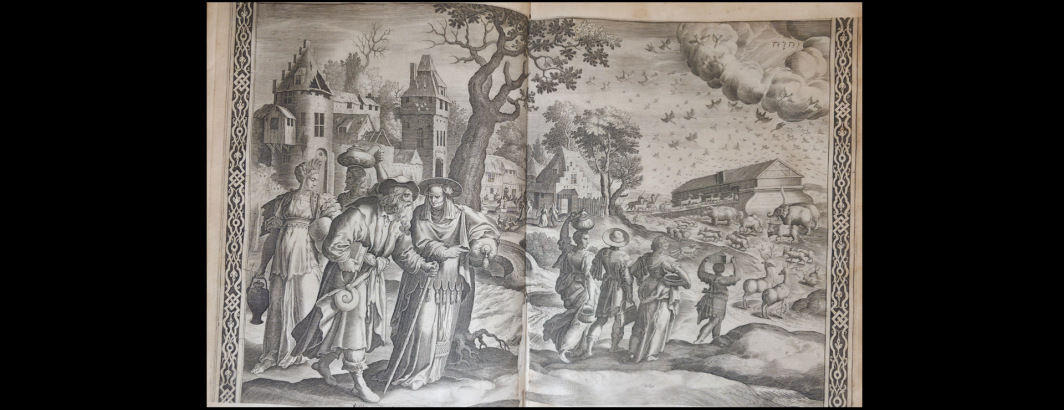
| 5 | 5 | OLD | Noah with his Household and Cattle going into the Ark. | Jan Sadeler | C. Visscher | יהוה (Tetragrammaton in the clouds) | Yahweh (God) | The scene clearly shows a large wooden ark in the background with a massive procession of animals and humans carrying supplies towards it. This directly corresponds to the biblical story of Noah entering the Ark, matching entry #5. | Noah's family is seen in the foreground carrying pots, bundles, and provisions. In the midground and background, a vast array of animals in pairs (elephants, camels, horses, birds in the sky) are migrating toward the large, rectangular Ark structure as dark clouds gather overhead. | ||
| 6 | 6 | OLD | Tower of Babel built. | C. Visscher | Superbe Nimrod, quæ rapit te vis malæ / Sanæ libidinis? paratur tam nihil / Immane, nec supra periculi metum / Tendit, quod haud in[fragilem] subiectu[m] q[ue] Deo. / In arduu[m] frustra struis molem, poli / Convexa; diversis parens verum omnium / Vos obruet linguis et ausus puniet, / Mortalium contra quis arma gesserit? P.C. | Proud Nimrod, what force of evil or senseless desire seizes you? Such an immense thing is prepared for nothing, nor does it reach beyond the fear of danger, because nothing is unbreakable and subject to God. In vain you build a massive structure into the heights, to the vault of heaven; the true parent of all things will overwhelm you with diverse languages and punish your daring. Who of mortals will take up arms against him? P.C. | The image depicts the construction of a massive, spiraling tower, and the caption explicitly names "Nimrod" and mentions being punished with "diverse languages," confirming it is the Tower of Babel. | A sprawling, detailed landscape showing the construction of a giant, multi-tiered circular tower. In the foreground, workers are cutting stone and using pulleys. A king (Nimrod) stands on a hill in the lower left, directing the work. | |||
| 7 | OLD | (DATED 1614) ALTERNATIVE ABRAHAM AND THE 3 ANGELS | Gillis de Hondecoeter | Jan van Londerseel | C. Visscher | This is a known 1614 landscape engraving by Jan van Londerseel after Gillis de Hondecoeter. It lacks the specific biblical iconography (angels, burning cities, etc.) required to match the surrounding Genesis entries in the TOC. It was likely an extra plate bound into this specific copy by the publisher or owner. | A highly detailed, verdant forest landscape. Large, gnarled trees dominate the left foreground. A path winds through the woods where peasant travelers (a man holding a staff, a woman carrying a load on her head, and a small child) walk alongside a dog. | ||||
| 8 | 7 | OLD | Abraham entertains the Angels. | Marten de Vos | C. Visscher | PARITURAM SARAM NUNCIANT ABRAHÆ ANGELI HOSPITES, SARAQUE RIDENTI, PROMISSIONIS VERBA REITERANT. Gene. 18. | The guest angels announce to Abraham that Sarah will give birth, and to the laughing Sarah, they reiterate the words of the promise. Genesis 18. | The image shows an old man kneeling before three winged angels, and the caption explicitly references Genesis 18, Abraham, Sarah, and the guest angels. | Abraham, depicted as an old bearded man, kneels humbly before a round table. Three angels with large wings surround the table. In the background left, Sarah stands in the doorway of a structure, listening to their conversation. | ||
| 9 | 8 | OLD | Abraham prays for Sodom. | ||||||||
| 10 | 9 | OLD | Lot goes with his household out of Sodom. | Peter Paul Rubens | C. Visscher | IGNE ET SULPHURE PLUIT SUPRA SODOMAM ET GOMORHAM: LIBERATUR DE INCENDIO LOTH CUM FAMILIA EIUS, UXOR IN SALIS STATUAM VERTITUR. | It rains fire and sulfur upon Sodom and Gomorrah: Lot is freed from the fire with his family, his wife is turned into a statue of salt. | The imagery shows angels forcefully leading a family from a burning city, and the text explicitly names Lot, Sodom, Gomorrah, and mentions his wife turning into a salt statue. | Two angels forcefully guide an older man (Lot) and his two daughters away from a disaster. In the mid-ground, Lot's wife is shown transformed into a white pillar. In the deep background, a city is engulfed in flames and smoke. | ||
| 11 | 10 | OLD | Lot with his Daughters. | Jodocus van Winghe (Winghe inventor) | Nicolaes Visscher | LOT IN SPELUNCA HABITAT, INEBRIANT EUM FILIÆ, CONCUMBUNT CUM INSCIO ALTERNATIM UT A PATRE SEMEN SERVENT. Genes. 19. | Lot lives in a cave, his daughters make him drunk, they sleep with him alternately without his knowledge so that they may preserve seed from their father. Genesis 19. | The image shows an old man in a rocky cave being served wine by nude women, and the caption references Genesis 19, explicitly describing Lot and his daughters. | Set within a rocky cave surrounded by dark trees. An older man (Lot) sits partially draped, flanked by his two nude daughters. One daughter pours liquid from a vessel into a cup to make him drunk. | ||
| 12 | 11 | OLD | Abraham sending Hagar away. | Marten de Vos | C. Visscher | CUM PUERO ISMAELE PROCUL DIMITTITUR HAGAR: QUEM SARA HÆREDEM NOLUIT ESSE SUUM. | Hagar is sent far away with the boy Ishmael: whom Sarah did not want to be her heir. | The scene illustrates a patriarch sending away a crying woman and child, while another woman watches from a house. The caption explicitly names Hagar, Ishmael, and Sarah. | Abraham stands outside a dwelling, gesturing outwards with his right hand, dismissing Hagar, who turns away crying while holding the hand of her young boy, Ishmael. In the background doorway, Sarah stands watching them leave. | ||
| 13 | 12 | OLD | Abraham's Offering (Sacrifice of Isaac). | Johan Londersel | C. Visscher | The central action shows an older man with a raised sword ready to slay a younger man on an altar, while an angel stops him. This is the universal iconography for the Binding of Isaac, which corresponds to TOC #12 (Abraham's Sacrifice). | An older, bearded man (Abraham) stands with a sword raised high, holding the head of a younger man (Isaac) who kneels beside a stone altar with a burning fire. Above them, an angel emerges from swirling clouds to halt the strike. The scene is set in a lush forest with a distant view of a town. | ||||
| 14 | 13 | OLD | Rebekah gives drink to Abraham's servants. | TOO FAINT AND BLURRY FOR FULL DETAILS IDENTIFICATION | |||||||
| 15 | 14 | OLD | Esau sells his birthright to Jacob. | C. Visscher | SUSCIPIT EN ESAU RUBICUNDAM A FRATRE POLENTAM. CUI PRIMOGENITI TRADIT HABERE DECUS. | Behold, Esau receives the red pottage from his brother, to whom he hands over the honor of the firstborn to possess. | The Latin caption explicitly states that Esau is taking "red pottage" from his brother and trading the honor of the "firstborn". This narrative perfectly matches TOC #14 (Esau sells his first birthright to Jacob). | An interior, domestic scene showing two men sitting at a table. The man on the right (Jacob) hands a bowl across the table to the man on the left (Esau), who wears a hat and hunting attire. Two dogs rest beneath the table. In the background, a figure tends to a large cooking pot over a blazing hearth. | |||
| 16 | 15 | OLD | Jacob's Dream. | C. Visscher | Genesis 28. v. 11<br><br>(Top center in Hebrew): יהוה | Genesis 28, verse 11<br><br>Yahweh (Jehovah) | The text cites Genesis 28:11, where Jacob sleeps on a stone. The image illustrates the subsequent dream described in that chapter: a ladder reaching to heaven with angels. This corresponds exactly to TOC #15 (Jacob's Dream). | A man (Jacob) lies asleep in the foreground, his head propped against a large stone. Behind him, a tall, wooden ladder stretches upward into a dramatic cloud formation. Several angels are depicted climbing up and down the ladder. At the very top of the clouds, the Hebrew Tetragrammaton (name of God) radiates light. | |||
| 17 | 16 | OLD | Jacob rolling the stone from the well. | WRONG ENGRAVED CAPTION? | Gillis de Hondecoeter | Joannes Londerfelius | C. Visscher | Finibus ex patrijs profugo ubi Rachel Cognato figens oscula grata suo. Gene 29 | A fugitive from his paternal borders, where Rachel plants pleasing kisses on her relative. Genesis 29. | ||
| 18 | 17 | OLD | Jacob meets Rachel. | C. Visscher | |||||||
| 19 | 19 | OLD | Jacob meets Esau. | C. Visscher | GENESIS c.32 vers 1 | ||||||
| 20 | 18 | OLD | Jacob's Wrestling with the Angel. | C. Visscher | SED QUUM RELIQUUS ESSET IAHAKOB, SOLUS QUIDAM LUCTATUS EST CUM EO, DONEC AURORA ASCENDERET. Geneseos 32. 24. | But when Jacob was left alone, a certain man wrestled with him until the dawn arose. Genesis 32:24. | Both the Latin caption and the biblical citation (Genesis 32:24) describe Jacob wrestling with a mysterious figure until daybreak. The foreground depicts this physical struggle with a winged angel, matching TOC #18 (Jacob's Wrestling with the Angel). | In the right foreground, under the shade of large trees, a man (Jacob) is engaged in intense hand-to-hand grappling with a winged angel. In the background to the left, separated by a river, a large caravan consisting of people, camels, and livestock is seen traveling along a path towards distant mountains. | |||
| 21 | 20 | OLD | Joseph being let down into the Pit. | C. Visscher | PROIICERENT FRATRES IOSEPHUM IN CISTERNAM, SUNT, VENDIDERUNTQUE EUM IISCHMAHELITIS. Geneseos 37. 24. | The brothers threw Joseph into the cistern, … and sold him to the Ishmaelites. Genesis 37:24. | The Latin text names "Iosephum", mentions brothers throwing him into a "cisternam" (cistern/pit), and cites Genesis 37. The art depicts a group forcing a youth into a hole in the ground. This matches TOC #20 (Joseph being lowered into the Pit). | A group of rustic men holding staffs are clustered around a circular stone opening in the rocky ground. They are physically pushing a younger man (Joseph) down into the dark pit. A few goats and sheep rest nearby, oblivious to the struggle. A fortified castle structure sits on a high hill in the background. | |||
| 22 | 23 | OLD | Judah and Tamar. | Gillis van Coninxloo (Egidius Coninxloo) | C. Visscher | IUDAS ET THAMAR COEUNT PROMITTITUR HOEDUS ANN., ARMILLAE, ATQUE PEDUM PRO PIGNORE DANTUR. Genesis 38. 6. | Judah and Tamar come together; a kid is promised. A ring, bracelets, and a staff are given as a pledge. Genesis 38:6. | The caption explicitly names "Iudas et Thamar" and describes the exchange of a ring, bracelets, and a staff as a pledge. The visual depicts a man handing a staff to a veiled woman, confirming it is TOC #23 (Judah and Tamar). | In a dense, shadowy forest setting, a man (Judah) stands speaking to a heavily veiled woman (Tamar) who is seated at the base of a massive tree trunk. He is in the act of handing her his long shepherd's staff. The background features a river winding toward a majestic, multi-tiered fortress carved into a mountain. | ||
| 23 | 24 | OLD | Moses found in the Water. | Maarten de Vos | C. Visscher | MOSES AQUIS IMMISSUS A PHARAONIS INVENTI FILIA MATRIQUE SUAE TRADITUR NUTRICANDUS. | Moses, placed in the waters, is found by Pharaoh's daughter and handed over to his own mother to be nursed. | The Latin text explicitly identifies the baby as "Moses" and mentions him being found by "Pharaonis… filia" (Pharaoh's daughter). The image shows women finding a baby in a basket in a river, matching TOC #24 (Moses found in the Water). | A scene set on the banks of a river (the Nile) with tall reeds. A regally dressed woman (Pharaoh's daughter) stands looking down as another woman kneels to inspect a woven basket floating at the water's edge containing a baby (Moses). A large stone bridge arching over the river and a city skyline are visible in the background. | ||
| 24 | 25 | OLD | Pharaoh with his army drowning in the Red Sea. | Paulus Frank (Paulus Fa. inventor) | C. Visscher | ITUR, ATROX PHARAO PERIT ÆQUORE, TRANSIT HEBRÆS SICUT INEXCULTÆ PER LOCA PLANA VIÆ. Exod. 14. 27. | They proceed; the fierce Pharaoh perishes in the sea, the Hebrews cross over as if on an uncultivated, level road. Exodus 14:27. | The image clearly illustrates chariots, horses, and soldiers drowning in swirling waters while others escape to dry land, directly matching the biblical event of the Red Sea crossing and TOC entry 25. | The scene depicts the dramatic destruction of Pharaoh's army in the Red Sea. In the center foreground, a crowned Pharaoh in a chariot is engulfed by waves. In the background, Moses and the Israelites stand safely on the shore. | ||
| 25 | 26 | OLD | Joshua and Caleb. | C. Visscher | The illustration shows two men carrying an oversized cluster of grapes on a pole. This is the iconic biblical depiction of Joshua and Caleb returning from spying out the land of Canaan (Numbers 13:23). | Two muscular men are walking across a wooden plank, bearing a massive, heavy cluster of grapes suspended on a thick wooden pole between their shoulders. A camp and landscape are visible in the background. | |||||
| 26 | 28 | OLD | Balaam's Donkey speaking. | Maarten de Vos | C. Visscher | AD MOAB INVECTOR BALAAM PROPERAVIT ASELLO QUEM STRICTO DOMINI NUNCIUS ENSE PRÆIT. Num. 22. 22. | Balaam, riding toward Moab, hastened on his donkey, whom the messenger of the Lord preceded with a drawn sword. Numbers 22:22. | The presence of a man riding a donkey that is suddenly halted by an imposing angel wielding a sword perfectly aligns with the story of Balaam's speaking donkey from Numbers 22. | A man (Balaam) is seated on a donkey that is rearing back. In front of them stands an imposing winged angel with a drawn sword blocking the path. Other travelers and a town are in the background. | ||
| 27 | 29 | OLD | Gideon testing his people at the Water. | Maarten de Vos | C. Visscher | AD PUGNAS APTI TOTA DE GENTE LEGUNTUR DE GELIDO SI QUIS FLUMINE LAMBIT AQUAS. | Those fit for battle from the entire nation are chosen, if anyone laps water from the cold river. | The image depicts soldiers drinking from a river in two distinct ways (lapping like dogs vs. kneeling to drink), with a commander watching. This is the exact method Gideon used to select his army in Judges 7. | A commander in ornate armor stands holding a spear, watching soldiers by a riverbank. Some soldiers are kneeling and putting their mouths directly to the water, while others are using their hands to bring water to their mouths. | ||
| 28 | 30 | OLD | Jephthah meeting his Daughter. | Nicolaes Visscher | Iudicum cap. XI. | Judges Chapter 11. | The reference "Iudicum cap. XI" (Judges 11) points to the story of Jephthah. The visual shows a horrified military leader being greeted by a young woman with a tambourine, matching Jephthah's tragic vow. | A man in armor and a turban recoils in distress, tearing at his garments, as a young woman joyfully approaches him playing a tambourine, accompanied by other women holding instruments. | |||
| 29 | 31 | OLD | Samson tearing a Lion apart. | Roelant Savery (R. Savery inven.) | ARMORUM NULLA VI CONTERIT ORA LEONIS ORA ET EX LUCTA FORTIS ABIT DUPLA. Iudicum 14. 5. | By no force of arms he crushes the lion's mouth, and from the struggle he departs doubly strong. Judges 14:5. | A man bare-handedly tearing apart the jaws of a lion in a wilderness setting is the universally recognized depiction of Samson's feat from Judges 14, matching TOC entry 31. | In a densely wooded forest landscape, a muscular man is depicted on the ground wrestling a lion, physically ripping the beast's upper and lower jaws apart with his bare hands. | |||
| 30 | 32 | OLD | Samson with Delilah. | C. Visscher | ROBUR UBI SIMSON MERETRICI PRODIT AVARE, HOSTIBUS EFFOSSO LUMINE PRÆDA FUIT. Iudicum 16. 19. | When Samson greedily betrayed his strength to the harlot, he became prey to the enemies, his light [eyes] dug out. Judges 16:19. | The scene shows a strong man sleeping on a woman's lap in a forest, while soldiers sneak up behind him with tools. This illustrates Samson's betrayal by Delilah. | A man sleeps peacefully with his head resting on the lap of a seated woman in a wooded area. Behind the trees, armed soldiers are stealthily approaching, preparing to ambush the sleeping man. | |||
| 31 | 33 | OLD | Samson's perishing/death. | Simon Vouet (S. Vouet inventor) | Nicolaes Visscher | SCHIMSCHON CONVIVANTIUM PELISCHTHEORUM DOMUM DIRUENDO, PLURES MOMENTO QUAM TOTA VITA MORTI TRADIDIT. | Samson, by destroying the house of the feasting Philistines, delivered more to death in a moment than in his entire life. | The image shows a muscular man pushing apart two giant structural pillars in a grand hall, causing it to collapse on a panicking crowd. This is Samson's death from Judges 16:30. | Chaos unfolds inside a grand, classical temple. A powerful, blind man in the center is pushing forcefully outward against two massive, ornately carved stone pillars. The structure is crumbling, and the banqueting crowd around him is falling in terror. | ||
| 32 | 35 | OLD | Saul anointed King by Samuel. | C. Visscher | Primus Hebræorum Saulus Rex ungitur, impar Viribus, hunc Samuel regia jura docet a viro eveniunt quæ dixerat ante Propheta, Omnia, sic regni sanctio certa fuit. 1 Samuel. 10. 1. | Saul is anointed the first King of the Hebrews, unequal in strength, Samuel teaches him royal rights; all things happen from the man which the Prophet had foretold, thus the sanction of the kingdom was certain. 1 Samuel 10:1. | The caption clearly cites 1 Samuel 10:1 and names Saul and Samuel. The visual shows an older prophet pouring oil over the head of a younger man, representing Saul's anointing as king. | In a heavily wooded landscape near a river with a distant castle, an older bearded man holding a staff pours oil from an animal horn over the bowed head of a younger man who kneels slightly before him. | |||
| 33 | 36 | OLD | David defeating Goliath. | Marten Heemskerck | C. Visscher | The illustration depicts a young, unarmored youth standing victorious over the fallen, heavily armored body of a giant, holding a massive sword. This clearly represents David defeating Goliath. | A young man stands triumphantly over the sprawling corpse of a giant soldier clad in intricate plate armor. The youth holds a massive curved sword. In the background, military camps and armies are visible. | ||||
| 34 | 37 | OLD | David's Triumph. | Nicolaes de Bruyn | C. Visscher | TRIUMPHUS ET VICTORIA DAVIDIS DE LEONE, URSO ET GIGANTE GOLIATHO, TYPUS CHRISTI, SALVATORIS NOSTRI. 1. Samuel 17. | The triumph and victory of David over the lion, bear, and the giant Goliath, a type of Christ, our Savior. 1 Samuel 17. | The image shows a triumphant procession where a young man carries a massive severed head, accompanied by soldiers and musicians. This illustrates David returning with the head of Goliath. | A victory procession moves through a landscape. A young man walks forward carrying the enormous, severed head of a giant by its hair. He is surrounded by soldiers carrying spears and halberds, and the scene is dense with figures. | ||
| 35 | 38 | OLD | David and Jonathan. | Jacobus Savarij (Jacob Savery) | C. Visscher | FRATERNO JONATHAN COMPLEXVS AMORE DAVIDEM DE PATRIS INSIDIIS ERUDIT ATQUE MINIS. | Jonathan, embracing David with brotherly love, warns him of his father's ambushes and threats. | The caption names Jonathan and David. The scene depicts 1 Samuel 20, where Jonathan shoots arrows into a field (retrieved by the boy in the background) to secretly warn David of King Saul's plot to kill him, after which they embrace. | A landscape engraving showing two men in classical armor in the foreground. One stands with his hand on his chest holding a bow, while the other kneels near a bow on the ground. A boy runs in the midground to retrieve arrows, with a castle across a river in the background. | ||
| 36 | 39 | OLD | David's servants with Nabal. | TOO FAINT AND BLURRY FOR FULL DETAILS IDENTIFICATION | Falling sequentially between the stories of Jonathan (38) and Abigail (40), this image depicts men resting under large trees while observing a grand, wealthy estate. This matches the biblical narrative of 1 Samuel 25, where David sends his men (knechten) to the wealthy Nabal in Carmel to ask for provisions. | A wide landscape view. In the right foreground, massive, detailed oak trees dominate, with a group of men resting and conversing beneath them alongside a dog. On the left, a large, ornate castle or manor house sits in the distance with a bridge leading to it. | |||||
| 37 | 40 | OLD | David meeting Abigail. | Nicolaes de Bruyn | C. Visscher | ABIGAIL MONTES SCANDENS, FERT MUNERA SECUM, QUEIS QUEAT ISAICUM CONSILIARE SIBI. 1. Samuel 25. | Abigail, climbing the mountains, brings gifts with her, by which she might reconcile the son of Jesse [David] to herself. 1 Samuel 25. | The caption explicitly names Abigail and references 1 Samuel 25. The image shows Abigail kneeling before David to offer gifts and apologize for her husband Nabal's insult, preventing David from slaughtering her household. | A dense forest scene. In the lower-left, a woman kneels in supplication before an armored man standing near horses. Behind her, a long winding procession of people and heavily laden pack animals (donkeys, camels) descends a hill from a fortress visible in the upper background. | ||
| 38 | 41 | OLD | David and Bathsheba. | David Vinckboons | Jan van Londerseel | C. Visscher | Bathseba dum vir abest, latices ingressa liquentes Membra lavat, Schytica candidiora nive; rex videt hanc, visamque cupit, potiturque cupita. Foedat adulterio sacra priora David. 2. Samu: 11. 2. | Bathsheba, while her husband is away, having entered the flowing waters, washes her limbs, whiter than Scythian snow; the king sees her, desires her once seen, and obtains what he desired. David defiles his former sacred acts with adultery. 2 Samuel 11:2. | The caption explicitly names Bathsheba and David, and references 2 Samuel 11. The image shows the classic biblical scene of King David spying on Uriah's wife, Bathsheba, as she bathes in a courtyard. | A highly detailed engraving of a formal Renaissance-style garden. In the foreground, a woman (Bathsheba) sits at the edge of an ornate fountain, bathing, attended by a servant. In the right background, a king looks down from the high balcony of a grand palace. | |
| 39 | 42 | OLD | Absalom hanging by his hair, is run through by Joab. | Maarten de Vos | C. Visscher | ABSALOM EX PUGNA FUGIENS EX ARBORE PENDET ILLIUS IOAB ET FERIT HASTA LATUS. 2. Samuel. 18. | Absalom, fleeing from the battle, hangs from a tree, and Joab strikes his side with a spear. 2 Samuel 18. | The caption names Absalom and Joab. The engraving perfectly matches the narrative in 2 Samuel 18, where David's rebellious son Absalom gets his long hair caught in an oak tree during a battle, and is subsequently killed by Joab. | A dynamic, chaotic battle scene. In the foreground, a man is suspended by his hair in the thick branches of a massive tree, his horse fleeing out from beneath him. Another armored man on a rearing horse plunges a spear into his side. An army fights in the valley below. | ||
| 40 | 43 | OLD | Solomon's first Judgment. | Peter Paul Rubens | C. Visscher | FEMINEAS DIRIMIT, REGIS PRUDENTIA LITES, UTRAQ3 DUM PROLEM TENDIT HABERE SUAM. | The king's prudence settles the women's disputes, while each strives to have the child as her own. | The image depicts the famous "Judgment of Solomon" (1 Kings 3). Two women claim to be the mother of a single surviving baby. Solomon orders the baby cut in half to reveal the true mother, who begs him to spare the child and give it to the other woman. | An indoor court scene set in a grand hall with classical columns. A king sits on a raised throne. In the center, a muscular executioner grasps a live infant upside down by the ankle, his sword raised. Two women react: one kneels pleadingly, the other watches. A dead infant lies on the floor. | ||
| 41 | 44 | OLD | Solomon serving the Idols. | Nicolaes de Bruyn | C. Visscher | SALOMON AB UXORIBUS PERSUASUS, SEQUEBATUR ASTAROTH ET MILCOM, IDOLA ZIDONIORUM ET AMMONITARUM. 1. Regi. 11. 15. | Solomon, persuaded by his wives, followed Ashtoreth and Milcom, the idols of the Zidonians and Ammonites. 1 Kings 11:15. | The caption states Solomon was persuaded by his wives to worship false idols. This depicts 1 Kings 11, where Solomon in his old age is led astray by his many foreign wives to build altars and worship pagan gods. | A king kneels in the left foreground before an altar bearing a statue of a classical/pagan idol. He is surrounded by a group of ornately dressed women, one of whom points towards the idol. The background features a large, complex cityscape filled with crowds of people. | ||
| 42 | 45 | OLD | Ahijah and Jeroboam. | David Vinckboons | Jan van Londerseel | Nicolaes Visscher | [Latin]: In partes vestem bis senas rumpit Ahias, / et sic rupturam denotat Imperij. / Jeroboam partes bis quinq tradit, et inde, / Quot Regni partes sit habiturus, habet. <br> [Dutch]: Ahia scheurt sijn kleet in stucken twee en tien, / En laet Jeroboam soo 't Rijcks verdeelingh sien. / Reg: 12 . 29. | Ahijah tears his garment in twelve pieces, and thus lets Jeroboam see the division of the kingdom. He hands ten pieces to Jeroboam, showing how many parts of the kingdom he will possess. Reg: 12. 29. | The text names Ahijah and Jeroboam. It illustrates 1 Kings 11:29-31, where the prophet Ahijah tears his new cloak into twelve pieces and gives ten to Jeroboam to symbolize God tearing the kingdom from Solomon's line and giving ten tribes to Jeroboam. | A dense, wooded landscape. In the lower-left center, two men stand on a dirt path. One man is actively tearing a large piece of fabric and handing the torn strips to the other man. A sprawling, highly detailed city and river landscape extends into the background on the right. | |
| 43 | 46 | OLD | Man of God killed by a Lion. | Gillis de Hondecoeter | Jan van Londerseel | C. Visscher | Ecce leena vorat divino haud numine plenum / Vatem, spernentem Jussa verenda dei. | Behold, the lion devours the prophet, by no means full of divine spirit, who despised the reverend commands of God. | This illustrates the somewhat obscure story from 1 Kings 13. An unnamed "Man of God" disobeys God's command not to eat or drink on his journey. As punishment, a lion kills him on the road, but miraculously does not eat his body or attack his donkey, which stand by. | A dark, moody forest scene dominated by large, heavily textured trees. In the midground towards the right, a lion stands calmly over a human corpse lying on the dirt path. A donkey stands undisturbed a short distance away. A city is faintly visible in the far background. | |
| 44 | 47 | OLD | Elijah fed by the Ravens. | Pieter Potter | C. Visscher | Elias fugiens rabiem Achabi confidet ad rivum Crith. REGUM 1. CAP. 17. VERS. 6. | Elijah, fleeing the madness of Ahab, trusts [God] at the brook Cherith. 1 Kings Chapter 17 Verse 6. | The caption specifically names Elijah and the brook Cherith. The image perfectly illustrates 1 Kings 17, where God commands ravens to bring bread and meat to the prophet Elijah while he hides from King Ahab during a severe drought. | A secluded forest scene by a rocky stream. An older, bearded man wrapped in heavy robes sits on a rock on the right, looking up. Above him, large ravens are flying among the tree branches, with one swooping down directly towards him carrying food in its beak. | ||
| 45 | 48 | OLD | Elijah and the Widow of Zarephath. | Pieter Potter | C. Visscher | Quumque pervenisset ad portam Civitatis, REGUM 1. CAP. 17. VERS. 10. | And when he came to the gate of the city… 1 Kings Chapter 17 Verse 10. | The text points directly to 1 Kings 17:10. After the brook Cherith dries up, Elijah is sent to Zarephath. He arrives at the city gate and meets a widow gathering sticks, whom he asks for water and a piece of bread. | A landscape scene depicting a meeting on a dirt road. A bearded man in robes holding a walking staff stands on the left, gesturing towards a woman on the right who is bent over, holding a bundle of sticks. A large, gnarled tree stands beside her, and a city gate is visible in the background. | ||
| 46 | 49 | OLD | Elijah offering against Baal's Priests. | The image clearly depicts the biblical story from 1 Kings 18 where Elijah challenges the prophets of Baal. Water jars are in the foreground, and supernatural fire is consuming the sacrifice on the stone altar, matching TOC entry 49. | A dramatic scene showing an ox burning fiercely on a large stone block altar. In the foreground, a bearded man (Elijah) kneels in fervent prayer. To the left, elaborately dressed men (priests of Baal) watch in shock. Large water pitchers rest on the ground. | ||||||
| 47 | 50 | OLD | Elijah being spoken to by the Angel. | C. Visscher | I. Regum 19. 7. (Mostly cut off) | … 1 Kings 19:7 | The visible citation "I. Regum 19. 7." refers to the moment an angel wakes Elijah under the broom tree to give him food. This directly matches TOC entry 50 (Elijah being spoken to by the Angel). | An older, bearded man (Elijah) rests beneath a large tree in a wooded landscape. A winged angel hovers nearby, gesturing toward the man and a small pitcher on the ground near his head, urging him to eat and drink. | |||
| 48 | 51 | OLD | Elijah being taken up into Heaven. | C. Visscher | Ut ecce Currus igneus et equi ignei separationum […] Regum Cap 2 Vers 11 | And behold, a chariot of fire and horses of fire parted them… [2] Kings Chapter 2 Verse 11 | The image shows a man being taken up to the clouds in a fiery chariot, leaving a cloak behind for a man on the ground. The scripture citation 2 Kings 2:11 and the visuals perfectly match TOC entry 51 (Elijah being taken up to Heaven). | A dynamic scene showing the prophet Elijah ascending into a swirling, stormy sky in a chariot pulled by two fiery, rearing horses. Below him, Elisha kneels on the earth, reaching his arms out in awe as Elijah's mantle falls down toward him. | |||
| 49 | 52 | OLD | Elisha being mocked by the Children. | Peter Paul Rubens | C. Visscher | BETHELEM ASCENDENS ELISAEUS ILLUDITUR A PUERIS CLAMANTIBUS, ASCENDE CALVE, QUIBUS ILLE IN NOMINE DÑI MALEDIXIT, VENERUNTQ. URSI DUO ET DILACERARUNT EORUM 42. | As Elisha was going up to Bethel, he was mocked by boys crying out, "Go up, you baldhead!" He cursed them in the name of the Lord, and two bears came and tore 42 of them. | The caption explicitly tells the story of Elisha, the mocking children, and the bears. This corresponds exactly with TOC entry 52 (Elisha being mocked by the Children). | A bald, bearded man in robes stands in a hilly landscape, gesturing angrily toward a group of fleeing children. Emerging from the woods on the left, two large bears are actively attacking the terrified youths. | ||
| 50 | 53 | OLD | Naaman of Syria washing himself in the Jordan. | Nicolaes de Bruyn | C. Visscher | NAHAMAN DESCENDENS IMMERSIT SE IN IARDENEM SEPTIES, SECUNDUM VERBUM VIRI DEI; ET MUNDUS FACTUS EST. II. Regum 5. 14. | Naaman went down and dipped himself in the Jordan seven times, according to the word of the man of God; and he was made clean. 2 Kings 5:14. | The caption identifies the main figure as Naaman washing in the river Jordan to cure his leprosy, matching TOC entry 53 (Naaman of Syria washing himself in the Jordan). | A wide landscape featuring a river and a city in the background. In the foreground, an elegantly dressed man (Naaman) removes his clothes with the help of servants. Further back in the mid-ground, he is shown standing waist-deep in the river, washing himself. | ||
| 51 | 54 | OLD | Sennacherib's Army being defeated by the Angel. | Peter Paul Rubens | C. Visscher | ITAQUE FUIT NOCTE EADEM, UT PRODIENS ANGELUS IEHOVAE PERCUTERET IN CASTRIS ASSYRIORUM CENTUM OCTOGINTA QUINQUE MILLIA. 2 Regum 19. 35. | And it came to pass that night, that the angel of the Lord went out, and struck in the camp of the Assyrians a hundred and eighty-five thousand. 2 Kings 19:35. | The caption explicitly cites the destruction of the Assyrian camp (Sennacherib's army) by the Angel of the Lord. This is an exact match for TOC entry 54 (Sennacherib's Army being defeated by the Angel). | A chaotic, dark battle scene. A divine figure (an angel) emerges from the clouds wielding a weapon. Below, soldiers in a military camp are shown in terror and agony, falling from panicked, rearing horses amidst their tents. | ||
| 52 | 55 | OLD | Esther appearing before Ahasuerus. | Maarten van Heemskerck (Heemskerck invent.) | C. Visscher | PECTORE SOLLICITO SED NON TRISTI OMINE REGEM CONVENIENS ESTER, FERCULA AD ALMA VOCAT. Esther Cap. 5. v. 2. | Approaching the king with an anxious heart but not a sad omen, Esther invites him to a pleasant banquet. Esther Chapter 5, verse 2. | The image text explicitly cites "Esther Cap. 5", and the scene shows a woman (Esther) kneeling before a king (Ahasuerus). This perfectly matches ToC entry #55. | The engraving depicts a grand throne room with classical architecture. King Ahasuerus sits on an ornate throne on the right, holding out his golden scepter towards Queen Esther, who kneels before him on the left, supported by her maidens. Courtiers look on, and a small dog rests at the foot of the throne. | ||
| 53 | 56 | OLD | Job's Temptation. | Nicolaes Visscher | PATIENTIAM HIOB AUDIVISTIS. Hiob 1. | You have heard of the patience of Job. Job 1. | The caption explicitly names "Hiob" (Latin/Germanic spelling for Job). The scene depicts the classic iconography of Job's suffering, perfectly aligning with ToC entry #56. | An older, emaciated man (Job) sits nearly naked on a pile of straw, covered in sores. His wife stands to the right, gesturing towards him (likely telling him to "curse God and die"). Three men (his friends) stand to the left in debate. In the background, scenes of destruction are visible, representing the loss of his livestock and home. | |||
| 54 | 111 | NEW | – being scourged/whipped. | Abraham van Diepenbeeck | C. Visscher | VULNERATUS EST PROPTER INIQUITATES NOSTRAS, ATTRITUS EST PROPTER SCELERA NOSTRA: DISCIPLINA PACIS NOSTRÆ SUPER EUM, ET LIVORE EIUS SANATI SUMUS. Isai. 53. | But he was wounded for our transgressions, he was bruised for our iniquities: the chastisement of our peace was upon him; and with his stripes we are healed. Isaiah 53. | The ToC uses a dash to indicate a continuation of the subject "Christus" from entry 109. The image depicts Jesus tied to a pillar being whipped (scourged), which translates to "gegeesselt" in Dutch. This matches ToC entry #111. | Jesus Christ is depicted stripped and bound to a low stone pillar in the center. He is surrounded by Roman soldiers and tormentors who are striking him with rods and whips. The scene is dramatic and chaotic, with a dog barking in the foreground. | ||
| 55 | 57 | OLD | Jeremiah's Prophecy. | Nicolaes de Bruyn | Nicolaes Visscher | EST MIHI POSSESSIO MEA SIMILIS LEONI IN SILVA: DIT CONTRA ME VOCEM SUAM; IDCIRCO ODI EAM. Ieremiæ 12. 8. | Mine heritage is unto me as a lion in the forest; it crieth out against me: therefore have I hated it. Jeremiah 12:8. | The caption clearly cites "Ieremiæ 12" (Jeremiah). In the chronological flow of the ToC, it directly follows Job (#56) and precedes Ezekiel (#58), identifying it firmly as ToC entry #57. | A heavily forested landscape teeming with wildlife (birds, deer, domestic animals). In the left foreground, an older bearded man (the Prophet Jeremiah) sits on the ground in contemplation next to a large, prominent lion, illustrating the metaphor in the verse cited in the caption. | ||
| 56 | 58 | OLD | Ezekiel's Prophecy. | Nicolaes de Bruyn | C. Visscher | PROPHETA EZECHIEL EX MANDATO DEI OSSA AREFACTA RESURGERE AC REVIVISCERE TUBET. | The prophet Ezekiel, by the command of God, orders the dried bones to rise and come back to life. | The caption explicitly names the "Prophet Ezekiel" and describes the resurrection of "dried bones." This famous biblical vision is the subject of ToC entry #58. | The engraving shows the "Valley of Dry Bones." In the center, the Prophet Ezekiel stands with raised hands. Surrounding him, skeletons are in various stages of resurrection—some are just bones, while others are gaining flesh and skin, pulling themselves up from the earth in a vast, sprawling landscape. | ||
| 57 | 59 | OLD | The three Youths in the fiery Furnace. | Nicolaes de Bruyn | C. Visscher | AUREA ADORATUR MANDATO REGIS IMAGO, HANC DANIEL SPREVIT, NEC COLUISSE IUVAT. Daniel. 3. | The golden image is worshipped by the king's command, Daniel spurned it, nor did it please him to worship it. Daniel 3. | The image shows soldiers throwing men into a massive fire, while a golden idol stands in the background. This matches Daniel chapter 3. ToC entry 59 translates to "The three youths in the glowing oven." | A large outdoor scene showing soldiers forcefully throwing people into a blazing, arched brick furnace. On the left, a king and his courtiers stand watching the execution. In the distant left background, tiny figures bow before a tall golden statue. A large dog stands in the foreground center. | ||
| 58 | 60 | OLD | Belshazzar's Banquet/Feast. | Ioannes Muller | Nicolaes Visscher | Cernite Chaldaei viva sub imagine Regis, Horresco referens, divini numinis iram. Scilicet hac luit poenas, ratione, superba, Numine contempto, lingua qui idola crepabat. Qui simili peccare modo praesumitis, Isto Discite ab exemplo, similis ne poena sequatur. | Behold the living image of the Chaldean King, I shudder to relate the wrath of the divine will. Doubtless by this means he pays the penalty for his proud reasoning, having despised the divine will, with a tongue that rattled off idols. You who presume to sin in a similar manner, learn from this example, lest a similar penalty follow. | The image depicts a chaotic feast where a king is terrified by a disembodied hand writing "MANE THETEL PHARES" on the wall. This is the biblical story of Belshazzar's Feast (Daniel 5). ToC 60 translates directly to "Belshazzar's Meal/Feast." | A dramatic, crowded banquet scene inside a grand, dark hall. At the center table, a king under an ornate canopy recoils in sheer terror. Above him to the right, a ghostly, glowing hand writes on the wall. Guests look on in shock, knocking over ornate drinking vessels. | ||
| 59 | 61 | OLD | Daniel in the Den of Lions. | Theodorus Berna (Dirck Barendsz) | Jacques de Gheyn II | C. Visscher | Bis fuit obiectus (res mira) Leonibus, Idem Seruatus DANIEL tot fuit et vicibus. Corpora bina licet dánata darentur ad escam… Quotidie, et tot oues, Turba pepercit q. | Daniel was thrown to the lions twice (a wondrous thing), and the same man was saved as many times. Although two bodies and so many sheep were given daily for food, the pack spared him. | The caption explicitly names "DANIEL" and references him being thrown to the lions ("Leonibus"). The visual confirms this. ToC 61 translates exactly to "Daniel in the lions' den." | Inside a dark, rocky cavern, an older, bearded man sits calmly on the ground, looking upward, surrounded by a pride of resting lions. Human bones and skulls are scattered on the floor. In the upper left sky, an angel flies while carrying another figure by the hair, bringing food. | |
| 60 | 62 | OLD | Hosea. | Gillis van Coninxloo (Egidius Coninxloo) | C. Visscher | EDIXIT IEHOVA HOSCHEHAE, ABI, ASSUME TIBI UXOREM SCORTUM ET NATOS SCORTI, EUM OMNINO SCORTETUR HAEC TERRA AVERSATA IEHOVAM. Hoschehae 1. 2. | Jehovah said to Hosea, Go, take unto thee a wife of whoredoms and children of whoredoms: for the land hath committed great whoredom, departing from Jehovah. Hosea 1:2. | The text directly quotes the Book of Hosea ("Hoschehae 1. 2"), where God commands the prophet to take an unfaithful wife. ToC entry 62 is "Oseas" (Hosea). | A sweeping, highly detailed landscape. In the right foreground, a family—a man holding a staff, a woman, and young children—rests near a stone bridge. The background features a vast view of a winding river, a village with large buildings, rolling hills, and tiny figures walking along paths. | ||
| 61 | 63 | OLD | Jonah in the Fish. | Maarten de Vos | C. Visscher | EVOMIT ABSORPTUM CAECO DE GUTTURE COETUS, REDDITUR ET TERRAE QUI MODO PRAEDA FUIT Ionas. 2. | The sea monster vomits forth the swallowed man from its blind throat, and he who was just now prey is returned to the land. Jonah 2. | The caption references "Ionas. 2" and the engraving clearly shows a man being spat out by a giant sea creature. ToC 63 translates to "Jonah in the Fish." | A dramatic seascape showing a massive, fantastical sea monster with wide, terrifying jaws vomiting a bearded man (Jonah) onto a rocky shoreline in the left foreground. In the turbulent waters behind the monster, a sailing ship full of panicking sailors is violently tossed by the waves. | ||
| 62 | 71 | NEW | The 3 Wise Men from the East, making their offering to Christ. | Peter Paul Rubens | C. Visscher | PROCIDENTES ADORAVERUNT EUM, ET APERTIS THESAURIS SUIS OBTULERUNT EI MUNERA, AURUM, THUS, ET MYRRHAM. Matth. 2. 11. | Falling down, they worshipped him, and opening their treasures, they offered him gifts, gold, frankincense, and myrrh. Matthew 2:11. | The visual depicts the classic Adoration of the Magi scene. The caption quotes Matthew 2:11 concerning the gifts of gold, frankincense, and myrrh. ToC 71 translates to "The 3 Wise Men from the East, making their offering to Christ." | An interior scene inside a rustic stable. On the right, Mary sits holding the infant Jesus on a manger, with Joseph standing behind her. On the left, three richly dressed kings offer gifts; the foremost king kneels in reverence. An ox and ass look on, and soldiers/entourage gather in the background. | ||
| 63 | 72 | NEW | Mary and Joseph fleeing with the Child (Flight into Egypt). | J. Jordaens | C. Visscher | NOCTE SUB OBSCURA PUERUM CUM MATRE IOSEPHUS DUCIT IN AEGIPTUM BARBARIEMQUE FUGIT. Math. 2. 13. | Under the dark night, Joseph leads the boy with his mother into Egypt and flees barbarism. Matthew 2:13. | The text cites Matthew 2:13 and describes Joseph taking the child and mother to Egypt. The visual shows the Holy Family traveling. ToC 72 translates to "Mary and Joseph fleeing with the Child." | A nighttime journey scene. Mary sits sidesaddle on a donkey, wrapped in heavy robes, securely holding the baby Jesus. Joseph walks beside them, leading the donkey with a staff. They are accompanied by floating cherubs holding torches that illuminate the dark, wooded path. A cow walks behind the donkey. | ||
| 64 | 73 | NEW | Child murder of Herod (Massacre of the Innocents). | Iacobus Tintoreti (Tintoretto) | Geertruyt Rogmans | C. Visscher | INFANTES MATRUM IUGULANTUR AB UBERE RAPTI, HOC NUMERO UT CADERET FILIUS IPSE DEI. Math. 2. | Infants are slaughtered, snatched from their mothers' breasts, in order that the Son of God himself might fall in this number. Matthew 2. | The image shows soldiers murdering infants while mothers try to stop them. The caption references Matthew 2 and the slaughter of infants. ToC 73 translates to "Children's murder of Herod" (Massacre of the Innocents). | A highly chaotic and violent scene set on a stone floor with classical pillars in the background. Heavily muscled soldiers are ruthlessly wrestling screaming infants away from the desperate grasp of their mothers. Several lifeless bodies of babies are scattered across the foreground. | |
| 65 | 75 | NEW | Christ tempted by Satan. | David Vinckboons | Joan. Londerseel | C. Visscher | Dura quaterdenis dum sole jejunia servat / Christus dira fames viscera sancta quatit, / Postulat e saxa panem fieri e sibi honore, / Et dare quod Christo est, sed citò victus abit. (Math. 4) | While he observes harsh fasts for forty suns (days), terrible hunger shakes Christ's holy flesh; (Satan) demands that bread be made from stones and honor be given to him, and to give what belongs to Christ, but quickly, having been defeated, he departs. (Matthew 4) | The text recounts Satan tempting Christ to turn stones to bread after fasting 40 days (Matthew 4). The ToC entry 75 translates to "Christ tempted by Satan." | A vast, dense woodland landscape framed by massive, gnarled trees on the left and right. In the lower-center clearing, two small figures stand facing each other: Jesus, and a winged, demonic figure (Satan) gesturing toward stones on the ground. A river, ruins, and a distant city fill the background. | |
| 66 | 79 | NEW | Centurion (Captain over a hundred) praying to Christ for his servant. | Nicolaes de Bruyn | C. Visscher | INGRESSUM AUTEM IESUM CAPERNAUMUM ADIIT CENTURIO, PRECANS EUM, ET DICENS DOMINE, PUER MEUS PROIECTUS EST DOMI PARALITITCUS. etc. Matthae 8. 5. | And when Jesus was entered into Capernaum, there came unto him a centurion, beseeching him, And saying, Lord, my servant lieth at home sick of the palsy, etc. Matthew 8:5. | The caption explicitly quotes Matthew 8:5 regarding the Centurion begging Jesus to heal his servant. ToC 79 translates to "Centurion over a hundred praying to Christ for his servant." | A sweeping forest landscape. In the left foreground, several figures rest beneath giant trees, including a seated woman and a standing man. A path winds through the forest to the distant middle ground, where a tiny scene depicts a centurion kneeling before Jesus, surrounded by soldiers, with a large, elaborate castle city in the background. | ||
| 67 | 80 | NEW | Christ walking through the corn/grain with his Disciples. | TOO FAINT AND BLURRY FOR FULL DETAILS IDENTIFICATION | David Vinckboons | C. Visscher | |||||
| 68 | 82 | NEW | Satan sowing bad seed (Parable of the Tares). | Abraham Bloemaert | C. Visscher | DUM DORMIUNT HOMINES INIMICUS ZIZANIA INTERSERIT TRITICO. Math. 13.24. | While men slept, his enemy sowed tares among the wheat. Matthew 13:24. | The image literally depicts the biblical parable of the tares, showing men sleeping in the foreground while a horned, demonic figure sows bad seeds in the background field. This perfectly matches entry 82. | A rural landscape featuring large, detailed trees in the foreground beneath which a group of men is sound asleep. In the mid-ground field, a devilish figure is scattering seeds. Farm houses are visible in the background. | ||
| 69 | 93 | NEW | The Lord sending out laborers into the Harvest. | David Vinckboons | C. Visscher | Matthæi 20. 1. | Matthew 20: 1. | Matthew 20:1 tells the parable of the workers in the vineyard. The image shows a master directing laborers holding tools, corresponding to entry 93 ("The Lord sending workers into the harvest"). | A highly detailed estate scene with a grand palace and formal gardens in the background. In the heavily wooded right foreground, a well-dressed master speaks to and directs a group of rustic laborers holding agricultural tools. | ||
| 70 | NEW | J. van de Velde | C. Visscher | Montis oliviferi non longè à culmine, Jesus / Jussit Discipulis, castelli habitacula monstrans: / Vicina, inde sibi reppertum ducere pullum: / Haud morâ, discipuli domini mandata facessunt. P.I. | Not far from the top of the Mount of Olives, Jesus commanded his disciples, pointing to the dwellings of the village: that they should bring to him from nearby a foal they would find. Without delay, the disciples carry out the Lord's commands. | The text describes Matthew 21:1-3, where Jesus sends disciples to fetch a donkey for his entry into Jerusalem. While not a standalone entry in the provided text index, it is the immediate narrative precursor to entry 94 and is part of the Triumphal Entry sequence. | Jesus stands on a rocky path pointing toward a distant village, speaking to his disciples. Two disciples in the background are seen untying a donkey and foal near the village buildings as instructed. | ||||
| 71 | 94 | NEW | Christ's entry into Jerusalem. | C. Visscher | Matthei Cap 21 vers 8 | Matthew Chapter 21 verse 8 | Matthew 21:8 describes the crowds spreading their cloaks on the road. The visual clearly depicts Jesus riding a donkey into a city with people laying garments down, matching entry 94 perfectly. | Christ is depicted riding a donkey toward the left, surrounded by an eager crowd. People are laying palm branches and throwing their outer cloaks onto the ground in front of the donkey. The gates of Jerusalem are visible behind them. | |||
| 72 | 101 | NEW | The tribute penny being shown to Christ. | Peter Paul Rubens | C. Visscher | REDDITE QUÆ SUNT CÆSARIS CÆSARI ET QUÆ DEI DEO. | Render unto Caesar the things that are Caesar's, and unto God the things that are God's. | The caption is the famous quote regarding the tribute penny, and the image shows a man handing a coin to Jesus. This directly matches entry 101 ("Christ being shown the tribute penny"). | Jesus stands in the center, gesturing upwards, engaged in debate with a group of Pharisees and scholars. One of the bearded men presents a coin to Jesus, testing him on the lawfulness of paying taxes to Caesar. | ||
| 73 | 105 | NEW | Christ's Supper (The Last Supper). | TOO FAINT AND BLURRY FOR FULL DETAILS IDENTIFICATION | C. Visscher | CÆNANTIBUS EIS ACCEPIT IESUS PANEM, ET BENEDIXIT AC FREGIT; DEDITQUE DISCIPULIS SUIS, ET AIT, ACCIPITE ET COMEDITE: HOC EST CORPUS MEUM. Math. 26. | While they were eating, Jesus took bread, and when he had given thanks, he broke it and gave it to his disciples, saying, "Take and eat; this is my body." Matthew 26. | The caption quotes the institution of the Eucharist at the Last Supper. The image shows Christ and the twelve disciples gathered around a table, exactly matching entry 105 ("The Last Supper of Christ"). | A dimly lit interior scene of the Last Supper. Jesus sits centrally at the table with a halo, breaking bread. Disciples surround him, with one figure (Judas) featured prominently in the shadowed foreground looking over his shoulder. | ||
| 74 | 106 | NEW | Christ praying in the Garden of Gethsemane. | PATER MI, SI POSSIBILE EST, TRANSEAT A ME CALIX ISTE: VERUNTAMEN NON SICUT EGO VOLO, SED SICUT TU. Matth. 26. | My Father, if it is possible, may this cup be taken from me. Yet not as I will, but as you will. Matthew 26. | The image shows Jesus praying while an angel appears with a cup, and disciples sleep nearby. This is the Agony in the Garden, matching entry 106 ("Christ praying in the Garden of Gethsemane"). | Christ kneels in agonizing prayer on a rocky mount on the left, looking up at an angelic figure descending from heavenly light. On the right, three disciples are fast asleep. In the far distance, soldiers arrive with torches. | ||||
| 75 | 107 | NEW | Judas betraying Christ. | Nicolaes de Bruyn | C. Visscher | IUDAS VERO QUI PRODEBAT IESUM, DEDERAT TURBÆ SIGNUM; QUEM OSCULATUS FUERO IS EST, PREHENDITE EUM. Matthæi. 26. 48. | Now he who was betraying Him had given the crowd a sign, saying, "Whomever I kiss, He is the one; seize Him." Matthew 26:48. | The caption and the visual depiction of Judas kissing Jesus amid a mob of soldiers undeniably represent the betrayal, matching entry 107 ("Judas betraying Christ"). | A chaotic, dark scene showing a mob of armed guards with torches. In the center, Judas embraces and kisses Jesus. In the immediate foreground, Peter has wrestled Malchus to the ground and is drawing his sword to strike him. | ||
| 76 | 109 | NEW | Christ before Caiaphas. | TUNC PRINCEPS SACERDOTUM SCIDIT VESTIMENTA SUA, DICENS, BLASPHEMAVIT: QUID ADHUC EGEMUS TESTIBUS. Matthæ. 26. 65. | Then the high priest tore his clothes and said, "He has spoken blasphemy! Why do we need any more witnesses?" Matthew 26:65. | The caption describes the High Priest tearing his clothes, which the visual perfectly illustrates alongside a bound Jesus. This corresponds to entry 109 ("Christ before Caiaphas"). | A bound Jesus is brought by armored soldiers before a High Priest (Caiaphas) who stands on a raised platform to the left. The priest is dramatically rending his robes in anger. A dog sits in the foreground watching the scene. | ||||
| 77 | 112 | NEW | – being crowned with a crown of thorns. | Abraham van Diepenbeeck | C. Visscher | PLECTENTES CORONAM DE SPINIS, POSUERUNT SUPER CAPUT EIUS, ET ARUNDINEM IN DEXTRA EIUS. ET GENU FLEXO ANTE EUM, ILLUDEBANT EI. Matth. 27. 29. | Twisting together a crown of thorns, they put it on His head, and put a reed in His right hand. And kneeling before Him, they mocked Him. Matthew 27:29. | The image clearly shows soldiers forcing a crown of thorns onto Christ's head while mocking him, which matches entry 112 ("[Christ] Being crowned with a crown of thorns"). | Jesus is seated with his hands bound, stripped of his outer garments. Burly soldiers are using a wooden staff to violently press a woven crown of thorns onto his head. One soldier kneels in front of him in a gesture of mocking homage. | ||
| 78 | 118 | NEW | Christ being laid in the Tomb. | Peter Paul Rubens | C. Visscher | ACCEPTO CORPORE IOSEPH INVOLVIT ILLUD IN SINDONE MUNDA, ET POSUIT ILLUD IN MONUMENTO SUO NOVO, QUOD EXCIDERAT IN PETRA. Math. 27. 59. | Taking the body, Joseph wrapped it in a clean linen cloth, and placed it in his own new tomb that he had cut out of the rock. Matthew 27:59. | The caption describes placing Jesus into the rock-hewn tomb, and the image illustrates men carrying his shrouded body into a cave, matching entry 118 ("Christ being laid in the tomb"). | Several men, including Joseph of Arimathea and Nicodemus, are heavily lifting the limp, pale body of Christ, carrying him toward a dark, arched stone tomb on the right. Grieving women follow behind them on the left. | ||
| 79 | 77 | NEW | Christ being baptized by John. | Marten de Vos | C. Visscher | The image clearly depicts John the Baptist pouring water over Jesus' head in a river, with the Holy Spirit descending as a dove, which is the baptism of Christ. | Jesus kneels in the shallow waters of the Jordan River, hands crossed over his chest. John the Baptist stands on the right bank, pouring water on Jesus' head. A dove descends from heaven above them. To the right, two angels hold Jesus' garments. On the left bank, two men sit and observe the scene. A city is visible in the distant background. | ||||
| 80 | 76 | NEW | John's Preaching. | Gillis van Coninxloo (Egidius Coninxloo) | Jan Londerseel | C. Visscher | |||||
| 81 | 83 | NEW | Herod's Banquet. | Peter Paul Rubens | Nicolaes Visscher | P. P. Rubens pinx. N. Visscher excud. <br><br>FILIA HERODIADIS DAT CAPUT JOHANNIS BAPTISTAE MATRI SUAE IN PATINA. Marci.6.27. | P.P. Rubens painted it. N. Visscher published it. <br><br>The daughter of Herodias gives the head of John the Baptist to her mother on a platter. Mark 6:27. | The Latin text explicitly describes the scene of Salome presenting the severed head of John the Baptist to her mother at King Herod's banquet. | A grand banquet scene inside a classical, palatial setting with a draped canopy. King Herod sits at the head of the table on the right. A young woman (Salome) approaches the table holding a large metal platter bearing the severed head of John the Baptist. The seated guests react with various expressions of shock and interest. A dog is in the lower right foreground. | ||
| 82 | 110 | NEW | – before Pilate. | Jacob Jordaens | C. Visscher | J. Jordaens invent. C. Visscher excudit <br><br>MANE CONSILIUM FACIENTES SUMMI SASERDOTES CUM SENIORIBUS, SCRIBIS, VINCIENTES IESUM, DUXERUNT ET TRADIDERUNT PILATO. Marci 15. | J. Jordaens designed it. C. Visscher published it. <br><br>Early in the morning the chief priests with the elders and scribes held a council, binding Jesus, they led him away and delivered him to Pilate. Mark 15. | While the text mentions delivering him to Pilate, the visual shows the Jewish Sanhedrin—specifically the figure on the throne wearing Jewish High Priest garments (the ephod and mitre)—meaning this represents the trial before Caiaphas before he is led away. | Jesus, stripped to the waist and bound by ropes, is being forcefully pushed forward by soldiers on the right. On the left, an elaborate throne is occupied by a Jewish High Priest, while other priests and elders stand nearby, gesturing and judging. A small dog barks at the base of the throne steps. | ||
| 83 | 67 | NEW | Angel's greeting to Mary (The Annunciation). | Marten de Vos | C. Visscher | Marten de Vos inventor. C. Visscher Excudit. <br><br>INGRESSUS ANGELUS, AD EAM DIXIT, AVE GRATIA PLENA DOMINUS TECUM BENEDICTA TU IN MULIERIBUS. Luce.1.26. | Marten de Vos designed it. C. Visscher published it. <br><br>The angel, having entered, said to her: Hail, full of grace, the Lord is with you, blessed are you among women. Luke 1:26. | The Latin text is the exact Biblical quote of the Annunciation, and the image shows the Archangel Gabriel appearing to Mary. | The Archangel Gabriel, possessing large wings and holding a lily stalk, sweeps into a bedchamber from the left, gesturing towards Mary. Mary sits on the right in front of an ornate, curtained bed, looking up from an open book with her hands crossed over her chest in humility. A burst of heavenly light containing a dove shines from the upper left. | ||
| 84 | 68 | NEW | Greeting of Mary and Elizabeth (The Visitation). | Peter Paul Rubens | Nicolaes Visscher | SURGENS MARIA PROFECTA EST IN MONTANAM CUM FESTINATIONE IN URBEM JUDA, ET INGRESSA EST DOMUM ZACHARIAE ET SALUTAVIT ELIZABETAM. Luce 1. 39. | Rising up, Mary set out into the hill country with haste to a city of Judah, and entered the house of Zacharias and greeted Elizabeth. Luke 1:39. | The Latin text explicitly describes Mary visiting Elizabeth, and the visual shows two pregnant women greeting each other affectionately. | Mary and Elizabeth embrace warmly on the stone steps of a building. An older man, Zacharias, watches them from an arched doorway behind them. To the right, a female servant carrying a large basket on her head climbs the stairs. A small dog jumps up excitedly near Mary's legs. | ||
| 85 | 70 | NEW | Birth of Christ (The Nativity). | C. Visscher | C. Visscher excud. <br><br>Luce Capit. 2 vers. 7. | C. Visscher published it. <br><br>Luke Chapter 2 verse 7. | Luke 2:7 is the verse that states Mary brought forth her firstborn son and laid him in a manger. The image is a classic Nativity scene. | The scene is set inside a rustic, wooden stable. Mary kneels, tenderly holding the swaddled infant Jesus above a manger filled with hay. Joseph stands protectively behind them. On the left, the heads of an ox and a donkey are visible, along with a seated dog. On the right, shepherds approach to worship. Through an opening in the background, an angel can be seen appearing to shepherds in the distant fields. | |||
| 86 | 74 | NEW | John in the Wilderness/Desert. | Gillis de Hondecoeter | Johannes van Londerseel | C. Visscher | Gillis De hondecoeter Inventor. C. Visscher excudit. <br><br>Vox ego sum clamans fastus Baptista locutus, Sylvarumq, fams, et amictus veste cameli. Johannes a Londerseel scul. | Gillis De hondecoeter designed it. C. Visscher published it. <br><br>"I am the voice of one crying out," spoke the Baptist. Dweller of the woods, clothed in a camel's garment. Johannes van Londerseel engraved it. | The caption names the "Baptist" in the woods clothed in camel hair. The visual matches by showing a dense, wild forest landscape representing the wilderness. | An incredibly detailed, overgrown forest landscape. Massive, ancient, twisted oak trees with thick foliage dominate the foreground and middle ground. At the bottom, reeds grow in a marshy river. Tiny figures are integrated into the deep background, including a small figure of John the Baptist walking in the woods. | |
| 87 | 84 | NEW | Peter's Fishery (Miraculous catch of fish). | Marten de Vos | C. Visscher | Marten de Vos invent. C. Visscher Excudit. <br><br>DUC IN ALTUM, ET LAXATE RETIA VESTRA IN CAPTURAM PISCIUM. ET CUM HOC FECISSENT, CONCLUSERUNT PISCIUM MULTITUDINEM COPIOSAM. Luce 5.4. | Marten de Vos designed it. C. Visscher published it. <br><br>Launch out into the deep, and let down your nets for a catch of fish. And when they had done this, they enclosed a copious multitude of fishes. Luke 5:4. | The text describes the biblical story of the miraculous catch of fish, and the visual shows disciples struggling to pull up a heavy net from their boat. | |||
| 88 | 103 | NEW | Mary Magdalene anointing Christ. | Peter Paul Rubens | P. P. Rubens Inv. <br><br>Lucae 7. | P.P. Rubens designed it. <br><br>Luke 7. | The image shows a woman weeping and washing Jesus' feet with her hair at a dinner gathering, a story from Luke 7 traditionally attributed to Mary Magdalene anointing Christ. | An intimate interior dining scene. Jesus sits at the right end of a table, draped in a robe. A woman (Mary Magdalene) kneels at his bare feet, washing them with her tears and drying them with her long hair. An ornate alabaster jar rests on the floor beside her. Several men, including disciples and Pharisees, crowd around the table, watching the event with intense expressions. A dog curls beneath the table on the left. | |||
| 89 | 85 | NEW | The mistreated Samaritan.* | Peter Paul Rubens | C. Visscher | PRIMA DEO PIETAS DEBETUR, PROXIMA FRATRI HIC SAMARITA TUAM SENTIT EGENUS OPEM. Lucae 10. 20. | First devotion is owed to God, next to the brother; here the needy feels your help, Samaritan. Luke 10:20 (Note: story is 10:30-37). | The caption explicitly mentions the "Samaritan" helping the needy, and the picture shows a man placing an injured victim onto an animal. | A wide, pastoral landscape. In the right foreground, a man (the Good Samaritan) is physically lifting a limp, semi-nude, injured man over the back of a horse. A dog stands nearby observing. In the background, a dirt path winds toward a town featuring a bridge, a river, and a large castle or manor. Another figure can be seen walking away down the path in the middle distance. | ||
| 90 | 86 | NEW | Christ with Martha and Mary. | C. Visscher | Visscher Excudebat.<br><br>Luce. Cap. 10. Vers. 38. | Visscher published this.<br><br>Luke Chapter 10, Verse 38. | The image clearly depicts the biblical story from Luke 10 where Jesus visits the home of two sisters. Mary sits at His feet listening, while Martha is shown standing, holding a basket, and gestured toward a kitchen area in the background, representing her busy preparations. | An interior scene showing Jesus seated on the left with a halo, speaking to a woman (Mary) who sits reading a book. To the right stands another woman (Martha) holding a basket of vegetables, pointing towards the background where a fire burns and figures are preparing food. Fish and fowl sit in baskets and tubs on the floor. | |||
| 91 | 87 | NEW | Christ delivering a possessed man. | David Vinckboons | Joan. Londerseel | C. Visscher | David Vinckboons inventor / Johannes […] sculpsit<br><br>Ejicit è misero Dominus Cacodæmona Muto / Protinus obsessus verba diserta sonat. / Christus stygijs dominatur, et illos / Cogit ad imperium cedere sede sua. Luce c. 11. | David Vinckboons designed this / Johannes engraved it.<br><br>The Lord casts out the mute demon from the wretched man. Immediately the possessed man utters clear words. Christ has dominion over the hellish forces, and compels them to yield their place at His command. Luke chap. 11. | The ToC title translates to "Christ delivering a possessed man." The Latin caption explicitly references casting out a demon ("Cacodæmona"), matching this entry. | A sweeping landscape showing a village, river, and mountains. In the lower right foreground, a group of figures surrounds a man writhing on the ground, as another figure (Christ) gestures to cast a demon out of him. In the distant background, pigs can be seen. | |
| 92 | 89 | NEW | The Lost/Prodigal Son. | C. Visscher | Visscher Excudebat<br><br>Luce Cap 15 vers 15. | Visscher published this.<br><br>Luke Chapter 15, verse 15. | The ToC title translates to "The Prodigal Son." The image illustrates the lowest point of the Prodigal Son's journey (Luke 15:15-16), where he is hired to feed swine and desires to eat their food. | A rugged outdoor scene depicting a half-naked, impoverished young man kneeling and praying beside a wooden trough. Large, bristly pigs (swine) are gathered around the trough eating. A dilapidated structure and farm equipment sit in the background. | |||
| 93 | 91 | NEW | Zacchaeus in the Fig Tree. | TOO FAINT AND BLURRY FOR FULL DETAILS IDENTIFICATION | C. Visscher | UT DOMINUM VIDEAT SCANDIT ZACHÆUS IN ALTUM, ILLIUS HOSPITIO LIMINA CHRISTUS ADIT. Luce 19.<br><br>Visscher Excudit | Zacchaeus climbs on high so that he might see the Lord; Christ approaches the threshold of his hospitality. Luke 19.<br><br>Visscher published this. | The ToC title translates to "Zacchaeus in the Fig Tree" (often translated as Sycamore). The image perfectly matches the story of the short-statured Zacchaeus climbing a tree to see Jesus passing by. | A dense forest landscape with a large tree in the center foreground. A man (Zacchaeus) is sitting high up in the branches of the tree. Below him, on a path, Jesus walks accompanied by a crowd of followers, pointing up toward the man in the tree. | ||
| 94 | 108 | NEW | Peter denying Christ. | C. Visscher | AIT AUTEM PETRUS, HEUS TU, NESCIO QUID DICAS. ET ILLICO, ADHUC IPSO LOQUENTE, VOCEM EMISIT GALLUS. Luce 22. 60.<br><br>Visscher Excudit | But Peter said, "Hey you, I do not know what you are saying." And immediately, while he was still speaking, the rooster crowed. Luke 22:60.<br><br>Visscher published this. | The ToC title translates to "Peter denying Christ." The image shows Peter being confronted by a maid and soldiers, his defensive posture, and the crucial inclusion of the rooster in the top left, fulfilling Christ's prophecy. | An interior nighttime scene illuminated by a fire in a pot. On the right, armored soldiers gamble on a table. In the center, a woman with a child points accusingly at an older, bearded man (Peter), who holds his hands up defensively. A rooster sits on a ledge in the upper left. | |||
| 95 | 115 | NEW | Christ being raised on the Cross. | Abraham van Diepenbeeck | C. Visscher | A. v. Diepenbeeck inven.<br><br>Visscher Excudit<br><br>ET POSTQUAM VENERUNT IN LOCUM QUI VOCATUR CALVARIÆ, IBI CRUCIFIXERUNT EUM. Luce 23. 33. | Designed by A. van Diepenbeeck.<br><br>Visscher published this.<br><br>And after they came to the place which is called Calvary, there they crucified him. Luke 23:33. | The ToC has three cross-related titles: dragging it (114), being raised on it (115), and hanging on it (116). This image shows the physical act of the cross being hoisted upward by ropes and men, matching "opgeheven werdende" (being raised). | A chaotic and dramatic scene showing several muscular men struggling to pull upright a heavy wooden cross to which Jesus is nailed. A man on a horse and figures with a dog observe the execution taking place on a barren hill. | ||
| 96 | 117 | NEW | Christ being taken down from the Cross. | Abraham van Diepenbeeck | C. Visscher | A. Diepenbeeck invent.<br><br>VIR NOMINE IOSEPH AB ARIMATHÆA CORPUS IESU DEPOSITUM INVOLVIT SINDONE, ET POSUIT EUM IN MONUMENTO EXCISO. Luce 23. 50.<br><br>Visscher Excudit | Designed by A. Diepenbeeck.<br><br>A man named Joseph from Arimathea wrapped the lowered body of Jesus in a linen shroud, and placed him in a hewn tomb. Luke 23:50.<br><br>Visscher published this. | The ToC title translates to "Christ being taken down from the Cross." The image shows the lifeless body of Jesus being lowered from the cross using a shroud, surrounded by mourning figures. | Several men stand on ladders leaning against the cross, carefully lowering the limp body of Jesus using a long white cloth. At the base of the cross, women, including Mary, kneel and mourn with hands clasped. A basin and crown of thorns rest on the ground. | ||
| 97 | 122 | NEW | Christ walking with two Disciples to Emmaus. | de Jonge excudit<br><br>ET FACTUM EST VT DUM COLLOQUERENTUR, ET SE MUTU ITARENT, IPSE IESUS ACCEDERET, ET VNA ITER FACERET CUM IPSIS. | Published by de Jonge.<br><br>And it happened that while they conversed, and [reasoned/questioned] each other, Jesus himself approached, and made the journey together with them. | The ToC title translates to "Christ walking with two Disciples to Emmaus." The image perfectly illustrates this post-resurrection appearance where Jesus (depicted with a glowing halo) joins two travelers on a road. | A landscape showing a path winding away from a stone bridge and village. Three men walk along the path; two are dressed as pilgrims with staffs and hats, while the figure in the center has a radiant halo, identifying him as the resurrected Christ. | ||||
| 98 | 123 | NEW | Christ becoming known by said Disciples in Emmaus. | Peter Paul Rubens | C. Visscher | P.P. Rubens inventor<br><br>Visscher Excudit<br><br>ADAPERTI SUNT AUTEM OCULI EORUM, ET AGNOVERUNT EUM: SED IPSE ABLATUS EST EX EORUM CONSPECTU. Luce 24. 31. | Designed by P.P. Rubens.<br><br>Visscher published this.<br><br>Then their eyes were opened, and they recognized him: but he vanished from their sight. Luke 24:31. | The ToC title translates to "Christ becoming known by the said Disciples in Emmaus." The engraving shows the climax of the Emmaus story where Jesus breaks bread and the disciples suddenly recognize Him. | An interior view of three men seated around a small table. The central figure (Jesus) breaks a loaf of bread. The disciple on the right throws his arms wide in shock and recognition, while the other disciple watches intently. A cat and dog sit on the floor nearby. | ||
| 99 | 92 | NEW | Christ calling the Children to Him. | TOO FAINT AND BLURRY FOR FULL DETAILS IDENTIFICATION | Nicolaes de Bruyn | C. Visscher | VOX EGO SUM CLAMANS LOCA PER DESERTA PARENTURO GRESSUM DOMINO CURSUMQUE VIARUM. Ioan. 1. 6. Luce 3. 3.<br><br>Visscher exc[udit] | I am a voice crying through the desert places: "Prepare the path for the Lord and the course of His ways." John 1:6, Luke 3:3.<br><br>Visscher published this. | The ToC title translates to "John's Preaching." The image depicts John the Baptist addressing a large, diverse crowd in a wilderness setting, matching the concept of his public ministry and sermons. | A wooded landscape filled with a large crowd of diverse people, including soldiers, elderly men, and families. On the left, a tall, gaunt, half-naked man (John the Baptist) stands pointing outward with his right hand, preaching to the gathered audience. | |
| 100 | 95 | NEW | Christ driving the buyers and sellers out of the Temple. | TOO FAINT AND BLURRY FOR FULL DETAILS IDENTIFICATION | C. Visscher | CUM FECISSET QUASI FLAGELLUM DE FUNICULIS, OMNES EIECIT DE TEMPLO, OVES QUOQUE ET BOVES, ET NUMULARIORUM EFFUDIT ÆS, ET MENSAS SUBVERTIT. Ioan 2. 14.<br><br>Visscher Excudit | When he had made as it were a whip of small cords, he drove them all out of the temple, and the sheep, and the oxen; and poured out the changers' money, and overthrew the tables. John 2:14.<br><br>Visscher published this. | The ToC title translates to "Christ driving the buyers and sellers out of the Temple." The image vividly shows Jesus using a whip to expel merchants, animals, and money changers from a grand building. | A dynamic scene inside a large, arched architectural space (the Temple). In the center, Jesus wields a whip of cords, aggressively driving away men carrying goods. On the right, sheep and cattle flee, while in the foreground, men tumble to the floor as bags of coins spill everywhere. | ||
| 101 | 96 | NEW | Christ and the Samaritan Woman at the Well. | C. Visscher | Ioannis Capittel 4 Vers. 5. | John Chapter 4, Verse 5. | The image clearly shows Jesus sitting by a stone well conversing with a woman holding a water jug. The scripture reference John 4 is the story of the Samaritan woman at the well. | A woman stands on the left, resting a large jug on a stone well. Jesus sits on the right side of the well, gesturing towards her. In the background right, disciples are seen approaching, and a large walled city is visible in the distance. | |||
| 102 | 102 | NEW | The Last Judgment. | Marten de Vos | C. Visscher | PATER FILIO AUTORITATEM DEDIT IUDICIUM EXERCENDI QUATENUS FILIUS HOMINIS EST Ioh.5.26.27. | The Father has given the Son authority to execute judgment, insofar as He is the Son of Man. John 5:26, 27. | The image depicts the biblical Last Judgment, specifically the separation of the sheep (righteous) and goats (wicked) as described in Matthew 25, overseen by divine authority, which aligns perfectly with TOC #102. | A large angel stands in the center dividing the scene. To the left, sheep are gathered, and people are ascending to heaven in the clouds. To the right, goats are gathered, and demons/monsters are dragging people into a fiery hellscape. | ||
| 103 | 97 | NEW | Woman accused of adultery. | Marten de Vos | C. Visscher | ADDUCUNT SCRIBÆ ET PHARISÆI MULIEREM IN ADULTERIO DEPREHENSAM. IESUS AUTEM INCLINANS SE DEORSUM DIGITO SCRIBEBAT IN TERRA. | The scribes and Pharisees bring a woman caught in adultery. But Jesus, bending down, wrote with his finger on the ground. | The scene shows a woman surrounded by accusers (Pharisees) while Jesus is bent over writing on the stone floor, the classic depiction of the woman caught in adultery. | Jesus is kneeling in the foreground, writing on a tiled floor. A woman stands in the center looking down humbly, surrounded by older men in ornate robes (scribes and Pharisees) holding books and pointing at her accusatorially. | ||
| 104 | 98 | NEW | Christ making a blind man see. | TOO FAINT AND BLURRY FOR FULL DETAILS IDENTIFICATION | H. Coninxloo (H. Coninxloo inventor) | Vischer & Ionge???? | OPTATA EXCUSSIS NUNC UTI LUCE TENEBRIS DAMISERO CHRISTE O LUX VENERANDA MIHI. Iohannis 9.1. | Since the darkness has now been shaken off, that I may use the desired light, O Christ, venerable light, grant it to me, a wretched one. John 9:1. | The caption references John 9 (the healing of the man born blind). The image shows Jesus touching the face of a kneeling man who is being guided by another, indicating the healing of the blind. | Jesus stands on the right surrounded by his disciples, touching the eyes of a kneeling man who uses a walking stick. A vast, detailed landscape dominates the background, featuring a large tree, a river with swans, and a village with a bridge. | |
| 105 | 99 | NEW | The Good Shepherd. | Marten de Vos | C. Visscher | BONUS PASTOR CUM VITÆ DISCRIMINE OVES TUETUR, AT FUGIT VENIENTE LUPO MERCENARIUS. Ioannis. x. | The good shepherd protects the sheep at the risk of his life, but the hireling flees when the wolf comes. John 10. | While the TOC title is "The Good Shepherd", the image illustrates the contrasting part of that parable: the "hireling" (mercenarius) fleeing while wolves attack the flock, referencing John 10. | A man drops his staff and runs away in panic toward a village in the background. In the foreground right, two wolves are viciously attacking a flock of sheep, illustrating the failure of the false shepherd. | ||
| 106 | 100 | NEW | Christ raising Lazarus from the Dead. | Abraham Bloemaert (Bloemaert Inventor.) | C. Visscher | IESUS VOCE MAGNA CLAMAVIT; LAZARE, VIDRAS. ET STATIM PRODIIT QUI FUERAT MORTUUS. | Jesus cried out with a loud voice; Lazarus, [obscured text, likely intended 'come forth']. And immediately he who had been dead came forth. | The engraving shows a man rising from a tomb wrapped in burial cloths while onlookers cover their noses, which is the definitive iconography of the raising of Lazarus. | Jesus stands center with his hand raised, commanding a figure (Lazarus) wrapped in shrouds who is sitting up out of a dark tomb. The crowd surrounding them reacts with shock, and several figures hold cloth over their noses against the smell of death. | ||
| 107 | 113 | NEW | Christ being shown to the people (Ecce Homo). | Marten de Vos | C. Visscher | EXIUIT ERGO IESUS PORTANS CORONAM SPINEAM, ET PURPUREUM VESTIMENTUM. ET DICIT EIS PILATUS; ECCE HOMO. Ioannis 19.5. | So Jesus came out, wearing the crown of thorns and the purple robe. And Pilate said to them; Behold the man. John 19:5. | The image shows Jesus on a balcony presented by a ruler to an angry mob, matching the "Ecce Homo" (Behold the Man) scene prior to his crucifixion. | Jesus, wearing a crown of thorns and a robe, stands on a balcony next to Pontius Pilate. Below them, a large, agitated crowd of soldiers and citizens gesture aggressively upward, demanding his crucifixion. | ||
| 108 | 114 | NEW | Christ carrying His Cross to Golgotha. | C. Visscher | […A ET] EDUXERUNT. ET BAIULANS SIBI CRUCEM, EXIVIT IN EUM QUI DICITUR CALVARIÆ, LOCUM. Ioan. 19. | […and they] led him out. And carrying his own cross, he went out to the place which is called Calvary. John 19. | The image depicts Christ carrying a heavy wooden cross surrounded by guards and weeping women, matching the journey to Golgotha. | Jesus struggles under the weight of a massive cross, looking backward toward a group of mourning women (the Daughters of Jerusalem). Roman soldiers with spears flank him, and a small dog walks in the foreground. The page is torn at the bottom left. | |||
| 109 | 116 | NEW | Christ hanging on the Cross between 2 murderers/thieves. | Abraham van Diepenbeeck | C. Visscher | IN CALVARIÆ LOCO CRUCIFIXERUNT EUM, ET CUM EO ALIOS DUOS, HINC ET HINC, MEDIUM AUTEM IESUM. Ioan. 19. | In the place of Calvary they crucified him, and with him two others, one on either side, and Jesus in the middle. John 19. | The image shows three men crucified on crosses, with Jesus in the center, directly aligning with the description of him hanging between two murderers. | Jesus hangs on the central cross. To his left and right are the two thieves on crossbeams. Below Jesus, Mary is fainting, supported by John, and Mary Magdalene kneels at the base of the cross. A skull lies on the ground (Golgotha). | ||
| 110 | 120 | NEW | The three Women at Christ's Tomb. | Peter Paul Rubens | C. Visscher | QUID INTER MORTUOS QUÆRITIS EUM QUI VIVIT, NON EST HIC, SED SUSCITATUS EST. | Why do you seek the living among the dead? He is not here, but has risen. | The scene shows women approaching a stone tomb and being met by glowing figures (angels) pointing upwards, illustrating the discovery of the empty tomb. | Three women stand inside a rock-hewn tomb looking astonished at two radiant angels who gesture upward. In the background outside the cave entrance, the three crosses on Calvary can be seen in the distance. | ||
| 111 | 121 | NEW | Christ showing Himself to Mary Magdalene. | CHRISTUS POST SUAM RESURRECTIONEM STATIM SE OFFERT MARIÆ, MAGDALENÆ, EAMQUE CONSOLATUR. Ioan 20 – 11. | Christ, immediately after his resurrection, presents himself to Mary Magdalene, and consoles her. John 20:11. | Jesus is shown holding a gardener's shovel (explaining why Mary initially mistook him for a gardener) appearing to a kneeling Mary Magdalene, depicting the "Noli me tangere" scene. | Jesus stands on the left holding a shovel over his shoulder. On the right, Mary Magdalene kneels on the ground reaching out to him. A small jar (for anointing) sits near her knees. A wooden fence and garden gate are behind them. | ||||
| 112 | 125 | NEW | Christ ascending to Heaven. | Abraham van Diepenbeeck | C. Visscher | ET QUUM HAEC DIXISSET, ASPICIENTIBUS IPSIS ELEVATUS EST, ET NUBES SUSCEPTUM EUM ABSTULIT AB OCULIS EORUM. Actorum 1. 9. | And when he had spoken these things, while they beheld, he was taken up; and a cloud received him out of their sight. Acts 1:9. | The image shows Jesus ascending into the clouds while the apostles watch from below, matching the biblical account of the Ascension. Item 125 translates to "Christ ascending to Heaven." | Jesus is depicted mid-air, ascending into heaven enveloped in clouds, with angels welcoming him. Below, a group of apostles and Mary stand on a grassy hill, gazing upward in awe with raised hands. | ||
| 113 | 126 | NEW | Philip baptizing the Chamberlain (Ethiopian Eunuch). | C. Visscher | HIC LAVAT AETHIOPEM NIGRUM PELLITQUE COLOREM, NON CUTIS AST ANIMAE, POST PANSA ORACLA PHILIPPUS. | Here Philip washes the black Ethiopian and drives away the color, not of the skin but of the soul, after revealing the oracles. | The image depicts Philip the Evangelist baptizing an Ethiopian man by a stream, with a chariot waiting in the background (Acts 8). Item 126 translates to "Philip baptizing the Chamberlain." | A dense, lush forest landscape with large trees framing the scene. In the foreground, Philip stands by a stream, baptizing a kneeling Ethiopian man. In the background, the man's horse-drawn carriage and attendants wait. | |||
| 114 | 127 | NEW | Paul's Conversion. | Karel van Mander I | |||||||
| 115 | 128 | NEW | Paul and Barnabas doing miracles at Lystra. | C. Visscher | DEO NON SANCTIS EIS SACRIFICANDUM. | Sacrifice must be made to God, not to these saints. | The image illustrates the locals of Lystra attempting to sacrifice an ox to Paul and Barnabas, mistaking them for gods, prompting Paul to tear his clothes in distress (Acts 14). Item 128 is "Paul and Barnabas doing miracles at Lystra." | A classical architectural setting where a crowd is preparing an animal sacrifice. A priest with a garlanded ox stands before two bearded men; one of the men (Paul) is tearing his garments in protest against being worshipped as a god. | |||
| 116 | 129 | NEW | Paul, taken captive to Rome, suffers shipwreck at the Island of Melita (Malta). | Dirck Barendsz (Theodorus Bernardus Amstelodamus inuentor.) | Harmen Jansz Muller (Harmanus Mullerus sculp:) | C. Visscher | Naufragio eiectus Melytes ad littora Paulus, Accenso dum membra rogo pauitantia mulcet: / Ecce Strue e media subitana vipera, fesso Insilit, dextroq haesit morsu astu. Pro te Christe, cruenta re vipera: cessit, Qua non assa luem, vipera, Paule, tibi. D.L. / Excutit ille feram morsuq et dente minacem. Mirari illaesum comites, et credere Diuum. P.H. | Paul, cast ashore on Melita by shipwreck, while he warms his shivering limbs at a lighted pyre: / Behold, from the middle of the pile a sudden viper leaps upon the weary man, and clings to his right hand with a cunning bite. … / He shakes off the wild beast, threatening with bite and tooth. His companions marvel that he is unharmed, and believe him a god. | The background shows a shipwreck, while the foreground depicts a man surviving a snake bite unharmed while gathering firewood, directly matching the story of Paul on Malta (Acts 28). Item 129 is "Paul, taken prisoner to Rome, suffers shipwreck on the Island of Melita." | A coastal scene showing a large ship sinking in a storm in the background. In the foreground, survivors gather on a rocky shore around a fire; a bearded figure (Paul) calmly holds up his hand, to which a viper has attached itself, as onlookers react in shock. | |
| 117 | 119 | NEW | Christ's resurrection from the Dead. | Peter Paul Rubens | C. Visscher | CHRISTUS RESURGENS EX MORTUIS, IAM NON MORITUR, MORS ILLI ULTRA NON DOMINABITUR. Roman. 6. | Christ rising from the dead dies no more; death will no longer have dominion over him. Romans 6. | The image shows Jesus Christ emerging victorious from a tomb while Roman guards fall away in terror, which is the traditional depiction of the Resurrection. Item 119 translates to "Christ's resurrection from the dead." | A radiant Jesus Christ stands triumphantly at the entrance of a rock-hewn tomb, holding a staff. Surrounding the tomb, heavily muscled Roman soldiers recoil in absolute terror, falling over themselves and shielding their eyes from the divine light. | ||
| MISSING | 1 | OLD | The Title Print. | ||||||||
| MISSING | 21 | OLD | Joseph distributing Corn/Grain in Egypt. | ||||||||
| MISSING | 22 | OLD | Joseph making himself known to his Brothers. | ||||||||
| MISSING | 27 | OLD | Plague of Serpents upon the Children of Israel. | ||||||||
| MISSING | 34 | OLD | Ruth and Boaz. | ||||||||
| MISSING | 64 | OLD | Tobias with the Angel. | ||||||||
| MISSING | 65 | OLD | Susanna with the villains (elders). | ||||||||
| MISSING | 69 | NEW | The Angel announcing Christ's birth to the Shepherds. | ||||||||
| MISSING | 78 | NEW | Wedding at Cana in Galilee. | ||||||||
| MISSING | 81 | NEW | Woman healed of the issue of blood by Christ. | ||||||||
| MISSING | 88 | NEW | The paralytic (literally: gout-sick) let down through the roof, was healed by Christ. | ||||||||
| MISSING | 90 | NEW | Lazarus and the Rich Man. | ||||||||
| MISSING | 104 | NEW | Title of the Passion/suffering of Christ. | ||||||||
| MISSING | 124 | NEW | Thomas feeling Christ's wounds. | ||||||||
| MISSING | 130 | NEW | The Evangelist John describing his revelation on the Island of Patmos. | ||||||||