


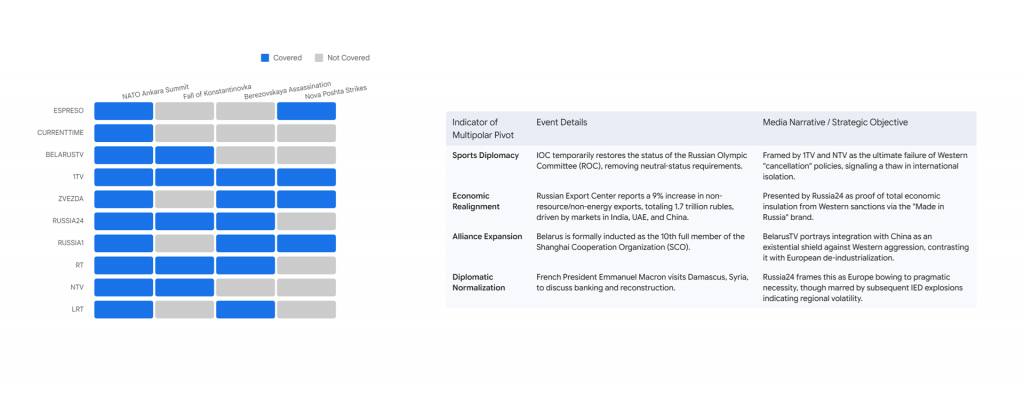
Over the last few days we have demonstrated the tremendous potential of applying Gemini's Deep Research capabilities to our daily Media Trends reports to look back on a week of Congressional debate and run cross-comparative analysis of CNN, MSNOW and Fox News. What might it look like to scale these experiments up even further and examine a day of Russian (Channel 1, NTV, Russia Today, Russia 1, Russia 24 and Zvezda), Belarusian (Belarus24), Ukrainian (Espreso), VOA (CurrentTime) and Lithuanian (LRT) coverage using our Media Trends reports for yesterday? In other words, let's ask Gemini Deep Research to deeply examine and compare our Media Trends reports for those 10 channels (Gemini is limited to 10 uploaded files at once) and explore the similarities and differences across these media universes. We'll test Gemini 3.1 Pro and see how its results vary across runs and then explore Gemini Deep Research with both a highly structured prompt and an entirely freeform unstructured prompt to see how the greater flexibility affects the results. Finally, we'll explore some of the challenges when conducting such large-scale research analyses, from exceeding context windows to the failure modes that can arise. No data was used to train or tune any model and all analyses were conducted only on our Media Trends PDF reports.
Let's start with this structured prompt that essentially asks Gemini to construct a comparative report in the same format as the individual per-channel reports. We also attached the PDF reports for July 7, 2026 for the ten channels above:
Attached are a set of PDF daily reports that each deeply analyze the trends, themes and overarching narratives of a set of global television news channels from around the world yesterday. I want you to deeply examine all of those reports and think deeply about their trends and themes. Then I want you to write a global analysis report that gives the state of the planet according to all of these reports and has the structure below. Use ONLY the information in these reports, do not use external sources.

GLOBAL ANALYSIS REPORT

THE GLOBAL VIEW
Open with an overarching look at the world yesterday as captured in these reports - its developments, themes, trends, patterns, unexpected findings, etc. Talk about regional, thematic or other patterns and trends you observe when looking across all of these reports.

SHARED STORIES
What are the shared major stories that dominated global coverage and were reported across multiple channels? For each, list the channels that covered it and also the ones that did not cover it and offer a brief hypothesis as to why each of those other channels did not cover this story.

BIGGEST GLOBAL STORIES BEING MISSED
Make a table of all the countries and for each list the biggest global stories attracting the most attention or having the greatest impact that weren't covered in that country. The idea is to capture what major global stories are not being covered in each country. Offer hypotheses as to why each of the missing stories is not being covered in that country.

CONTESTED NARRATIVES
Now compare the reports against each other. Look carefully for "contested narratives" in which multiple channels are discussing the same story, but from differing or outright opposing viewpoints, framings, contexts, narratives or details. Explain carefully these differences and offer hypotheses that explain those differences.

GLOBAL KEY GOVERNANCE TRENDS
Look across the "Key Governance Topics" sections in all of the reports. What are the broad regional and global trends you observe in each of these topics across the world? Cite key examples.

GLOBAL LEGISLATIVE TRENDS
Look across the "Legislative Roundup" sections in all of the reports. What are the broad regional and global trends you observe in this section across the world? Cite key examples.

GLOBAL TRENDS & THEMES
Look across the "Trends And Themes" sections in all of the reports. What are the broad regional and global trends you observe in this section across the world? Cite key examples.

GLOBAL STRATEGIC FORESIGHT
Look across the "Strategic Foresight" sections in all of the reports. What are the broad regional and global trends you observe in this section across the world? Cite key examples.

GLOBAL RECOMMENDATIONS & IMPLICATIONS
Look across the "Recommendations & Implications" sections in all of the reports. What are the broad regional and global trends you observe in this section across the world? Cite key examples.

CONCLUSIONS / ANALYSIS
In this section, add any concluding remarks about what you are observing globally through these reports.

COMPLETE STORY INVENTORY
In this section, list all of the stories from the sections above that were covered by at least 3 channels in a massive table and for each of them list the countries that covered the story and a brief explanation of why other countries didn't cover the story.
We'll run it first through Gemini Pro 3.1 to see what a rapid triage assessment done in tens of seconds looks like and then run the same prompt and reports through Gemini Deep Research to compare what Gemini is capable of when given tens of minutes and far greater computing resources. To see how consistent the results are, we'll actually run the same prompt twice with Gemini Pro 3.1 to see how significantly its findings differ across runs:
- Gemini Pro 3.1 Research Report – Structured Analysis Prompt – Run 1.
- Gemini Pro 3.1 Research Report – Structured Analysis Prompt – Run 2.
- Gemini Deep Research Report – Structured Analysis Prompt.
What about a more generalized prompt that purposely allows Gemini to adopt the structure and narrative flow that best fits its analysis?
Attached are a set of PDF daily reports that each deeply analyze the trends, themes and overarching narratives of a set of television news channels yesterday.
I want you to read them all very carefully and deeply and examine and analyze the similarities and differences in their coverage, from what stories they covered to their narratives to how they framed and presented their coverage. Explain in detail your hypotheses for the major differences in their coverage. How would you best describe their parallel coverage universes yesterday?
This yields:
In an important warning of the challenges in robustly applying models like Deep Research to document archives, in our original first run, instead of attaching the PDF reports, we provided a list of their public URLs in our prompt. When Gemini presented its proposed research plan, it made no mention of being unable to retrieve the public URLs and, after around 10 minutes, returned a complete report that, at first glance, appeared to be exactly what was requested. However, after expanding the source list dropdown under each paragraph of the report, we noticed that all of the sources were a combination of various websites across the internet and a number of previous GDELT blog posts – the PDF reports themselves made not a single appearance.
Incredibly, Gemini Deep Research looked at the URLs of the PDF reports, saw which channels they referred to, and then conducted Google Web searches across the open internet to locate reporting about those channels' coverage across the web to produce the requested report – meaning that the results were not only not based on our Media Trends reports, they weren't even based on an analysis of the channels' coverage – they were based on third party discussions of their coverage from across the internet, raising serious questions about the report's findings. Yet the report was extensive and detailed enough that someone who didn't click through all of the source dropdowns might have easily missed that the report was not based on the Media Trends reports at all. Remarkably, Gemini did not raise any errors or otherwise clearly note that the report did not incorporate the requested PDFs at all:
Thinking this was a one-off fluke, we ran the analysis again. Once again, Gemini reported no concerns in its research plan about accessing the listed PDF report URLs and reported no errors when it actually produced the report. This time, Gemini lists the PDF reports as its sources under each paragraph of its report, making it at first glance appear to have been able to download all of the reports and correctly research the report. However, the report opens with this strange line: "An exhaustive examination of the global television news landscape for July 5, 2026, reveals a profound, systemic anomaly within the international media monitoring infrastructure: a complete and universal failure in data accessibility across all targeted regional and international broadcasting nodes. The vast array of daily reports—specifically designed to ingest, process, and deeply analyze the trends, themes, and overarching narratives of more than sixty critical global television news channels—were uniformly inaccessible." Yet, instead of aborting the report and coming back to the user, Gemini Deep Research produced an entire final report that mixes claims apparently pulled from thin air, sourced to PDFs that the report lists as the consulted sources, but which the narrative asserts Gemini could not access.
Given that Gemini's consumer interface only supports up to 10 attached files, why not just concatenate all of the PDFs together and upload as a single file? The answer is that Gemini, like other current advanced frontier reasoning models, supports only a 1M token window, meaning it can only load a portion of the full report list. Even extracting just the text of the reports does not bring the input token count down to a level where the model can examine all of the reports at once. As we continue this series, we'll be exploring different potential approaches, such as examining each section of the reports individually, so stay tuned!