
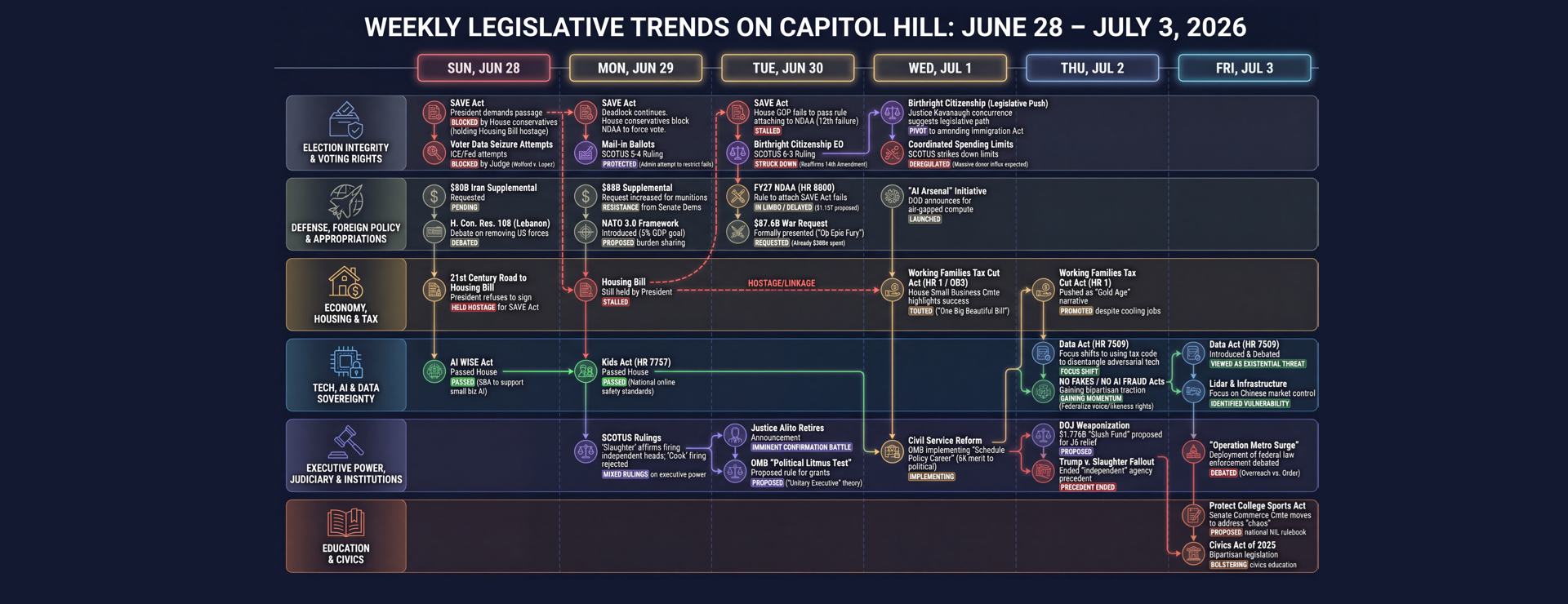
Leveraging our new findings on how Gemini handles PDFs, earlier today we showcased applying Gemini Deep Research to an entire day of our Media Trends reports. What if instead we leveraged this enormous new context token window space to analyze first two months and then ultimately half a year of our Today's Trends on Capitol Hill reports using Gemini Deep Research? Using our PDF concatenation approach, Gemini was able to read all 1,000 pages of Capitol Hill reports stretching back to the start of this year and deeply examine the legislative trends of 2026 to date – an incredible achievement for a frontier model. No data was used to train or tune any model and only our own Capitol Hill PDF reports were provided to Gemini, not the actual broadcasts themselves.
First we'll start by examining just the last month and a half to test our approach, asking Gemini Deep Research Pro Extended to explore the legislative trends of June 1 – July 12, 2026 using the following prompt:
Attached is a concatenated set of deep analysis reports about Capitol Hill business June-July 2026.
Deeply analyze these and produce a deeply researched rich analytical report about the legislative trends of Congress and the US Government over the past two months.
Be thorough, examine the underlying trends large and small and provide context and hypotheses that explain these trends.
At the end look to the future and project where these trends appear to be heading.
Now let's extend this back to the start of this year examining all reports January 10 – June 12, 2026 (Gemini is limited to 1,000 pages per PDF so we'll skip January 1-9 to keep the total combined report length to below 1000 pages):
Attached is a concatenated set of deep analysis reports about Capitol Hill business January-July 2026.
Deeply analyze these and produce a deeply researched rich analytical report about the legislative trends of Congress and the US Government over the past half year.
Be thorough, examine the underlying trends large and small and provide context and hypotheses that explain these trends.
At the end look to the future and project where these trends appear to be heading.
For those interested in the technical details, below is our workflow. We can use this code snippet to calculate the number of tokens that an arbitrary text file will consume when loaded into Gemini:
export GEMINI_API_KEY='[YOURKEY]'
jq -Rs '{contents:[{parts:[{text:.}]}]}' ./INPUT.TXT |
curl -sS -X POST \
  'https://generativelanguage.googleapis.com/v1beta/models/gemini-3.1-pro-preview:countTokens' \
  -H "x-goog-api-key: $GEMINI_API_KEY" \
  -H 'Content-Type: application/json' \
  --data-binary @- |
jq -r '.totalTokens'
Computing the token count of PDFs requires a slightly more complex command that attaches it as an inline file:
export GEMINI_API_KEY='[YOURKEY]'
base64 -w0 ./20260110-20260712TODAYSTRENDSONCAPITOLHILL.pdf |
jq -Rs '{
  contents: [{
    parts: [{
      inline_data: {
        mime_type: "application/pdf",
        data: .
      }
    }]
  }]
}' |
curl -sS -X POST \
  'https://generativelanguage.googleapis.com/v1beta/models/gemini-3.1-pro-preview:countTokens' \
  -H "x-goog-api-key: $GEMINI_API_KEY" \
  -H 'Content-Type: application/json' \
  --data-binary @- |
jq -r '.totalTokens'
First, we'll concatenate all of the PDFs together. Including the infographics exceeds the max filesize for a single PDF for Gemini. We could work around this by splitting things up, but let's go ahead and just strip off the infographic cover pages to absolutely minimize filesize and token count.
#remove the first page of all of the PDFs to reduce size...
apt-get -y install qpdf
time find *.pdf | parallel --eta 'qpdf {} --pages {} 2-z -- {}-notitle.pdf'

#first we'll concatenate all of the reports together...
apt-get -y install poppler-utils
time pdfunite ./20260101-20260712TODAYSTRENDSONCAPITOLHILL/*-notitle.pdf 20260101-20260712TODAYSTRENDSONCAPITOLHILL.pdf
pdfinfo 20260101-20260712TODAYSTRENDSONCAPITOLHILL.pdf
#>1000 pages

#we exceeded Gemini's max of 1000 pages per PDF, so let's remove the first 10 days of 2026 to bring down the page count...
rm 2026010*.pdf
time pdfunite ./20260101-20260712TODAYSTRENDSONCAPITOLHILL/*-notitle.pdf 20260110-20260712TODAYSTRENDSONCAPITOLHILL.pdf
pdfinfo 20260110-20260712TODAYSTRENDSONCAPITOLHILL.pdf
#996 pages

#and now we'll run our token count snippet above...
#557760 tokens
We'll also make a version of just the June-July 2026 reports that includes the infographics:
pdfinfo 2026JUNEJULYTODAYSTRENDSONCAPITOLHILL.pdf
#272 pages
#152320 tokens