As we continue to explore and try to better understand the completeness of a set of several exceptionally rare picture Bibles, including the 1585 Jode Thesaurus (the very first picture Bible), another institution recently shared a historical inventory of their own copy that we needed to compare against the Jode's original Latin table of contents pages. Understanding how other institutions' copies deviate from the original table of contents would help us better understand which kinds of holes are to be expected in surviving copies.
Their inventory consisted of a PDF of photographs of a typewritten table with copious handwritten corrections, annotations and additional notes scrawled across the pages in very small tight print and cursive handwriting that wrapped around surrounding text, connected via circuitous hand drawn arrows, and often undulated or curved to fit the contours of the printed table. Making things even more difficult, their copy was in an entirely different order from the standard ordering of the Jode, used very different English colloquial language to refer to each series, was missing nearly 60% of the total plates, and a number of the handwritten corrections changed the name of different rows in the inventory to entirely different series names by crossing out the typed text and writing the new name in the surrounding space or elsewhere on the page with an arrow connecting it.
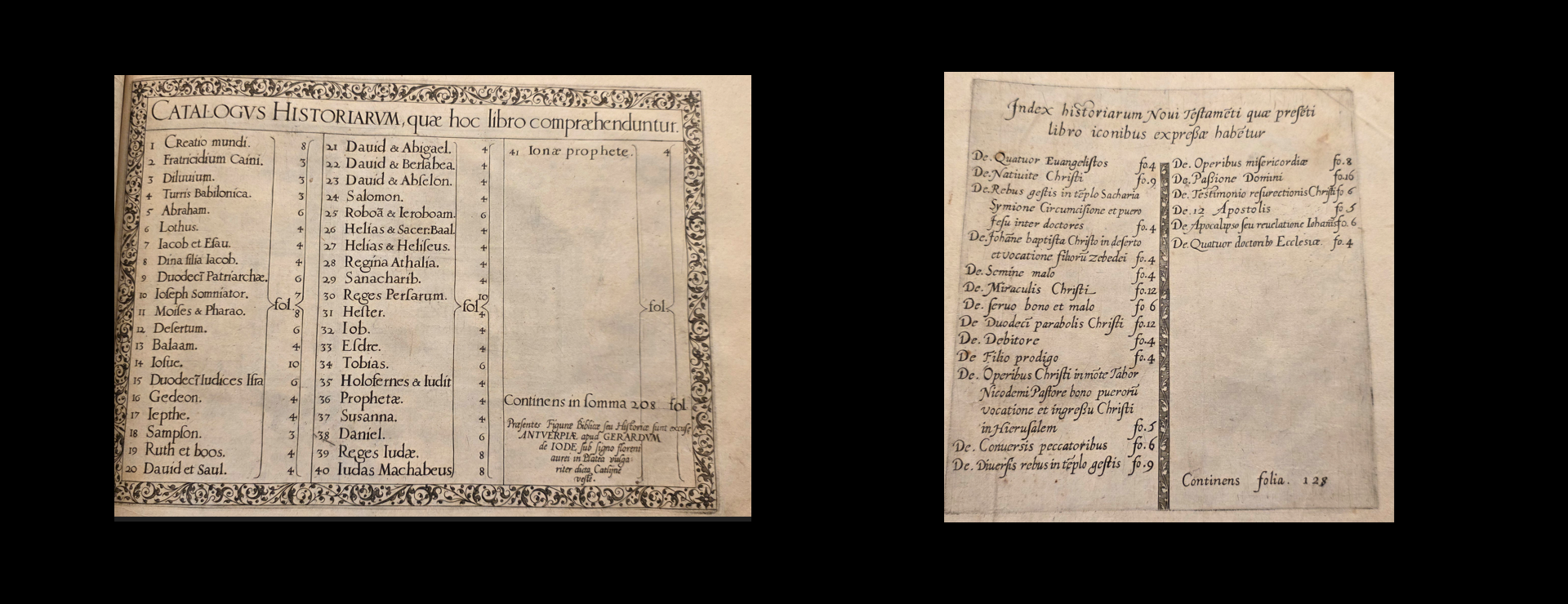
Complicating matters further, their inventory was written in English and used modern colloquial descriptive names for each series that required considerable thinking and a deep understanding of the relevant Biblical scenes to line up with their formal titles, while the Jode's original tables of contents were in engraved Latin in two very different layouts, one with an elaborate print typeface with embellishments, in a tabular layout with floral borders, while the the other was in italics and in list format, as seen above.
How could we possibly compare these two lists? Incredibly, we uploaded to Gemini 3.1 Pro the two original tables of contents from the Jode and the inventory PDF from the other institution and simply asked Gemini:
I have two photographs of tables of contents of the Old and New Testaments in my copy of the Jode Thesaurus.
I have also attached a PDF inventory of another copy.
Line them up and make a table that compares the two copies and highlight what they both have and what is different.
Translate everything into English.
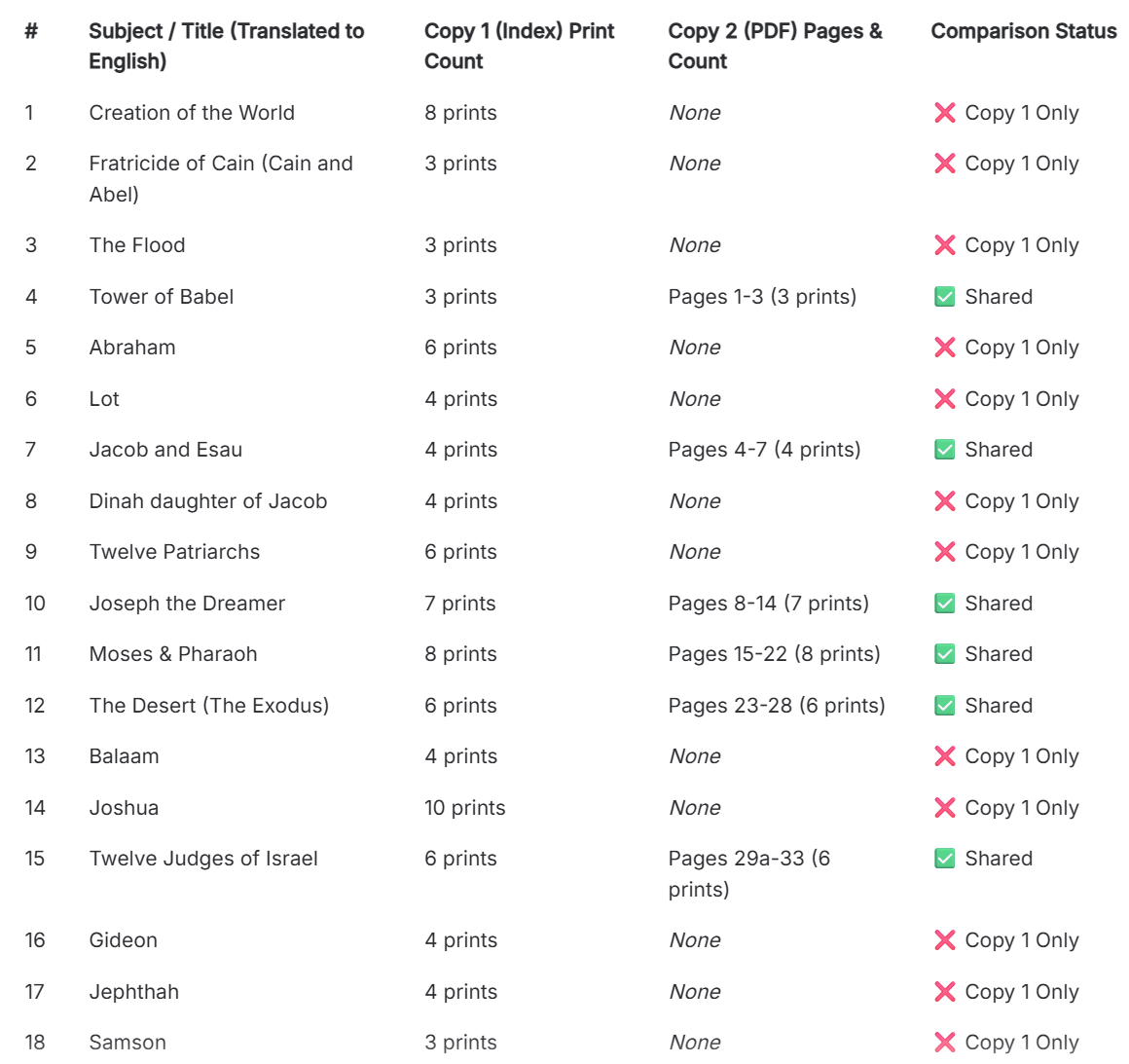
Incredibly, Gemini 3.1 Pro not only correctly merged the typewritten and handwritten corrections and annotations of the inventory PDF, it recognized that the two series were in totally different orders and using very different series names in two different languages and so went through series-by-series and identified the formal Latin title in the table of contents that corresponded to each colloquial English series description in the inventory PDF, reordered the inventory in the table of contents order and compared each series and the number of reported plates in each, producing a single comparison table.
You can see a portion of the final comparison table below, showing how Gemini even integrated visual icons into its final table to make the report instantly visually skimmable. A manual spotcheck of the results below confirmed Gemini's analysis was exactly correct, demonstrating the tremendous potential of AI tools like Gemini to entirely transform collection assessment in large institutions.