
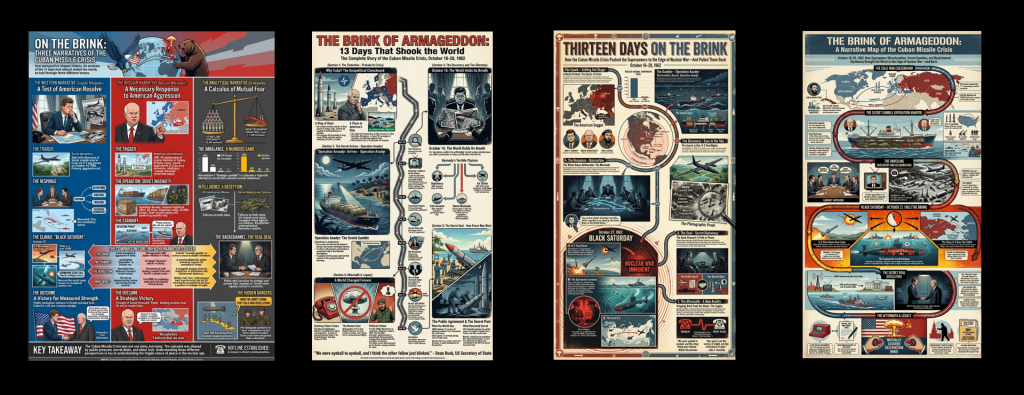
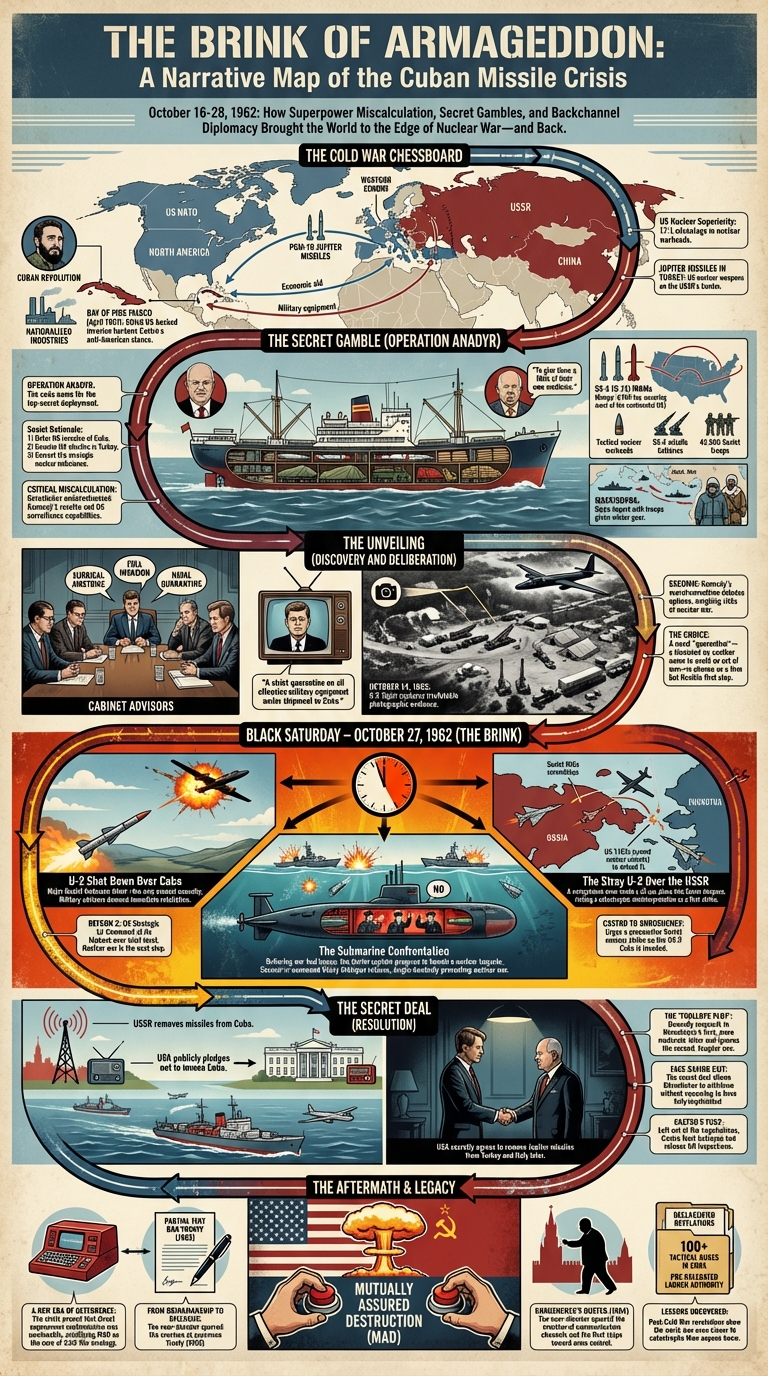
Just how different are the narratives of the Cuban Missile Crisis as told through the English edition of Wikipedia, the Russian edition and Grokipedia? Here we use Gemini 3 Pro and Nano Banana Pro to distill the event down into three infographics (one per article) and then a comparative infographic and textual report outlining the major differences in their underlying narratives. Such visuals offer a powerful reminder of just how differently the same event can be seen and narrated across countries and platforms.
COMPARATIVE ANALYSIS
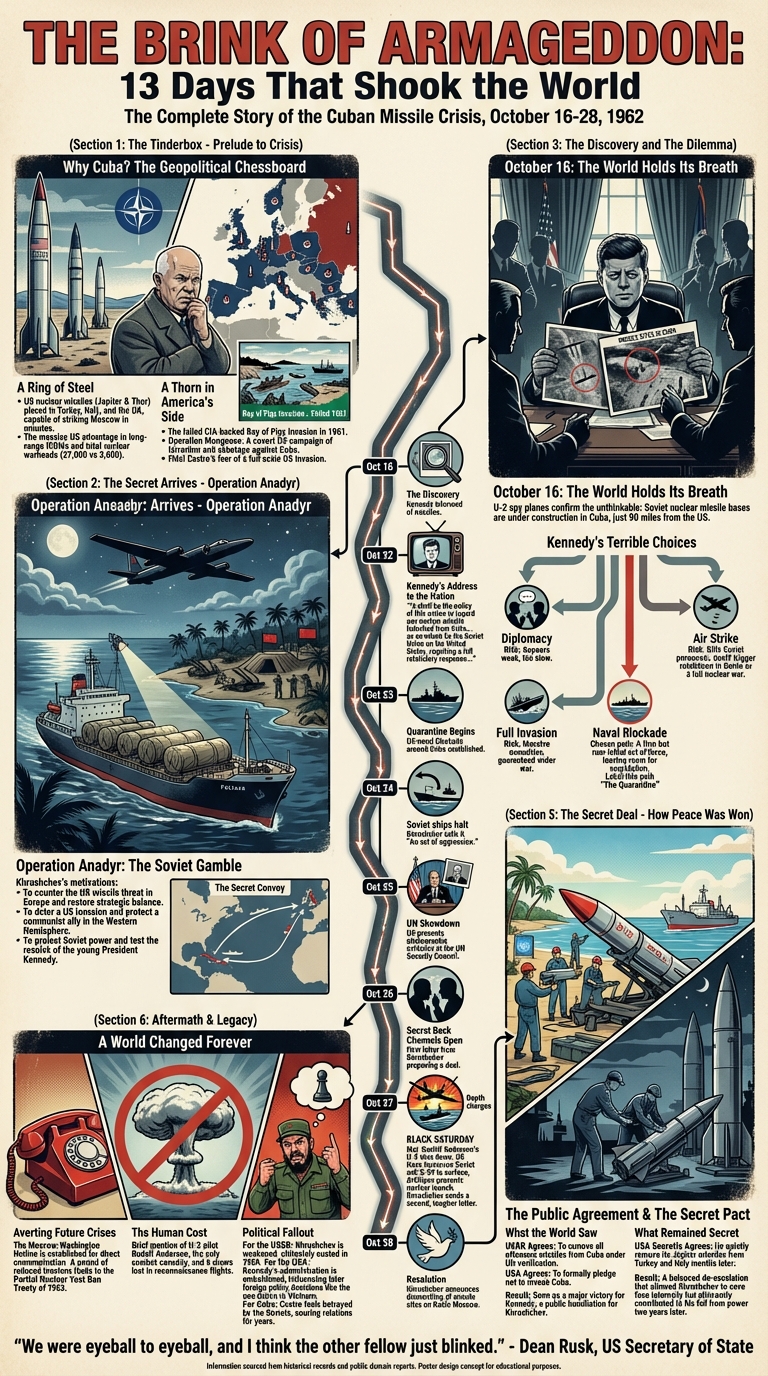
WIKIPEDIA ENGLISH LANGUAGE
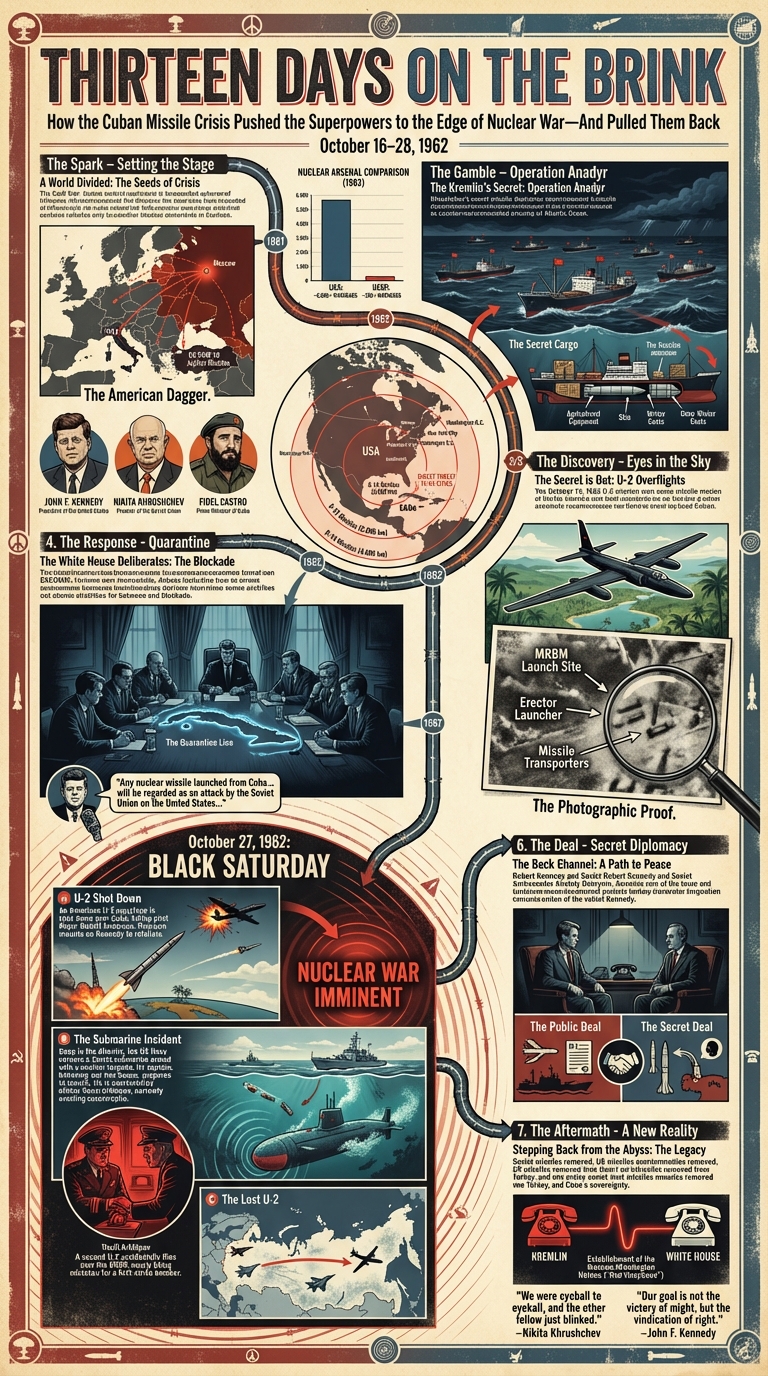
WIKIPEDIA RUSSIAN LANGUAGE
GROKIPEDIA
COMPARATIVE INFOGRAPHIC PROMPT
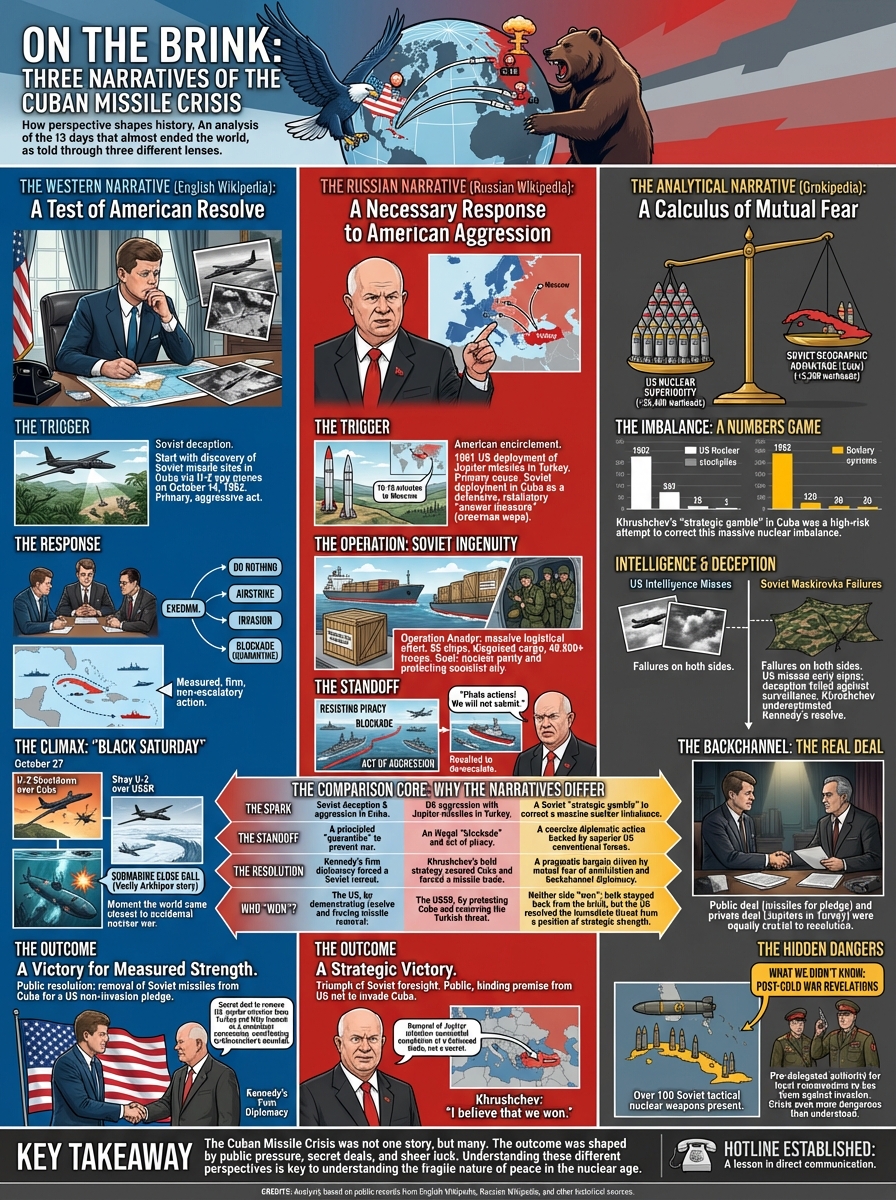
This is the infographic generation prompt generated by Gemini 3 Pro in response to the below request that was then used to make the comparative visualization at the top of this page:
Create a prompt for a large illustrated explainer poster designed to be printed on a large-format poster printer and hung up on the wall that narrates the differences in the three reports below as a single large poster that can be printed and hung on a wall that outlines all of the major themes and trends and findings. Focus on the major differences of the three reports and tease apart how they are different and why. The poster should be entirely in English.
Prompt for a Large-Format Illustrated Explainer Poster
Poster Title: ON THE BRINK: THREE NARRATIVES OF THE CUBAN MISSILE CRISIS
Core Concept: Design a single, large-format illustrated poster that explains the Cuban Missile Crisis by comparing and contrasting three distinct narratives: the traditional Western viewpoint (from the English Wikipedia), the Russian viewpoint (from the Russian Wikipedia), and a modern, data-driven analytical viewpoint (from "Grokipedia"). The poster's primary goal is to tease apart the major differences in how each source frames the causes, key events, resolution, and ultimate meaning of the crisis, explaining why these differences exist.
Target Audience: High school and university students, history enthusiasts, and the general public. The design should be visually engaging, educational, and accessible, capable of being understood both at a glance and through detailed reading.
Overall Layout and Structure:
The poster should be organized into three main vertical columns, one for each narrative, with a central, horizontal "Comparison Core" that directly contrasts key themes across the three perspectives.
-
-
- Dimensions: Designed for large-format printing (e.g., 36" x 48" or A0 size).
- Visual Style: A clean, modern infographic style. Use a consistent icon set, clear typography, and a balanced mix of illustrations, maps, timelines, and text blocks. The visual language should guide the viewer through the comparison.
- Color Palette: Use a distinct primary color for each narrative to create immediate visual separation:
- Column 1 (English Wikipedia): Cool Blue (#00529B) – Representing the American/Western perspective.
- Column 2 (Russian Wikipedia): Bold Red (#D42121) – Representing the Soviet/Russian perspective.
- Column 3 (Grokipedia): Neutral Gray/Gold (#4A4A4A, #FFBF00) – Representing the objective, analytical perspective.
-
Content for Each Section:
Poster Header:
-
-
- Main Title: ON THE BRINK: THREE NARRATIVES OF THE CUBAN MISSILE CRISIS
- Subtitle: How perspective shapes history. An analysis of the 13 days that almost ended the world, as told through three different lenses.
- Key Visual: A central, stylized graphic of the Earth caught between a stylized American eagle and a Russian bear, with missile trajectories arcing between Cuba and the US/Turkey.
-
Column 1: The Western Narrative (Based on English Wikipedia)
-
-
- Headline: A Test of American Resolve
- Tone: Narrative-driven, focusing on the drama of decision-making.
- Key Themes to Visualize and Explain:
- The Trigger: Soviet deception. Start with the discovery of Soviet missile sites in Cuba via U-2 spy planes on October 14, 1962. Depict the famous U-2 reconnaissance photos. Frame this as the primary, aggressive act that initiated the crisis.
- The Response: Kennedy's leadership. Illustrate the EXCOMM meetings with portraits of JFK, RFK, and McNamara. Use a diagram to show the response options considered (Do Nothing, Airstrike, Invasion, Blockade). Emphasize the choice of the naval "quarantine" as a measured, firm, yet non-escalatory action. Include a map of the quarantine line.
- The Climax: "Black Saturday." Create a mini-timeline for October 27, highlighting the U-2 shootdown over Cuba, the stray U-2 over the USSR, and the submarine close call (the Vasily Arkhipov story). Frame this as the moment the world came closest to accidental nuclear war.
- The Outcome: A victory for measured strength. State clearly that the public resolution was the removal of Soviet missiles from Cuba in exchange for a US non-invasion pledge. Mention the secret deal to remove US Jupiter missiles from Turkey and Italy, but frame it as a secondary concession that made Khrushchev appear weak and contributed to his later downfall.
- Key Illustration: A portrait of a pensive John F. Kennedy in the Oval Office, with a backdrop of U-2 photos and naval charts.
-
Column 2: The Russian Narrative (Based on Russian Wikipedia)
-
-
- Headline: A Necessary Response to American Aggression
- Tone: Justificatory, focusing on strategic balance and national security.
- Key Themes to Visualize and Explain:
- The Trigger: American encirclement. Start with the 1961 US deployment of Jupiter missiles in Turkey. Use a map showing the short flight time from Turkey to Moscow, explicitly labeling this as the primary cause of the crisis. Frame the Soviet deployment in Cuba as a defensive, retaliatory "answer measure" (ответная мера).
- The Operation: Soviet ingenuity. Detail "Operation Anadyr." Use graphics to show the massive logistical effort: 85 ships, disguised cargo, and the secret transport of 40,000+ troops. Emphasize the goal of achieving nuclear parity and protecting a socialist ally.
- The Standoff: Resisting piracy. Describe the US naval action as a "blockade" and an "act of aggression." Quote Khrushchev's letters denouncing US "pirate actions." Depict Soviet ships defiantly sailing toward the blockade line before being recalled by Moscow to de-escalate.
- The Outcome: A strategic victory. Frame the resolution as a triumph of Soviet foresight. Highlight the extraction of a public, binding promise from the US not to invade Cuba as the primary achievement. Present the removal of Jupiter missiles from Turkey not as a secret, but as the successful completion of a balanced trade. End with Khrushchev's quote: "I believe that we won."
- Key Illustration: A portrait of a determined Nikita Khrushchev, with a backdrop of a map showing US missiles in Turkey pointed at the USSR.
-
Column 3: The Analytical Narrative (Based on "Grokipedia")
-
-
- Headline: A Calculus of Mutual Fear
- Tone: Clinical, data-driven, and thematic.
- Key Themes to Visualize and Explain:
- The Imbalance: A numbers game. Use clear infographics to show the stark US advantage in strategic nuclear weapons in 1962 (e.g., ~26,400 US warheads vs. ~3,300 Soviet). Explain that Khrushchev's "strategic gamble" in Cuba was a high-risk attempt to correct this asymmetry.
- Intelligence & Deception: Failures on both sides. Use a timeline to show how US intelligence missed early signs of the deployment and how Soviet maskirovka (deception tactics) ultimately failed against U-2 surveillance. Highlight Khrushchev's critical error in underestimating Kennedy's resolve.
- The Backchannel: The real deal. Focus on the secret negotiations between Robert F. Kennedy and Anatoly Dobrynin. Emphasize that the public deal (missiles for a pledge) and the private deal (Jupiters in Turkey) were equally crucial to the resolution.
- The Hidden Dangers: Post-Cold War revelations. Include a callout box titled "What We Didn't Know." Explicitly mention the declassified facts: the presence of over 100 Soviet tactical nuclear weapons on Cuba and the pre-delegated authority for local commanders to use them against an invasion. This reframes the crisis as even more dangerous than was understood at the time.
- Key Illustration: A diagram of a balance scale, with "US Nuclear Superiority" on one side and "Soviet Geographic Advantage (Cuba)" on the other, teetering precariously.
-
Central Section: The Comparison Core
This horizontal band runs across the middle of the poster, visually linking the three columns. Use arrows pointing from the central themes to the corresponding explanations in each column.
-
-
- Title: Why the Narratives Differ
- Structure: A table or set of callouts comparing the three perspectives on key questions.
-
| Theme | The Western Narrative (English Wiki) | The Russian Narrative (Russian Wiki) | The Analytical Narrative (Grokipedia) |
| THE SPARK | Soviet deception & aggression in Cuba. | US aggression with Jupiter missiles in Turkey. | A Soviet "strategic gamble" to correct a massive nuclear imbalance. |
| THE STANDOFF | A principled "quarantine" to prevent war. | An illegal "blockade" and act of piracy. | A coercive diplomatic action backed by superior US conventional forces. |
| THE RESOLUTION | Kennedy's firm diplomacy forced a Soviet retreat. | Khrushchev's bold strategy secured Cuba and forced a missile trade. | A pragmatic bargain driven by mutual fear of annihilation and backchannel diplomacy. |
| WHO "WON"? | The US, by demonstrating resolve and forcing missile removal. | The USSR, by protecting Cuba and removing the Turkish threat. | Neither side "won"; both stepped back from the brink, but the US resolved the immediate threat from a position of strategic strength. |
Poster Footer:
-
-
- Key Takeaway: "The Cuban Missile Crisis was not one story, but many. The outcome was shaped by public pressure, secret deals, and sheer luck. Understanding these different perspectives is key to understanding the fragile nature of peace in the nuclear age."
- Credits: "Analysis based on public records from English Wikipedia, Russian Wikipedia, and other historical sources."
- Visual: A simple graphic of the Moscow-Washington hotline telephone, symbolizing the primary lesson learned from the crisis.
-
ONE-PAGE COMPARATIVE ANALYSIS REPORT
How about a one-page textual report comparing the three?
Write a one-page report that narrates the differences in the three reports below. Focus on the major differences of the three reports and tease apart how they are different and why. The report should be entirely in English.
A Comparative Analysis of Three Narratives of the Cuban Missile Crisis
The Cuban Missile Crisis of October 1962 is a cornerstone of Cold War history, yet its narrative is far from monolithic. An analysis of three distinct accounts—the English Wikipedia (EW), the Russian Wikipedia (RW), and the AI-synthesized "Grokipedia" (G)—reveals how framing, structure, and tone can produce profoundly different understandings of the same historical event. The primary differences lie in their attribution of causality, narrative structure, and overall perspective.
The most fundamental divergence is in the framing of causality. The Russian Wikipedia, titled "Caribbean Crisis," immediately and unequivocally frames the event as a direct response to American aggression. Its first sentence establishes the cause as the 1961 deployment of US Jupiter missiles in Turkey, which threatened Moscow. The entire narrative that follows is presented as a justifiable, defensive counter-move. In contrast, the English Wikipedia, titled "Cuban Missile Crisis," presents a more complex and multi-faceted origin. While acknowledging the Jupiter missiles as a background factor, it weaves a broader narrative that includes the failed Bay of Pigs invasion, the anti-Castro "Cuban Project," and Soviet Premier Khrushchev's perception of President Kennedy's weakness. This framing situates the Soviet deployment as a calculated gambit within a wider geopolitical context, rather than a simple tit-for-tat reaction. Grokipedia synthesizes these points into a strategic analysis, framing the Soviet action as a logical, albeit risky, move to "rectify the asymmetry in strategic nuclear forces" and achieve "a rough parity," thus analyzing the motive rather than simply justifying or contextualizing it.
Secondly, the reports differ significantly in their narrative structure and tone. The English and Russian Wikipedia articles follow a traditional, chronological structure, recounting the crisis day-by-day. This method builds narrative tension and immerses the reader in the escalating events as they unfolded. However, their tones diverge; EW adopts a neutral, encyclopedic voice that strives for objectivity by presenting multiple viewpoints (e.g., the debates within EXCOMM), while RW maintains a justificatory tone, emphasizing the illegality of the US "quarantine" by labeling it an "act of aggression" and "piracy." Grokipedia eschews a chronological narrative altogether, opting for a thematic and analytical structure. It deconstructs the crisis into components like "Geopolitical Background," "Soviet Strategic Gamble," and "US Crisis Management." Its tone is not neutral but assertive and professorial, presenting synthesized conclusions ("declassified records underscore," "validated the concept of mutually assured destruction") as established fact. This makes it less of a story and more of a strategic post-mortem, using the crisis as a case study for Cold War theory.
Finally, the emphasis placed on key events and their resolution highlights each source's unique perspective. EW provides granular detail on the American decision-making process, dedicating significant space to the EXCOMM deliberations and the role of Robert Kennedy's backchannel diplomacy. Its account of the resolution highlights the secret deal to remove missiles from Turkey but frames the public outcome as a humiliation for Khrushchev. RW, conversely, portrays the resolution as a strategic victory for the USSR. It prominently features a long quote from Khrushchev defending his actions and emphasizes that the primary Soviet goal—securing a US guarantee not to invade Cuba—was achieved. Grokipedia focuses on the long-term strategic lessons, emphasizing the establishment of the Moscow-Washington hotline and the validation of deterrence theory. It uniquely dedicates space to historiography, explicitly discussing how "Post-Cold War Declassifications" have challenged early myths, exposing the presence of tactical nuclear weapons and secret concessions that complicate any simple narrative of "who won."
In conclusion, these three reports demonstrate that history is not merely a collection of facts but a constructed narrative. The English Wikipedia provides a detailed, Western-centric chronological account; the Russian Wikipedia offers a powerful counter-narrative of justified response; and Grokipedia delivers a detached, analytical synthesis focused on strategic lessons. Together, they reveal that understanding an event as critical as the Cuban Missile Crisis requires examining not only what happened, but also how, and for whom, its story is told.