
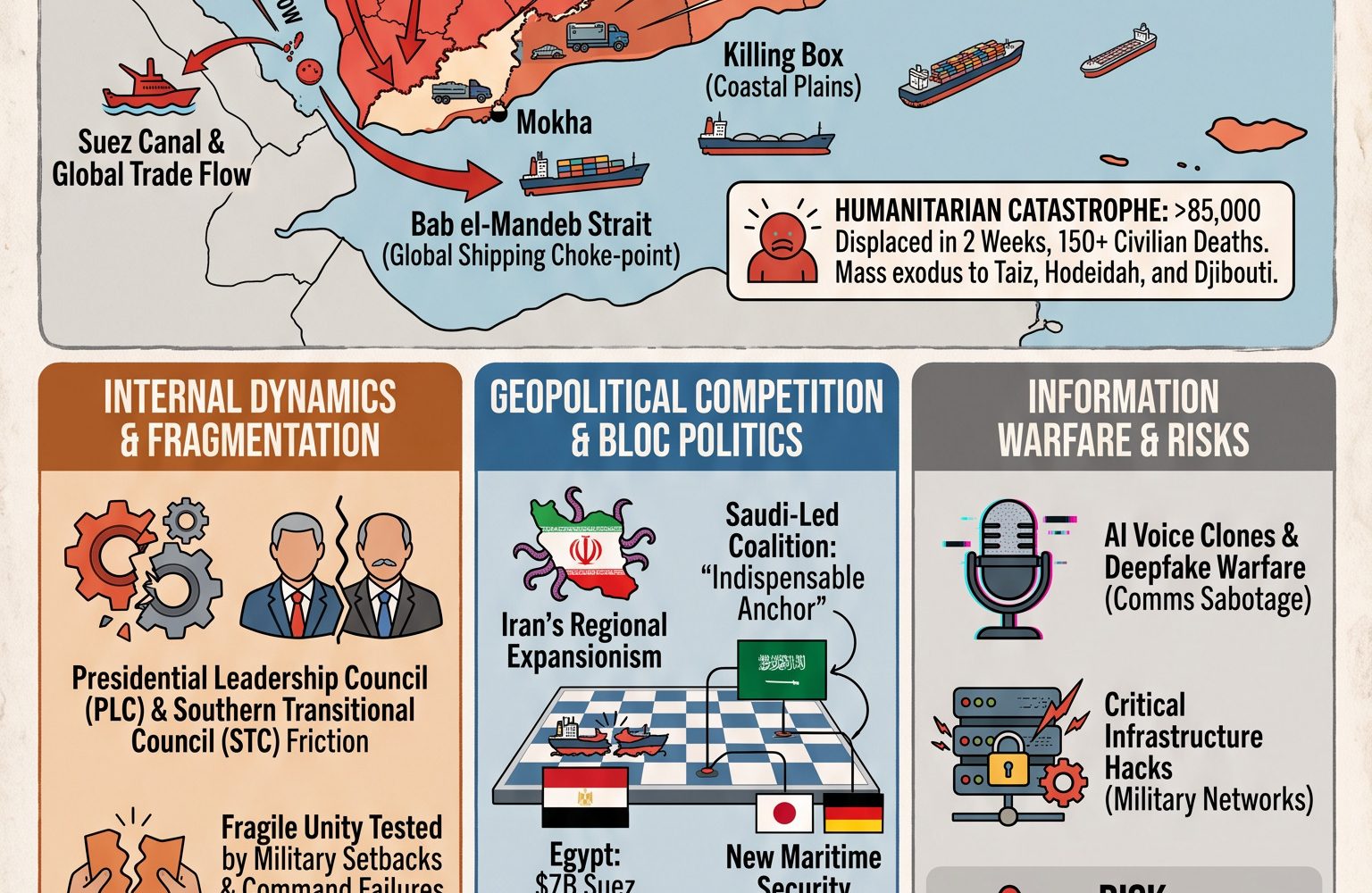
Given the flood of news coverage about Houthi advances in Yemen over the past week, it can be difficult to stay on top of all of the latest developments and especially to understand the context of a given report. For example, take this AP recap of a week of Houthi attacks that brings the reader up to date on a number of developments, but assumes the reader already knows a lot of the background of the conflict. What might it look like to open the AP article in your browser and ask Gemini to use our Today's Media Trends reports for Yemen TV for the past five days as background information to contextualize the AP article for a reader, filling in the backstory, blanks and local context? The results below offer a fascinating glimpse into the potential of this approach. No data was used to train or tune any model.
Attached are a set of deeply analytical reports about Yemen over the past week.
On the left in my browser window is a news article.
Use the information in these backgrounder reports to contextualize this news article.
Help me better understand this article using the contents of these deep analysis reports.
Here are the five Today's Media Trends reports we provided Gemini:
- Yemen TV: September 16, 2026
- Yemen TV: September 15, 2026
- Yemen TV: September 14, 2026
- Yemen TV: September 13, 2026
- Yemen TV: September 12, 2026
And this is the context it provided for the reader to help them better understand the AP article:
1. The Tactical Catalyst: Why the West Coast Collapsed (AI Deepfakes & Telecom Sabotage)
While the AP article notes that the Houthis captured Mokha and forced pro-government units into retreat, it does not explain how such a entrenched front collapsed so rapidly:
- Generative AI & Voice Cloning Warfare: The reports reveal that Houthi electronic warfare units weaponized generative AI to clone the voices of senior pro-government military commanders. They broadcast fraudulent retreat orders across frontline frequencies, creating immediate chaos, routing tactical fields, and causing the collapse of defensive lines in the Dhubab and Al-Khokha sectors.
- Exploitation of Telecom Infrastructure: Because the anti-Houthi coalition continues to rely on legacy national telecommunications infrastructure (such as Yemen Mobile and YOU, which have backend servers in Houthi-controlled Sana'a), the Houthis intercepted military signals intelligence and tracked the real-time geolocation of field commanders.
- State Countermeasures: Following the fall of the primary command center at the Khalid bin al-Walid military camp on Jabal al-Nar, the government ordered a complete ban on Houthi-linked cellular networks in liberated zones like Ma’rib (migrating to Sabafon) and deployed the newly formed 6th Drone Warfare Brigade.
2. The Military Reality: The "Killing Box" Strategy
The AP article mentions that the government is relying on airstrikes to blunt the advance. The background documents detail the specific military doctrine being applied:
- The "Box of Death" (Killing Box): After pro-government forces retreated to Al-Khawkhah, the Yemeni Armed Forces and the Saudi-led Coalition transitioned from infantry defense to an attritional air strategy. They allowed Houthi armor and supply convoys to pull forward into the flat, exposed coastal plains of Tihama, designating these zones as "killing boxes" for Su-22, F-5, and drone strikes.
- Contrarian Interpretation: The reports note two divergent interpretations of this retreat: state media frames it as a calculated "tactical draw-down" to destroy Houthi heavy equipment in open terrain and trigger international intervention, whereas internal critics view it as an outright rout that masks deep military exhaustion.
3. Severe Fractures Inside the Anti-Houthi Coalition (The "2026 Ultimatum")
The AP article references an "array of forces that have fought each other as recently as January." The reports provide critical context on the brinkmanship threatening to dissolve the Presidential Leadership Council (PLC):
- STC Parallel Governance: Southern Transitional Council (STC) head Aidarous Al-Zoubaidi attempted to exploit the military chaos by issuing over 30 unilateral, parallel state decrees. A formal constitutional legal panel intervened to rule these void, reaffirming that command and appointments rest solely with PLC President Dr. Rashad al-Alimi.
- The 2026 "Last Chance" Deadline: Senior officials warn that 2026 represents the final opportunity to integrate autonomous military factions (Tariq Saleh’s National Resistance, Tihama Brigades, STC militias, and the regular army) under a unified Ministry of Defense command.
- Saudi Direct Intervention: Saudi Major General Falah Al-Shahrani has been stationed in Aden conducting aggressive mediation, using direct financial and logistical pressure to force factional integration before internal balkanization results in the complete loss of the government's international mandate.
4. Beyond Commercial Shipping: Chokepoints, Iraq, and the Mecca Interception
The AP report touches on the regional aspect (attacks on the East-West pipeline and regional proxies). The background reports show a broader, coordinated escalation:
- Targeting Restricted Airspace South of Mecca: On September 16, Saudi air defense intercepted a Houthi loitering munition south of Mecca. Yemeni state media framed this not as a stray missile, but as an ideological, sectarian escalation rooted in Iranian revolutionary doctrine intended to contest Saudi Arabia's administrative and religious legitimacy over the Holy Sites.
- The Iraq–Yemen Drone Axis: Prior to the pipeline strikes, coordinated drone attacks targeting Riyadh and Medina originated from Iraqi territory, confirming Yemeni government warnings that the Houthis are now fully synchronized with Iraqi "Axis of Resistance" militias to stretch Saudi air defenses.
- Collapse of Backchannel Statecraft: The Omani-brokered maritime security summit between Gulf states and Iran abruptly collapsed, signaling the failure of diplomatic containment. Consequently, a new defensive alignment is emerging between Saudi Arabia, Egypt, Turkey, and Pakistan to patrol the Red Sea independently of Western/UN naval mechanisms.
5. Information Warfare and the "Trump Backchannel"
The AP mentions that U.S.–Houthi talks were hosted in Oman and that the Houthis are cautious about provoking U.S. intervention. The background reports shed light on how this is being weaponized in the information war:
- The "Hypocrisy" Psy-Op: The Yemeni Ministry of Interior and state media heavily amplified intelligence leaks and statements (referencing Donald Trump and J.D. Vance) alleging that Houthi leadership was covertly "begging" Washington for deals to protect their leadership assets.
- Objective: The PLC deployed this counter-narrative specifically to erode the Houthi leadership’s ideological purity among its frontline fighters and domestic recruitment base, contrasting their public "Death to America" dogma with their backchannel overtures.
6. The Humanitarian Toll: Demographic Cleansing & Regional Spillovers
The AP notes that 125,000 have been displaced and mentions civilian casualties. The background reports reveal a systematic pattern of displacement:
- Rapid Displacement Curve: Verified IDP figures surged from 70,000 across six provinces (Sept 12) to over 85,000 (Sept 14–15), before reaching the 125,000 cited by the UN in the AP report, with Taiz, Marib, and Aden bearing the primary strain.
- Tactical Evictions & Atrocities: Monitors documented that Houthi forces in newly seized coastal towns issued 30-minute eviction notices to entire villages, executed wounded soldiers and 53 prisoners of war in field hospitals, and targeted judges in Hays and Mokha. This has been analyzed as a deliberate doctrine of terror to depopulate the coastal rim and create a hollowed-out military buffer zone along the Bab el-Mandeb.
- Maritime Flight to Djibouti: The International Organization for Migration (IOM) documented an immediate maritime outflow, with over 2,000 refugees crossing the Bab el-Mandeb to Djibouti within the first week alone.
- The Economic Shock: In Sana'a, the Houthis hiked petrol prices to 525 rials/liter to fund their offensive, while the loss of Mokha has choked supply chains into Aden, threatening strategic food reserves and leaving the wider Yemeni economy in a state of 50% historic GDP contraction.