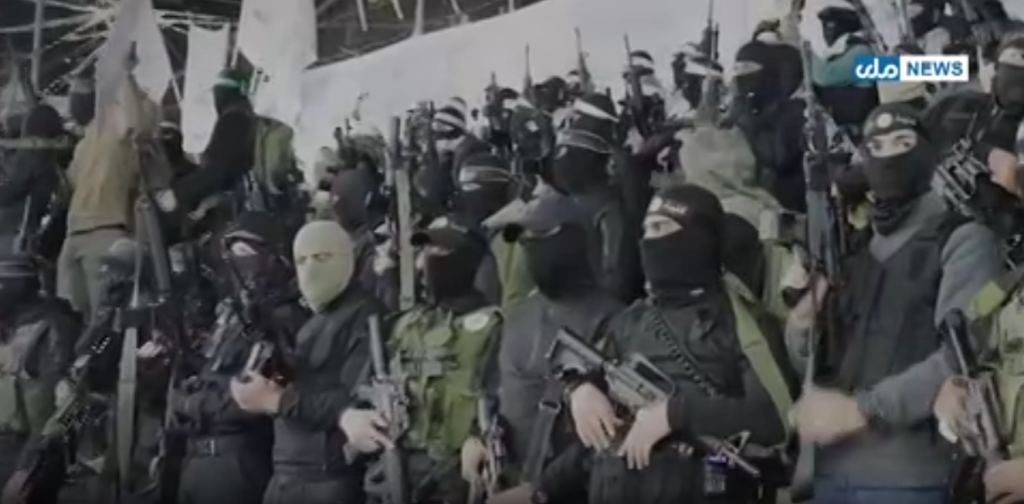
Earlier this morning we discussed some of our latest work on applying advanced visual reasoning models to watch television news broadcasts from around the world and identify "significant" events and narratives, which just this morning flagged a fascinating clip from Afghanistan outlining the Taliban's perspective on the pen versus the rifle. In our experiments from this morning, we asked Gemini to explain why it flagged the clip as important and offer a brief contextualization of it within the history of the Taliban and Afghan society. What if we gave Gemini far more time to produce that contextualization and allowed it to spend time deeply researching its topic, reading through thinktank, NGO and academic publications and weaving all of this additional information into a final report? Imagine a workflow in which a frontline frontier Gemini model watches each broadcast and identifies the most societally significant stories and narratives and passes those on to Gemini Deep Research to produce a deep dive deeply researched and fully cited analytic report on each. Let's see how the results stack up for our brief Taliban clip. No data was used to train or tune any model.
For our first two attempts, we provided Gemini Deep Research with the 1 minute video clip and tested using Gemini 3.1 Pro versus Gemini 3.8 Flash as the underlying reasoning model. This is the prompt we used:
Watch this clip from RTA very carefully.
Consider both the imagery and transcript.
Using your deep knowledge of Afghanistan, the Taliban and Afghan society, contextualize this clip for me. Be detailed and justify your answers.
Would you flag this clip as being of particular interesting/importance to a scholar studying the evolution of Afghanistan since the Taliban takeover?
If so, explain why and justify your answer.
Give me a very detailed report helping me understand its meaning and what it tells me about Afghanistan and the Taliban today.
Unfortunately, neither model appears to have actually examined the video clip itself, instead producing generic reports on the state of the Afghan television and news landscapes under the Taliban and how the Taliban's approach to the media has evolved. Gemini 3.1 Pro, as expected, produces a longer and more deeply synthesized report than 3.8 Flash. Despite not actually examining the video itself, both reports actually provide a rich and highly informative background to the Taliban's approach to media and imagery that would help a scholar or journalist better understand the significance of this narrative and provide them jumping-off points to relevant researchers and reports they could consult:
- Gemini Deep Research + Gemini 3.1 Pro + Video Clip: The Architecture of Erasure: Deciphering the Islamic Emirate’s Media Apparatus and the Implications of the Article 17 Image Ban
- Gemini Deep Research + Gemini 3.8 Flash + Video Clip: Visual Semiotics, Ideological Hegemony, and the Aniconic Turn: An Analytical Evaluation of Radio Television Afghanistan (RTA) Broadcasts Under the Islamic Emirate
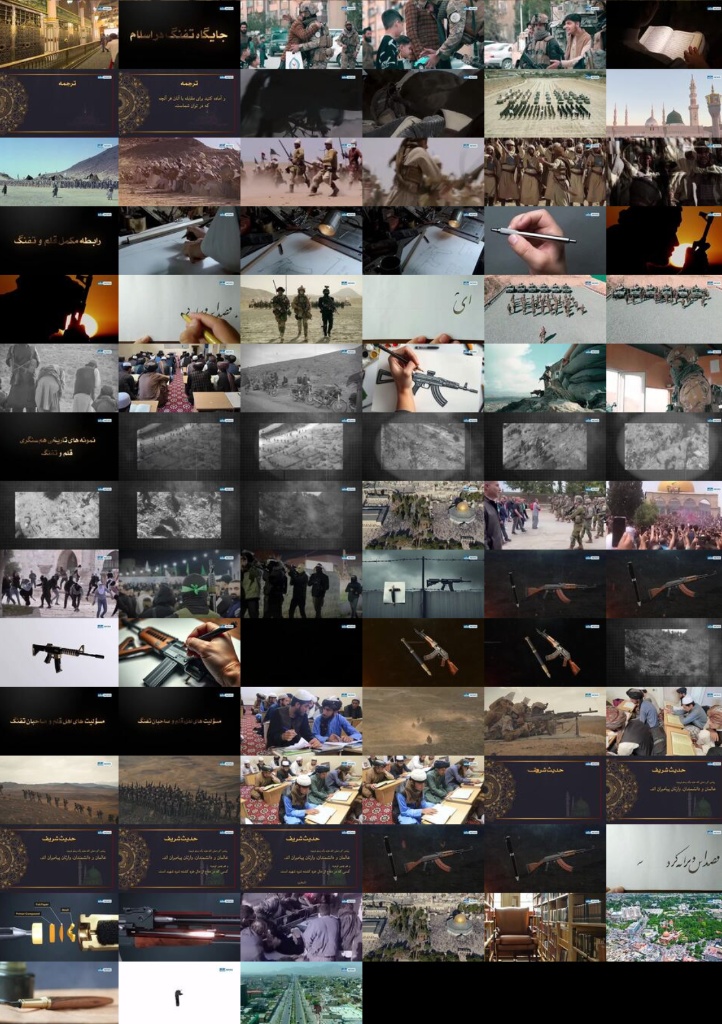
Since the Deep Research harness seems to prevent the two Gemini models from being able to watch the video itself, which they normally could, we repeated our analysis using the same prompt above and Gemini 3.1 Pro, but this time we attached the brief transcript of the clip and an excerpt from the Visual Explorer's 1/4fps thumbnail montage of the broadcast showing the portion relating to the clip and a bit of the airtime before and after it for context. This time Gemini was able to discuss the clip itself and contextualize it within the broader report:
This is the transcript excerpt we used and the thumbnail grid excerpt:
[00:00 – 00:10] "…intellectual [people of the pen] alongside resistance fighters—meaning the rifle—have engaged in defending the Islamic identity of Palestine.
[00:11 – 00:15] Extreme separation or balance between the pen and the rifle.
[00:16 – 00:26] In secular societies, attempts are sometimes made to separate the pen and the rifle from each other, and even to present them as being in opposition.
[00:27 – 00:32] This leads to the weakening of both powers.
[00:33 – 00:46] From an Islamic perspective, these two must remain in balance: neither knowledge remaining without power, nor power without awareness, which would result in tyranny.
[00:47 – 00:52] (On-screen title and narration) Responsibilities of the people of the pen and holders of the rifle.
[00:53 – 00:59] The people of the pen must produce religious, political, and cultural insight and knowledge, and…"