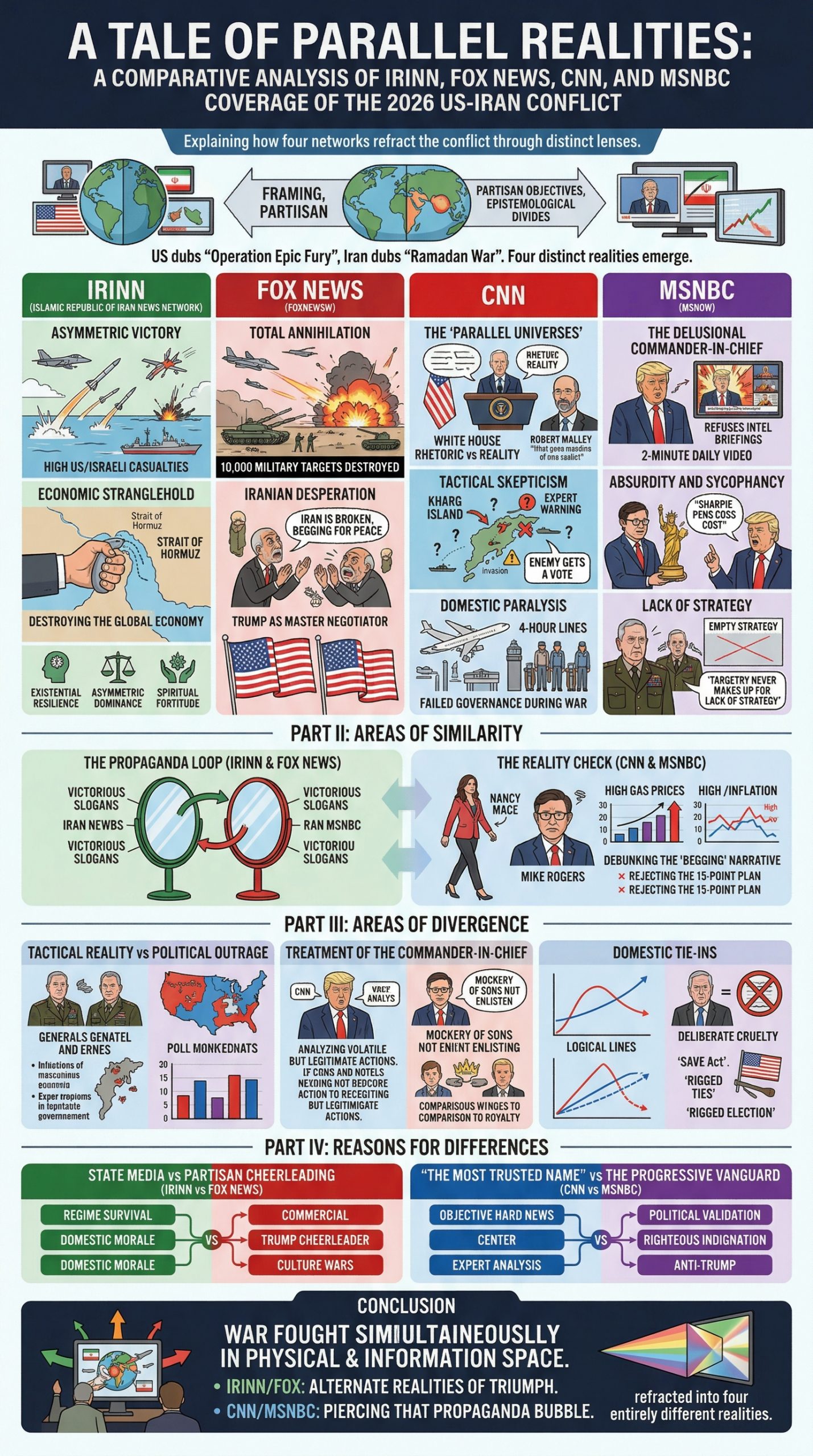
What does Gemini 3.1 Pro High Thinking have to say when asked to compare and contrast how Iranian vs American television news channels are covering the conflict in Iran? Let's examine Iran's Persian-language domestically-focused IRINN against the "big three" domestically-focused US channels CNN, MS Now and Fox News. Only the public enterprise Gemini API was used and no data was used to train or tune any model.
Attached are the transcripts for four television news channels.
Ignore all advertising and non-news content and identify ONLY the parts related to the conflict with Iran and write a 1-5 page deeply reasoned analysis that compares and contrasts the channels' coverage of the conflict with Iran from the attached transcripts.
Identify the key themes of each channel's coverage and provide a detailed breakdown of where their coverage is similar and where it diverges and explain the most likely reasons for their differences.
Integrate key quotes from the transcripts into your report.
Title: A Tale of Parallel Realities: A Comparative Analysis of IRINN, Fox News, CNN, and MSNBC Coverage of the 2026 US-Iran Conflict
Introduction
Based on the provided March 2026 broadcast transcripts, the media coverage of the ongoing US-Iran military conflict—dubbed "Operation Epic Fury" by the US and the "Ramadan War" by Iran—presents a fascinating study in media framing, partisan objectives, and epistemological divides. By analyzing the transcripts from the Islamic Republic of Iran News Network (IRINN) and Fox News, alongside the newly provided transcripts from CNN and MSNBC, a four-way spectrum of reality emerges.
While IRINN and Fox News operate as mirror images of one another—each utilizing the conflict to project asymmetric dominance, extreme nationalism, and absolute victory—CNN and MSNBC operate as the skeptical counterweights. Both CNN and MSNBC focus heavily on the chaotic reality of the war, the lack of a coherent strategy, and the severe domestic fallout. However, while CNN approaches the conflict through the lens of tactical and geopolitical analysis, MSNBC frames the war primarily as a symptom of President Donald Trump’s psychological unfitness and the erosion of American democratic norms.
This analysis breaks down the key themes of each channel, explores their structural similarities and stark divergences, and explains the underlying geopolitical and media-ecosystem drivers responsible for these differences.
Part I: Key Themes in Network Coverage
IRINN (Islamic Republic of Iran News Network)
IRINN operates as the official state broadcasting organ of Iran. Its coverage is designed to project existential resilience, asymmetric dominance, and spiritual fortitude.
-
- Asymmetric Victory: Focuses heavily on the human and technological tolls inflicted on the US and Israel, claiming mass casualties and downed aircraft.
- Economic Stranglehold: Iran’s closure of the Strait of Hormuz is framed as a masterful stroke destroying the global economy.
Fox News (FOXNEWSW)
Fox News approaches the conflict through a lens of overwhelming American conventional dominance and the personal strength of President Donald Trump.
-
- Total Annihilation: Portrays the war as a one-sided technological slaughter, citing "10,000 military targets" destroyed.
- Iranian Desperation: A dominant theme is that Iran is entirely broken and begging for peace, with Trump depicted as a master negotiator.
CNN
CNN’s coverage acts as a real-time reality check on the administration's claims, focusing heavily on geopolitical consequences, military logistics, and the domestic economic impact.
-
- The "Parallel Universes" of the War: CNN emphasizes the massive disconnect between the White House's rhetoric and the reality on the ground. As former US special envoy Robert Malley stated on CNN: "There’s a universe in the president's head in which the United States has won the war… and then there's a real world in which the war is ongoing… and Iran [is] holding the world economy hostage."
- Tactical Skepticism: CNN focuses heavily on the rumored US ground invasion of Kharg Island. Through interviews with retired generals and diplomats, CNN highlights the severe dangers of this plan. As one expert noted, "The enemy gets a vote," warning that holding Kharg Island would result in mass American casualties.
- Domestic Paralysis: CNN tightly weaves the war coverage with the ongoing Department of Homeland Security (DHS) shutdown, providing live looks at 4-hour TSA lines at airports, highlighting how the administration is failing to execute basic domestic governance while fighting a foreign war.
MSNBC (MSNOW)
MSNBC frames the conflict almost entirely around President Trump’s character, his unfitness for command, and the sycophancy of the Republican party.
-
- The Delusional Commander-in-Chief: MSNBC leans heavily into reports that Trump refuses to read intelligence briefings. Multiple hosts cite an NBC News report that Trump is briefed via a two-minute daily video montage consisting of "clips of stuff blowing up." Democratic Senator Chris Van Hollen is quoted saying, "He's completely delusional, he's detached from reality."
- Absurdity and Sycophancy: MSNBC juxtaposes the deadly serious nature of the war with the absurdity of Trump's behavior. The network highlights Speaker Mike Johnson gifting Trump a made-up "America First" golden statue, and dedicates airtime to mocking Trump for spending nearly five minutes of a wartime Cabinet meeting ranting about the cost of Sharpie pens.
- Lack of Strategy: The network relentlessly attacks the administration's lack of an endgame. As one host noted, citing Jim Mattis: "Targetry never makes up for lack of strategy, and when I listen to this reporting, I'm hearing a lot of tactics."
Part II: Areas of Similarity
1. The Propaganda Loop (IRINN and Fox News)
Despite sitting on opposite sides of a violent geopolitical fault line, IRINN and Fox News construct closed epistemic loops. Both networks tell their audiences that their respective military has already won the war, and that the enemy is desperately seeking an off-ramp.
2. The Reality Check (CNN and MSNBC)
Just as Fox and IRINN mirror each other in projecting strength, CNN and MSNBC mirror each other in projecting alarm.
-
- Highlighting Bipartisan Dissent: Both CNN and MSNBC prominently feature quotes from frustrated Republicans. Both networks highlight Representative Nancy Mace storming out of a classified briefing, quoting her saying: "The justifications presented to the American public for the war in Iran were not the same military objectives we were briefed on today… this gap is deeply troubling." Both networks also highlight Armed Services Chair Mike Rogers complaining about the administration's lack of transparency.
- Focus on Economic Pain: Both networks push back against Trump's claim that Americans aren't feeling the pain of the war. They heavily report on gas nearing $4 a gallon, the USPS imposing an 8% fuel surcharge, and inflation expected to top 4%.
- Debunking the "Begging" Narrative: Both networks actively debunk Trump's assertion that Iran is "begging" for a deal, pointing out that Iran has publicly rejected Trump's 15-point plan and countered with impossible demands, such as war reparations and total sovereignty over the Strait of Hormuz.
Part III: Areas of Divergence
Where CNN and MSNBC diverge is not in their facts, but in their editorial framing, tonal delivery, and the types of voices they elevate to analyze the crisis.
1. Tactical Reality vs. Political Outrage
-
- CNN relies on former military commanders, international diplomats, and regional correspondents (e.g., Jim Sciutto in Tel Aviv) to explain the mechanics of the crisis. When discussing Kharg Island, CNN breaks down the topography, the threat of Iranian shoulder-fired missiles, and the logistical nightmare of an amphibious Marine landing. CNN asks: How does this war work, and why is it failing?
- MSNBC relies on political commentators, left-leaning strategists, and Democratic politicians (e.g., Jamie Raskin, Ro Khanna) to explain the politics of the crisis. MSNBC focuses on how the war is dragging down Trump's poll numbers, the hypocrisy of his "America First" isolationist base supporting a Middle Eastern war, and the cowardice of Republicans who refuse to check his power. MSNBC asks: What does this war say about Trump and the Republican Party?
2. The Treatment of the Commander-in-Chief
-
- CNN treats Trump as a volatile but legitimate geopolitical actor whose decisions must be analyzed for their global market and military impacts. CNN covers his Cabinet meeting by analyzing his remarks on oil tariffs and his threats to NATO allies.
- MSNBC treats Trump with overt mockery and moral indignation. Host Lawrence O'Donnell dedicates a segment to mocking Eric, Don Jr., and Barron Trump for not enlisting in the military now that the recruitment age has been raised to 42, comparing them unfavorably to FDR's sons and Queen Elizabeth.
3. Domestic Tie-ins
While both networks cover the DHS shutdown, they frame it differently. CNN focuses on the logistical nightmare, sending reporters to Houston and Atlanta to interview frustrated travelers waiting in four-hour TSA lines. MSNBC frames the TSA lines as a deliberate act of cruelty by Trump and Republicans to force through the SAVE Act (a voting restriction bill), tying the airport chaos directly to Trump's attempts to "rig the election."
Part IV: Reasons for Differences
The fundamental differences in coverage across these four networks stem from the distinct geopolitical realities, corporate media models, and target audiences of each channel.
1. State Media vs. Partisan Cheerleading (IRINN vs. Fox News)
IRINN is a direct mouthpiece for the Iranian state, prioritizing regime survival and maintaining domestic morale under intense bombardment. Fox News operates in a commercial, highly partisan American market, acting as a cheerleader for the Trump administration while merging the war narrative with domestic culture wars. Both must project total victory to appease their respective bases.
2. "The Most Trusted Name in News" vs. The Progressive Vanguard (CNN vs. MSNBC)
-
- CNN's mandate is to position itself as the objective, hard-news center. To achieve this, CNN's producers fill the screen with "straight news" reporters, former generals, and intelligence officials. Their goal is to explain the complexities of the world to an audience that values institutional expertise. Therefore, their critique of Trump is routed through military and economic pragmatism—showing that his actions are destabilizing the Strait of Hormuz and causing global inflation.
- MSNBC's mandate is to serve as the progressive, anti-Trump vanguard. Their audience tunes in for political validation, moral clarity, and righteous indignation. Therefore, MSNBC's producers highlight the absurdities of the Trump administration (the "stuff blowing up" videos, the Sharpie pens, the golden statues) to reinforce the narrative that Trump is not just a bad strategist, but a fundamental threat to the American republic.
Conclusion
The coverage of the 2026 Iran conflict illustrates how modern warfare is fought simultaneously in the physical domain and the information space. IRINN and Fox News provide their audiences with alternate realities of glorious, unmitigated triumph. In contrast, CNN and MSNBC attempt to pierce that propaganda bubble. However, they do so through entirely different lenses: CNN through the cold, hard metrics of global logistics and military strategy, and MSNBC through the fiery lens of political outrage and democratic institutional decay. To watch all four networks is to see the exact same war refracted into four entirely different realities.
And let's turn it into an infographic:
Create a large illustrated explainer poster designed to be printed on a large-format poster printer and hung up on the wall that narrates the attached briefing as a single large poster that can be printed and hung on a wall that outlines all of the core details. It should cover all of its key details.