As myriad government staffers, think tank experts and security advisors spent their Sundays preparing briefings for senior officials and clients on last night's shooting at the White House Correspondents' Dinner, how might Gemini be able to accelerate that synthetization process – aggregating the flood of details across an infinite array of journalism, government, formal, informal and first person sources, reconciling conflicting and chaotic reports, and delivering a clear, cohesive briefing on the incident and its implications for the future? Here we will ask both Gemini 3.1 Pro Search Grounding and Gemini Deep Research to prepare detailed overviews of the incident for comparison, both prepared at 5:15PM EST today.
Let's start with Gemini Deep Research. You can read the full report below (the prompt used is the same as for our Gemini 3.1 Pro Search Grounding experiment in a moment). This report offers extensive detail and ties the events into planning for the FIFA World Cup and 2028 Olympics, the DHS shutdown, White House Ballroom and other related topics. At the same time, its list of media interviews and commentary from US Government officials misses a number of prominent interviews published last night and this morning that were widely covered in the media and its assessment of future implications and recommendations are relatively simplistic and appear more strongly guided by expert media commentary than by Gemini's own reasoning and tying all of the findings together. Nevertheless, it demonstrates Gemini Deep Research's ability to rapidly triage a quite detailed report of a major news event from across a wide range of sources into a cohesive and fully cited narrative report to help a briefer update their principle.
Now let's try Gemini 3.1 Pro with Search Grounding:
Give me a complete and exhaustive report on the White House Correspondent's Dinner shooting last night.
Include maps, timelines and all known details.
Include an exhaustive list of responses/reactions from major US Government officials, including their media interviews since the attack. At the end of the report, provide a richly detailed analysis and assessment of the incident's implications for US Homeland security and make a series of policy, operational and other recommendations to prevent such incidents from occurring in the future.
Incident Overview and Timeline
On the evening of Saturday, April 25, 2026, a shooting took place at the Washington Hilton hotel in Washington, D.C., during the annual White House Correspondents' Association (WHCA) dinner[1][2]. This was the first WHCA dinner attended by Donald Trump during his presidencies[2].
The event was attended by President Trump, First Lady Melania Trump, Vice President JD Vance, members of the Cabinet, members of Congress, and hundreds of journalists and guests[2][3][4][5]. The WHCA president for 2026 was CBS News reporter Weijia Jiang[3][4].
Timeline of Events (April 25, 2026):
- Before the Incident: The suspect had checked into the Washington Hilton on Friday, April 24, as a guest[6]. He had reportedly traveled by train from Los Angeles to Chicago, and then to Washington, D.C.[6]
- Approx. 8:36 p.m. EDT: The suspect charged through a metal detector screening area outside the main ballroom where the dinner was being served[2][6][7]. He was armed with a 12-gauge Mossberg Maverick 88 pump-action shotgun, a .38-caliber Armscor Precision semi-automatic handgun, and multiple knives[2].
- The Shooting: Surveillance video released by President Trump later that night showed a man sprinting through the security screening area[6][8]. The suspect fired at least one shot, with some witnesses reporting hearing between five and eight gunshots[2][6]. Secret Service agents shouted "shots fired"[2][9]. Guests ducked under tables, and Secret Service personnel and the counterassault team swarmed the stage[9][10].
- Evacuation: Vice President Vance was removed from the room first[10]. Agents initially covered President Trump in place before escorting him and the First Lady from the stage[10]. The President briefly stumbled but was assisted by his security detail[10]. Other Cabinet members and attendees were also evacuated or sheltered in place[1][2]. Staff directed attendees to emergency exits, and the ballroom was eventually evacuated[4][9].
- Apprehension: Secret Service agents chased and apprehended the suspect, tackling him to the ground[2][9].
- Following the Incident: President Trump was held in a secure presidential suite at the hotel before returning to the White House[10]. At the White House, about two hours later, still in his tuxedo, he addressed reporters[10]. The dinner was postponed[1][5].
The Suspect
The suspect was identified by law enforcement as Cole Tomas Allen, a 31-year-old from Torrance, California[3][7][9]. Authorities described him as an educator with an engineering degree[6].
He purchased the shotgun used in the attack in August 2025 and the handgun in 2023, according to law enforcement sources[6]. A senior U.S. official told CBS News that authorities found anti-Trump and anti-Christian rhetoric on his social media accounts, and that he left a written "manifesto" expressing a desire to target Trump administration officials[6].
Casualties and Injuries
No attendees or protectees were injured[2]. The suspect was not injured by gunfire but was taken to a hospital for evaluation[6][9]. One Secret Service officer was shot in their bullet-resistant vest and was expected to recover[2][9].
Responses from U.S. Government Officials
- President Donald Trump: Following the incident, President Trump posted on Truth Social that he and the First Lady were safe and that the dinner would be rescheduled within 30 days[1]. He also posted surveillance footage and photos of the suspect in custody on social media[6][8]. During remarks at the White House later that evening, he stated, "We're not going to let anybody take over our society," and suggested the suspect was a "lone wolf"[10]. When asked by reporters why he had been targeted numerous times, he replied, "When you're impactful, they go after you. When you're not impactful, they leave you alone"[7][10].
- Acting Attorney General Todd Blanche: In an interview on CNN's State of the Union with Margaret Brennan on Sunday morning, Blanche stated that investigators believe the suspect was targeting members of the Trump administration[3][6]. When asked if the suspect could be charged with attempting to assassinate the President, Blanche replied, "absolutely"[3].
- FBI Director Kash Patel: Flanking President Trump during his White House remarks, Patel stated that the FBI was examining the weapons and shell casings recovered, interviewing witnesses, and urged anyone with information to come forward[10].
- D.C. Metropolitan Police Department Interim Chief Jeff Carroll: In a late-night news conference, Carroll confirmed the weapons the suspect was carrying and stated that he was a guest at the hotel[6].
- U.S. Attorney Jeanine Pirro: Pirro, who was present at the dinner, stated the suspect would face preliminary charges including "using a firearm during a crime of violence, and assault on a federal officer using a dangerous weapon," with the possibility of additional charges[2].
Security Implications and Recommendations
The incident highlights several ongoing challenges for U.S. homeland security and the protection of high-level officials.
Vulnerability of Soft Targets and High-Profile Events:
While the Washington Hilton has historically hosted presidential events and is equipped to establish secure perimeters, the WHCA dinner presents a unique challenge due to the high concentration of high-value targets (the President, Vice President, Cabinet members, and members of Congress) in a single location that is also populated by thousands of attendees and media personnel.
Insider/Guest Access:
The suspect was reportedly a registered guest at the hotel, highlighting the complexities of securing public venues that must maintain commercial operations while simultaneously hosting high-security events[6]. The ability of an individual to bring firearms into the hotel prior to an event where the President is speaking underscores a vulnerability in perimeter security.
Recommendations:
- Enhanced Perimeter and Venue Screening: Security protocols for venues hosting the President or multiple high-level protectees may require expansion. This could include requiring magnetometer screening for all individuals entering a hotel or facility—not just the specific event space—in the days leading up to and during a high-profile gathering.
- Review of Threat Assessment Protocols: While the investigation into the suspect's background is ongoing, analyzing his path to radicalization and any prior indicators (such as the reported social media rhetoric or manifestos) will be crucial for the Secret Service and FBI. Improving the identification of "lone wolf" actors before they mobilize to violence remains a significant challenge.
- Counter-Sniper and Counter-Assault Enhancements: The incident reinforces the necessity of the Secret Service Counter Assault Team (CAT), which responded immediately. Continued investment in training, personnel, and equipment for tactical response units is essential for mitigating active shooter situations at protective sites.
- Coordination Between Agencies: Seamless integration between the Secret Service, FBI, and local law enforcement (in this case, the D.C. Metropolitan Police Department) is critical for intelligence sharing, securing large perimeters, and managing the aftermath of security breaches. Post-incident reviews should focus on communication and coordination during the chaotic moments of the attack.
Sources
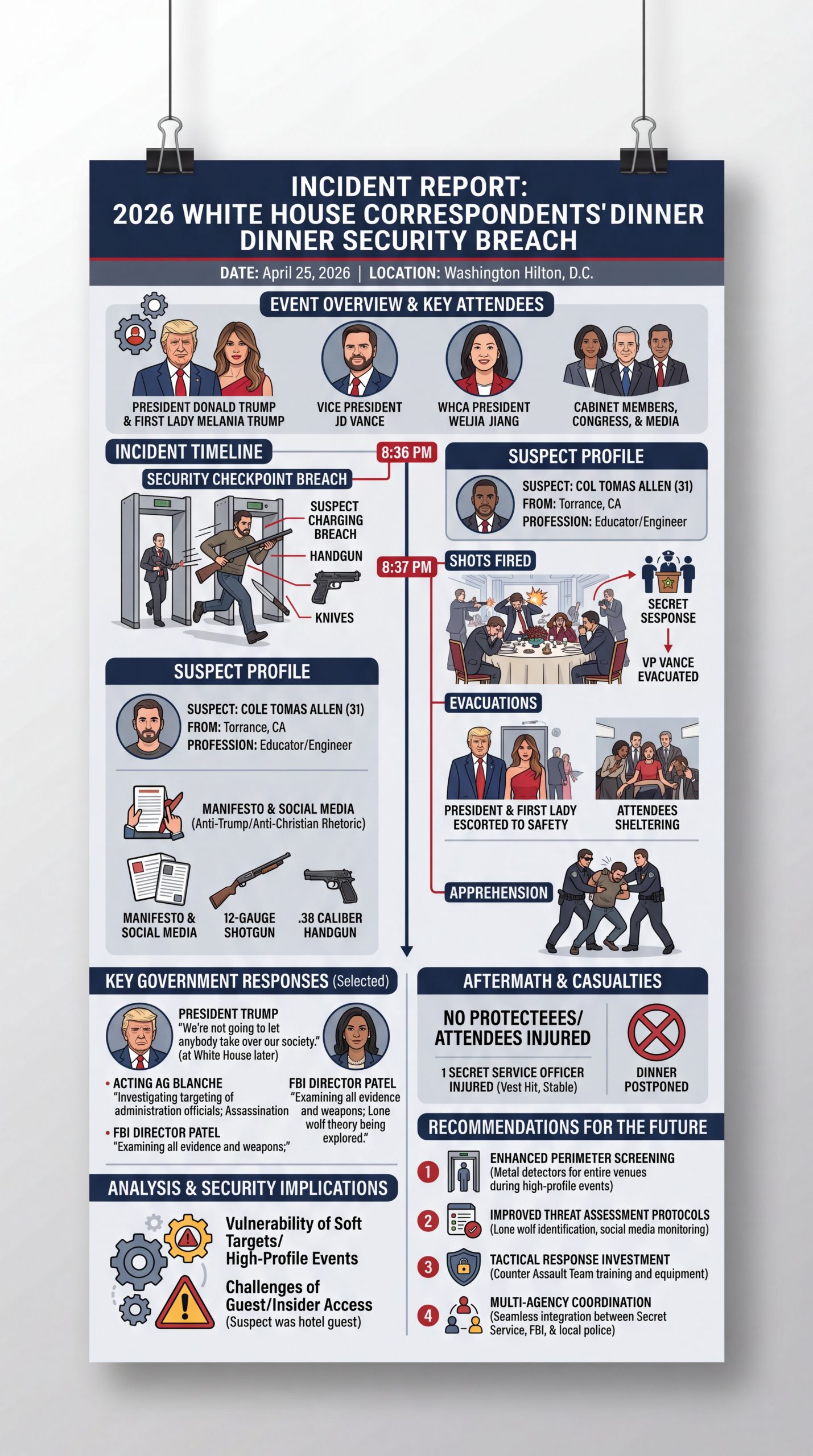
And let's turn this report into an infographic:
Create a large illustrated explainer poster designed to be printed on a large-format poster printer and hung up on the wall that narrates the above briefing as a single large poster that can be printed and hung on a wall that outlines all of the core details. It should cover all of its key details and be in portrait orientation.