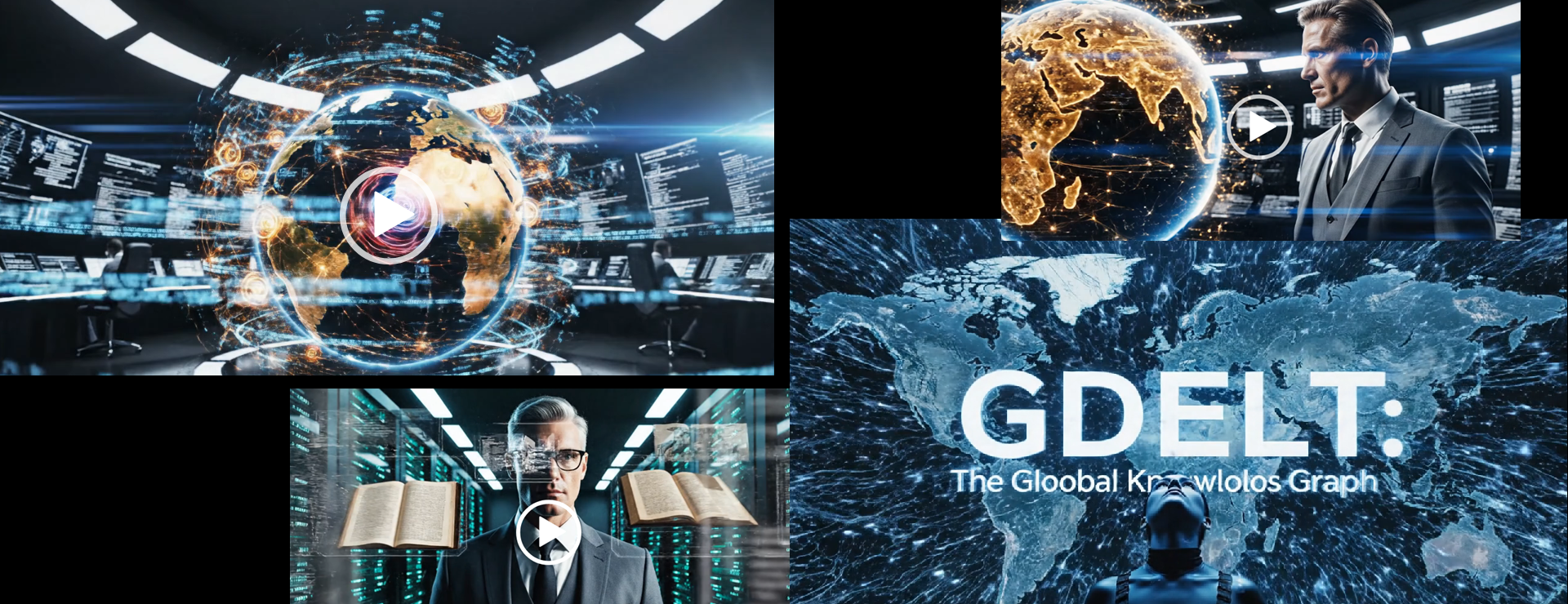
What would it look like to turn the GDELT Project into a Hollywood blockbuster movie trailer using Veo? How about turning my resume into a similarly epic trailer? Here we try a few examples exploring using Veo 3.1 directly and using Gemini 3.1 Pro to write scripts for Veo to use.
Let's start with this simple prompt with Veo:
Make a Hollywood blockbuster movie trailer that is a promo for the GDELT Project.
What if we give Veo a more detailed description?
Make this into a Hollywood blockbuster movie trailer.
The GDELT Project is a revolutionary planetary-scale realtime graph and observatory of global human society. Leveraging the full power of the modern cloud and the latest AI and analytic advances, GDELT transforms the planetary firehose of the digital world into a single massive realtime global graph of daily life on Planet Earth. From exabytes to insights, GDELT transforms the realtime deluge of global news coverage into actionable insights into society’s most complex grand challenges. Monitoring video, audio, imagery and text spanning 400 languages over 200 years from every corner of the globe, GDELT transforms this live-chronicle of human life into a catalog of the world’s events, entities, narratives, emotions, stories, dreams and fears and the infinite connections among them: what’s happening, who’s involved and how the world feels about it, every moment of every day, encoded as an exascale open planetary graph. From mapping global conflict and modeling global narratives to providing the data behind one of the earliest alerts of the COVID-19 pandemic, from disaster response to countering wildlife crime, epidemic early warning to food security, estimating realtime global risk to mapping the global flow of ideas and narratives, GDELT explores how we can use massive data, computing power and AI to let us see the world through the eyes of others and even forecast the future, capturing the realtime heartbeat of the planet we call home.
Today GDELT not only powers directly or indirectly much of the world’s risk modeling and forecasting, it has become the vanguard of the bleeding edge of reimagining how the latest AI and analytic advances can help us understand our global world in unprecedented new ways as one of the largest and most advanced applied open AI initiatives over global society.
Now let's have Gemini 3.1 Pro High Thinking turn the description into a Veo prompt:
Write a Veo prompt to turn the GDELT Project description below into a Hollywood blockbuster movie trailer:
The GDELT Project is a revolutionary planetary-scale realtime graph and observatory of global human society. Leveraging the full power of the modern cloud and the latest AI and analytic advances, GDELT transforms the planetary firehose of the digital world into a single massive realtime global graph of daily life on Planet Earth. From exabytes to insights, GDELT transforms the realtime deluge of global news coverage into actionable insights into society’s most complex grand challenges. Monitoring video, audio, imagery and text spanning 400 languages over 200 years from every corner of the globe, GDELT transforms this live-chronicle of human life into a catalog of the world’s events, entities, narratives, emotions, stories, dreams and fears and the infinite connections among them: what’s happening, who’s involved and how the world feels about it, every moment of every day, encoded as an exascale open planetary graph. From mapping global conflict and modeling global narratives to providing the data behind one of the earliest alerts of the COVID-19 pandemic, from disaster response to countering wildlife crime, epidemic early warning to food security, estimating realtime global risk to mapping the global flow of ideas and narratives, GDELT explores how we can use massive data, computing power and AI to let us see the world through the eyes of others and even forecast the future, capturing the realtime heartbeat of the planet we call home.
Today GDELT not only powers directly or indirectly much of the world’s risk modeling and forecasting, it has become the vanguard of the bleeding edge of reimagining how the latest AI and analytic advances can help us understand our global world in unprecedented new ways as one of the largest and most advanced applied open AI initiatives over global society.
Let's visualize its one-paragraph prompt:
A cinematic blockbuster movie trailer shot of a colossal, hyper-realistic holographic Earth floating in the center of a cavernous, dark high-tech control room. A violent, glowing hurricane of digital data—made of thousands of tiny flashing screens, historical footage, and glowing text in hundreds of languages—spirals out of the darkness and crashes into the globe. As the data absorbs, the Earth transforms into a breathtaking, interconnected planetary graph of bright glowing nodes. Deep red shockwaves erupt on the surface representing global conflicts and pandemics, instantly surrounded and contained by bright blue AI calculating lines predicting the future. The camera performs a rapid, sweeping dolly-zoom around the globe as the entire planet begins to pulsate rhythmically like a massive, glowing golden heartbeat. Shot on 35mm anamorphic lenses, volumetric lighting, epic cinematic lens flares, hyper-detailed, photorealistic, sci-fi thriller aesthetic, 8k.
And its multi-part prompt:
Make this into a Hollywood blockbuster movie trailer. Use a booming, Hans Zimmer-style synth-bass soundtrack, fast rhythmic cutting, and a deep, dramatic voiceover reading a condensed version of the text: "Every day, a planetary firehose of information floods our world. Thousands of languages. Billions of stories. Dreams, fears, and conflicts. What if we could see it all? What if we could map the chaos… and forecast the future? Welcome to the bleeding edge of human insight. Welcome… to GDELT." End with "The GDELT Project" text at the end in cinematic lettering.
Shot 1: The Planetary Firehose (The Setup)
Prompt: Cinematic extreme wide shot. A massive, towering wall of rushing digital data streams cascading downward like a glowing digital waterfall. The data is a hyper-realistic blur of news broadcasts, diverse human faces, and text characters from 400 different languages overlapping in a chaotic but beautiful matrix of light. Dynamic camera pan moving upward through the data stream. High contrast, cinematic lighting, dramatic shadows, blockbuster movie opening aesthetic, ultra-realistic.
Shot 2: Exabytes to Insights (The Processing)
Prompt: Macro close-up of a futuristic, glowing fiber-optic processor. The chaotic, chaotic bright light from the data streams enters the dark crystalline processor and instantly reorganizes into perfectly structured, glowing blue geometric laser lines. The camera pushes in rapidly as the geometric lines shoot out into the dark space. Depth of field, anamorphic lens flares, slick high-tech thriller aesthetic, photorealistic VFX.
Shot 3: Mapping the Chaos (The Conflict & Risk)
Prompt: A dark, moody cinematic shot from a bird's-eye view looking down at a hyper-realistic, glowing digital map of the world projected onto a dark glass table. Suddenly, aggressive red warning flares ignite across the map—symbolizing storms, global conflicts, and viral outbreaks. A web of intense, bright silver artificial intelligence neural lines shoots across the map, intersecting the red zones and projecting holographic graphs of the future into the air. Fast-paced camera movement, dramatic chiaroscuro lighting, tense thriller atmosphere.
Shot 4: The Human Element (The Empathy)
Prompt: Cinematic montage transition effect: A rapid, emotionally intense sequence of reflections seen inside the lens of a massive robotic camera eye. The reflections show flashes of humanity: emergency responders in a storm, a bustling night market in Asia, a protest, wildlife in the savannah, and a doctor holding a vial. The camera pulls back to reveal the glowing mechanical eye is part of a massive, benevolent AI server glowing with warm golden light. Hyper-detailed, emotionally resonant, cinematic lighting, photorealistic.
Shot 5: The Realtime Heartbeat (The Finale)
Prompt: Epic, sweeping blockbuster drone shot circling a colossal, translucent glowing Earth made entirely of billions of interconnected light-points, floating in the center of a pitch-black void. The entire globe pulsates with a rhythmic, powerful thud, emitting waves of warm golden light like a beating heart. The camera aggressively pushes in toward the core of the glowing planet as the light consumes the screen. Masterpiece, Unreal Engine 5 style, volumetric fog, blinding cinematic lens flare, dramatic and awe-inspiring, 8k resolution.
Let's ask Gemini 3.1 Pro to turn the introductory section of my resume into a Veo prompt:
Turn this into a prompt for Veo to turn into a Hollywood blockbuster-style movie trailer:
One of Foreign Policy Magazine's Top 100 Global Thinkers of 2013, Dr. Kalev Hannes Leetaru is a global advisor
to governments, NGOs and the world’s largest organizations, helping them solve tomorrow’s greatest challenges
in an ever more uncertain world. His pioneering GDELT Project fundamentally transformed modern global risk
forecasting and how we think about the use of massive data, advanced analytics and AI to understand our world
through massive realtime global data, becoming one of the most iconic and largest realtime open graphs over Planet
Earth. For nearly thirty years his landmark studies have been at the forefront of reimagining how we understand
our world through some of largest and most innovative datasets, computing platforms and technologies on the
planet.
Revolutionizing the scale at which we understand society. Repurposing emotion to forecast the future. Reinventing
how we use AI to “see” the world. Reimagining news as a catalog of earth. Reconceiving the future of television for
as the first social media-driven live television show. Reenvisioning a thousand years of books as the world’s
most unique art gallery. Redefining academia’s collective scholarly output into insights. Reappraising
supercomputing as a tool for understanding society itself. Rethinking how we use data to understand tomorrow.
Kalev translates the world’s most advanced technologies from cloud to Generative AI into real-world applications
that transform the world, building futures that “reimagine our world through data.”
Transformation at these scales involving the world’s largest and most complex grand challenges is as much about
people and ideas as it is about technology. As a journalist, thought leader, storyteller, builder-scholar and advisor
through more than 1,300 articles he has explored the interplay between information, society, technology and
democracy through columns for major news outlets. His work has been cited in
the presses of more than 100 nations. With a transdisciplinary career spanning academic, commercial, journalistic, non-profit and governmental sectors
worldwide, Kalev works with governments and organizations across the globe to reimagine how we use data to
understand the world around us at scales and in ways never before imagined.
Gemini offers two options – one a single-paragraph prompt and one a four-scene structured prompt. Let's start with the single-paragraph prompt:
A cinematic, high-budget Hollywood sci-fi movie trailer shot. A tall white male visionary scientist in a three piece suit stands in a dark, hyper-modern command center. In front of him floats a massive, glowing 3D holographic globe of Earth, pulsing with millions of golden connection lines and neon blue data streams representing the GDELT Project. Fast-moving global news feeds, digital text, and emotional heatmaps flicker across the air around the globe like a living digital ecosystem. Dramatic, high-contrast lighting with anamorphic lens flares, shallow depth of field, 8k resolution, photorealistic. The camera slowly and epicly arcs around him as he analyzes the glowing web of human history, his face illuminated by the light of the data. High-stakes, intellectual thriller atmosphere.
How about centering on the globe without a central person?
A cinematic, high-budget Hollywood sci-fi movie trailer shot. A dark, hyper-modern command center. In center floats a massive, glowing 3D holographic globe of Earth, pulsing with millions of golden connection lines and neon blue data streams representing the GDELT Project. Fast-moving global news feeds, digital text, and emotional heatmaps flicker across the air around the globe like a living digital ecosystem. Dramatic, high-contrast lighting with anamorphic lens flares, shallow depth of field, 8k resolution, photorealistic. The camera slowly and epicly arcs around the globe as AI analyzes the glowing web of human history, illuminated by the light of the data. High-stakes, intellectual thriller atmosphere. An AI voice announces it is uncovering hidden patterns in human history.
What about the four-scene prompt?
Make this into a Hollywood blockbuster movie trailer.
Scene 1: The Unseen Force (The Scale of Data)
Prompt:
Cinematic, slow-motion shot moving through a vast, dark supercomputing server room. Rows of towering servers pulse with emerald and cyan lights. The camera glides forward as the physical servers dissolve into a swirling nebula of billions of glowing, golden particles of data representing human thought and global events. Photorealistic, high-end sci-fi thriller aesthetic, 8k.
Scene 2: The Visionary (The Thinker)
Prompt:
Close-up on a white male in a three piece suit, a focused, intellectual advisor, looking intently at transparent holographic screens. Reflections of fast-scrolling historical documents, ancient books, and AI code flicker across his face. Soft, cinematic backlighting, high-contrast shadows, dramatic tone, shot on 35mm film.
Scene 3: The Catalog of Earth (The Core Concept)
Prompt:
An epic, photorealistic satellite view of Planet Earth rotating in deep space. Suddenly, a brilliant, glowing web of light nodes—representing global media and human emotion—erupts across the continents, mapping the entire globe in real-time. Majestic cosmic lighting, cinematic, incredibly detailed, blockbuster scale.
Scene 4: The Future Unfolded (The Climax)
Prompt:
A fast-paced, dynamic montage. Bustling global metropolises, digital newsrooms, and ancient libraries rapidly transition and dissolve into flowing streams of golden code. The shot pulls back to reveal the scientist looking out a massive window at a futuristic city skyline, representing a world understood and safeguarded by data. Lens flares, dramatic sunset lighting, awe-inspiring blockbuster finale shot.