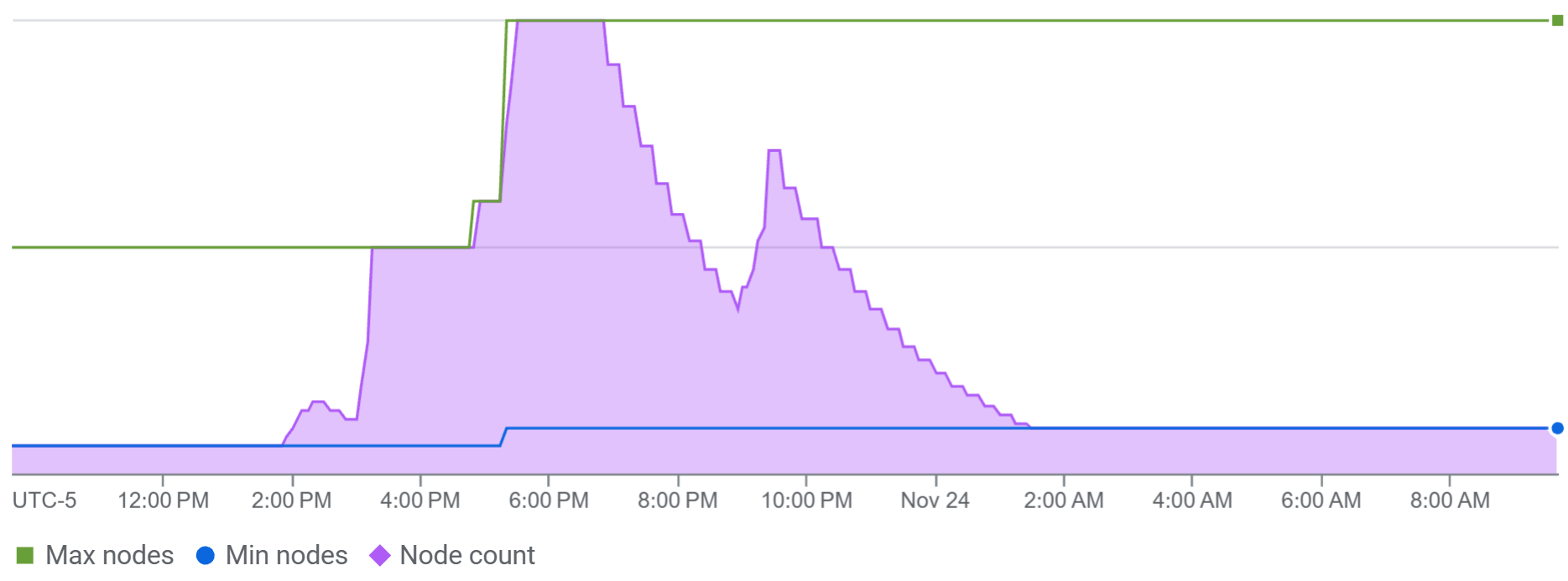
Unlike web servers, microservices and other infrastructure that can be trivially scaled as load increases, databases are extremely challenging to scale for massive bulk loads. It isn't just a matter of adding new nodes: the hot spots must be identified, sharded if possible and safely redistributed across all of the new nodes, then recombined and redistributed back as load decreases. Under our previous production search platform this required enormous amounts of manual human oversight and intervention with tremendous domain expertise to maintain system stability during large bulk load operations, especially as its architecture was not amenable to rapidly growing and shrinking its fleet count by an order of magnitude in the space of hours. Spanner's autoscaling completely automates all of this. Below is the node count graph of our Spanner search instance as we performed a large bulk load of historical data yesterday. Spanner scaled up and down very modestly during our initial load tests, then scaled vertically as the main loading began, up to the max allowed nodes and then again when we doubled that max. At its final peak node count, CPU remained within our target range and we observed no further speed improvements, so we did not increase it further. Once the loading completed, Spanner began rapidly ramping down, before scaling back up as we processed a second batch, after which it rapidly scaled back down.
In all, Spanner scaled up and back down by more than an order of magnitude over a 12 hour period, all without any human intervention, oversight or manual tuning.