


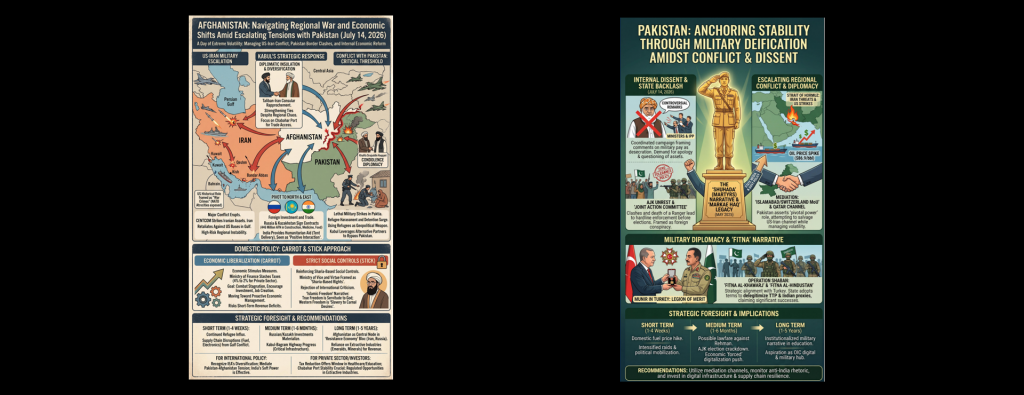
Today's Media Trends reports covering yesterday's coverage have a powerful new addition: a new "Geopolitical Framing" section explores how nations and world leaders are portrayed and depicted in each channel's coverage. Gemini is asked to identify the most prominent countries and leaders mentioned on each channel and write a brief assessment of how they are being portrayed. We are immensely excited about the potential of this new capability for leadership assessment, diplomatic trend evaluation and subtle geopolitical foreshadowing. In today's Afghan (RTA News) and Pakistani (PTV News) Media Trends reports we can see that both nations frame the other as adversarial, succinctly capturing their current geopolitical stance. What is remarkable here is that Gemini was able to discern the narrative framings below entirely on its own, simply by reading through an entire day's coverage on the two channels and deeply reasoning about its between-the-lines subtext. As usual, no data is used to train or tune any model.
AFGHANISTAN
The regional perception is one of extreme polarization. Pakistan is consistently framed as a violator of human rights and a military aggressor, while Iran is treated as a pragmatic, albeit complicated, neighbor. The United States is depicted as a destabilizing force in the region, whose current conflict with Iran threatens Afghan interests, and whose historical role is characterized by "war crimes," specifically NATO atrocities recently exposed in British media.
COUNTRIES
- Pakistan: Portrayed as a hostile, lawless actor. Transcripts emphasize their "military strikes" on civilians and "harassment" of the vulnerable. One analyst describes Pakistan's actions as using refugees as a diplomatic tool to implement their own agenda.
- Iran: Characterized as a strategic partner despite regional instability. The IEA values Iran for its transit capacity (Chabahar) and seeks to insulate the bilateral relationship from the broader US-Iran naval war.
- India: Framed as a benevolent donor and an important trade partner. The delivery of humanitarian aid is seen as a sign of "positive interaction" and "mutual respect," contrasting sharply with the portrayal of Pakistan.
- Russia and Kazakhstan: Portrayed as serious economic partners. Their willingness to sign multi-million dollar contracts is presented as proof of Afghanistan's growing "investment climate" and regional integration.
LEADERS
- Khalifa Sirajuddin Haqqani: Portrayed as a compassionate and stable leader. His visit to Paktia is framed as "condolence diplomacy," showing him as a protector of the people against foreign aggression.
- Amir Khan Muttaqi: Depicted as a competent and tireless diplomat. His meetings with Iranian and other foreign officials are shown as evidence of Kabul's expanding regional influence.
- Sheikh Mohammad Khalid Hanafi: Framed as the principled guardian of social morals. He is shown urging scholars to support the hijab and religious order as the foundation of the state.
PAKISTAN
The state media portrays Pakistan as a disciplined, victorious, and moral anchor in a chaotic world. India is depicted as a failing democracy led by a "media-shy" and "defeated" leader (Modi), while Iran is a "brotherly" but "volatile" state that needs Pakistani guidance to avoid self-destruction. The U.S. is framed as a necessary but transactional power, often led astray by "Zionist lobbies."
- Pakistan (The State/Military): Framed as invincible and indispensable. "Pakistan is the first Muslim nuclear power and a messenger of peace" in a region of conflict. The military is the "jewel on the nation's forehead."
- India (Narendra Modi): Characterized as weak, isolated, and "afraid of the media." Reports emphasize Modi avoiding questions in New Zealand and Australia, unable to face the "embarrassment" of his 2025 military defeat.
- Iran (Leadership/Revolutionary Guard): Portrayed as emotional and prone to "miscalculation." Analysts suggest Iran's attacks on Saudi and Qatari tankers were "stupidity" that risked their international solidarity.
- Afghanistan (Taliban Regime): Portrayed as "ungrateful" (کمن ارحᓝتماᒨیمارح ᐨᓞکمن). Despite Pakistan’s decades of support, the regime is accused of exporting terrorism and "sitting in India’s lap."
- Turkey (Recep Tayyip Erdogan): Framed as the ultimate "brother." The award given to Field Marshal Munir is seen as validation of Munir’s leadership and Pakistan’s regional standing.