


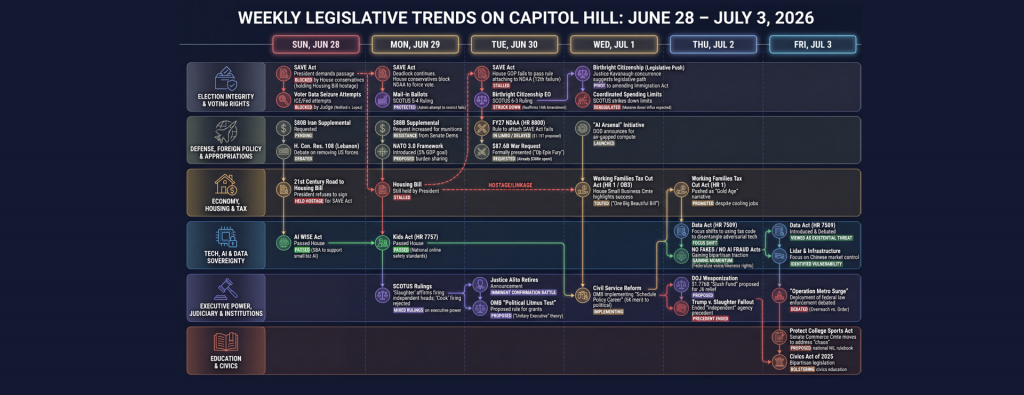
Earlier today we explored the tremendous power of applying Gemini to deeply analyze our free daily Today's Trends on Capitol Hill newsletter to visualize and understand weekly legislative trends and momentum on Capitol Hill, including a powerful timeline infographic charting the core legislative activity of Congress last week. At the end of that analysis, we briefly demonstrated how Gemini could assist a Congressional staffer to understand the weekly high-level trends of a particular legislative area like AI regulation. Let's dive a bit deeper on that concept and ask Gemini to act as a legislative affairs assistant and draft reports on current US legislative trends on a topic heavily in the news: Ukraine, a country receiving comparatively little Congressional attention over the past week: Estonia and a topic that is received outsized attention relating to both Ukraine and Iran: drones. In particular, we'll ask Gemini to do what keyword searches cannot: identify legislative trends and activity relating to or impacting each of these three topics that doesn't actually mention them by name – the kind of "persona-based search" that has immense potential to revolutionize how we find information of relevance to us. As before, we'll ask Gemini 3.1 Pro to examine the Today's Trends on Capitol Hill reports from June 28-July 4, 2026. No data was used to train or tune any model.
Attached are a series of daily reports deeply analyzing legislative trends of the United States Government from the past week.
Deeply read through them to understand the major legislative trends and themes of the past week.
I am a legislative affairs officer responsible for monitoring and engaging around US policy regarding or impacting Ukraine.
Give me an overview of the legislative landscape of the past week involving, relating to, or impacting Ukraine and its interests.
Estimate where things seem to be heading.
Give me a list of legislation and legislative trends that impact Ukraine but don't explicitly mention Ukraine or don't at first glance appear to relate to Ukraine but have strong nexus and impact on Ukraine.
What are some key topics and points to bring up with Congressional offices to bolster support for Ukraine based the legislative trends of the past week?
Propose 10 bills (titles and brief descriptions of each) that you think are likely to draw bipartisan support and have a chance of passing that would be helpful to Ukraine.
Overview of the Legislative Landscape Impacting Ukraine
The U.S. legislative environment is currently dominated by massive domestic political friction (the SAVE Act standoff, 14th Amendment Supreme Court rulings, and an impending 2026 midterm election) and a heavy geopolitical pivot toward the Middle East (the "Epic Fury" conflict in Iran) and the Indo-Pacific.
Explicitly, Ukraine remains tied to the U.S. defense industrial base. The administration has requested an $87.6 billion supplemental funding package, which includes $21 billion specifically to replenish munition stockpiles depleted by conflicts in both Iran and Ukraine.
However, the broader landscape indicates that direct, unilateral U.S. financial aid to Ukraine is taking a backseat to a new strategic doctrine. The U.S. is pushing a "NATO 3.0" framework ahead of the Ankara Summit, which demands European allies take primary responsibility for conventional defense and increase defense spending to 5% of GDP, allowing the U.S. to pivot its primary resources to the Indo-Pacific.
Where Things Are Heading (Trajectory Estimate)
- The "Europeanization" of the Ukraine Conflict: The U.S. is actively shifting the conventional defense burden to Europe. Future U.S. assistance to Ukraine is likely to be framed not as direct aid, but as logistical, intelligence, and technological backstopping while European nations (particularly frontline states like Poland) take the lead on conventional military and financial support.
- Competition for Defense Resources: The active U.S. conflict in Iran is burning through U.S. munitions. Ukraine advocates will have to navigate a highly constrained U.S. defense supply chain that is currently prioritizing the Middle East and Indo-Pacific deterrence.
- Gridlock Threatens Defense Policy: The FY 2027 National Defense Authorization Act (H.R. 8800) is currently stalled due to conservative rebels linking it to the SAVE Act (voter ID legislation). This gridlock threatens the timely authorization of funds needed to sustain the "arsenal of freedom."
Implicit Legislation and Trends with a Strong Nexus to Ukraine
While not explicitly named "Ukraine bills," the following trends and legislative actions will profoundly impact Ukraine’s strategic interests:
- FY 2027 NDAA (H.R. 8800): This $1.15 trillion bill focuses heavily on "rebuilding the arsenal of freedom" and sustaining legacy platforms. The expansion of the U.S. defense industrial base is vital for sustaining the artillery and interceptor pipelines Ukraine relies on.
- The Iran "Peace Through Strength" Campaign: The U.S. campaign in Iran has reportedly resulted in the near-total destruction of Iran's conventional military and nuclear infrastructure. Because Iran is a primary supplier of drones and ballistic missiles to Russia, the degradation of the Iranian military-industrial complex directly benefits Ukraine’s air defense situation.
- Defense Procurement Reform & "Neo-Primes": The Department of Defense is pushing fixed-price acquisition models and awarding contracts to venture-backed startups ("neo-primes") to scale complex munitions faster. Ukraine stands to benefit from faster, cheaper, and more innovative U.S. weapons production.
- The Data Act (H.R. 7509) / Technological Decoupling: Uses the tax code to force American businesses to divest from Chinese, Russian, Iranian, and North Korean technology. This represents a broad economic war against the authoritarian axis backing Russia.
- AI Arsenal Initiative: The DOD is heavily investing in bespoke, air-gapped compute capacity for classified war-fighting tasks and battlefield transparency. AI-driven defense tech developed here will likely trickle down to Ukrainian forces.
Key Topics and Points for Congressional Offices
To successfully advocate for Ukraine in this highly polarized, "America First" legislative environment, you should pivot your messaging to align with current Capitol Hill priorities:
- The Russia-Iran Nexus: Emphasize that the U.S. fight against Iranian aggression and Ukraine’s fight against Russian aggression are the exact same fight. Degrading Russian forces in Ukraine destroys the market and testing ground for Iranian and North Korean weaponry.
- Rebuilding the U.S. Industrial Base (Jobs): Frame Ukraine assistance strictly through the lens of the U.S. economy. Highlight that the $21 billion for munitions replenishment is being spent in American factories, creating blue-collar jobs, and revitalizing the U.S. "arsenal of freedom" for future conflicts.
- Ukraine as a Blueprint for NATO 3.0: Praise the administration's NATO 3.0 goal of having Europe take the lead. Frame Ukraine as the ultimate partner in this transition: Ukraine is fighting the conventional land war in Europe, allowing the U.S. to focus its naval and air assets on China in the Indo-Pacific.
- The Battlefield Tech Sandbox: Highlight Ukraine as the premier testing ground for U.S. defense innovation. Argue that supplying Ukraine with emerging tech from U.S. "neo-primes" allows the Pentagon to beta-test AI and drone capabilities in a real-world, high-intensity conflict against a near-peer adversary without risking U.S. personnel.
10 Proposed Bipartisan Bills to Bolster Support for Ukraine
Given the current climate of extreme polarization, "America-first" populism, and tech-focused defense spending, here are 10 tailored legislative proposals designed to attract bipartisan support while advancing Ukraine’s interests:
- The Arsenal of Freedom Revitalization Act
- Description: Provides targeted tax incentives and fast-track permitting for U.S. manufacturing firms that open new facilities to produce 155mm artillery, interceptors, and drones, explicitly linking domestic job creation to allied munitions replenishment.
- The Authoritarian Axis Disruption Act
- Description: Imposes secondary sanctions and massive tariffs on any foreign entity supplying dual-use technology or electronic components to the military-industrial bases of Russia, Iran, or North Korea.
- The Transatlantic Burden-Sharing Facilitation Act
- Description: Streamlines U.S. Foreign Military Sales (FMS) and export controls exclusively for NATO countries that exceed the 3% or 5% GDP defense spending threshold, empowering them to rapidly purchase U.S. arms to backfill the older Soviet-era equipment they donate to Ukraine.
- The "Neo-Prime" Battlefield Innovation Act
- Description: Creates a dedicated DOD grant program for venture-backed American defense startups to develop low-cost, high-yield autonomous drones and electronic warfare systems, mandating that successful prototypes be field-tested by vetted international partners actively engaged in defending their sovereignty (e.g., Ukraine).
- The Allied Energy Grid Resilience Act
- Description: Establishes a public-private partnership via the Department of Energy to export modular, localized green energy and grid-hardening technologies to allied nations facing kinetic infrastructure attacks, helping Ukraine survive winter while boosting the U.S. energy tech sector.
- The Captured Adversarial Technology Exploitation Act
- Description: Directs the DOD and intelligence community to establish formal intelligence-sharing and financial bounty programs with partner nations (like Ukraine) to capture, reverse-engineer, and share data on downed Russian, Iranian, and Chinese drone and missile technology.
- The Strategic Mineral Allied Sourcing Act
- Description: Uses the U.S. tax code to incentivize American tech and defense companies to source critical minerals (like titanium and lithium) from aligned European democracies—including Ukraine—to decouple the U.S. supply chain from Chinese and Russian dominance.
- The Veterans to Defense Tech Fellowship Act
- Description: A domestic labor bill creating paid fellowships for U.S. veterans to work in defense startups ("neo-primes") building unmanned systems and AI tools. It addresses the domestic tech labor shortage while directly accelerating the production of the exact asymmetric weapons Ukraine relies on.
- The Sovereign Data and Digital Identity Protection Act
- Description: Piggybacking on the momentum of the NO FAKES Act, this bill provides cyber-assistance and U.S. cybersecurity software to allied democracies to protect their civilian populations from Russian and Chinese AI-generated deepfakes, election interference, and digital identity theft.
- The Frozen Asset Reconstruction Bond Act
- Description: Authorizes the U.S. Treasury to issue "Reconstruction Bonds" to American infrastructure and logistics companies, funded directly by the interest and seized assets of sanctioned Russian oligarchs and the Russian Central Bank, ensuring American businesses are paid to rebuild Ukraine using Russian money rather than U.S. taxpayer dollars.
What about a country less in the news like Estonia?
Attached are a series of daily reports deeply analyzing legislative trends of the United States Government from the past week.
Deeply read through them to understand the major legislative trends and themes of the past week.
I am a legislative affairs officer responsible for monitoring and engaging around US policy regarding or impacting Estonia.
Give me an overview of the legislative landscape of the past week involving, relating to, or impacting Estonia and its interests.
Estimate where things seem to be heading.
Give me a list of legislation and legislative trends that impact Estonia but don't explicitly mention Estonia or don't at first glance appear to relate to Estonia but have strong nexus and impact on Estonia.
What are some key topics and points to bring up with Congressional offices to bolster support for Estonia based the legislative trends of the past week?
Propose 10 bills (titles and brief descriptions of each) that you think are likely to draw bipartisan support and have a chance of passing that would be helpful to Estonia.
Based on the intelligence gathered from the legislative reports covering late June to early July 2026, here is an analysis and strategic playbook tailored for your role as a Legislative Affairs Officer advocating for Estonia.
1. Overview of the Legislative Landscape Impacting Estonia
The US legislative and executive landscape is undergoing a massive structural shift dominated by a highly polarized domestic environment, the strain of ongoing conflicts (Iran and Ukraine), and a forceful pivot in defense doctrine.
The Emergence of "NATO 3.0" and the "Loyalty Scorecard":
The most critical development for Estonia is the administration’s aggressive push for "NATO 3.0" ahead of the Ankara Summit. The US is demanding European allies take primary responsibility for conventional defense and is pushing a staggering 5% GDP defense spending target by 2035. The administration is explicitly framing the alliance through a "loyalty scorecard," threatening to withdraw permanent forces from "laggard" nations like Germany and Denmark, while shifting its military footprint to "loyal" frontline partners like Poland and the Baltic states.
Technological Sovereignty and the New Cold War:
Congress is obsessed with "technological decoupling" from China, Russia, Iran, and North Korea. "Data security" and "digital sovereignty" are now viewed as primary theaters of conflict, with lawmakers advancing the Data Act (HR 7509) to weaponize the tax code against adversarial tech. Simultaneously, the DOD is launching an "AI Arsenal" to rapidly integrate autonomous weapons and build bespoke, air-gapped compute capacities.
2. Estimate: Where Things are Heading
- A Bifurcated NATO: The US will likely succeed in forcing a division of labor where it pivots its primary resources to the Indo-Pacific, leaving Europe to manage the Russian threat. A structural shift in the US military footprint is imminent—moving assets away from Western Europe and directly onto the Eastern Flank (Estonia, Latvia, Lithuania, Poland) to reward high-spending allies.
- Defense Procurement Shakeup: Munitions stockpiles are severely depleted due to operations in Iran and Ukraine. The US is turning to "fixed-price" contracts and venture-backed "neo-primes" to scale defense tech faster than traditional contractors can handle.
- A "Sovereign Internet": The US is ending the era of "internet permissiveness" by moving toward a curated, heavily regulated digital space, driven by fears of AI deepfakes and foreign digital piracy.
3. Non-Explicit Legislation & Trends with a Strong Nexus to Estonia
While not naming Estonia directly, several domestic and geopolitical bills have massive implications for your portfolio:
- The Data Act (HR 7509): This bill uses tax penalties to force businesses to divest from adversarial tech (specifically Chinese/Russian infrastructure like LiDAR). Nexus: Estonia is a global leader in secure, non-adversarial digital infrastructure and e-governance. US companies looking to safely offshore or partner for R&D will look to trusted digital havens like Estonia.
- DOD "AI Arsenal" & "Fixed-Price" Acquisitions: The Pentagon is looking to bypass traditional defense contractors to harness private capital for rapid innovation. Nexus: Estonia’s highly vibrant defense-tech startup ecosystem (e.g., autonomous systems, robotics, AI) is perfectly positioned to capture these US defense dollars if transatlantic procurement pipelines are opened.
- Secure Grid Act (HR 7257) & Energy Security Debates: Congress is intensely focused on protecting the US electrical grid from cyber and physical threats. Nexus: Estonia has unparalleled expertise in cyber-defense of critical infrastructure and the technical realities of decoupling power grids from Russia.
- $1.15 Trillion NDAA (FY 2027) & Supplemental War Funding: The struggle to pass the NDAA and the $87.6B supplemental request highlights deep fractures over defense spending. Nexus: Any delay in munitions replenishment directly impacts the availability of systems like HIMARS and interceptors for the Baltics.
4. Key Topics & Points to Bring Up with Congressional Offices
To bypass the deep partisan gridlock and secure bipartisan support, tailor your messaging to the dominant narratives of the day:
- "We Are the Model for the NATO Loyalty Scorecard": Do not fight the burden-sharing narrative; embrace it. Remind both Republicans (who want "loyal" allies) and Democrats (who want strong alliances) that the Baltics are already exceeding the 5% GDP target. Frame Estonia as the tip of the spear that proves the "NATO 3.0" model works.
- Pitch Estonia as a "Tech-Sovereignty" Partner: When meeting with offices focused on the Data Act or AI regulation, highlight Estonia’s history of fending off Russian cyberattacks and its clean, secure 5G/digital infrastructure. Position Estonia as the ultimate safe harbor for US data and joint AI development.
- Offer Estonian Expertise on "Ambient Doubt" and Deepfakes: With Congress panicking over synthetic media and AI-driven election interference, offer Estonia’s blueprint for societal digital literacy and verified digital identity as a proven countermeasure.
- Advocate for Joint Defense-Tech Procurement: Urge Armed Services Committee members to include provisions in the NDAA that make it easier for US "neo-primes" to co-develop autonomous systems and drones with Baltic defense startups.
5. Proposed Bipartisan Bills to Bolster Support for Estonia
Here are 10 conceptual bills designed to appeal to current US legislative trends (burden-sharing, tech decoupling, defense innovation) while directly benefiting Estonia:
- The Frontline Defenders Munitions Prioritization Act
- Description: Mandates priority processing and expedited Foreign Military Sales (FMS) for NATO allies that contribute more than 3.5% of their GDP to defense. This rewards Estonia’s high spending by moving them to the front of the line for backlogged US weapons systems.
- The US-Baltic Digital Sovereignty & AI Partnership Act
- Description: Establishes a joint US-Baltic working group and funding mechanism under the DOD’s "AI Arsenal" initiative to co-develop autonomous defense systems and secure, air-gapped military compute nodes on the Eastern Flank.
- The Trusted Tech Supply Chain & R&D Act
- Description: Expands the tax incentives proposed in the Data Act (HR 7509) by offering "bonus depreciation" to US firms that establish R&D partnerships with tech firms headquartered in NATO countries that have legally banned Chinese and Russian telecom equipment.
- The Transatlantic "Neo-Prime" Integration Act
- Description: Streamlines the bureaucratic process for venture-backed defense startups in frontline NATO nations (like Estonia) to bid on US Department of Defense "fixed-price" acquisition contracts, fostering a shared defense-industrial base.
- The Sovereign Grid Defense & Cyber Exchange Act
- Description: Creates a federally funded exchange program between US state-level energy regulators (facing domestic grid threats) and Baltic cyber-security experts to share best practices on decoupling from adversarial power grids and defending against state-sponsored cyber warfare.
- The Allied Counter-Drone Operations Act
- Description: Allocates NDAA funding for joint US-Estonian military exercises explicitly focused on electronic warfare and counter-drone (C-UAS) technology, utilizing Estonia's proximity to adversarial electronic warfare environments as a testing ground for US systems.
- The Digital Identity & Civic Resilience Act
- Description: Directs the Cybersecurity and Infrastructure Security Agency (CISA) to study Estonia's secure digital identity and e-governance frameworks to develop voluntary guidelines for US states seeking to combat election fraud, deepfakes, and "memory contamination."
- The NATO 3.0 Forward Posture Infrastructure Act
- Description: Authorizes specialized military construction (MILCON) funds to rapidly expand bases, logistical hubs, and pre-positioned equipment stocks specifically in allied nations that meet the administration's new "NATO 3.0" burden-sharing criteria.
- The Combatting Adversarial Disinformation Act
- Description: Establishes a joint US-European center of excellence based in Tallinn (leveraging the existing NATO CCDCOE infrastructure) dedicated specifically to tracking, exposing, and developing technological countermeasures against Russian and Chinese AI-generated disinformation.
- The Strategic Chokepoint & Maritime Defense Act
- Description: While the US pivots naval assets to the Indo-Pacific, this bill provides maritime security grants and uncrewed surface vessel (USV) technology transfers to Baltic and Nordic states to independently secure the Baltic Sea against Russian naval threats, fulfilling the US demand for European conventional defense leadership.
Given the enormous nexus of drones to both Ukraine and Iran, what about a drone industry legislative affairs officer hoping to encourage broader US investment and utilization of drones across civilian, military and public safety sectors?
Attached are a series of daily reports deeply analyzing legislative trends of the United States Government from the past week.
Deeply read through them to understand the major legislative trends and themes of the past week.
I am a legislative affairs officer responsible for monitoring and engaging around US policy regarding or impacting drones across civilian, military and public safety sectors.
Give me an overview of the legislative landscape of the past week involving, relating to, or impacting drones.
Estimate where things seem to be heading.
Give me a list of legislation and legislative trends that impact the drone landscape but don't explicitly mention drones or don't at first glance appear to relate to drones but have strong nexus to drones or impact on the drone landscape.
What are some key topics and points to bring up with Congressional offices to bolster support for drones based the legislative trends of the past week?
Propose 10 bills (titles and brief descriptions of each) that you think are likely to draw bipartisan support and have a chance of passing that would be helpful to the drone landscape and use of drones across civilian, military and public safety sectors.
Based on the provided daily legislative reports from June 28 to July 4, 2026, here is an analysis tailored to your role as a legislative affairs officer for the drone sector.
1. Overview of the Legislative Landscape Impacting Drones
The past week reflects a rapidly evolving and highly securitized landscape for unmanned aerial systems (UAS) and counter-UAS (C-UAS) technologies, driven by global conflicts and high-profile domestic events.
- Military & Defense: Drones are at the center of the ongoing conflict in Iran ("Operation Epic Fury"). The depletion of traditional munition stockpiles has accelerated a shift toward "neo-primes" (venture-backed defense startups) receiving fixed-price contracts to scale complex munitions and drone technologies faster than legacy contractors. The Department of War is actively considering sanctioning fully autonomous drone operations due to "battlefield transparency," which has made manned systems highly vulnerable to adversaries. Additionally, the DOD’s "AI Arsenal" initiative aims to build bespoke, air-gapped computing capacity tailored for these autonomous, classified war-fighting tasks.
- Public Safety & Domestic Security: There is a massive surge in the deployment of counter-drone (C-UAS) technology. The "America 250" celebrations are prompting the "largest counter-drone deployment in history" around the National Mall and New York Harbor, with "zero tolerance" immediate seizure protocols for unauthorized flights. Furthermore, local successes, such as the drone mitigation deployed by NYC Mayor Mamdani during World Cup watch parties, are spotlighting the need for municipal C-UAS authorities.
- Commercial & Supply Chain: The sector is facing intense "technological protectionism." Lawmakers are targeting LiDAR technology, noting that 80% of the U.S. market is controlled by Chinese companies. Lawmakers perceive adversarial access to this infrastructure-mapping data as an existential threat.
2. Where Things are Heading
- The Era of Manned Dominance is Waning: The U.S. military is preparing for a structural transition toward autonomous drone swarms. Expect massive budget reallocations away from legacy manned systems toward unmanned and AI-driven platforms over the next 1–5 years.
- Aggressive Decoupling & Supply Chain Shocks: The U.S. government is moving toward a "block and penalize" framework for foreign tech. We are heading toward a near-total purge of Chinese-manufactured components (especially LiDAR, cameras, and batteries) in commercial and public safety fleets, enforced through the tax code and federal grant restrictions.
- C-UAS Federalization: As local authorities face the threat of transnational gangs (like Tren de Aragua) and manage National Special Security Events (NSSEs), expect rapid, bipartisan movement to expand counter-drone authorities to state and local law enforcement.
3. Implicit Legislation & Trends (Nexus to Drones)
Several broader legislative pushes do not have "drone" in the title but will fundamentally reshape the industry:
- The Data Act (HR 7509): Ostensibly a tax bill, this legislation weaponizes the tax code to force businesses to divest from adversarial technology by denying R&D expensing or bonus depreciation. Because the commercial drone market heavily relies on Chinese LiDAR and microelectronics, this will drastically raise the cost of operating legacy commercial drone fleets.
- Secure Grid Act (HR 7257): Aimed at protecting energy distribution from cyber and physical threats. This implicitly creates a massive mandate for the use of commercial inspection drones to monitor grid vulnerabilities, while simultaneously banning the use of foreign-made drones to conduct those inspections.
- Permitting Reform for Energy/Infrastructure: Efforts by lawmakers to streamline environmental reviews for pipelines, green energy, and offshore wind will create a boom in commercial drone surveying and mapping demand.
- "Schedule Policy Career" & OMB Grant Rule: The centralization of federal grant-making and politicization of scientific grants could drastically alter how university drone research, AI automation, and autonomy R&D are federally funded.
- The "Securitization of Everything": Non-military sectors are increasingly viewed through a national security lens. Commercial drone delivery, agriculture mapping, and civil surveying will increasingly be regulated by national security apparatuses rather than just the FAA.
4. Key Topics & Points for Congressional Outreach
To bolster support for your initiatives across the aisle, utilize the following messaging strategies based on current Capitol Hill dynamics:
- "Battlefield Transparency" & Neo-Primes: When speaking to Defense subcommittees, argue that the U.S. cannot win the "Total Competition" with China using legacy manned platforms. Advocate for continued "fixed-price" contracts to help agile drone startups (neo-primes) bridge the valley of death and quickly replenish depleted munitions.
- Domestic Sensor Sovereignty: When discussing HR 7509 (The Data Act), point out that while blocking Chinese LiDAR is necessary for national security, the U.S. commercial drone sector will collapse without incentives to build a domestic LiDAR and components supply chain. Push for "friend-shoring" subsidies.
- C-UAS as a "Public Safety/Law & Order" Imperative: Align with the administration's "Safe and Beautiful" and "law and order" initiatives. Point to the successes in NYC and the America 250 preparations to argue that local law enforcement needs funded, standardized counter-drone authorities to protect communities and critical infrastructure.
- Drones as "Militant Pragmatism": For the growing bloc of locally-focused, pragmatic lawmakers (the "Mayoral Party" mentioned in the reports), pitch drones as practical tools to fix local problems—rapid infrastructure inspection, efficient emergency response, and grid resilience—bypassing federal gridlock.
5. Proposed Bipartisan Bills to Support the Drone Landscape
Here are 10 tailored legislative proposals designed to attract bipartisan support by marrying Republican national security/decoupling priorities with Democratic infrastructure, safety, and labor priorities:
- The Domestic Sensor and LiDAR Independence Act
- Description: Provides targeted tax credits and federal grants to U.S. and allied manufacturers of LiDAR, optics, and flight controllers to rapidly replace Chinese market dominance and ensure compliance with the Data Act (HR 7509).
- State and Local C-UAS Empowerment Act
- Description: Establishes a standardized framework and federal grant program through DHS to equip state and local law enforcement with approved Counter-UAS technologies for National Special Security Events (NSSEs) and critical infrastructure protection.
- Agile Unmanned Systems Procurement Act
- Description: Codifies the DOD's use of "fixed-price" contracts for venture-backed defense startups ("neo-primes"), ensuring rapid acquisition and scaling of autonomous drone swarms to adapt to modern "battlefield transparency."
- Critical Grid Drone Inspection Act
- Description: An add-on to the Secure Grid Act (HR 7257) that provides matching funds to utility companies that utilize domestically sourced, secure commercial drones for the physical inspection and cyber-hardening of the U.S. power grid.
- First Responder Drone Modernization Act
- Description: Creates a DOJ/FEMA grant program to help municipal fire, EMS, and police departments transition their drone fleets away from adversarial tech to secure, U.S./allied-manufactured platforms.
- AI Arsenal Air-Gap Security Act
- Description: Establishes clear, unified cybersecurity and "air-gapping" standards for all AI-driven unmanned military and federal civilian systems, ensuring autonomous drones cannot be remotely compromised or tracked by foreign adversaries.
- Unmanned Infrastructure Permitting Fast-Track Act
- Description: Allows infrastructure developers (offshore wind, pipelines, highways) to expedite environmental and structural reviews by submitting certified, high-fidelity mapping data collected by secure commercial drones.
- Next-Generation Aviation Workforce & Literacy Act
- Description: Provides federal funding to community colleges and trade schools to train the next generation of drone operators, AI system technicians, and C-UAS specialists, directly addressing the "AI literacy gap" and preserving domestic jobs.
- Drone Data Sovereignty & Privacy Act
- Description: Prohibits the routing of telemetry, visual, or LiDAR data collected by commercial drones operating in U.S. airspace through servers located in foreign countries of concern, protecting both civil liberties and national security.
- Operation Allied Skies (NATO 3.0 Drone Integration Act)
- Description: Establishes a joint U.S.-European procurement fund to develop interoperable, autonomous UAS platforms, fulfilling the "NATO 3.0" conventional defense burden-sharing requirements while driving contracts to Western drone manufacturers.