
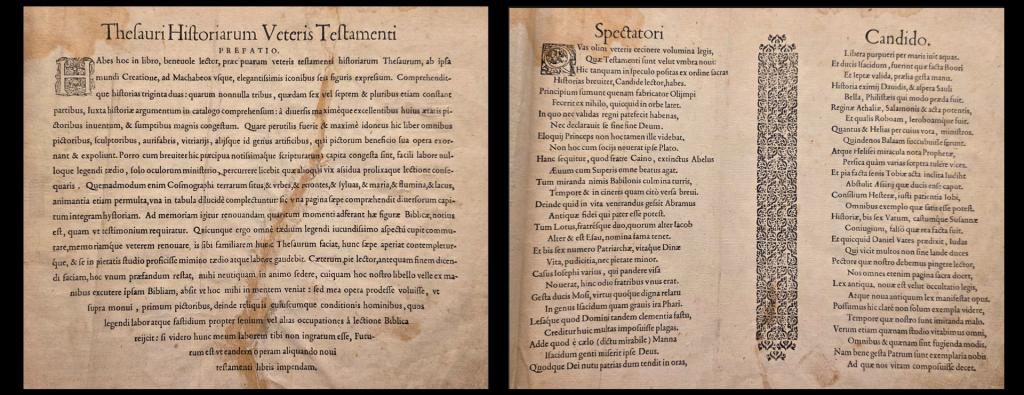
In our increasingly AI-intermediated world, the conceptions of user interface, algorithm-free browsing and in-order consumption of books and other printed works seem like quaint notions of a by-gone era, but they are ever more important when it comes to understanding our most important historical works and the way in which they were viewed in their era. Mass-produced printed "picture Bibles" emerged in the late 1500s, with Jode's 1585 Thesaurus being arguably the first true "picture bible" (Durer's series was not strictly biblical and Holbein's was of a slightly different vein). Some of these, like the Thesaurus and Visscher Royal are so rare that just a small number of complete copies are known to survive. Most uniquely, these books represent the early nexus of the art and book worlds and the broader emergence of book printing as a means to mass distribute art.
In a fascinating quirk of libraries vs museums, despite being books, the majority of the surviving copies of these Bibles are held by art and history museums, rather than libraries. While libraries tend to digitize books from cover to cover, creating digital replicas that can be read in page order, museums tend to digitize these works as individual independent engravings, treating each page as an artifact entirely unrelated to one another. Worse, few have chosen to digitize the title plates, tables of contents, poems, prefaces and other key textual elements. What few digitized copies of some of these books exist are just randomly ordered individual images, making it impossible to understand the purposeful ordering in which they appeared in the original work or to associate them with the critical descriptive and provenance information contained on the interstitial title cards.
We are therefore experimenting with what it might look like to digitize these books in their entirety at very high resolution and make them available as digital flipbooks that allow them to be read from front to back in their original page order. Working with a unique collection of nearly complete intact copies of each of these seminal Bibles, work is underway to digitize them at high resolution and make them available as digital flipbooks to explore the importance of interface in a disintermediated world.
You can explore one of our first experiments: the cover and first 20 pages of Jode's 1585 Thesaurus, available via the Internet Archive.