


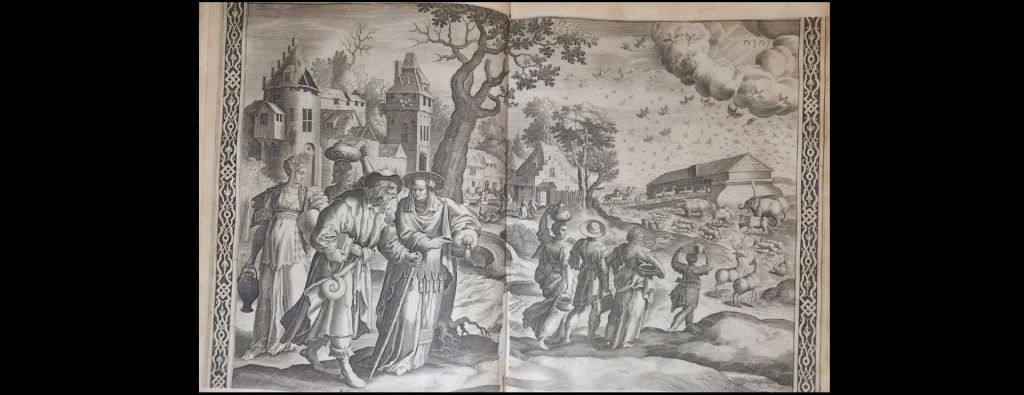
One of the most important roles of museums and other cultural institutions is not just putting items on display, but in contextualizing and explaining them for their visitors across many different audiences. While the final descriptive text and visuals on display to visitors should always be written and reviewed by an expert to ensure accuracy, to what degree could Gemini Deep Research be used as part of initial scoping and research by an institution looking to better understand the history, context and significance of key works in their collections? Here we explore creating targeted Deep Research reports for three of the landmark picture Bibles (Holbein's Icones, Jode's Thesaurus and Visscher's Royal Bible), the genre of picture Bibles and of large antiphonals, how a specific collection's holdings fit into the chronology of picture Bibles and placing a specific unique work in the landscape of the world's largest known books.
Let's start with asking for targeted histories of each of the following three works. The histories are largely accurate, though in a few places they rely too much on single narrow sources. Overall they are each excellent starting points and overviews for a curator wishing to come up to speed on the overall history and significance of each:
- The Articulation of Sacred History: A Comprehensive Analysis of Hans Holbein the Younger's Icones
- The Visual Theology and Market Dynamics of Gerard de Jode's Thesaurus: A Comprehensive History of the First Picture Bible
- The Monumental Canvas of Faith: A Comprehensive History of Visscher's Royal-Sized Picture Bible
Now let's ask Gemini for an overview of the entire landscape of picture Bibles in the printed era:
Here we can see the limitations of applying Deep Research to questions as massive as the entire landscape and history of picture Bibles and the simple fact that current AI "research" systems don't insomuch conduct original research as they merely aggregate web search results, meaning that for complex and intricate topics for which the source works are so rare that publicly available scholarship is more limited, the models will struggle. In effect, they are more "literature review" than "research".
Most importantly, in its analysis above, Gemini entirely misses the most important milestone of the copperplate era, the Jode, and instead leaps to Merian and presents Visscher's century-later reprinting of the Jode as the major milestone. This is in sharp contrast to the relatively strong reports produced above for the individual works themselves, offering a reminder that deep research-style queries are best kept to narrowly scoped questions that are likely to yield high-density focused web search results.
Instead, what if we give Gemini Deep Research a list of the specific milestone Bibles in the Collection we are examining and repeat our original query about the history and chronology of the picture Bible, but ask it to specifically situate the ones in our Collection? This time the results correctly organize their respective contributions, but we lose some of the key contextual detail and situating history of the first attempt. Overall, however, this report demonstrates the power of Deep Research for contextualizing the specific set of works in a given institutional collection and how they are connected to one another and the overall landscape of their field:
Now, let's assume an institution has recently acquired an extremely large Spanish antiphonal and wants to understand the history of large antiphonal production and use:
Finally, let's assume that antiphonal is exceptionally large and the institution wants to understand how it and the broader realm of large Spanish antiphonals fit into the history and landscape of the largest books ever produced. This is where Deep Research tools shine their brightest: conducting a customized bespoke literature review to situate a specific finding or question in its broader scholarly landscape. Where would a 76cm x 56cm vellum Spanish antiphonary fit in the pantheon of history's largest handwritten books?
And let's repeat this same query, but limited only to the world's largest parchment-leaf books, to reduce the focus on modern paper:
Now let's go back and look just at Spanish antiphonals:
And large Spanish antiphonals specifically, rather than merely as part of large antiphonals in general:
And specifically about a large Spanish antiphonal from 1716 that measures 76 x 56: