


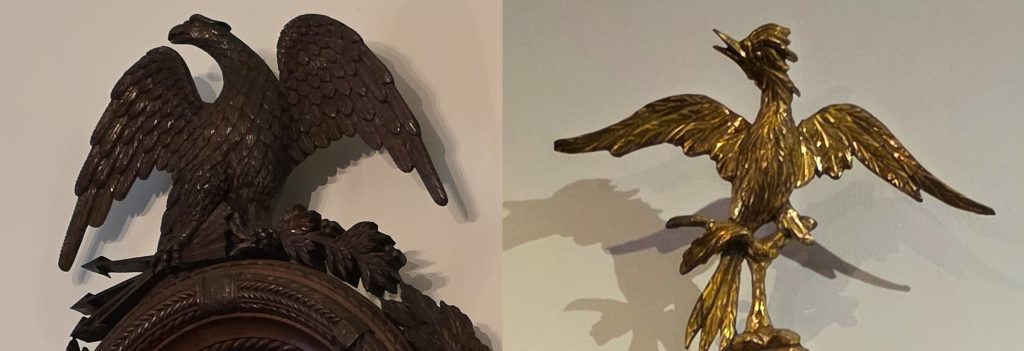
Last week we had the tremendous opportunity to tour both the US Department of State's Diplomatic Reception Rooms and the White House Historical Association's historic Decatur House. Two bird-like crests caught our eye on these two tours, one an eagle that seemed just a bit off and a second bird we couldn't quite identify. Can Gemini help us out?
Let's start with this eagle crest of a mirror in the Decatur House:
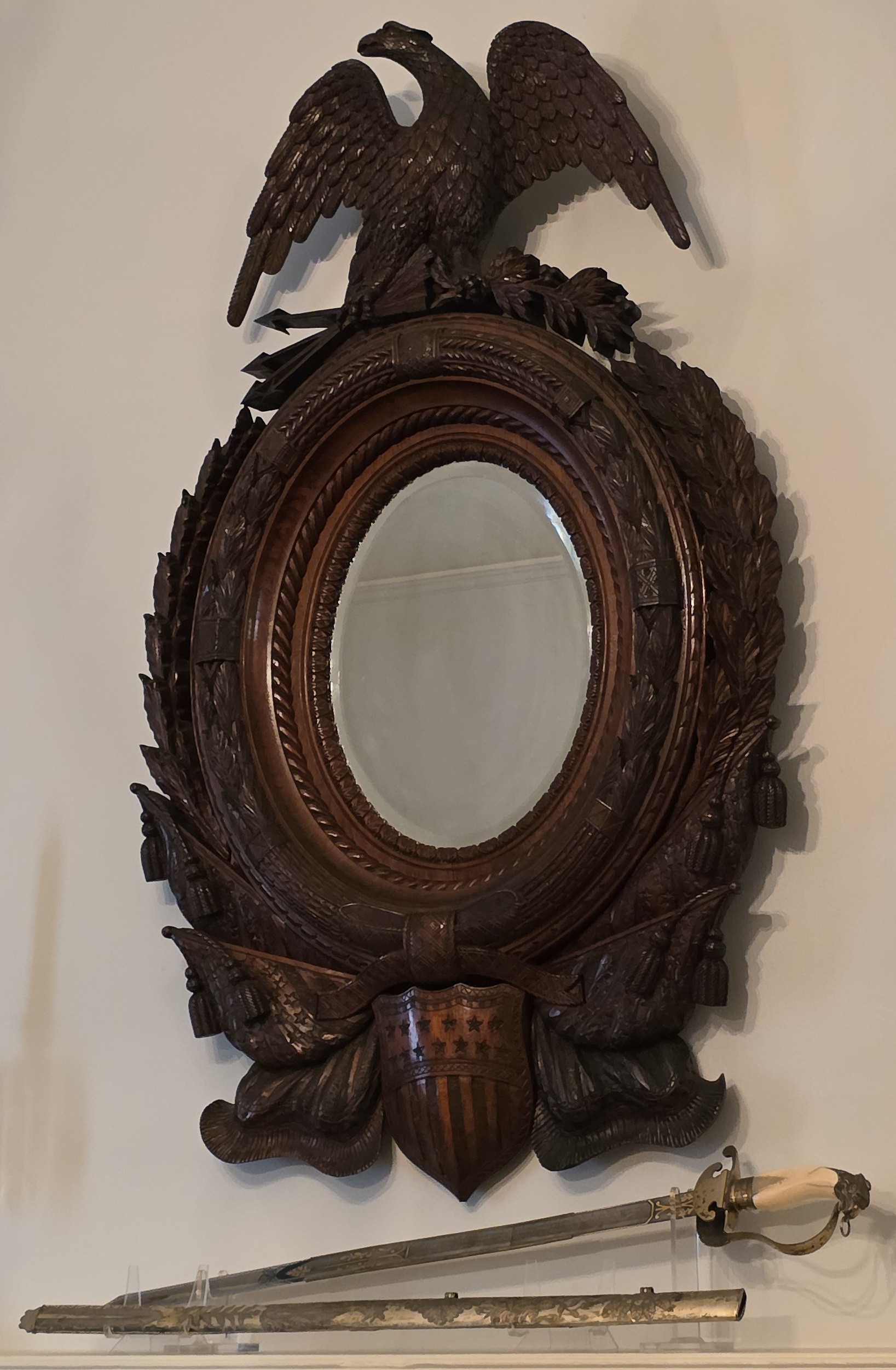
The eagle with its arrows and olive branches is familiar as the Great Seal of the United States, but something seemed off in this rendition, but we couldn't immediately place it. Gemini catches it for us: the head is turned towards the arrows (war) rather than the olive branches (peace) and even explains in detail for us, including the fact that this actually was the orientation of the Great Seal until 1945 – a fact that most viewers likely wouldn't know!
Identify and explain in detail the symbolism.
The bird carved atop the mirror frame is an American Bald Eagle (Haliaeetus leucocephalus), depicted in the heraldic style of the Great Seal of the United States. This specific piece is a 19th-century American carved walnut overmantel mirror associated with the historic Decatur House in Washington, D.C. (or crafted directly after its design), displayed above an early 19th-century eagle-pommel naval officer's sword.
Step-by-Step Reasoning for the Identification
While the monochromatic dark walnut wood hides the Bald Eagle's signature white head and tail feathers, three layers of visual evidence confirm the exact species and motif:
-
Anatomical Proportions and Raptor Features:
-
The Beak: The bird has a heavy, deeply hooked, raptorial bill designed for tearing flesh, paired with a prominent supraorbital ridge (brow bone) that gives the eye a fierce, hooded appearance.
-
Plumage and Posture: The heavily feathered neck, broad chest, and long, powerful primary wing feathers held in the heraldic "displayed" posture (wings spread open to the sides) are hallmarks of the eagle in Neo-Classical and Federal American decorative arts.
-
-
Definitive Heraldic Attributes (The Talons):
-
Look closely at what the bird is clutching in its talons at the top of the oval frame:
-
Viewer's Left (Eagle's Right Talon): It grasps a bundle of three arrows.
-
Viewer's Right (Eagle's Left Talon): It grasps a fruiting olive branch.
-
-
In global heraldry, an eagle clutching arrows in one claw and an olive branch in the other is unique to the Great Seal of the United States, which by law and tradition specifically depicts the native American Bald Eagle.
-
-
Surrounding Decorative Context:
-
The Union Shield: At the bottom center of the mirror frame sits the escutcheon (shield) from the Great Seal, featuring stars in the upper chief and vertical stripes below.
-
Draped National Flags: Flanking the shield are carved American flags with stars, stripes, and ceremonial tassels.
-
Naval Sword: Resting on the mantel directly below the mirror is an early 19th-century American eagle-head pommel sword with an ivory grip and scabbard, underscoring the early U.S. military and naval theme of the display.
-
Detailed Breakdown of the Symbolism
Every carved element on this mirror works together to project the ideals of the American Republic—balancing military readiness with a desire for peace and national unity:
-
The Bald Eagle (Sovereignty, Strength, and Freedom): Chosen by the Founding Fathers in 1782 because it is indigenous solely to North America, the Bald Eagle represents supreme authority, courage, and unbridled freedom. Because it soars high above the earth, it traditionally symbolizes a lofty, independent perspective.
-
The Olive Branch vs. The Bundle of Arrows (War and Peace): The olive branch is an ancient Mediterranean symbol of peace and concord, while the arrows represent martial power and the readiness to defend the nation. (In 19th-century woodcarving, three arrows were frequently substituted for the official thirteen because carving thirteen paper-thin wooden shafts made them prone to snapping.)
-
Crucial Departure from the Great Seal (The Eagle Facing the Arrows): A standout feature of this carving is how it diverges from the official Great Seal of the United States: here, the arrows are placed in the eagle's right (dexter) talon, the olive branch is in its left (sinister) talon, and the eagle's head is turned sharply toward the arrows. On the official Great Seal, the olive branch occupies the right talon (the position of highest honor in heraldry) and the eagle always faces the olive branch to signify that the United States favors peace over war. There are three primary reasons why this carving reverses that arrangement and faces the arrows:
-
Martial Commemoration & Military Context: Given its pairing with an officer's sword and its association with Decatur House (built for Commodore Stephen Decatur, hero of the Barbary Wars and the War of 1812, and later occupied by Union generals and statesmen during the Civil War), the piece celebrates military service. Turning the eagle's gaze toward the arrows—and placing them in the dominant right claw—intentionally shifts the symbolic emphasis from passive peace to active defense, wartime readiness, and martial valor.
-
Pre-1945 Presidential and Military Insignia: Prior to President Harry S. Truman's Executive Order 9646 in 1945, even the U.S. Presidential Seal and Flag depicted the eagle facing the arrows in its left talon, and countless 19th-century U.S. Army and Navy commissions, uniform buttons, and trophies of arms placed the arrows in the right talon with the eagle looking directly at them.
-
Heraldic Dexter Tradition Mixed with Artisan Interpretation: In classical European heraldry, a beast or bird almost always faces its own right side (dexter, the viewer's left), as facing left was considered dishonorable or a sign of retreat. Nineteenth-century woodcarvers often maintained the rule that the eagle must face its right side, while simultaneously placing the weapons of war in the dominant right claw to honor a military patron or reflect a wartime period (such as the Civil War era when this Victorian Renaissance Revival walnut frame was carved).
-
-
The Wreath of Oak and Laurel Leaves (Endurance and Victory): Encircling the central beveled glass is a lush garland of carved foliage. In classical iconography, laurel leaves represent triumph, honor, and military victory, while oak leaves symbolize steadfast strength, longevity, and civic virtue.
-
The Shield and Draped Flags (Constitutional Unity): At the base, the vertical stripes (pales) on the shield support the horizontal upper bar (chief) studded with stars, representing the individual states united under and supporting the federal government. The tasseled flags tied with a ribbon bind the composition together under the banner of patriotism and national pride.
-
The Mirror Glass Itself (Self-Reflection and Civic Duty): In 19th-century American parlors, patriotic overmantel mirrors served not only to reflect candlelight and enlarge a room, but also as a symbolic frame: anyone looking into the glass saw their own reflection literally surrounded by the emblems of the Republic, reinforcing their identity and duty to the nation.
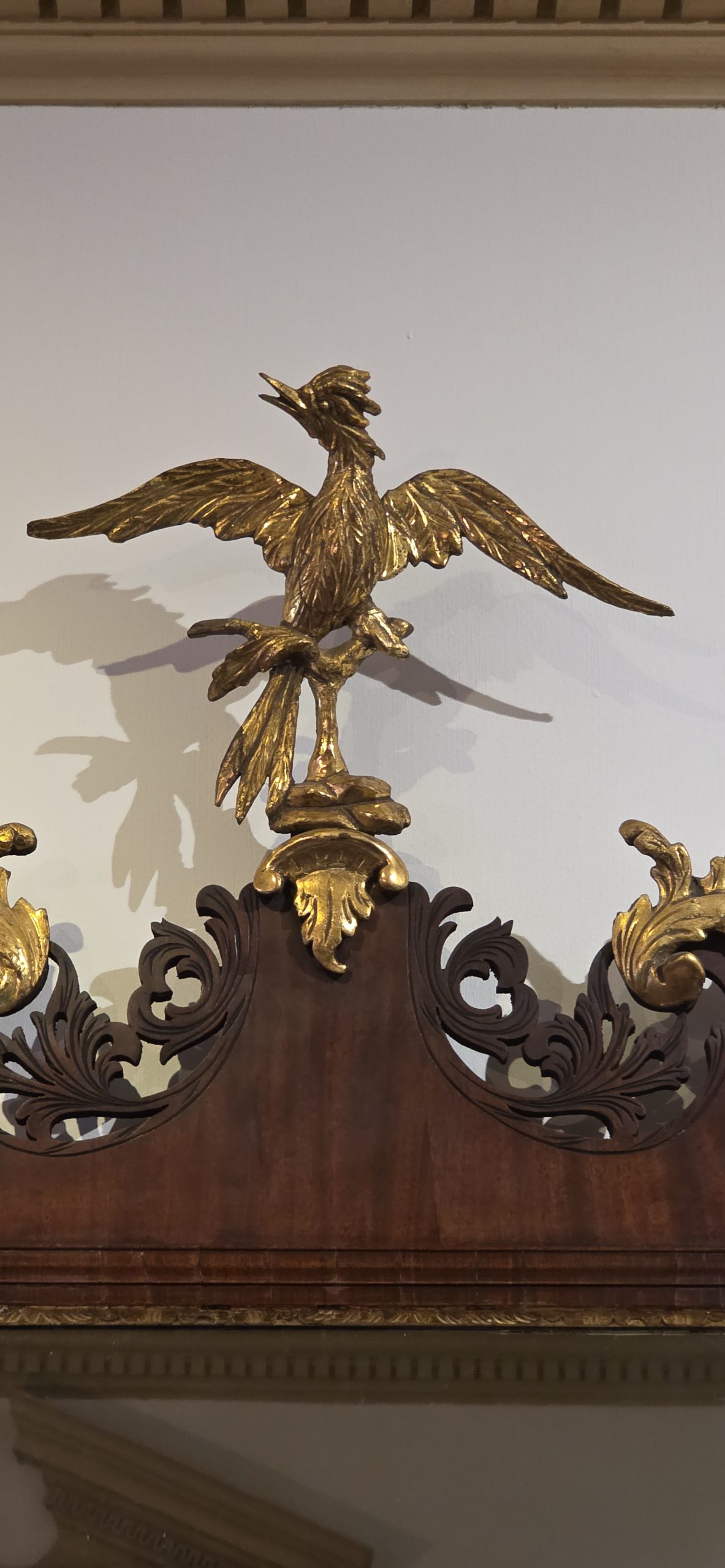
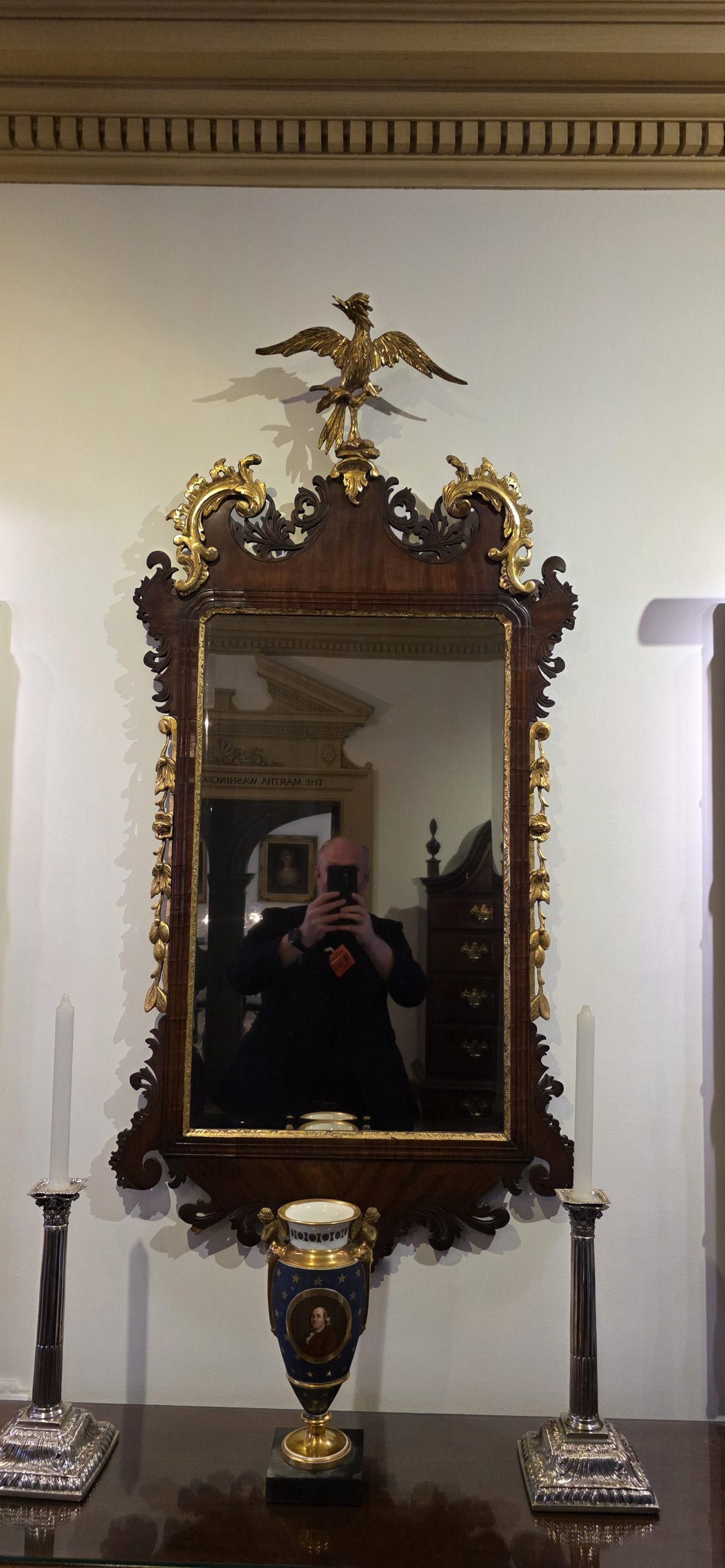
How about this strange bird in the Diplomatic Receiving Rooms? One would expect an eagle given the context of the US Department of State, but it clearly isn't an eagle. What is it?
Let's again ask Gemini:
What bird is that? Explain in detail the symbolism and explain your reasoning in detail.
The gilded bird crowning this 18th-century Chippendale mahogany and parcel-gilt looking glass is a Phoenix—also known in 18th-century Anglo-American decorative arts as a "Ho-Ho bird" (a Westernized adaptation of the Chinese Fenghuang and Japanese Hō-ō).
Because this looking glass is displayed in The Gallery of the U.S. Department of State’s Diplomatic Reception Rooms—positioned directly above a star-spangled Paris porcelain vase depicting Benjamin Franklin (ca. 1830–1840) and a John Townsend block-and-shell chest of drawers—visitors frequently assume the bird at the crest is an American bald eagle. However, a close inspection of both its physical traits and its 18th-century design history confirms that it is a mythical Phoenix/Ho-Ho bird.
1. Detailed Reasoning: Why It Is a Phoenix (Ho-Ho Bird) and Not an Eagle
Several anatomical and art-historical clues in your photos distinguish this bird from a raptor or eagle:
-
The Feathered Crest (Topknot): Look at the top of the bird's head in the close-up: it has a prominent, swept-back plume of crest feathers. Bald eagles have smooth, flat-crowned heads, whereas both the classical phoenix and the Asian Fenghuang are defined by an ornate crest or tuft of head plumage.
-
The Beak and Neck Proportions: An eagle possesses a heavy, deeply hooked, raptorial beak and a thick, muscular neck. This carving features a long, sinuous, S-curved neck and a slender, sharply pointed, elongated beak caught open in song or cry—the classic silhouette of the Rococo Ho-Ho bird.
-
The Streaming Tail Plumage: Extending below the bird's perch on the left side are long, split, pheasant-like tail feathers cascading downward. Eagles have short, broad, fan-shaped tails, while the phoenix/Ho-Ho bird is celebrated for trailing, exotic tail plumes.
-
Chronology and Furniture Style (Chippendale vs. Federal): The mirror is a George III / Chippendale-style mahogany and parcel-gilt looking glass (circa 1760–1780), characterized by its fretwork scrolled pediment, gilt rocaille acanthus scrolls, and carved floral and fruit garlands cascading down the sides. This design belongs to the mid-18th-century Rococo and Chinoiserie movement popularized by Thomas Chippendale’s The Gentleman and Cabinet-Maker's Director (1754). The American bald eagle did not appear on furniture finials until after the adoption of the Great Seal of the United States in 1782, becoming a hallmark of Federal-period mirrors (ca. 1790–1820). In the 1760s and 1770s, the phoenix/Ho-Ho bird was the premier crest ornament on high-style looking glasses.
2. Detailed Symbolism
In an 18th-century drawing room or gallery, the gilded phoenix atop a looking glass carried three distinct layers of meaning, blending Eastern trade influences, Western classical mythology, and early American political identity:
A. The Chinoiserie "Ho-Ho Bird" (Virtue, Harmony, and Global Sophistication)
During the mid-18th century, wealthy British and Colonial American elites were captivated by Chinoiserie—fanciful European interpretations of Chinese and Japanese art inspired by imported porcelain, lacquerware, and silk.
-
On East Asian imports, Westerners encountered the Fenghuang (Chinese) or Hō-ō (Japanese)—a mythical composite bird combining the sleek neck of a crane, the crest of a pheasant, and the tail of a peacock. English carvers anglicized Hō-ō into the "Ho-Ho bird."
-
In Chinese tradition, the Fenghuang is the sovereign of birds, symbolizing high moral virtue, cosmic harmony (the balance of yin and yang), peace, and prosperity, said to appear only in lands blessed with just governance.
-
Displaying a gilded Ho-Ho bird in an 18th-century Anglo-American parlor signaled cosmopolitan refinement, wealth, and participation in global maritime trade.
B. The Classical Western Phoenix (Immortality, Light, and Family Legacy)
At the same time, Western cabinetmakers and homeowners viewed this exotic bird through Greco-Roman and Christian mythology as the Phoenix—the sacred bird that lived for 500 years before consuming itself in fire and rising renewed from its own ashes.
-
A Symbol of Light and the Sun: In classical antiquity, the phoenix was associated with Apollo/Helios (the sun god), and its golden feathers were said to blaze like sunlight. Because large plate-glass mirrors were engineered to catch and multiply scarce interior candlelight—note the pair of silver candlesticks flanking the mirror—crowning the frame with a gold-leaf phoenix turned the looking glass into a literal and symbolic beacon of light and brilliance.
-
Dynastic Permanence: Because plate glass was heavily taxed and extraordinarily expensive to cast and ship in the 1700s, a looking glass of this scale was one of the most valuable status symbols a family could own. The immortal phoenix at the summit symbolized the enduring legacy, prosperity, and permanence of the family lineage.
C. Early American Political Meaning (Rebirth and a Rising Nation)
When placed in an early American setting like the Diplomatic Reception Rooms, the Chippendale phoenix takes on a resonant political dimension:
-
Before and during the American Revolution—prior to the bald eagle becoming the official national emblem in 1782—American patriots and Founders frequently invoked the phoenix as an emblem of political regeneration, resilience, and a new republic rising from the ashes of British colonial rule.
-
Founding figures including George Washington displayed Chippendale looking glasses crowned with gilded phoenix finials (such as those preserved at Mount Vernon), making the phoenix a direct visual precursor to the Federal eagle that would replace it a generation later.