What does the preface to the 1562 second edition of Virgil Solis's famous "Biblische Figuren des Alten und Neuen Testaments" say? Unfortunately, this preface is written in Early New High German using Blackletter Fraktur, which makes it extremely difficult to read. Let's ask Gemini to read and translate for us. The use of AI tools to read complex old scripts from 500-year-old books and translate from archaic languages into modern English and other languages is one of the most mundane but powerful applications of AI for museums that we've found in our daily cataloging work.
Translate ENTIRELY into English.
Do not summarize.
Translate EVERYTHING into English ENTIRELY.
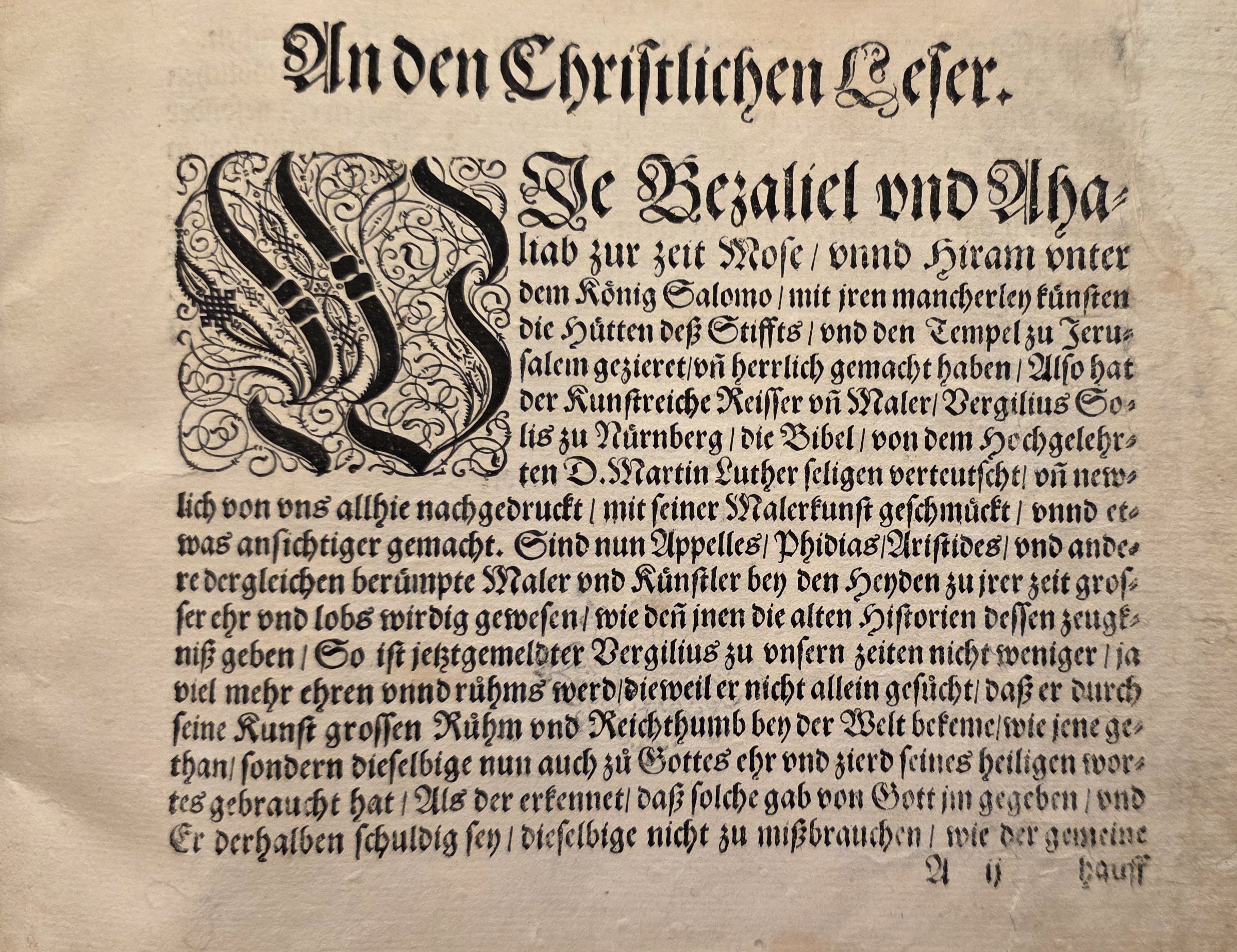
PAGE 1:
To the Christian Reader. Just as Bezalel and Oholiab at the time of Moses, and Hiram under King Solomon, with their diverse arts adorned and made glorious the Tabernacle of the Covenant and the Temple in Jerusalem, so has the artful draftsman and painter, Vergilius Solis in Nuremberg, decorated with his art of painting and made somewhat more visual the Bible, translated into German by the highly learned late Dr. Martin Luther, and recently reprinted by us here. If now Apelles, Phidias, Aristides, and other such famous painters and artists among the heathens in their time were worthy of great honor and praise, as the ancient histories bear witness to them, then the presently mentioned Vergilius in our times is no less, indeed much more worthy of honor and fame, because he has not only sought to gain great fame and wealth in the world through his art, as those did, but has now also used the same for the honor of God and the adornment of His holy word, as one who recognizes that such a gift was given to him by God, and he is therefore obliged not to misuse it, as the common
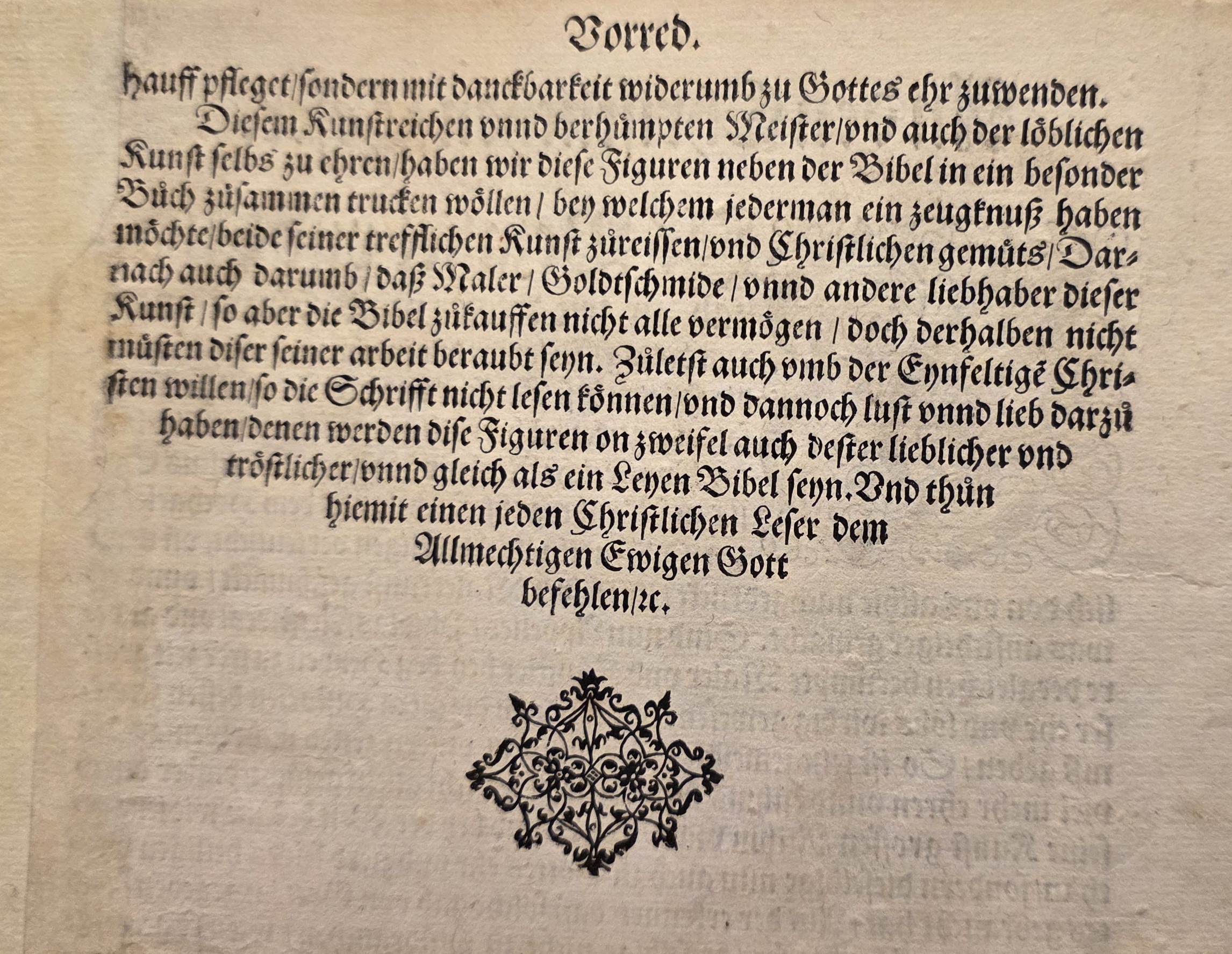
PAGE 2:
Foreword. crowd is accustomed to do, but rather to turn it back with gratitude to the honor of God. To honor this artful and famous master, and also the praiseworthy art itself, we have wanted to print these figures together in a separate book besides the Bible, through which everyone might have a testimony, both of his excellent art of drawing, and of his Christian disposition. Furthermore also for the reason that painters, goldsmiths, and other lovers of this art, who however are not all able to buy the Bible, should nevertheless not be deprived of this work of his. Finally also for the sake of the simple Christians, who cannot read the Scripture, and yet have a desire and love for it; to them these figures will without a doubt be all the more lovely and comforting, and act just as a lay Bible. And herewith we commend every Christian reader to the Almighty Eternal God, etc.