

Traditional OCR workflows that turned scanned books into searchable text work amazingly well on modern material, but tend to struggle when confronted with the unusual scripts and typography, archaic languages, abbrevations, printing issues, page damage, ideosyncracies and handwritten annotations of rare and older works. Even more importantly, older works are often in languages and use abbreviation standards that are no longer readable by the majority of the public, but even libraries that have invested in human-corrected OCR have never translated their collections. What would it look like to apply a state of the art visual reasoning and translation model to perform the most advanced OCR and translation available today to a 400-year-old book? Continuing our new collection-scale analysis workflow built on Gemini Carbon, we've added a new module for collection-scale transcription and translation, applying it to a 1616 printing of Delrio's Disquisitionum Magicarum and even including transcription and translation remarks that explain the model's decisions for ambigous, abbreviated and damaged passages. In all, Gemini Carbon transcribed 602,517 words spanning 3,733,602 characters, yielding 763,045 translated words across 4,489,860 characters. We are immensely excited by the potential and possibilities opened up by this new workflow.
Here you can see the records for the first 20 pages:
{"pdf_page": 1, "book_page": "Front cover", "production_methods": ["manuscript_marginalia_or_additions"], "languages": ["Italian / Latin (numeric notation)"], "scripts": ["Early modern Arabic numerals"], "typography_analysis": null, "distinct_hands_on_page": ["Hand 1: Early modern brown ink numeric pen trials on limp vellum cover"], "transcription": "[Hand 1: 10   18\n20\n16 [?]\n77]", "translation": null, "remarks": "Limp or semi-limp vellum upper cover with alum-tawed or vellum lacing visible along the spine hinge at left. Several faint early modern Arabic numerals/calculations in faded brown ink appear in the upper right quadrant and just right of center across the central horizontal crease."}
{"pdf_page": 2, "book_page": "Spine", "production_methods": ["manuscript_marginalia_or_additions"], "languages": ["Neo-Latin", "Spanish (proper surname)"], "scripts": ["17th-c. Italian cursive", "Early modern Humanist display capitals and minuscules"], "typography_analysis": null, "distinct_hands_on_page": ["Hand 2: 17th-c. faded brown ink cursive at head of spine", "Hand 3: 17th/18th-c. bold brown ink Humanist display lettering on spine"], "transcription": "[Hand 2: Disqu[isitionum] Magi[ca]rum]\n[Hand 3: +\nDel Rio.\n-;-]", "translation": "[Hand 2: Of Magical Investigations]\n[Hand 3: +\nDel Rio.]", "remarks": "Vellum spine with two layers of manuscript titling: an earlier, heavily abraded cursive short title at the head (`Disqu[isitionum] Magi[ca]rum`) and a bolder Humanist display author title (`Del Rio.`) framed above by a cross potent/fleury and below by a decorative dash-and-comma flourish."}
{"pdf_page": 3, "book_page": "Fore-edge", "production_methods": ["blank_no_text"], "languages": [], "scripts": [], "typography_analysis": null, "distinct_hands_on_page": [], "transcription": "", "translation": null, "remarks": "Photograph of the fore-edge of the text block; no fore-edge lettering or gauffering is present."}
{"pdf_page": 4, "book_page": "Head edge", "production_methods": ["blank_no_text"], "languages": [], "scripts": [], "typography_analysis": null, "distinct_hands_on_page": [], "transcription": "", "translation": null, "remarks": "Photograph of the head edge of the text block showing the sewn yellow/tan headband at top; no edge lettering is present."}
{"pdf_page": 5, "book_page": "Tail edge", "production_methods": ["blank_no_text"], "languages": [], "scripts": [], "typography_analysis": null, "distinct_hands_on_page": [], "transcription": "", "translation": null, "remarks": "Photograph of the tail edge of the text block showing the sewn tailband at bottom; a tiny partial ink loop on the inner edge of the front vellum turn-in at lower left corresponds to the bottom edge of the front pastedown (slice_page 6)."}
{"pdf_page": 6, "book_page": "Front pastedown", "production_methods": ["manuscript_marginalia_or_additions"], "languages": ["Early Modern Italian"], "scripts": ["16th/17th-c. Italian chancery cursive"], "typography_analysis": null, "distinct_hands_on_page": ["Hand 4: 16th/17th-c. brown ink Italian cursive on underlying manuscript waste sheet"], "transcription": "[Hand 4 (left margin fragment, beneath torn overlay):\n[...]uen\n[...]mol\n[...]ra\n[...]se\nC[...]\nM[...]\na[...]\nL[...]\na[...]]\n\n[Hand 4 (lower center fragment, beneath torn overlay):\nMed.[?] an[...]\ndi S. M[...]\n[...]]\n\n[Hand 4 (lower right inverted fragment):\n[...]]", "translation": "[Hand 4 (left margin fragment): (too fragmentary for continuous translation)]\n[Hand 4 (lower center fragment): ... of Saint M[...]]", "remarks": "Composite front pastedown showing wide vellum turn-ins at head and fore-edge and two alum-tawed thongs laced through at right. A blank laid-paper sheet was pasted over an earlier Italian manuscript waste leaf; tears along the left and bottom margins of the blank top sheet expose fragmentary line endings and phrases (`di S. M[...]`) of the underlying document."}
{"pdf_page": 7, "book_page": "Title page recto (covered with pasted-over sheet)", "production_methods": ["movable_metal_type", "manuscript_marginalia_or_additions"], "languages": ["Neo-Latin"], "scripts": ["Humanist Antiqua", "Chancery Italic", "17th-c. Italian cursive"], "typography_analysis": "Early 17th-century Venetian red-and-black quarto title-page typography printed by Vincenzo Fiorina (Venice, 1616), seen faintly through a thin blank laid-paper sheet pasted over the entire recto (with the crisp black Roman capital 'L' of 'LIBRI' directly exposed through a small tear in the overlay): graduated Venetian Old-Style Roman display capitals in multiple sizes, paired with Aldine/Granjon-tradition Chancery Italic for the descriptive subtitle and edition statement, medium Roman text type for the author's titles and privilege line, a full-measure horizontal rule, and a large scrollwork-framed woodcut printer's device above the imprint.", "distinct_hands_on_page": ["Hand 5: 17th-c. Italian cursive ownership inscription in dark brown ink at head (partially struck through)", "Hand 6: 17th-c. Sicilian/Italian chancery-humanist cursive ownership inscription in dark brown ink", "Hand 7: 17th-c. medium brown ink shelfmark/inventory notes in upper left margin"], "transcription": "[Hand 5: Est  Vincentij ]\n[Hand 6: et inde\nD[omi]ni Protonot[arij] Apost[oli]ci et Can[oni]ci D[on] Vincentij Prouenzale Nicosien[sis].]\n[Hand 7: deara. [?]   \n]\n\n[Printed title page visible beneath pasted-over sheet:]\nLIBRI SEX.\nOpus [...] pernecessarium Theologis, Iurisconsultis, Medicis, Philosophis;\nsed praesertim Verbi Dei Concionatoribus, & vtriusque Fori Iudicibus,\nquibus in primis aurea praecepta traduntur.\nAVCTORE\nMARTINO DEL RIO\nSocietatis Iesu Presbytero, LL. Licentiato, & S. Theol. Doct.\nolim in Academia Gratzensi, ac dein Salmanticensi publico SS. Scripturae\n[Professore]\nHac Veneta, & Postrema Editione omnium maxime elaborata, suaeque pristinae integritati\nrestitutum: ac praeterea Auctoris Vita, Et quatuor locupletissimis Indicibus auctum.\n[...]\nAD ILLVSTRISSIMVM, ET EXCELLENTISSIMVM\n[L]AVRENTIVM IVSTIN[IANVM]\n[woodcut printer's device]\nVENETIIS, APVD VINCENTIVM FIORINAM. [MDCXVI.]\nCum Priuilegiis, & Superiorum Permissu.", "translation": "[Hand 5: This belongs  Vincenzo ]\n[Hand 6: and thereafter\nto Master Don Vincenzo Provenzale of Nicosia, Protonotary Apostolic and Canon.]\n[Hand 7: deara. (?) <Case/Shelf 57> / ]\n\n[Printed title page beneath overlay:]\nSIX BOOKS [OF MAGICAL INVESTIGATIONS].\nA work [...] altogether indispensable to Theologians, Jurisconsults, Physicians, and Philosophers;\nbut especially to Preachers of the Word of God, and Judges of both Courts [ecclesiastical and civil],\nto whom above all golden precepts are imparted.\nBY AUTHOR\nMARTÍN DEL RÍO,\nPriest of the Society of Jesus, Licentiate of Laws, and Doctor of Sacred Theology,\nformerly Public [Professor] of Sacred Scripture at the University of Graz, and thereafter at Salamanca.\nIn this Venetian and Latest Edition, the most carefully prepared of all, restored to its original integrity:\nand moreover enlarged with the Life of the Author, and four most copious Indexes.\n[...]\nTO THE MOST ILLUSTRIOUS AND MOST EXCELLENT\nLORENZO GIUSTINIANI.\nVENICE, AT THE PRESS OF VINCENZO FIORINA. [1616.]\nWith Privileges, and by Permission of the Superiors.", "remarks": "A remarkable bibliographic survival: a thin blank sheet of laid paper was pasted directly over the recto of the red-and-black title page of Martín Del Río's 'Disquisitionum Magicarum Libri Sex' (Venice: Vincenzo Fiorina, 1616; dedicated to Lorenzo Giustiniani). Where the overlay sheet suffered a small puncture/abrasion immediately after Hand 7's note, the crisp black printed Roman capital 'L' of 'LIBRI' is directly exposed; elsewhere black-printed text and the woodcut device show through in cool grey tones, while red-printed lines ('MARTINO DEL RIO', '[L]AVRENTIVM IVSTIN[IANVM]', 'VENETIIS, APVD VINCENTIVM FIORINAM') show faintly warm orange. Angle brackets <...> denote words struck through in ink. Hand 6 records ownership by Don Vincenzo Provenzale of Nicosia (Sicily), Protonotary Apostolic and Canon; 'D[omi]ni' governs the genitive phrase after 'Est', while 'D[on]' is the Sicilian clerical honorific."}
{"pdf_page": 8, "book_page": "Title page verso", "production_methods": ["blank_no_text"], "languages": [], "scripts": [], "typography_analysis": null, "distinct_hands_on_page": [], "transcription": "", "translation": null, "remarks": "Unprinted verso of the covered title leaf (slice_page 7). Reversed iron-gall ink bleed-through from Hands 5, 6, and 7 on the recto is visible across the upper quarter; no independent text or annotation is written on this side."}
{"pdf_page": 9, "book_page": "Title page", "production_methods": ["movable_metal_type", "xylographic_block_printing", "manuscript_marginalia_or_additions"], "languages": ["Neo-Latin"], "scripts": ["Latin Antiqua", "Chancery Italic", "Early modern Latin cursive"], "typography_analysis": "Two-color (red and black) Venetian Renaissance/Baroque title-page layout set in graded sizes of Garamond/Granjon-tradition old-style Roman capitals and lowercase, paired with Granjon-style Aldine/French italic for descriptive subtitles and editorial statements; ligatures include ct, st, ſſ, ſi, æ, and &; woodcut printer's device of Vincenzo Fiorini (crowned female allegory holding flowers and cornucopia between two obelisks within strapwork cartouche flanked by putti) containing xylographic capitals along the oval frame, above a full-measure horizontal rule.", "distinct_hands_on_page": ["Hand 1: Early modern brown ink cursive cipher or collation mark at lower right foot"], "transcription": "DISQVISITIONVM\nMAGICARVM\nLIBRI SEX,\nQuibus continetur accurata curioſarum artium, & vanarum\nſuperſtitionum confutatio;\nApprime vtilis, & perneceſſaria Theologis, Iuriſconſultis, Medicis, Philoſophis,\nac præſertim Verbi Dei Concionatoribus, & vtriuſq; Fori Iudicibus,\nquibus in primis aurea præcepta traduntur.\nAVCTORE\nMARTINO DEL-RIO\nSocietatis Ieſu Presbytero, LL. Licentiato, & Theol. Doct.\nolim in Academia Grætzenſi,ac dein Salmatic.publico S.S.Profeſſore.\nHac Veneta, & Poſtrema Editione omnium maxime elaborata, ſuaque priſtinæ integritati\nreſtituta: ac præterea Auctoris Vita, Et quattuor Locupletiſſimis Indicibus aucta.\nOpe,atque Opera impenſa F. PAVLINI BERTI Lucenſis\nOrdinis Eremitarum Sancti Auguſtini, Congregationis Lombardiæ.\nAD ILLVSTRISSIMVM, ET EXCELLENTISSIMVM\nD. LAVRENTIVM IVSTINIANVM.\n[Woodcut printer's device motto: [...] VERA ~ HINC REFL[...]]\nVENETIIS, APVD VINCENTIVM FLORINVM. M DC XVI.\nCum Priuilegijs, & Superiorum Permiſſu. [Hand 1: c6]", "translation": "Six Books of Magical Disquisitions, in which is contained an accurate refutation of curious arts and vain superstitions; eminently useful and indispensable to theologians, jurists, physicians, and philosophers, and especially to preachers of the Word of God and judges of both courts [ecclesiastical and civil], to whom above all golden precepts are imparted. By the author Martin Delrio, priest of the Society of Jesus, Licentiate of Laws, and Doctor of Theology, formerly public Professor of Sacred Scripture in the University of Graz, and thereafter at Salamanca. In this Venetian and latest edition, worked out most carefully of all and restored to its pristine integrity; and furthermore enlarged with the Life of the Author and four most copious Indexes, through the aid and at the diligent expense of Friar Paolino Berti of Lucca, of the Order of Hermits of Saint Augustine, of the Congregation of Lombardy. Dedicated to the Most Illustrious and Most Excellent Lord Lorenzo Giustiniani. [Printer's device motto: ... true ... hence blooms anew ...] At Venice, at the press of Vincenzo Fiorini, 1616. With privileges, and by permission of the Superiors. [Hand 1: c6]", "remarks": "Printed in red and black ink (lines 2, 4–5, 10, 15–16, 18, and 19 in red). Standard abbreviations expanded in translation: 'vtriuſq;' = utriusque; 'LL.' = Legum; 'Theol. Doct.' = Theologiae Doctore; 'Salmatic.' = Salmaticensi; 'S.S.' = Sacrae Scripturae; 'F.' = Fratris; 'D.' = Dominum. In line 4, the 'u' of 'Quibus' is partially abraded with a small dark stain. Around the oval border of Vincenzo Fiorini's woodcut device, 'VERA' (upper left) and 'HINC REFL[...]' (right) are legible while the lower-left and lower-right letters are worn in the block."}
{"pdf_page": 10, "book_page": null, "production_methods": ["blank_no_text"], "languages": [], "scripts": [], "typography_analysis": null, "distinct_hands_on_page": [], "transcription": "", "translation": null, "remarks": "Unprinted verso of the title leaf ([a1v]). Visible reversed lettering and the reversed mark at bottom left are ink show-through from the recto."}
{"pdf_page": 11, "book_page": "a 2", "production_methods": ["movable_metal_type", "xylographic_block_printing", "stamped_text"], "languages": ["Neo-Latin", "Modern Italian"], "scripts": ["Latin Antiqua"], "typography_analysis": "Dedicatory epistle set in a large Pica/English-size Venetian old-style Roman (Garamond tradition) with display titling in Roman capitals and spaced small capitals; woodcut strapwork headpiece with central grotesque mask, smaller foliate woodcut divider, and 6-line inhabited xylographic initial 'S' depicting a figure amid flames/scrollwork; long 'ſ' ligatures (ſt, ſi, ſſ, ſp, ſu) and æ/œ diphthongs.", "distinct_hands_on_page": [], "transcription": "Illuſtriſſimo, & Excellentiſſimo\nDOMINO LAVRENTIO\nIVSTINIANO\nDomino Colendiſſimo.\n[Stamp: BIBLIOTECA SALOMONE / NICOSIA]\nFR. PAVLINVS BERTI LVCENSIS S. P. D.\nSTATIM atque Venetias adueni,\nBiblia Regia, Abulenſis, Alberti Ma\ngni, Ægydij Romani, & aliorum\nopera editurus in lucem; quos de re\nlitteraria optimè mereri accepi, eos\nſuſpicere cœpi. facilè autem fuit, &\nquidem breui , Te antiquo Familiæ , & nouo propriæ\nvirtutis ſplendore clariſſimè fulgentem ſtudiorum , &\nſtudioſorum Protectorem obſeruare , atque de labori-\nbus meis, tuo nomine colluſtrandis cogitare: abſtinui\ntamen hactenus, ne temeritatis vitio notarer, & argue-\nrer ; abſtinuiſſemque diutius, niſi noto ſydere tuæ beni-\ngnitatis magnetem attraxiſſes obſeruantiæ meæ . At\na 2    quo-", "translation": "To the Most Illustrious and Most Excellent Lord Lorenzo Giustiniani, Most Revered Lord. [Stamp: Salomone Library, Nicosia.] Friar Paolino Berti of Lucca sends warm greetings. As soon as I arrived in Venice, intending to publish into the light the Royal Bible and the works of [Alonso Tostado] of Ávila, Albertus Magnus, Giles of Rome, and others, I began to look up with esteem to those whom I heard to deserve the very best of the republic of letters. Moreover, it was easy—and indeed took only a brief time—to recognize You, shining most brightly both with the ancient splendor of your Family and with the new brilliance of your own virtue, as a Protector of studies and of scholars, and to contemplate illuminating my own labors with your name. Yet I refrained until now, lest I be branded and accused of the fault of rashness; and I would have refrained even longer, had you not by the well-known star of your kindness drawn the magnet of my devotion. But", "remarks": "Abbreviation 'FR. ... S. P. D.' = Frater ... Salutem Plurimam Dicit. 'Abulenſis' refers to Alonso Tostado, Bishop of Ávila. Line-end word division 'Ma / gni' lacks a printed hyphen. Purple institutional ownership stamp of the Biblioteca Salomone of Nicosia (Sicily) impressed at left center."}
{"pdf_page": 12, "book_page": null, "production_methods": ["movable_metal_type"], "languages": ["Neo-Latin"], "scripts": ["Latin Antiqua"], "typography_analysis": "Continuation of the dedicatory epistle set in large old-style Roman type (matching a2r), 10 lines of text plus right-aligned catchword at the foot of the page; notable use of e-caudata ('morę') alongside standard 'æ' ligature ('Quæſtionum', 'Prælo').", "distinct_hands_on_page": [], "transcription": "quoniam expectanti nihil ſatis feſtinatur,has Delrij cu-\nrioſas,vtiles,graues,atque iucundas Diſquiſitiones Ma-\ngicarum Quæſtionum, quarum deſiderium iamdiù te-\nnuit litterarum Profeſſores;impatiens morę,typis ſubie\nci,& nunc tandem Prælo ſubductas,priuſquam Bergo-\nmum Authoritatem,& Maieſtatem Reipub. veneran-\ndam in te vno perferas , tibi volui dedicatas . Non\nquantum valuerim,ſed quantum voluerim,faxit Deus,\nvt inſpicias,quò me multum voluiſſe , & parùm valuiſ-\nſe cognoſcas. Venetijs. M D C X V I.\nVita,", "translation": "since nothing hastens fast enough for one who waits, impatient of delay I committed to type these curious, useful, weighty, and pleasant Disquisitions of Magical Questions by Delrio, the desire for which has long held professors of letters; and now that they have at last been drawn from the press, before you bear away to Bergamo in your single person the venerable Authority and Majesty of the Republic, I wished them dedicated to you. May God grant that you look not upon how much I was able to achieve, but how much I wished to do, whereby you may recognize that I wished much, and availed little. At Venice, 1616. [Catchword:] Life,", "remarks": "Leaf [a2v]. Line 4 omits a hyphen after 'ſubie / ci'. Lorenzo Giustiniani served as Venetian Podestà/Capitano of Bergamo; Berti alludes to his imminent departure to assume that magistracy on behalf of the Venetian Republic ('Reipub.' = Reipublicae)."}
{"pdf_page": 13, "book_page": null, "production_methods": ["movable_metal_type", "xylographic_block_printing"], "languages": ["Neo-Latin", "Early Modern Spanish"], "scripts": ["Latin Antiqua", "Chancery Italic"], "typography_analysis": "Biographical notice set in medium-sized (approximate Pica/Small Pica) Venetian old-style Roman, headed by large Roman display type and opened with a 6-line xylographic arabesque/strapwork initial 'O'; indented bibliography of 19 titles set in matching Aldine/Granjon-style Chancery Italic with swash capitals ('A', 'D', 'M', 'P').", "distinct_hands_on_page": [], "transcription": "Vita,& Scripta Auctoris.\nOPVS quod damus,Lector, viri eſt ſua,maiorumq́ue virtute\nilluſtris.Hiſpanus erat patre,Proannenſi Vico [vulgò Proan-\nno ] in Montibus Campoò oriundus : vbi etiamnum veſti-\ngia arcis antiquum eiuſdem Familiæ domicilium, quod Hi-\nſpanicè Solar vocatur. Vetuſtiſſima huius memoria ab Octa-\nuiani Imperio arceſſitur, cum pro gente ſua ad Montem\nSierra Tejada dictum pugnat , obitq́ue fortiter Generoſus\nCantaber Lucio Lamia oppugnante . Ex cuius proſapia Fruendus, qui felicio-\nre euentu vnà cum Chriſtianis, quos Rex Pelagius anno 720. eius curæ com-\nmiſerat, quoſque Donga celebris, adhuc ſpelunca capere non poterat , dum in\nMauros impetum facit, magnam eorum multitudinem inter fluuios Deba , &\nOba fudit, & fugat . Ab hac victoria gentilitium nomen, & inſigne Del-Rio\ngenti fuit. Fidus huius rei teſtis liber , quem Del Bezerro vocant , in quo\nFamiliæ Hiſpaniæ ad origines ſuas reuocantur , ſtirpemq́ue hanc ramos ſuos\nlatè diffudiſſe,interq́ue alios nobilem vnum in Bureba,ex quo Gonſaluus Ro-\nderici Del- Rio Regis Henrici Quarti corporis cuſtos poſteros reliquit diſper-\nſos in varia Regum obſequia . Atque hunc cuius librum præ manibus habes,\neius abnepotem Brabantia , matre ex nobili de Villanoua Celtiberiæ familiæ ,\nedidit ingenio raro, cuius rei monumenta hæc fidem faciunt .\nScholia in Claudianum .\nEmendationes in Solinum .\nDe Tragœdia veterum .\nDe vita Annæi Senecæ patris, & filij .\nDe verſibus tragicis .\nAduerſaria, & commentaria in Senecam .\nNotæ perpetuæ in Ius ciuile .\nRepetitio in legem tranſigere .\nCommentaria in legem contractus .\nAnnotationes in monita Sancti Orientij.\nAEnigmata Sancti Aldhelmi .\nDiſquiſitionum Magicarum Libri Sex.\nCommentaria,& Catena in Cantica Canticorum .\nSpeculum Marianum .\nPolemica Mariana.\nFlorida Mariana.\nSuper Threnos Ieremiæ .\nSuper Geneſim .\nAdagia Sacra .\nAlia præterea dedit , quæ alieno nomine circumferuntur , ſed & poſthuma\nquædam apparantur ; Vir etſi Mineruæ ſtudia coleret impenſiùs , iuuenili ta-\nmen", "translation": "Life and Writings of the Author.\nThe work that we present, Reader, is that of a man illustrious both by his own virtue and by that of his ancestors. On his father's side he was a Spaniard, originating from the village of Proaño (commonly called Proanno) in the Mountains of Campoo, where even now stand the ruins of a stronghold, the ancient seat of that same family, which in Spanish is called a 'Solar' [ancestral manor]. The oldest record of this lineage is traced back to the reign of Octavian, when a noble Cantabrian fought for his people at the mountain called Sierra Tejada and died bravely while Lucius Lamia was besieging them. From his stock came Fruendus, who with a happier outcome, together with the Christians whom King Pelagius in the year 720 had entrusted to his charge and whom the famous cave [Cova]donga could no longer hold, while making an assault upon the Moors routed and put to flight a great multitude of them between the rivers Deva and Ova. From this victory the family derived the surname and coat of arms of Del-Río ('Of the River'). A trustworthy witness of this fact is the book they call 'Del Bezerro' [Libro Becerro de las Behetrías], in which the families of Spain are traced back to their origins, showing that this stock spread its branches widely, including one noble branch in La Bureba, from which Gonzalo Rodríguez del Río, bodyguard to King Henry IV, left descendants dispersed in various royal services. And Brabant brought forth this man whose book you hold in your hands—his great-great-grandson, born of a mother from the noble Celtiberian [Aragonese] family of Villanueva—endowed with rare genius, to which the following monuments bear witness:\nScholia on Claudian.\nEmendations on Solinus.\nOn the Tragedy of the Ancients.\nOn the Life of Annaeus Seneca the Elder and the Younger.\nOn Tragic Verses.\nAdversaria and Commentaries on Seneca.\nPerpetual Notes on the Civil Law.\nLecture on the Law 'Transigere'.\nCommentaries on the Law of Contract.\nAnnotations on the Commonitorium of Saint Orientius.\nThe Enigmas of Saint Aldhelm.\nSix Books of Magical Disquisitions.\nCommentaries and Catena on the Song of Songs.\nThe Marian Mirror.\nMarian Polemics.\nMarian Blossoms.\nOn the Lamentations of Jeremiah.\nOn Genesis.\nSacred Adages.\nHe also produced other works besides, which circulate under another's name, and certain posthumous works are also being prepared. Although this man cultivated the studies of Minerva most earnestly, yet with youthful", "remarks": "Leaf [a3r]. Contains code-switching into Early Modern Spanish for ancestral places, institutions, and genealogical registers ('Proanno', 'Campoò', 'Solar', 'Sierra Tejada', 'Del-Rio', 'Del Bezerro'). 'Donga' in line 10 is a known typographical truncation for 'Couadonga' (Covadonga). Note printed square brackets around '[vulgò Proanno ]' and acute accents over enclitic '-q́ue'."}
{"pdf_page": 14, "book_page": null, "production_methods": ["movable_metal_type"], "languages": ["Neo-Latin"], "scripts": ["Latin Antiqua"], "typography_analysis": "Conclusion of the Vita set in the same medium Venetian old-style Roman as [a3r], followed by a centered woodcut grotesque-mask tailpiece and a large Roman catchword ('Elen-') at bottom right.", "distinct_hands_on_page": [], "transcription": "men vigore armorum dexteritatem fuit conſecutus . Quid mirum , ſi patre\nCantaber, matre Celtiber ? Omni genere Scientiarum præſtans,officia publi-\nca , atque imperium perpetuò recuſauit , plus in meriti conſcientia , quàm in\nfunctionis fructu ponens . Philippi Secundi Hiſpan. Regis Conſiliarius,& Su-\npremus in ſuo exercitu Iudex , æquum ſe, & incorruptum ſemper exhibuit:\nSpretis mundi illecebris Ieſu Societatem ingreſſus, exemplo ſocijs , admiratio-\nni omnibus fuit. Diuinarum litterarum ſtudijs, ſe totum tradidit, adeoq́ue exi-\nmius euaſit Theologus , vt Louanij in Belgio, Grecij in Stiria, Salmanticæ in\nHiſpania , Sacrarum Scripturarum oracula ſumma cum laude ſit interpreta-\ntus . Acerrimus fuit hæreticorum inſectator , ab omnibus laudem , à ſubditis\ndum Arſelariæ in Brabantia Dominus fuit , etiam amorem obtinuit . Dum\nSalmantica Louanium maiore celeritate, quàm vires ferebant, properat, tertio\nquàm eo appulit die anno 1608. obijt, magno omnium luctu .\nElen-", "translation": "vigor he attained dexterity in arms. What wonder, if he was Cantabrian on his father's side and Celtiberian on his mother's? Excelling in every branch of learning, he perpetually refused public offices and command—Wait: although actually serving as Councillor to Philip II, King of Spain, and Judge Advocate General in his army (afterward refusing higher worldly honors), placing more value in the consciousness of merit than in the profit of office, he always showed himself fair and incorruptible. Spurning the allurements of the world and entering the Society of Jesus, he was an example to his brethren and a marvel to all. He devoted himself wholly to the study of Sacred Literature, and became so distinguished a theologian that at Louvain in Belgium, Graz in Styria, and Salamanca in Spain he interpreted the oracles of Sacred Scripture with the highest praise. He was a most fierce pursuer of heretics; he won praise from all, and even love from his subjects while he was Lord of Aartselaar in Brabant. While hastening from Salamanca to Louvain with greater speed than his strength could bear, he died on the third day after he arrived there in the year 1608, to the great grief of all. [Catchword:] Table-", "remarks": "Leaf [a3v]. Note 'Hiſpan.' = Hispaniae (or Hispaniarum). 'Arſelariæ' Latinizes Aartselaar near Antwerp, the seigneury held by Martin Delrio prior to entering the Society of Jesus in 1580. Slight paper thinning/stain moderately lightens ink in the upper right corner ('præſtans,officia publi- / ca , atque imperium perpetuò recuſauit , plus in meriti conſcientia , quàm in'), but every letter remains legible."}
{"pdf_page": 15, "book_page": null, "production_methods": ["movable_metal_type"], "languages": ["Neo-Latin"], "scripts": ["Latin Antiqua"], "typography_analysis": "Summary table of the six books centered vertically on the page, set in two sizes of Venetian old-style Roman: display-size Roman for the two-line heading and a Large Pica/English Roman with spaced capitals ('LIB. I.'–'LIB. VI.') and hanging indentation for the book summaries.", "distinct_hands_on_page": [], "transcription": "Elenchus Librorum, & eorum,quæ\nipſis generatim continentur .\nLIB. I.    De Magia generatim,& de Naturali, Artificia-\n              li,& Præſtigiatrice .\nLIB. II.   De Magia Dæmoniaca,& eius efficacitate.\nLIB. III.  De Maleficio & vana obſeruatione .\nLIB. IV.   De Prophetia,Diuinatione,& Coniectatione .\nLIB. V.    De Iudicis officio , & ordine iudiciario in hoc\n              crimine .\nLIB. VI.   De officio Confeſſarij , ac remediis licitis , &\n              illicitis .\nI N", "translation": "Summary of the Books, and of those matters which are generally contained in them.\nBook I. On Magic in general, and on Natural, Artificial, and Prestidigitatory [Illusionist] Magic.\nBook II. On Demonic Magic, and its efficacy.\nBook III. On Harmful Sorcery [Maleficium] and Vain Observance.\nBook IV. On Prophecy, Divination, and Conjecture.\nBook V. On the Duty of the Judge, and judicial procedure in this crime.\nBook VI. On the Duty of the Confessor, and on lawful and unlawful remedies.\n[Catchword:] ON", "remarks": "Leaf [a4r]. Notice inconsistent orthography of genitive/ablative plural endings within the same line ('Confeflarij' vs. 'remediis')."}
{"pdf_page": 16, "book_page": null, "production_methods": ["movable_metal_type"], "languages": ["Neo-Latin"], "scripts": ["Latin Antiqua", "Chancery Italic"], "typography_analysis": "Two-column verse layout without column rule; titles and Rosweyde's signature set in Roman capitals and lowercase, while both poems (Lipsius's Phalaecian hendecasyllables in col. 1 and Rosweyde's iambic trimeters in col. 2) are set in Granjon-style Chancery Italic with 2-line initial capitals (italic swash 'C' in col. 1, Roman 'M' in col. 2) and indented run-over lines.", "distinct_hands_on_page": [], "transcription": "IN R. V.\nMARTINI DEL-\nrij Diſquiſitiones\nMagicas .\nIuſti Lipſi Carmen.\n\nCVius doctũ opus hoc ? quod ima,\n    ſumma\nPenna permeat, & ſagace mente\nSagas, & Stygias ſtriges reuelat ?\nQuod tu Theſſala terra,voſq; Colchi,\nInfames male cantibus patraſtis ;\nQuod Panes,Satyrique,Duſiique\nPeccaſtis,genus improbum,ſalaxque;\nTotum hoc eruit,erutis medetur :\nSed quis ? Delrius eruditione ,\nIdem religione, clarus . ergo\nHic pura, & liquida omnia ; hic ve-\n    nena\nNulla,quæ timeas opinionum .\nHuic libro faueas,faue tibi ipſe ,\nAtque iſtum lege,vt ima,ſumma no-\n    ris.\n\nIN EASDEM\nPARODIA.\n\nMAgia , quam libro hoc videtis\n    obſidem ,\nAit fuiſſe fraudium peculium,\nNeque vllius medentis arte gloriam\nNequiſſe præualere, ſiue toxico\nOpus foret necare, ſiue faſcino.\nEt hoc negat feraciora Theſſali\nNegare rura, noxiumque Caucaſum,\nScythaque ſaxa , conſcioſque Colchi-\n    cos,\nIberiam,tuumque Taure verticem :\nVbi iſta,poſt Magia, floruit prius\nAgreſtis herba ; nam Promothei in\n    iugo\nVapore ſæpe tabido imbuit ſata.\nZarate Mede,lethiferque Dardane,\nTibi hæc fuiſſe, & eſſe cognitiſſima\nAit Magia; poſtuma ex origine;\nTua exuiſſe dicit è proſapia,\nTuo exaraſſe perfidas ſtylo notas;\nEt inde tot per æmula dolos manus\nDecus tuliſſe, læua ſiue dextera\nOpus patraret,aut vtrumq; mutuas\nSuo dediſſet impigre vices hero.\nNeque vlla vota Noxialibus Deis\nSibi eſſe facta,cum veniret à viro\nNouiſſimo hoc ad vſque ſæculum re-\n    cens .\nSed hæc prius vere : nunc Apolline\nSilet loquente,ſeque dedicat tibi\nApollo Delrie,atque Apollo Delrij .\n\nHERIBERT. ROSVVEI-\n    DVS. S. I.\nPRI-", "translation": "[Col. 1:] On the Magical Disquisitions of the Reverend Man Martin Delrio. A Poem of Justus Lipsius.\nWhose learned work is this, which penetrates the depths and the heights with its pen, and with a keen mind unmasks witches and Stygian screech-owls [striges]? What you, Thessalian land, and you, infamous Colchians, wickedly accomplished with your spells; what sins you committed, Pans, Satyrs, and Dusii [Gaulish incubus-demons], a shameless and lustful breed—all of this he unearths, and what is unearthed he heals. But who? Delrio, illustrious in erudition, and equally so in religion. Therefore everything here is pure and clear; here are no poisons of opinions for you to fear. Favor this book—favor yourself—and read it, so that you may know the depths and the heights.\n\n[Col. 2:] A Parody on the Same.\nMagic, whom you see held hostage in this book, declares that she was once the special treasure of deceits, and that the renown of no healer could prevail against her by art, whether the task was to slay by poison or by the evil eye. And this she denies that the fertile fields of the Thessalian can deny, or baleful Caucasus, and Scythian crags, and the complicit Colchians, Iberia [Georgia], and your summit, Mount Taurus: where she, afterward Magic, first flourished as a wild herb; for on Prometheus's ridge she often steeped the crops in pestilential vapor. Median Zarates [Zoroaster] and deadly Dardanus, to you Magic says these things were and are most well known from her remotest origin; she says that she sprang forth from your lineage, that with your stylus she scratched treacherous characters, and thence through so many crafts of rival hands bore off the prize, whether left hand or right performed the work, or whether either hand briskly rendered mutual service to its master; nor were any vows ever made by her to the Gods of Harm [until now], when she came from this latest man right down to the present age. But these things were so formerly: now, while Apollo speaks, she falls silent, and surrenders herself to you, Apollo Delrio, and Delrio's Apollo.\nHeribert Rosweyde, of the Society of Jesus.\n[Catchword:] PRI-", "remarks": "Leaf [a4v]. Abbreviations: 'R. V.' = Reverendi Viri; 'doctũ' = doctum; 'voſq;' = vosque; 'vtrumq;' = utrumque; 'HERIBERT. ROSVVEIDVS. S. I.' = Heribertus Rosweidus Societatis Iesu. Rosweyde's 'Parodia' is a strict metrical parody (in pure iambic senarii) of Catullus, Carmen 4 ('Phaselus ille, quem videtis, hospites'). Three Venetian compositor's corruptions appear in Rosweyde's poem when collated against earlier Northern editions and Catullus 4: (1) 'Promothei' for 'Promethei'; (2) 'exuiſſe' (three minims: u+i) for 'exiiſſe' ('Tua exiisse dicit e prosapia'); and (3) 'vere' (which breaks the iambic trimeter) for 'fuere' ('Sed haec prius fuere: nunc Apolline', echoing Catullus 4.25 'Sed haec prius fuere')."}
{"pdf_page": 17, "book_page": "b", "production_methods": ["movable_metal_type"], "languages": ["Humanist Ancient Greek", "Neo-Latin"], "scripts": ["Greek minuscule with ligatures", "Greek majuscule", "Latin Antiqua", "Latin Italic"], "typography_analysis": "Parallel-column bilingual verse layout with inter-column reference capitals (A–E) and signature 'b' with catchword 'Stre-' at foot right. Left column set in Granjon-tradition cursive Greek type rich in ligatures (ου, στ, σσ, ντ, καὶ, εὐ), with majuscule Greek titling and a 2-line initial Δ. Right column set in Granjon/Garamond-style italic for the hexameter verse, paired with Garamond-style old-style Roman capitals and lowercase in the heading and a 2-line Roman initial T.", "distinct_hands_on_page": [], "transcription": "[Left column]\nΦΕΔΕΡΊΚΟΥ\nΙ'ΑΜΩΤΊΟΥ Ι'ΑΤΡΟῦ Ε῎ΠΟΣ\nΕἰς τὴν τοῦ Πατρὸς Μαρτίνου Δελρίου\nβίβλον περὶ Μαγείας.\n\nΔΗναίοι πάρος ἄνδρες, ὅσοι μεγαλώνυμα τιμὴν,\nΟὔνομά τ' ἐκτήσαντο θεοδμήτοιο Μαγείης,\nΙ'δμοσυνῃ σοφίῃ τε μετέπρεπον, ἠδὲ συνεργὸν\nΕὐθείαις πραπίδεσσι συνηρμόξαντο προνοίην,\nΜυστιπόλοι γεγαῶτες, ἀνασσόντων τε πάρεδροι,\nΦύσιος ἰχνητῆρες ἀμύμονες, ἴδριες ἄστρων ,\nΜουσάων θεραπόντες, Α'κεστορίης τ' ἀγερώχου .\nΤοῖος ἔην φύλοισι μετ' ἀλλοδαποῖσιν Ι'ωσήφ,\nΤοῖος ἐνὶ Φαρίοισι πολύτροπα θαύματα δείξας\nΜωσῆς, Α'σσυρίῃ τε πόλει Δανίηλος ἀγαυὸς .\nΚαὶ Σολομῶν περίπυστος Ι'ουδαίοις ἐπιτάσσων .\nΤοῖοι δ' ἀντολίηθε Μάγοι δίζηντο κιόντες\nΧριστὸν ἐπικλινθέντα χαμαιζήλῳ ἐνὶ λίκνῳ .\nΤόφρα δ' ἀπὸ Δαίμονος οἶστρος ἀλάστορος ἄνδρας ἐ-\nλαύνων\nΔειλαίους, σφετέρῃσιν ἀτασθαλίῃσι δαμάντας,\nΑ'σσεβίην ἐφέηκε, Γοητείης τε πανέργου\nΜνήσατο λύγεα πολλὰ, καὶ ἄπλετα δήνεα λώβης,\nΜαντοσύνην, πόσιας τε, καὶ ἐχθίστας ἐπαοιδὰς .\nΚείνων ἐξεγένοντο παλαιγενέων ἐπὶ φωτῶν ,\nΜαινάδος Αἰγύπτοιο θυηπόλοι, ἥ τε Σαούλῳ\nΕἰρομένῳ μάντευμα θεοπρόπος ἤνεπε Γραῖα\nΚαὶ πινυτὴ Μήδεια, κακὸν σκίναρ Αἰήταο.\nΚαὶ Σίμων ἀθέμιστος, ἐπωνυμίην τε Μάγοιο\nΔεξάμενος, καὶ Καρποκράτης, ὃς ἀπεχθέα τέχνην\nΑ'μφαδίην ἐδίδαξεν, ἀναιδείῃ πεποιθὼς.\nΝῦν δὲ Μάγων κακόεργα σίνη, δολερῶν τε Γοή-\nτων ,\nΓαίης ἄχθεα λυγρὰ, κατ' ἀνθρώπους ἀλάληνται,\nΠασσυδίῃ πλάζοντα, Θεοῦ κρατέοντος ἕκητι ,\nΕ'νδικον ὃς βροτέῃσιν ἀλιτροσύνῃσι χολωθεὶς\nΚαὶ νέφος ἠερόφοιτον ἀτεκμάρτοιο Μαγείης,\nΚαὶ τίσιν ἠλιτόποινον ἀμοιβάδα τοῖσιν ὀπάζει,\nΟἵ σφισι πίστιν ἄμεμπτον ἐπιτρέψαντες ἀέλλαις,\nΨεύδεος ἀσσεβέεσσιν ὑπεζεύγνυντο λεπάδνοις.\nΚαί κεν ἀμαυρώσασα πολυσπερέων γένος ἀνδρῶν\nΓαῖαν ὅλην ἐκάλυψε μελακρήδεμνος ὁμίχλη.\nΕἰ μὴ Δέλριος ἐσθλὸς ἑῇ παιήονι βίβλῳ\nΙ'ητὴρ ἐπίκαιρος ἀθέσφατον εὖ ζόφον ὦσεν ,\nΑ'τρεκίης πάντεσσιν ἄγων φαεσίμβροτον αἴγλην .\nΕἴδεα γὰρ μορφάς τε καὶ αἴτια πάντα Μαγείης\nΑ'μφοτέρης ἑκάτερθε κλυτῇ σφρηγίσσατο δέλτῳ .\n\n[Center column markers]\nA\nB\nC\nD\nE\n\n[Right column]\nFEDERICI IAMOTII\nMEDICI CARMEN IN PA-\ntris Martini DelRij librum\nde Magia.\n\nTEmporibus priſcis veterũ quicunq; Magiæ\nCœleſtis magnamq; decus, nomenq; tulerũt,\nIlluſtri Sophia, & doctrinæ laude cluebant,\nCultaq; iungebant ſolerti pectora menti:\nSacrifici quondam celebres, à Rege ſecundi ,\nNaturæ indagatores, aſtrûmq; periti:\nEgregias artes Medicas, Muſasq; colentes.\nTalis erat Ioſeph peregrinæ gentis alumnus:\nTalis apud Pharios Moſes oracula promens:\nTalis , & Aſſyriæ Daniel ſpectabilis vrbi.\nTalis erat Solomon, dum regia ſceptra teneret ,\nIudææ, taleſq; Magi, qui Solis ab ortu\nVilibus in cunis Chriſtum petiere iacentem .\nInterea miſeros infeſti dæmonis œ-\nſtrus\nMortales agitans, ſua quos vecordia torſit ,\nEmiſit ſcelus, & fraudes, varioſq; nocendi\nFallendiq; aſtus, varias & repperit artes\nFalſidicûm vatum præſagia, pocula, cantus.\nHinc exorta lues, ætas hinc priſca parentum\nProtulit Aegypti Myſtas bacchantis, Anumq;\nFatidicam, quæ tetra dedit reſponſa Saulo .\nHinc Medea ſagax, AEetæ dira propago :\nImpius hinc Simo Magus, ex cognomine dictus:\nHinc quoq; Carpocrates, Magicæ q̃ tradidit ar\nPublicus interpres poſito præcepta pudore. (tis\nNunc Magicæ peſtes, impoſturæq;, nefanda\nPondera telluris, totum graſſantur in orbem,\nLudificantq; animos: at non ſine numine patris\nAEtherij, qui iure malis offenſus, opacas\nMentibus humanis tenebras offundit, & atra\nImprouiſè oculis præſtringit nube Magiæ,\nExigit & meritas hominum de crimine pœnas,\nQuiq; fidem ſanctam leuibus liquere procellis,\nQuique iugo falſi ſummittunt impia colla.\nIamque adeò genus humanum terraſq; patentes\nCaligo obrueret fulua circundata vitta ,\nNi bonus, & Medica ſpectatus DelRius arte,\nDiſcuteret tenebras ſani medicamine libri,\nEt clara veri perfunderet omnia luce.\nNam ſpecies formaſq; omnes, cauſaſque Magiæ\nDuplicis aggreſſus aucta ſignare tabella\n\nb        Stre-", "translation": "Poem of Frédéric Jamot, Physician, on Father Martin Delrio's Book on Magic.\n\nIn ancient times of old, all those men who won the renowned honor and name of God-built [Latin: heavenly] Magic excelled in knowledge and wisdom, and joined cooperative forethought to upright hearts: initiated priests they were, assessors next in rank to kings, blameless searchers of nature and skilled in the stars, servants of the Muses and of noble Medicine. Such a man was Joseph among foreign tribes; such was Moses, displaying manifold wonders among the Egyptians, andillustrious Daniel in the Assyrian city; and famed Solomon while he held royal command over the Jews; and such were the Magi who came from the rising of the sun and sought Christ lying in a humble cradle.\n\nMeanwhile a gadfly from the avenging Demon, driving wretched mortals whom their own folly tormented, sent forth impiety and devised many murky snares of all-working Sorcery and boundless counsels of ruin [Latin: various tricks of harming and deceiving, and invented various arts]: divination, potions, and most hateful incantations. From those men in the days of the ancients arose the sacrificing priests of frenzied Egypt, and the prophetic Crone who uttered a grim oracle to inquiring Saul; and cunning Medea, dire offspring of Aeëtes; and lawless Simon, who received the surname of Magus; and Carpocrates too, who, trusting in shamelessness, publicly taught the precepts of the hateful art.\n\nAnd now the evil-working plagues of Magicians and deceitful Sorcerers, baneful burdens of the earth, roam abroad among mankind, leading them astray in throngs [Latin: mocking their minds]—though not without the will of the sovereign heavenly Father, who, justly angered at mortal transgressions, sends upon them both the air-roaming cloud of baffling Magic [Latin: pours dark shadows over human minds and unexpectedly blinds their eyes with the black cloud of Magic] and a requiting punishment fitting their sin, for those who abandoned blameless faith to light gusts and bowed their impious necks beneath the yoke-straps of falsehood.\n\nAnd indeed a dark-veiled [Latin: tawny-filleted] mist would have dimmed the race of wide-scattered men and covered the whole wide earth, had not noble Delrio, a timely physician renowned in the healing art, thoroughly thrust away the boundless gloom with his healing book, bringing to all the mortal-illuming radiance of truth. For having undertaken to seal upon his enlarged tablet all the kinds, forms, and causes of twofold Magic— [catchword: Strenuus]", "remarks": "Liminary poem by the French humanist physician and Hellenist Frédéric Jamot (Federicus Jamotius, d. c. 1609), composed in Homeric/Nonnian Greek dactylic hexameters on the left with a close parallel Neo-Latin hexameter version on the right. Standard Greek typographic ligatures (ου, στ, σσ, ντ, καὶ, εὐ) have been expanded in the transcription while preserving printed breathings, accents, and spellings (e.g., 'μελακρήδεμνος' for 'μελαγκρήδεμνος' in Greek l. 37; Latin l. 2 'magnamq;' printed for 'magnumq;'). In Latin l. 25, '(tis' is turned up to the end of l. 26 to complete 'ar[tis]'."}
{"pdf_page": 18, "book_page": null, "production_methods": ["movable_metal_type"], "languages": ["Humanist Ancient Greek", "Neo-Latin"], "scripts": ["Greek minuscule with ligatures", "Greek majuscule", "Latin Italic", "Latin Antiqua"], "typography_analysis": "Continuation of the two-column bilingual layout with inter-column reference capitals A–E and catchword 'Instar' at foot right. Left column in Granjon cursive Greek type; right column in Granjon/Garamond italic with Roman capitals for sacred names (IESV) and section letters.", "distinct_hands_on_page": [], "transcription": "[Left column]\nΨεύδεος ἐμπέδομυθον ἐτητυμίην τε διείρξας ,\nΠρυμνόθεν ἐξέρριψε πλάνης ἀπατήνορος ἄτην.\nΩ῏ μέγα τολμήεντος, ὃς ἀκνάμπτοισι μενοίναις,\nΜῶλον ἄγων τεράτεσσιν ἀμαιμακέτοισιν ἀρήρης ,\nΔυσσεβίην ἐδάμασσας, ἀλεξικάκου Διὸς υἷον\nΑ῎λκιμον Η῾ρακλῆα καλῷ μιμούμενος ἔργῳ .\nΤοίοις δ' ἔμφυτον ἔμμεν ἑταιρείῃ φρονὸς ἀλκὴν\nΥ῾μετέρῃ πινυτός κεν ἀνὴρ ῥέα τεκμήραιτο\nΗ῞τε πολυκμήτοιο μόγου ποτὶ δύσβατον αἶπος\nΕ᾿ρχομένη, θνητὰ μετέρχεται ἠνεκὲς ἔργα .\nΠληθὺν δ' οὐκ ἀνέγωγε θεοπρεπέων ἱερήων\nΙ᾿ΗΣΟΥ῏ χαρίεντος ἐπώνυμον ἐξονομήνω ,\nΟἵτινες ἠνορέῃσι, καὶ ἔργμασιν ἔξοχα πάντων\nΕ῎πρεπον ἀργαλέοισι Σὺ δ' ἀμφιέπειας ἕκαστα\nΚαλλιόπη σὺ γὰρ οἶσθα πολυσπερέων στίχας ἀνδρῶν ,\nΟἵ τε πρὸς ἠοίην, οἵ θ' ἕσπερον, οἵ τ' ἀνὰ μέσσην\nΚλήρους ἑστήσαντο, τεράστια τόσσα καμόντες .\nΗ῾μεῖς δὲ κλέος οἶον ἀκούομεν, οὐ σαφὲς ἴδμεν .\nΟὔτε γὰρ ἐσχατόωντος ἀφίγμεθα τέρματα κόσμου.\nΑ᾿λλὰ σὺ πάντ' ἴσασα θεὰ, καὶ πατράσι κεδνοῖς\nΘυμήρη τάδε δῶρα τεῆς πόρσυνον ἀοιδῆς .\nΘάμορος ἐκ Μουσέων ἐθέλει τὰ πρῶτα φέρεσθαι\nΠορφυρέων κορυφὴ Βελλάρμινος ἀρητήρων .\nΟ῞ς βέλος ἄρμενον ἧκεν ἀνικήτοιο φαρέτρης ,\nΩ᾿κύ τε, καὶ φωνῆεν ὅσοις νόος εὖ ἐχέφρων .\nΚάππαυσεν διχόμητιν ἔριν, καὶ νεῖκος ἀναιρῶν ,\nΚαὶ κλόνον ἀμφήριστον ἀληθέος ἀμφὶ λατρείης ,\nΚαὶ ζαθέου θεσμοῖο, καὶ οὐκ ἀπεπαύσατο σείων\nΠάντα λίθον, καὶ πάντα κάλων, καὶ πᾶσαν ἀνάγκην,\nΤαῦτα πρὶν ἢ συνετοῖσιν ἀναμφήριστα τιθείη .\nΟὐδ' ἄρα Μαλδώνατος Ι᾿βηρίδος ἄνθος ἀρούρης\nΗ῞σσονα μόχθον ἔμεινεν, ὅπως εὐάγγελον ἠχὼ\nΧριστοῦ παμβασιλῆος ἀνάκτορος, ἣν ὑποφῆται\nΤέσσαρες ἐσφρήγισσαν ἐνὶ τετράζυγι δέλτῳ ,\nΠᾶσιν ἀναπτύξειεν , ἀρίζηλόν τε τελέσσῃ\nΠαρισίοις ἀστοῖσι, καὶ ἀλλοδαποῖσι γενέσθαι .\nΠιερίῳ τοῖόν τι Περύριος ἔνθεος οἴστρῳ ,\nΜαντιπόλου Δανιῆλος ἀπήλασε δάσκιον ὄρφνην\nΚαὶ ζόφον ἀχλυόεντα , καὶ ἀμφαδίοις ἐπέεσσιν\nΑ᾿μφιβόλου σκοτόεντα διήϊεν ὄργια φωτὸς .\nΤυῤῥιάδην μέγα κάρτος ὁμοῦ καὶ θούριος ἀλκῆς\nΜαρνάμενον θείοιο δίκης ὕπερ Α᾿ρχιερηος\nΚαὶ κανόνων, ὤτρυνε μέσην ἀνὰ δῆριν ὀροῦσαι\nΘαρσαλέοις στήθεσσι τὸ, καὶ μεγαλήτορος ἀνδρὸς\nΥ῾ψηλαῖς ἀρεταῖσιν ἀνάντια δείματο τύρσιν\nΑ᾿μβαίνειν, καὐθένδε φαάντερον ἔμμεναι αὐτὸν .\nΠόσσος ἀγὼν, πόσση δὲ βίη πέλε Ποσσηβίνου,\nΗ῏μος Α᾿ριστάρχοιο δίκην , ἔστιζε δικαστὴς\n\n[Center column markers]\nA\nB\nC\nD\nE\n\n[Right column]\nStrenuus, & ſimplex falſo diſtinguere verum,\nFunditùs euertit noxas, quas intulit error.\nO nimium audacẽ, qui forti pectore, & armis,\nTerrarum peſtes, immania monſtra, laceſſens,\nImpia corda domas, auerrunco Ioue nati\nAemulus Alcidæ, factoque exempla ſecutus.\nHinc catus, & prudens vir colligat inſita pror-\nEſſe ſodalitio fortiſſima pectora veſtro, (ſus\nAſpera quæ ſpectẽt, & ſemper ad ardua tendãt,\nMagnaque ſuſcipiant duro comitata labore.\nSed mihi nec cœtus liceat memorare priorum\nMyſtarum, placidi IESV de nomine dictos,\nQui ſolida virtute cluent , operumque labore\nDifficili præſtant reliquis . Tu ſingula pande\nCalliope: tibi namque datum cognoſſe, quis horã\nAuroram, mediumque axem, ſolemque cadentẽ\nIncolat, & qui tot faciant miracula rerum.\nFama leuis tantum noſtras peruenit ad aures,\nNec ſtabilis: neq; enim fines penetrauimus orbis\nExtremos. At tu, quæ diſpicis omnia, Muſa,\nPatribus hæc claris grati da munera cantus.\nPoſtulat à Muſis primas Bellarminus Heros\nFerre, Sacerdotum columẽ quos purpura veſtit:\nCommoda qui mittens inuicta tela pharetra,\nExcita conſultiſq; ſonantia mentibus, acres\nCompoſuit lites; & iurgia plena tumultu\nAncipiti, vera de relligione, Deique\nLegitimo cultu : nec deſtitit ante mouere\nSaxũ omne, atq; omnem funẽ, & quæcunq; neces\nVoluere, q̃ doctis hæc indubitata reliq̃t. (ſe eſt\nNec fuit inferior, quem Maldonatus Iberæ\nGentis honos adijt, labor, vt vox nũtia læti, (olim\nQuam dedit Omnipotens Chriſtus, quã quatuor\nQuadruplici vates obſignauere tabella ;\nPlana foret cunctis, nec ciui cognita tantùm\nPariſio, ſed, & externis manifeſta pateret .\nSic, & Pierio ſtimulante Pererius œſtro,\nFatidico Daniele procul caliginis vmbram\nDiſpulit, & tenebras, verbiſq; interpres apertis\nExpoſuit dubij myſteria tecta Prophetæ.\nInclyta Turriadæ virtus, & roboris ardor,\nPontificis pro iure ſacri, Canonumque vetuſto\nDogmate pugnãtem, mediũ protraxit in agmen\nIntrepidum: ſummiſque viri virtutibus altam\nExtruxit turrim, facili quam magnanimus vir\nAſcenſu ſuperaret, & hinc conſpectior eſſet.\nQuanta fuit vis, quæ contentio Poſſeuini ,\nCum docto ſimul, ingentique volumine iudex,\n\nInſtar", "translation": "—and strenuously distinguishing steadfast-worded truth from falsehood, he uprooted from its foundations the ruinous delusion that deceives mankind [Latin: the harms that error brought in]. O man of great daring, who with unbending resolve [Latin: brave heart and arms], joining battle against irresistible monsters, the plagues of the earth, tame impious hearts, rivaling mighty Heracles, son of evil-averting Zeus, and following his example in noble deed! From such things a wise and prudent man might easily infer that in your Society there is an innate strength of mind [Latin: most brave hearts], which marches toward the steep, hard-to-climb summit of much-wrought toil and unceasingly pursues great mortal labors.\n\nYet I could not recount by name the multitude of godlike priests named after gentle JESUS, who have excelled above all others in manliness and arduous works. May you, Calliope, unfold each detail! For to you it is given to know the ranks of wide-scattered men—those who have established their missions toward the dawn, toward the evening, and along the mid-heaven axle, accomplishing so many wondrous deeds. We hear rumor alone and have no sure knowledge, for we have not reached the bounds of the farthest world. But you, goddess who behold all things, bestow these pleasing gifts of your grateful song upon the illustrious Fathers.\n\nHeroic Bellarmine, chief of purple-clad priests, claims first honors from the Muses: shooting a fitting shaft from his invincible quiver—swift, and speaking to the wise [Pindar, Ol. 2.85]—he quelled divided strife, abolishing contention and disputed turmoil over true worship and sacred law; nor did he cease moving every stone, every rope, and every necessity until he rendered these matters beyond doubt for the learned.\n\nNor was the toil less that Maldonado, flower of the Iberian land, undertook, so that the glad herald voice of Christ the almighty King, which four prophets of old sealed in a fourfold tablet, might be unfolded plain to all, and become conspicuous not only to the citizens of Paris, but also to foreign peoples.\n\nEven so Pereira, inspired by a Pierian gadfly, drove far away the shadowy gloom and murky darkness from prophetic Daniel, and as an interpreter with clear words traversed the dark mysteries of the enigmatic prophet.\n\nGlorious valor and impetuous ardor of strength urged Torres [Turrianus], fighting on behalf of the right of the sacred High Priest and the ancient dogma of the Canons, to rush fearlessly into the thick of the fray; wherefore too for brave breasts and the lofty virtues of a great-hearted man it built a steep tower for him to ascend [Latin: a lofty tower which the great-souled man might surmount by easy ascent], and thence be all the more conspicuous.\n\nHow great was the struggle, how great the might of Possevino, when like Aristarchus, as a judge in a learned and vast volume, he marked— [catchword: Instar]", "remarks": "Jamot's encomium turns here to a catalogue of celebrated Jesuit scholars: Robert Bellarmine (1542–1621), Juan Maldonado (1533–1583), Benito Pereira (Pererius, 1536–1610, printed 'Περύριος' in Greek l. 37), Francisco Torres (Turrianus, c. 1509–1584, with a pun on 'turris'/'τύρσις' = tower), and Antonio Possevino (1533–1611, author of the *Bibliotheca Selecta*). Notable printed Greek forms preserved diplomatically: l. 7 'φρονὸς' (for 'φρενὸς'), l. 11 'οὐκ ἀνέγωγε' (for 'οὐκ ἂν ἔγωγε'), l. 22 'Θάμορος' (rendered 'Heros' in Latin; likely a misprint for 'Θούριος' or 'Θεόμορος'). In the right column, turned-over line endings '(sus', '(se est', and '(olim' are printed at the right margin of the adjacent lines."}
{"pdf_page": 19, "book_page": "b 2", "production_methods": ["movable_metal_type"], "languages": ["Humanist Ancient Greek", "Neo-Latin"], "scripts": ["Greek minuscule with ligatures", "Greek majuscule", "Latin Italic", "Latin Antiqua"], "typography_analysis": "Conclusion of Jamot's parallel-column Greek and Latin poem, with inter-column reference capitals A–E, spaced majuscule 'ΤΕΛΟΣ.' and 'FINIS.' at the foot of the respective columns, and signature 'b 2' at bottom right.", "distinct_hands_on_page": [], "transcription": "[Left column]\nΑ᾿νδρῶν μνήματα πυκνὰ σοφῶν ἀπείρονι βίβλῳ;\nΠέλτανου πόσον ἔργον, ἀπειρεσίῃσιν Α᾿χαιῶν\nΑ᾿ρχετύπων σελίδεσσι Λατινίδα γῆρυν ἄγοντος;\nΠόσσος ἔην Ρ῾ιβέρας , ὅτε θέσφατα σεμνὰ Προ-\nφητέων ,\nΜείονας οὓς καλέουσιν, ἑῷ διεπέφραδε μύθῳ ;\nΩ῏ πόσσῃ Σκονδόγχος ἀγακλυτὸς ἀλκὶ πιθήσας,\nΒασκανίην, καὶ συκίφασιν φιλολοίδορον ἀνδρῶν\nΕ᾿ργολάβων, ἀπάνευθεν ἑῶν ἀπέερξεν ἑταίρων ,\nΓράμμασι Κωστήροιο περίφρονος Αὔσονα κόσμον ,\nΑ᾿μφιβαλὼν, κείνου τε συνέμπορος ἴχνεσιν ἐμβὰς ;\nΤίς Μολίναν κε δύναιτο Συαρέσιόν τε κατ' αἶσαν\nΕἰπέμεν αἰνῆσαί τε; τίς ἔμφρονα Βάζιον ἔργων\nΑ῎ξια μυθήσαιτο, Βαλεντιάδην τε πρόφαντον ;\nΝαὶ μὴν Σερβιάδαο πιφάσκεο λευκάδα χαίτην,\nΧριστιάδην τε γέροντα, νέων κοσμήτορε δισσὼ ,\nΤὸν μὲν ἐν Αὐδομάρῃς, ὁ δὲ πτόλιν ἀγλαόθωκον\nΔουακίην κόσμησε περιγλώσσοισι ῥεέθροις .\nΑ᾿μφαδίως ἀγορῇσιν ἀμαρτάδος ἄνδρας ἐλέγ-\nχων .\nΤῷ καὶ μοχθίζοντι βοηθόος ὤρεγε χεῖρας\nΑ᾿νδρὶ φίλῳ Δαυσκήϊος, ὁ καὶ Μούσῃσι μεμηλὼς ,\nΕ῾λλάδος Αὐσονίης τε συνήορα δόγματα βάζει.\nΟ῞ς τε Σελευκείοιο καταυγάζων Βασιλείου\nΜνήματα σιγαλόεντα σοφῇ μετεφράσσατο δέλτῳ,\nΕ᾿ξείης ἅτε δῖον ἀπ' ἀχλύος ἐς φάος ἄξει.\nΩ῾ς ἄρα Κασταλίοιο κυβερνητῆρα χαλινὸν\nΔώματος ἰθύνοντι, παρ' Αὐδομάρου τεμένεσσιν,\nΧριστιάδῃ παρέμεινε φέρων Βερβήκιος ἄλκαρ ,\nΟ῞ν θέσαν ἀρχηγοὶ φιλοπειθέος ἤρανον ἥβης,\nΗ῏ς ἅτε δὴ κτίλος ἠϊθέων, προκέλευθος ὁδεύει,\nΗ῎ν σοφίης ἐπὶ νᾶμα, καὶ ἐς νομὸν ἡδὺν ἐλαύνει.\nΜυρίοι ἄλλοι ἔασιν ὅλης ἐνὶ πείρασι γαίης ,\n(Εὐμενέες τελέθοιεν ἐμῇ ξύμπαντες ἀοιδῇ)\nΤάξιος ἀγλαΐῃσιν ἀριστεύοντες ἑταῖροι.\nΗ῾μεῖς δ' ἀνδρομέοισι νοήμασι μέτρα φέρωμεν\nΤοῖσδε γὰρ οὐ σθενέοι κεν ἀνὴρ σάφα τεκμήρασθαι\nΘνητὸς ἐὼν. ὀλίγος δὲ νόος μερόπεσσι καὶ ἀλκή.\nΔέλριε καρτερόθυμε σὺ δ' ἄγρια δῆριν ὀφέλλων\nΘηρσὶν ἀϊδροδίκῃσιν, ἀδειμάντῳ φρενὸς ὁρμῇ,\nΘαμβαλέοις ἔργοισιν ἀγήραον ἤραο κῦδος.\nΑ᾿λλὰ μόθον πείραινε, φέρων εὐαλθέ' ἀρωγὴν\nΑ᾿τρεκίῃ πολεμιζομένῃ, καὶ νητρεκὲς ἄλκαρ .\nΕἰσόκεν ἡ μὲν ἕλῃσι φίλην ἑτεραλκέα νίκην .\nΗ῾ δ' ἀπάτη κακοποιὸς, ἀερτάζουσά τε χεῖρας\nΑ᾿μφοτέρας, καὶ νῖκος ἀπαυδήσασα, λιγυχθῇ.\nΔὴ τότε Βελγικὸν οὖδας ἀληθείῃ κε τεθήλοι ,\nΚαὶ σὲ διηνεκέεσσιν ἐφυμνήσειεν ἀοιδαῖς.\nΤ Έ Λ Ο Σ .\n\n[Center column markers]\nA\nB\nC\nD\nE\n\n[Right column]\nInſtar Ariſtarchi, variorum ſcripta notaret?\nQuantus Peltani labor, exemplaria Græca\nPleraque vulgantis , Romano compta lepore ?\nQuantus erat Riberas, cum nos oracula va-\ntum ,\nQuos paruos dixere, ſuo ſermone doceret ?\nNobilis ò quanto Scondonchus robore fretus ,\nPropulit à Socijs odium, linguaſque procaces,\nEt Quadruplatorum conuicia falſa remouit ?\nScitaque donauit cultu monimenta Latino\nCoſteri, ipſiuſque comes veſtigia preſſit ?\nQuis digno Molinamque, Suareſiumq; diſertũ\nExtulerit cantu? quis Vazqui fortia facta\nLaudibus ornarit meritis, clarũque Valentem?\nIã mihi Seruiadæ canos circũſpice crines, (eſt,\nChriſtiademq; ſenem: iuuenũ queis tradita cura\nQuorũ hic Audomaros, ſublimis at ille Duacũ ,\nMœnia facundæ decorauit flumine linguæ,\nDeteſtanda palam, paſſimque piacula damnans.\nAſtitit hinc opifer , ſociamque laboris amico\nPorrexit dextram, Muſarum maxima cura\nDauſqueius , Latiæ doctor, Graiæque camœnæ.\nSplendida qui monumenta Seleucenſi Baſilei\nDoctis explicuit chartis: quæ protinus almam\nProferet in lucem cæcis exempta latebris.\nSic, & Caſtaliæ moderantem legib. æquis (nũ\nFræna domus, apud Audomari memorabile fa-\nChriſtiadem leuat auxilio Veruecius aſtans,\nRectores docili quem præfecere iuuentæ,\nCui præit, vt veruex iuuenum ſectarius, & quã\nAd Sophiæ fontes, & dulcia paſcua ducit.\nSunt alij innumeri varijs in finibus orbis .\n( Adſint ô facileſque meæ, placidæq; camœnæ )\nOrdinis eximia clari virtute ſodales:\nAt nos humanis certum, finemque, modumque\nMentib. addamus: nec enim hos cõprendere pos\nMortales, quib. exigua eſt ſolertia mentis. (ſint\nTu verò impauido, cõſtãtiq; impete, DELRI,\nAcria bella gerens ſæua cum gente ferarum ,\nMirificis auſis decus immortale tuliſti .\nPerge modo inſigni bellum finire triumpho :\nAffer opem vero, belloque tuere petitum ,\nDum palma laudem referat: fallacia contrà\nSubdola, damnoſis infeſtans artibus orbem,\nVictori det victa manus, palmamque relinquat;\nBelgica tum tellus vero florebit, & æquo ,\nEt te perpetuum cantu celebrabit in æuum.\nF I N I S .\n\nb 2", "translation": "—the dense monuments of wise men? How great was the labor of Peltanus, bringing a Latin voice to countless pages of Greek originals [Latin: publishing numerous Greek exemplars adorned with Roman grace]? How great was Ribera, when in his discourse he expounded the solemn oracles of the Prophets whom men call Minor? Relying on what mighty strength did noble Schoondonck ward off malice and the railing calumny of venal informers from his companions, clothing the writings of wise Coster in Ausonian [Latin] adornment and treading closely as a fellow traveler in his footsteps? Who could fittingly tell of and praise Molina and eloquent Suárez? Who could recount worthily the brave deeds of Vázquez and illustrious Valencia?\n\nCome too, behold the white hair of Servaes [Serviades] and aged Christiades, twin marshals of youth, the one among the people of Saint-Omer, while the other adorned the splendid-throned city of Douai with fluent streams of eloquence, openly convicting men of detestable sins in public assemblies [Note: the Latin slightly reverses 'hic' and 'ille' or refers back chiasmically: 'of whom the latter adorned Saint-Omer, the former lofty Douai']. Next to his toiling friend stood Dausque as a helper and stretched out a comrade's hand—Dausque, dearest care of the Muses, teacher of the Latin and Greek Muse, who illuminated and translated in his learned pages the shining monuments of Basil of Seleucia, which he will straightway bring forth out of dark hiding-places into the kindly light. So too Vervecius stood by and brought aid to Christiades as he guided with fair laws the steering rein of the Castalian house beside the famed sanctuary of Saint-Omer—Vervecius, whom the rectors appointed guardian of obedient youth, before whom he walks like a bellwether ram leading the young men, driving them to the stream of Wisdom and into sweet pasture.\n\nCountless others there are to the ends of the whole earth (may they all be gracious to my song!), companions excelling in the splendors of the Order. Yet let us set due measure and limit to human thoughts; for a mortal man would not have strength to gauge them clearly, since scant is the mind and strength of mortals.\n\nBut you, stout-hearted Delrio, fiercely waging battle against lawless beasts with dauntless onset of spirit, have won unaging glory by your wondrous deeds. Press on, then, to finish the fray in glorious triumph, bringing healing aid and unerring defense to beleaguered Truth, until she wins dear, tide-turning victory, while mischief-working Deceit, raising both hands in surrender and renouncing strife [Latin: the palm], is bent in defeat. Then indeed shall the Belgian soil bloom with truth and justice, and celebrate you forever in unceasing songs.\n\nTHE END.", "remarks": "Continues the Jesuit roll-call with Theodor Peltanus (1511–1584), Francisco Ribera (1537–1591), Aegidius Schoondonck (Scondonchus, 1556–1617, rector of the English/Walloon Jesuit colleges at Saint-Omer and Latin translator of Frans Coster, 1532–1619), Luis de Molina (1535–1600), Francisco Suárez (1548–1617), Gabriel Vázquez (1549–1604), Gregorio de Valencia (1549–1603), and figures active in the Spanish Netherlands at Saint-Omer and Douai—including Claude Dausque (Dausqueius, 1566–1644, whose *editio princeps* and Latin version of Basil of Seleucia appeared in 1604, dating this state of the prelims or forecasting its imminent publication: 'protinus ... proferet in lucem') and Vervecius (with an etymological play on Latin 'vervex' / Greek 'κτίλος', bellwether ram). Preserved printed forms: Greek l. 8 'συκίφασιν' (for 'συκόφασιν'), l. 46 'λιγυχθῇ' (metathesis for 'λυγιχθῇ', 'be bent/overcome'); Latin l. 24 'Seleucensi' (for 'Seleucensis')."}
{"pdf_page": 20, "book_page": null, "production_methods": ["movable_metal_type", "xylographic_block_printing"], "languages": ["Neo-Latin"], "scripts": ["Latin Antiqua"], "typography_analysis": "Single-column monumental verse display set entirely in large-body Garamond-style old-style Roman type, with spaced titling capitals ('IN EVNDEM / TRIMETRI.'), internal small/full-capitals emphasis ('ORCVS', 'ORBIS', 'SORTI', 'DELRIO', 'BELGICIS', 'IBERIS'), a 3-line Roman initial G, a woodcut headpiece featuring a central grotesque mask amid scrolling volutes, and a woodcut fleuron/cartouche ornament below the title.", "distinct_hands_on_page": [], "transcription": "I N   E V N D E M\nT R I M E T R I.\n\nGAudebat ORCVS arte dæmonas ſua :\nMagicíſque monſtris vertere Orbem cardine:\nGemebat ORBIS Tartari victus dolo ,\nMaliſque tabeſcebat æger cantibus .\nQuid hoc ? gemit nunc ORCVS , & verſa vice\nLætatur ORBIS fraudibus liber Stygis .\nEtiamne SORTI tertio in regno locus ?\nNon. Iſta virtus eſt viri. cuius viri ?\nDELRIO. notum BELGICIS nomen ſcholis ,\nNotumque IBERIS plura vis ? librum lege .\n\nIOANNES GAVDA. S. I.", "translation": "Iambic Trimeters on the Same.\n\nOrcus used to rejoice in overturning the World from its hinge by the Demon's own art and magic monsters; the World used to groan, vanquished by the guile of Tartarus, and wasted away sick with evil incantations. What is this? Now Orcus groans, and with fortunes reversed the World rejoices, freed from the frauds of the Styx. Does Lot [Fortune] have a place even in the third [underworld] realm? No. That is the valor of a man. Of what man? DELRIO—a name well known to Belgian schools, and well known to Spanish ones. Do you want more? Read the book.\n\nJan van Gouda, S.J.", "remarks": "Ten iambic trimeters by the Dutch/Flemish Jesuit controversialist and preacher Jan van Gouda (Joannes Gauda, 1571–1630). Line 1 prints the Greek-inflected genitive singular 'dæmonas' (for 'dæmonis' / δαίμονος, scanning – ⏑ ⏑? Actually 'dæ-mo-nas' has short final -as if Greek acc. pl. 'rejoiced in his demons by his art, and in overturning...'; taking 'dæmonas' as Greek acc. pl. makes 'arte ... sua' ablative with 'gaudebat' or 'vertere'—either 'rejoiced by his art in his demons, and in overturning...' or a printer's slip for 'dæmonis'). Line 7 plays on 'Sors' (both blind Fortune causing a reversal of roles and the mythological drawing of lots by which Pluto received the 'tertium regnum', the underworld)."}
And a detailed look at the record for page 961 that mixes Latin and Greek text, along with italics:
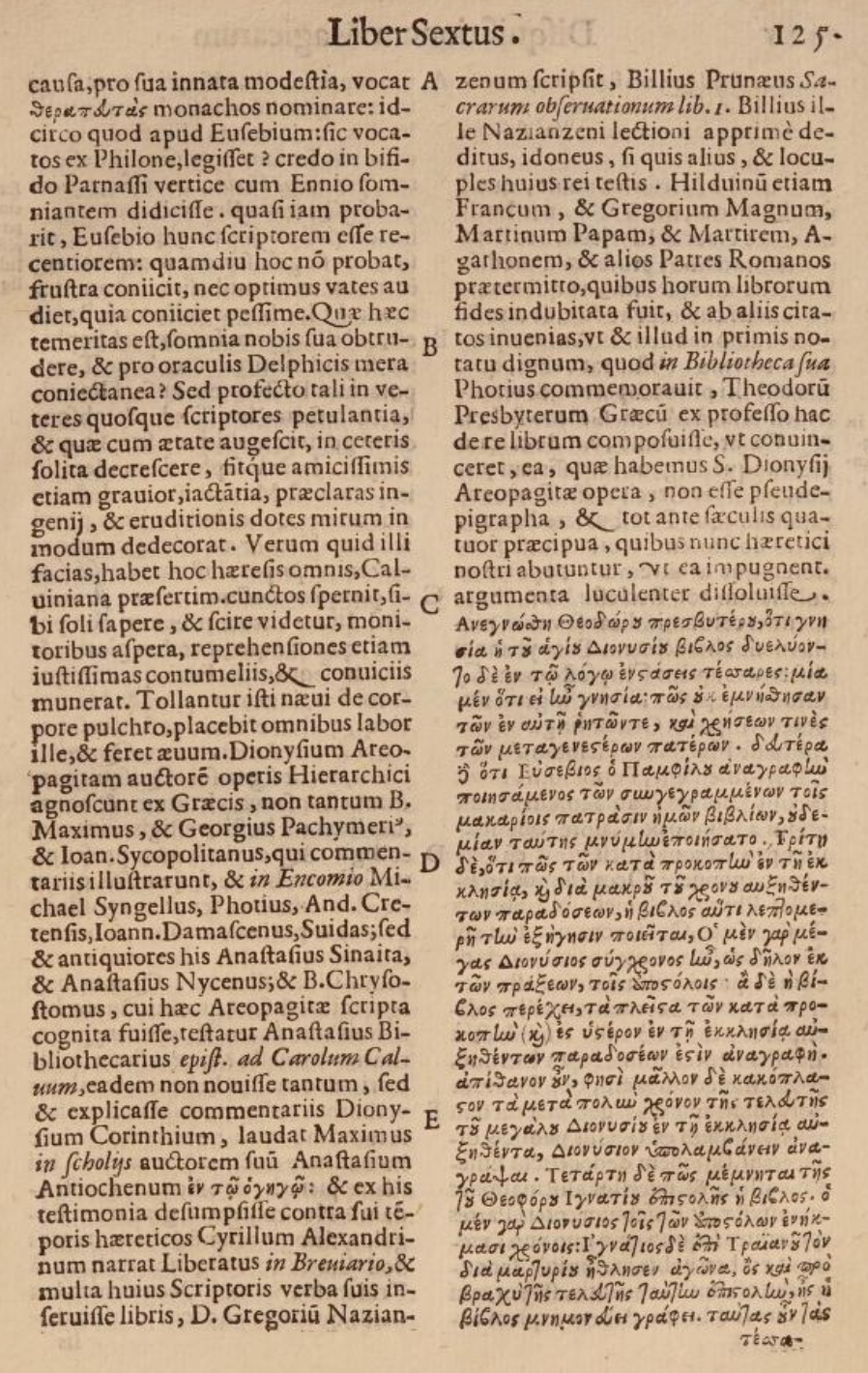
The full JSON record for this page:
{
  "pdf_page": 961,
  "book_page": "125",
  "production_methods": [
    "movable_metal_type"
  ],
  "languages": [
    "Neo-Latin",
    "Byzantine Greek"
  ],
  "scripts": [
    "Latin Antiqua",
    "Chancery Italic",
    "Greek minuscule with ligatures"
  ],
  "typography_analysis": "Garamond-Granjon style late-16th/early-17th-century French/German old-style Roman (Antiqua) set in two columns with intercolumnar reference capitals (A–E), paired with Granjon-style italic for titles of cited works and cursive-ductus Greek minuscule type ('grecs du roi' tradition) featuring frequent ligatures (ου, στ, καί, τῶν, γάρ, τῆς, etc.).",
  "distinct_hands_on_page": [],
  "transcription": "Liber Sextus. 125\n\n[Col. 1]\ncauſa, pro ſua innata modeſtia, vocat\nθεραπευτὰς monachos nominare: id-\ncirco quod apud Euſebium: ſic voca-\ntos ex Philone, legiſſet? credo in bifi-\ndo Parnaſſi vertice cum Ennio ſom-\nniantem didiciſſe . quaſi iam proba-\nrit , Euſebio hunc ſcriptorem eſſe re-\ncentiorem: quamdiu hoc nō probat,\nfruſtra coniicit, nec optimus vates au\ndiet, quia coniiciet peſſime. Quæ hæc\ntemeritas eſt, ſomnia nobis ſua obtru-\ndere, & pro oraculis Delphicis mera\nconiectanea? Sed profecto tali in ve-\nteres quoſque ſcriptores petulantia,\n& quæ cum ætate augeſcit, in ceteris\nſolita decreſcere , fitque amiciſſimis\netiam grauior, iactātia, præclaras in-\ngenij , & eruditionis dotes mirum in\nmodum dedecorat . Verum quid illi\nfacias, habet hoc hæreſis omnis, Cal-\nuiniana præſertim. cunctos ſpernit, ſi-\nbi ſoli ſapere , & ſcire videtur, moni-\ntoribus aſpera, reprehenſiones etiam\niuſtiſſimas contumeliis, & conuiciis\nmunerat . Tollantur iſti næui de cor-\npore pulchro, placebit omnibus labor\nille, & feret æuum. Dionyſium Areo-\npagitam auctorē operis Hierarchici\nagnoſcunt ex Græcis , non tantum B.\nMaximus , & Georgius Pachymeriꝰ,\n& Ioan. Sycopolitanus, qui commen-\ntariis illuſtrarunt, & in Encomio Mi-\nchael Syngellus, Photius, And. Cre-\ntenſis, Ioann. Damaſcenus, Suidas; ſed\n& antiquiores his Anaſtaſius Sinaita,\n& Anaſtaſius Nycenus; & B. Chryſo-\nſtomus , cui hæc Areopagitæ ſcripta\ncognita fuiſſe, teſtatur Anaſtaſius Bi-\nbliothecarius epiſt. ad Carolum Cal-\nuum, eadem non nouiſſe tantum , ſed\n& explicaſſe commentariis Diony-\nſium Corinthium , laudat Maximus\nin ſcholiis auctorem ſuū Anaſtaſium\nAntiochenum ἐν τῷ ὁδηγῷ: & ex his\nteſtimonia deſumpſiſſe contra ſui tē-\nporis hæreticos Cyrillum Alexandri-\nnum narrat Liberatus in Breuiario, &\nmulta huius Scriptoris verba ſuis in-\nſeruiſſe libris , D. Gregoriū Nazian-\n\n[Intercolumnar letters: A, B, C, D, E]\n\n[Col. 2]\nzenum ſcripſit , Billius Prunæus Sa-\ncrarum obſeruationum lib. 1. Billius il-\nle Nazianzeni lectioni apprimè de-\nditus, idoneus , ſi quis alius , & locu-\nples huius rei teſtis . Hilduinū etiam\nFrancum , & Gregorium Magnum,\nMartinum Papam, & Martirem, A-\ngathonem, & alios Patres Romanos\nprætermitto, quibus horum librorum\nfides indubitata fuit, & ab aliis cita-\ntos inuenias, vt & illud in primis no-\ntatu dignum, quod in Bibliotheca ſua\nPhotius commemorauit , Theodorū\nPresbyterum Græcū ex profeſſo hac\nde re librum compoſuiſſe, vt conuin-\nceret , ea , quæ habemus S. Dionyſij\nAreopagitæ opera , non eſſe pſeude-\npigrapha , & tot ante ſæculis qua-\ntuor præcipua , quibus nunc hæretici\nnoſtri abutuntur , vt ea impugnent,\nargumenta luculenter diſſoluiſſe .\nἈνεγνώσθη Θεοδώρου πρεσβυτέρου, ὅτι γνη\nσία ἡ τοῦ ἁγίου Διονυσίου βίβλος διελύον-\nτο δὲ ἐν τῷ λόγῳ ἐνστάσεις τέσσαρες: μία\nμὲν ὅτι εἰ ἦν γνησία: πῶς οὐκ ἐμνήσθησαν\nτῶν ἐν αὐτῇ ῥητῶν τε , καὶ χρήσεων τινὲς\nτῶν μεταγενεστέρων πατέρων . δευτέρα\nδ’ ὅτι Εὐσέβιος ὁ Παμφίλου ἀναγραφὴν\nποιησάμενος τῶν συγγεγραμμένων τοῖς\nμακαρίοις πατράσιν ἡμῶν βιβλίων, οὐδε-\nμίαν ταύτης μνήμην ἐποιήσατο . Τρίτη\nδὲ, ὅτι πῶς τῶν κατὰ προκοπὴν ἐν τῇ ἐκ\nκλησίᾳ, κὰι διὰ μακροῦ τοῦ χρόνου αὐξηθέν-\nτων παραδόσεων, ἡ βίβλος αὕτη λεπτομε-\nρῆ τὴν ἐξήγησιν ποιεῖται, Ὁ μὲν γὰρ μέ-\nγας Διονύσιος σύγχρονος ἦν, ὡς δῆλον ἐκ\nτῶν πράξεων, τοῖς ἀποστόλοις : ἃ δὲ ἡ βί-\nβλος περιέχει, τὰ πλεῖστα τῶν κατὰ προ-\nκοπὴν καὶ ἐς ὕστερον ἐν τῇ ἐκκλησίᾳ αὐ-\nξηθέντων παραδόσεών ἐστιν ἀναγραφή.\nἀπίθανον οὖν, φησὶ μᾶλλον δὲ κακόπλα-\nστον τὰ μετὰ πολὺν χρόνον τῆς τελευτῆς\nτοῦ μεγάλου Διονυσίου ἐν τῇ ἐκκλησίᾳ αὐ-\nξηθέντα, Διονύσιον ὑπολαμβάνειν ἀνα-\nγράψαι . Τετάρτη δὲ πῶς μέμνηται τῆς\nτοῦ Θεοφόρου Ἰγνατίου ἐπιστολῆς ἡ βίβλος. ὁ\nμὲν γὰρ Διονύσιος τοῖς τῶν ἀποστόλων ἐνήκ-\nμασε χρόνοις: Ἰγνάτιος δὲ ἐπὶ Τραϊανοῦ τὸν\nδιὰ μαρτυρίου ἤθλησεν ἀγῶνα, ὃς καὶ πρὸ\nβραχὺ τῆς τελευτῆς ταύτην ἐπιστολὴν, ἧς ἡ\nβίβλος μνημονεύει γράφει. ταύτας οὖν τὰς\nτέσσα-",
  "translation": "Book Six. 125\n\n...cause, out of his innate modesty, he calls a fault—that he names monks *therapeutai*: because, forsooth, he had read in Eusebius that they were called thus by Philo? I believe he learned this while dreaming with Ennius on the cleft summit of Parnassus, as though he had already proved that this writer is more recent than Eusebius! So long as he does not prove this, he conjectures in vain, nor will he be reputed the best prophet, because he conjectures most wretchedly. What rashness is this, to thrust his dreams upon us and pass off mere conjectures for Delphic oracles? Assuredly, by such insolence toward all ancient writers alike, and by a boastfulness which grows with age (whereas in others it is wont to diminish) and becomes burdensome even to his closest friends, he wonderfully disfigures his brilliant gifts of intellect and erudition. Yet what can you do with him? Every heresy has this trait, especially the Calvinist one: it scorns everyone, seems to itself alone to be wise and knowledgeable, is harsh toward advisers, and repays even the most just rebukes with insults and abuse. Remove these blemishes from a handsome body, and that work of his will please everyone and endure through the ages. Among the Greeks, Dionysius the Areopagite is acknowledged as the author of the Hierarchical work not only by Blessed Maximus, George Pachymeres, and John of Scythopolis [Sycopolitanus], who illustrated it with commentaries, and in his *Encomium* by Michael Syncellus, Photius, Andrew of Crete, John of Damascus, and Suidas; but also, more ancient than these, by Anastasius of Sinai, Anastasius of Nicaea, and Blessed Chrysostom—to whom Anastasius Bibliothecarius testifies in his *Epistle to Charles the Bald* that these writings of the Areopagite were known, and that Dionysius of Corinth not only knew those same writings but also explained them in commentaries. Maximus in his *Scholia* cites as his authority Anastasius of Antioch *in the Hodegos*; and Liberatus relates *in his Breviarium* that Cyril of Alexandria drew testimonies from them against the heretics of his time; and Billy of Prunay wrote in Book 1 of his *Sacred Observations* that St. Gregory Nazianzen inserted many words of this writer into his own books—that famous Billy, supremely devoted to the reading of Nazianzen, a qualified and trustworthy witness of this matter if ever there was one. I also pass over Hilduin the Frank, Gregory the Great, Pope and Martyr Martin, Agatho, and other Roman Fathers, for whom the authenticity of these books was undoubted, and whom you may find cited by others; as also that fact worthy of special note above all, which Photius recorded *in his Bibliotheca*: that Theodore the Greek Presbyter expressly composed a book on this subject to prove convincingly that the works we possess of St. Dionysius the Areopagite are not pseudepigraphical, and brilliantly refuted so many centuries ago the four principal arguments which our present-day heretics misuse to attack them:\n\n\"Read: a work of Theodore the Presbyter, showing that the book of Saint Dionysius is genuine. Four objections were resolved in the treatise. First, if it was genuine, how is it that some of the later Fathers made no mention of the sayings and citations contained in it? Second, that Eusebius Pamphili, when compiling a catalogue of the books written by our blessed Fathers, made no mention whatever of this one. Third, how does this book give a detailed explanation of traditions that grew up gradually and over a long period of time in the Church? For the great Dionysius was contemporaneous with the Apostles, as is clear from the Acts, whereas most of what the book contains is a record of traditions that grew up progressively and afterward in the Church; it is implausible, the objector says—or rather a clumsy forgery—to suppose that Dionysius recorded things that developed in the Church long after the death of the great Dionysius. Fourth, how does the book mention the epistle of the God-bearer Ignatius? For Dionysius flourished in the times of the Apostles, whereas Ignatius fought the contest of martyrdom under Trajan, and shortly before his death wrote this epistle which the book mentions. These four—\"",
  "remarks": "From Martin Delrio's 'Disquisitionum Magicarum Libri Sex' (Book VI), attacking Joseph Justus Scaliger's denial of the authenticity of the Corpus Areopagiticum and quoting Photius, 'Bibliotheca', codex 1 (on Theodore the Presbyter). Note the Tironian/con-style abbreviation 'ꝰ' (-us) in 'Pachymeriꝰ' and nasal macrons ('nō', 'iactātia', 'auctorē', 'ſuū', 'tēporis', etc.). Anastasius of Sinai's 'Hodegos' is misattributed here to Anastasius of Antioch."
}
And the last few fields reformatted for ease of reading:
TYPOGRAPHY ANALYSIS
Garamond-Granjon style late-16th/early-17th-century French/German old-style Roman (Antiqua) set in two columns with intercolumnar reference capitals (A–E), paired with Granjon-style italic for titles of cited works and cursive-ductus Greek minuscule type ('grecs du roi' tradition) featuring frequent ligatures (ου, στ, καί, τῶν, γάρ, τῆς, etc.).
TRANSCRIPTION
Liber Sextus. 125
[Col. 1]
cauſa, pro ſua innata modeſtia, vocat
θεραπευτὰς monachos nominare: id-
circo quod apud Euſebium: ſic voca-
tos ex Philone, legiſſet? credo in bifi-
do Parnaſſi vertice cum Ennio ſom-
niantem didiciſſe . quaſi iam proba-
rit , Euſebio hunc ſcriptorem eſſe re-
centiorem: quamdiu hoc nō probat,
fruſtra coniicit, nec optimus vates au
diet, quia coniiciet peſſime. Quæ hæc
temeritas eſt, ſomnia nobis ſua obtru-
dere, & pro oraculis Delphicis mera
coniectanea? Sed profecto tali in ve-
teres quoſque ſcriptores petulantia,
& quæ cum ætate augeſcit, in ceteris
ſolita decreſcere , fitque amiciſſimis
etiam grauior, iactātia, præclaras in-
genij , & eruditionis dotes mirum in
modum dedecorat . Verum quid illi
facias, habet hoc hæreſis omnis, Cal-
uiniana præſertim. cunctos ſpernit, ſi-
bi ſoli ſapere , & ſcire videtur, moni-
toribus aſpera, reprehenſiones etiam
iuſtiſſimas contumeliis, & conuiciis
munerat . Tollantur iſti næui de cor-
pore pulchro, placebit omnibus labor
ille, & feret æuum. Dionyſium Areo-
pagitam auctorē operis Hierarchici
agnoſcunt ex Græcis , non tantum B.
Maximus , & Georgius Pachymeriꝰ,
& Ioan. Sycopolitanus, qui commen-
tariis illuſtrarunt, & in Encomio Mi-
chael Syngellus, Photius, And. Cre-
tenſis, Ioann. Damaſcenus, Suidas; ſed
& antiquiores his Anaſtaſius Sinaita,
& Anaſtaſius Nycenus; & B. Chryſo-
ſtomus , cui hæc Areopagitæ ſcripta
cognita fuiſſe, teſtatur Anaſtaſius Bi-
bliothecarius epiſt. ad Carolum Cal-
uum, eadem non nouiſſe tantum , ſed
& explicaſſe commentariis Diony-
ſium Corinthium , laudat Maximus
in ſcholiis auctorem ſuū Anaſtaſium
Antiochenum ἐν τῷ ὁδηγῷ: & ex his
teſtimonia deſumpſiſſe contra ſui tē-
poris hæreticos Cyrillum Alexandri-
num narrat Liberatus in Breuiario, &
multa huius Scriptoris verba ſuis in-
ſeruiſſe libris , D. Gregoriū Nazian-
[Intercolumnar letters: A, B, C, D, E]
[Col. 2]
zenum ſcripſit , Billius Prunæus Sa-
crarum obſeruationum lib. 1. Billius il-
le Nazianzeni lectioni apprimè de-
ditus, idoneus , ſi quis alius , & locu-
ples huius rei teſtis . Hilduinū etiam
Francum , & Gregorium Magnum,
Martinum Papam, & Martirem, A-
gathonem, & alios Patres Romanos
prætermitto, quibus horum librorum
fides indubitata fuit, & ab aliis cita-
tos inuenias, vt & illud in primis no-
tatu dignum, quod in Bibliotheca ſua
Photius commemorauit , Theodorū
Presbyterum Græcū ex profeſſo hac
de re librum compoſuiſſe, vt conuin-
ceret , ea , quæ habemus S. Dionyſij
Areopagitæ opera , non eſſe pſeude-
pigrapha , & tot ante ſæculis qua-
tuor præcipua , quibus nunc hæretici
noſtri abutuntur , vt ea impugnent,
argumenta luculenter diſſoluiſſe .
Ἀνεγνώσθη Θεοδώρου πρεσβυτέρου, ὅτι γνη
σία ἡ τοῦ ἁγίου Διονυσίου βίβλος διελύον-
το δὲ ἐν τῷ λόγῳ ἐνστάσεις τέσσαρες: μία
μὲν ὅτι εἰ ἦν γνησία: πῶς οὐκ ἐμνήσθησαν
τῶν ἐν αὐτῇ ῥητῶν τε , καὶ χρήσεων τινὲς
τῶν μεταγενεστέρων πατέρων . δευτέρα
δ’ ὅτι Εὐσέβιος ὁ Παμφίλου ἀναγραφὴν
ποιησάμενος τῶν συγγεγραμμένων τοῖς
μακαρίοις πατράσιν ἡμῶν βιβλίων, οὐδε-
μίαν ταύτης μνήμην ἐποιήσατο . Τρίτη
δὲ, ὅτι πῶς τῶν κατὰ προκοπὴν ἐν τῇ ἐκ
κλησίᾳ, κὰι διὰ μακροῦ τοῦ χρόνου αὐξηθέν-
των παραδόσεων, ἡ βίβλος αὕτη λεπτομε-
ρῆ τὴν ἐξήγησιν ποιεῖται, Ὁ μὲν γὰρ μέ-
γας Διονύσιος σύγχρονος ἦν, ὡς δῆλον ἐκ
τῶν πράξεων, τοῖς ἀποστόλοις : ἃ δὲ ἡ βί-
βλος περιέχει, τὰ πλεῖστα τῶν κατὰ προ-
κοπὴν καὶ ἐς ὕστερον ἐν τῇ ἐκκλησίᾳ αὐ-
ξηθέντων παραδόσεών ἐστιν ἀναγραφή.
ἀπίθανον οὖν, φησὶ μᾶλλον δὲ κακόπλα-
στον τὰ μετὰ πολὺν χρόνον τῆς τελευτῆς
τοῦ μεγάλου Διονυσίου ἐν τῇ ἐκκλησίᾳ αὐ-
ξηθέντα, Διονύσιον ὑπολαμβάνειν ἀνα-
γράψαι . Τετάρτη δὲ πῶς μέμνηται τῆς
τοῦ Θεοφόρου Ἰγνατίου ἐπιστολῆς ἡ βίβλος. ὁ
μὲν γὰρ Διονύσιος τοῖς τῶν ἀποστόλων ἐνήκ-
μασε χρόνοις: Ἰγνάτιος δὲ ἐπὶ Τραϊανοῦ τὸν
διὰ μαρτυρίου ἤθλησεν ἀγῶνα, ὃς καὶ πρὸ
βραχὺ τῆς τελευτῆς ταύτην ἐπιστολὴν, ἧς ἡ
βίβλος μνημονεύει γράφει. ταύτας οὖν τὰς
τέσσα-
TRANSLATION
Book Six. 125
…cause, out of his innate modesty, he calls a fault—that he names monks *therapeutai*: because, forsooth, he had read in Eusebius that they were called thus by Philo? I believe he learned this while dreaming with Ennius on the cleft summit of Parnassus, as though he had already proved that this writer is more recent than Eusebius! So long as he does not prove this, he conjectures in vain, nor will he be reputed the best prophet, because he conjectures most wretchedly. What rashness is this, to thrust his dreams upon us and pass off mere conjectures for Delphic oracles? Assuredly, by such insolence toward all ancient writers alike, and by a boastfulness which grows with age (whereas in others it is wont to diminish) and becomes burdensome even to his closest friends, he wonderfully disfigures his brilliant gifts of intellect and erudition. Yet what can you do with him? Every heresy has this trait, especially the Calvinist one: it scorns everyone, seems to itself alone to be wise and knowledgeable, is harsh toward advisers, and repays even the most just rebukes with insults and abuse. Remove these blemishes from a handsome body, and that work of his will please everyone and endure through the ages. Among the Greeks, Dionysius the Areopagite is acknowledged as the author of the Hierarchical work not only by Blessed Maximus, George Pachymeres, and John of Scythopolis [Sycopolitanus], who illustrated it with commentaries, and in his *Encomium* by Michael Syncellus, Photius, Andrew of Crete, John of Damascus, and Suidas; but also, more ancient than these, by Anastasius of Sinai, Anastasius of Nicaea, and Blessed Chrysostom—to whom Anastasius Bibliothecarius testifies in his *Epistle to Charles the Bald* that these writings of the Areopagite were known, and that Dionysius of Corinth not only knew those same writings but also explained them in commentaries. Maximus in his *Scholia* cites as his authority Anastasius of Antioch *in the Hodegos*; and Liberatus relates *in his Breviarium* that Cyril of Alexandria drew testimonies from them against the heretics of his time; and Billy of Prunay wrote in Book 1 of his *Sacred Observations* that St. Gregory Nazianzen inserted many words of this writer into his own books—that famous Billy, supremely devoted to the reading of Nazianzen, a qualified and trustworthy witness of this matter if ever there was one. I also pass over Hilduin the Frank, Gregory the Great, Pope and Martyr Martin, Agatho, and other Roman Fathers, for whom the authenticity of these books was undoubted, and whom you may find cited by others; as also that fact worthy of special note above all, which Photius recorded *in his Bibliotheca*: that Theodore the Greek Presbyter expressly composed a book on this subject to prove convincingly that the works we possess of St. Dionysius the Areopagite are not pseudepigraphical, and brilliantly refuted so many centuries ago the four principal arguments which our present-day heretics misuse to attack them:
"Read: a work of Theodore the Presbyter, showing that the book of Saint Dionysius is genuine. Four objections were resolved in the treatise. First, if it was genuine, how is it that some of the later Fathers made no mention of the sayings and citations contained in it? Second, that Eusebius Pamphili, when compiling a catalogue of the books written by our blessed Fathers, made no mention whatever of this one. Third, how does this book give a detailed explanation of traditions that grew up gradually and over a long period of time in the Church? For the great Dionysius was contemporaneous with the Apostles, as is clear from the Acts, whereas most of what the book contains is a record of traditions that grew up progressively and afterward in the Church; it is implausible, the objector says—or rather a clumsy forgery—to suppose that Dionysius recorded things that developed in the Church long after the death of the great Dionysius. Fourth, how does the book mention the epistle of the God-bearer Ignatius? For Dionysius flourished in the times of the Apostles, whereas Ignatius fought the contest of martyrdom under Trajan, and shortly before his death wrote this epistle which the book mentions. These four—"
REMARKS
From Martin Delrio's 'Disquisitionum Magicarum Libri Sex' (Book VI), attacking Joseph Justus Scaliger's denial of the authenticity of the Corpus Areopagiticum and quoting Photius, 'Bibliotheca', codex 1 (on Theodore the Presbyter). Note the Tironian/con-style abbreviation 'ꝰ' (-us) in 'Pachymeriꝰ' and nasal macrons ('nō', 'iactātia', 'auctorē', 'ſuū', 'tēporis', etc.). Anastasius of Sinai's 'Hodegos' is misattributed here to Anastasius of Antioch.