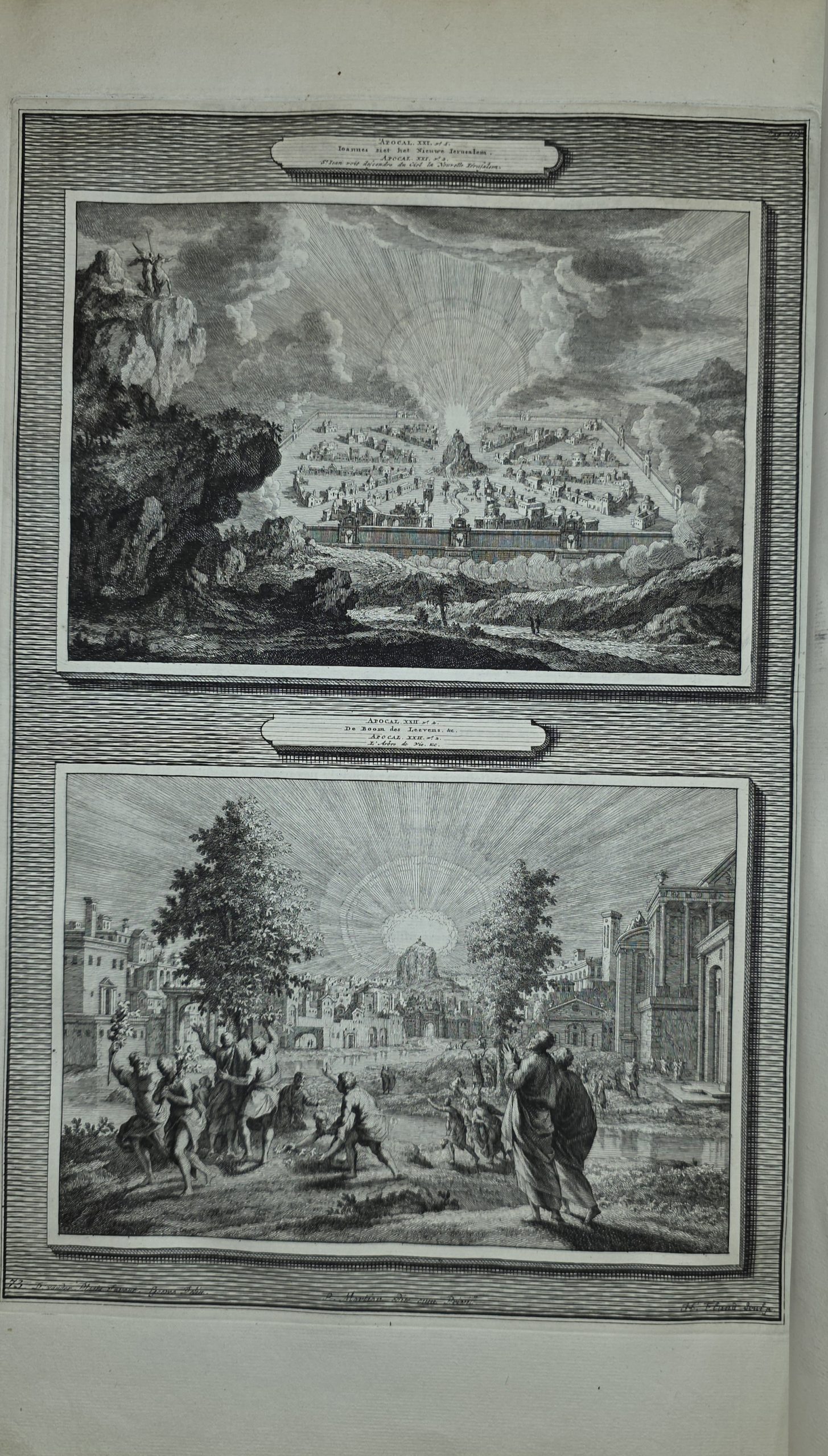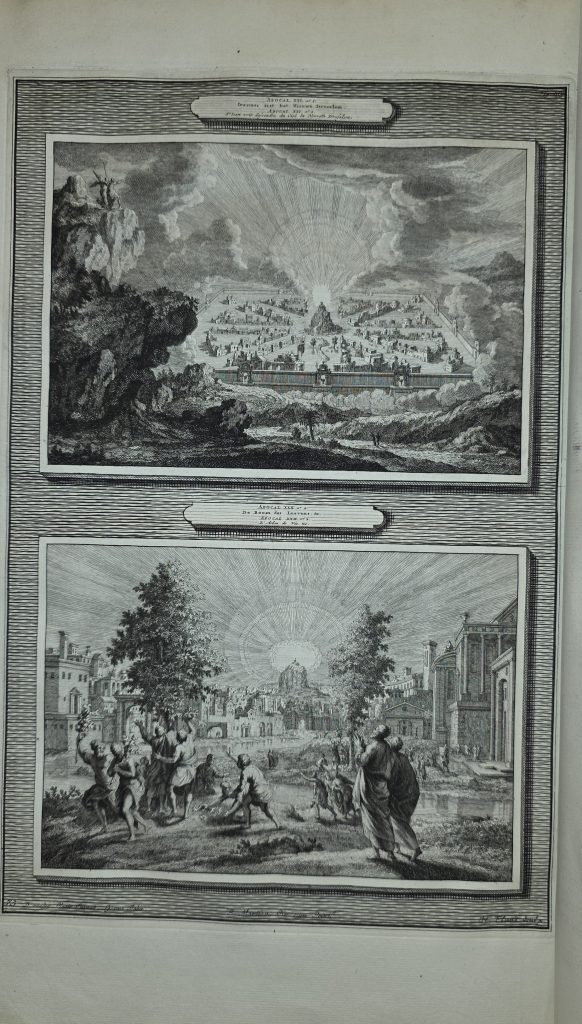
One of the most fascinating and powerful aspects of Gemini Deep Research for museum curatorial research is the way in which it has been able to surface uncommon and rarely mentioned differentiating details about unusual "states" or editions of works, especially those that differentiate first printings of rare works. When we first acquired our first edition 1866 Mame Dore Bible, none of the antiquarian book dealers or art scholars we spoke to mentioned that there were actually two states of the first edition, with Adam in Formation of Eve covered with a robe vs bush, of which our copy turned out to be the rarer first state, but Gemini flagged this immediately in the photos we provided it. Similarly, few auction or sales listings or library descriptions of Mortier's 1700 Large Bible discuss the "avant/apres les clous" ("before/after the nails") state, in which the last plate of the second volume broke during printing and was nailed back together, but once again Gemini not only flagged our copy as being the important "before the nails" state, but helped us track down several of the key references, debunked a common claim and found us an image of the "after" state, showing how Gemini's automous research capabilities can seamlessly transition into interactive curatorial Q&A.
Mortier's famous 1700 "Large Bible of Mortier" is a monumental set of more than 428 Biblical scenes across 214 full-page engraved sheets, with ours being of the large-margin 17.5" x 11" size. Unlike many picture Bibles of its era, all of its engravings were custom commissioned for the work, rather than being repurposed from other works, printed on thick wove paper with deep impressions and immaculate inking. As part of our curatorial aquisition workflow, we run each new work through Gemini Deep Research to identify any unique nuances of our specific copy that were not surfaced during the initial research phase or discussions with outside experts. In this case, none of the dealers or art experts we spoke to flagged that the first edition Mortiers are actually separated into two states based on the last plate of the second volume, the final Apocalypse plate. Early in the printing run, this massive copperplate cracked in half and was nailed onto a wooden board rather than being reengraved, yielding two states: the "before and after the nails". This specific state had never come up in any of our initial research or conversations with a number of experts. Indeed, searching for book and library listings of Mortier's Large Bible, precious few mention this distinguishing state and even fewer provide photos of the plate itself. Yet, Gemini immediately flagged that our copy was of the "before" state.
We then switched to interactive mode to explore more about this fascinating finding. Interestingly, those catalog entries and sales listings that do mention the before/after state almost never mention which specific plate is the one in question. Gemini tracked this right down for us, collecting a number of references like this Boston Public Library Quarterly edition from 1949 that touts its recent aquisition of a "before" copy and mentions the specific plate: "An accident happened to the plate illustrating St. John’s vision of the New Jerusalem and the tree of life in the Apocalypse — facing p. 145 in the second volume — which necessitated the nailing together of the broken parts, the nails at the border leaving their marks on the subsequent impressions. Copies have therefore been identified as “before the nails” or “with the nails.”
Fascinatingly, we kept encountering references to Brunet's 1814 "Manuel du libraire et de l'amateur de livres", Volume 2, page 112, claiming that Brunet stated that none of the Dutch copies contain the first state of this plate. In fact, Gemini tracked down the original digitized work at the Internet Archive for us and translated what the actual passage says, which is that only a small number of Dutch copies have the first state, not that none of them do: "HISTORY of the Old and New Testament (by David Martin), enriched with more than 400 figures. Antwerp (Amsterdam): P. Mortier, 1700, 2 vols., large folio. [152] This work, known under the title Mortier's Bible, is sought after on account of the engravings with which it is decorated; but to secure fine impressions, one must select copies whose figures were printed before the accident that befell the final plate of the Apocalypse, on page 145 of the second volume. That plate, having cracked, was repaired with nails; the impressions left by these nails along the borders of the print gave rise to the collector's designation of copies "before" or "with" the nails (avant ou avec les clous). Before the nails, this Bible is valued at 80 to 120 francs; large paper copies at 120 to 160 francs bound in calf, and 160 to 240 francs bound in morocco. Fine copies have fetched up to 300 francs at the La Vallière and Belin sales, and 420 francs at the d'O… sale. — With the nails: 60 to 72 francs; large paper copies at 80 to 120 francs. The edition printed with Dutch text is often said to contain the first impressions of the engravings; however, this holds true for only a small number of copies. 60 to 100 francs."
Incredibly, despite extensive searching, it turns out that finding imagery of this plate in the "after nails" state is extremely difficult, but here again, Gemini located a copy:
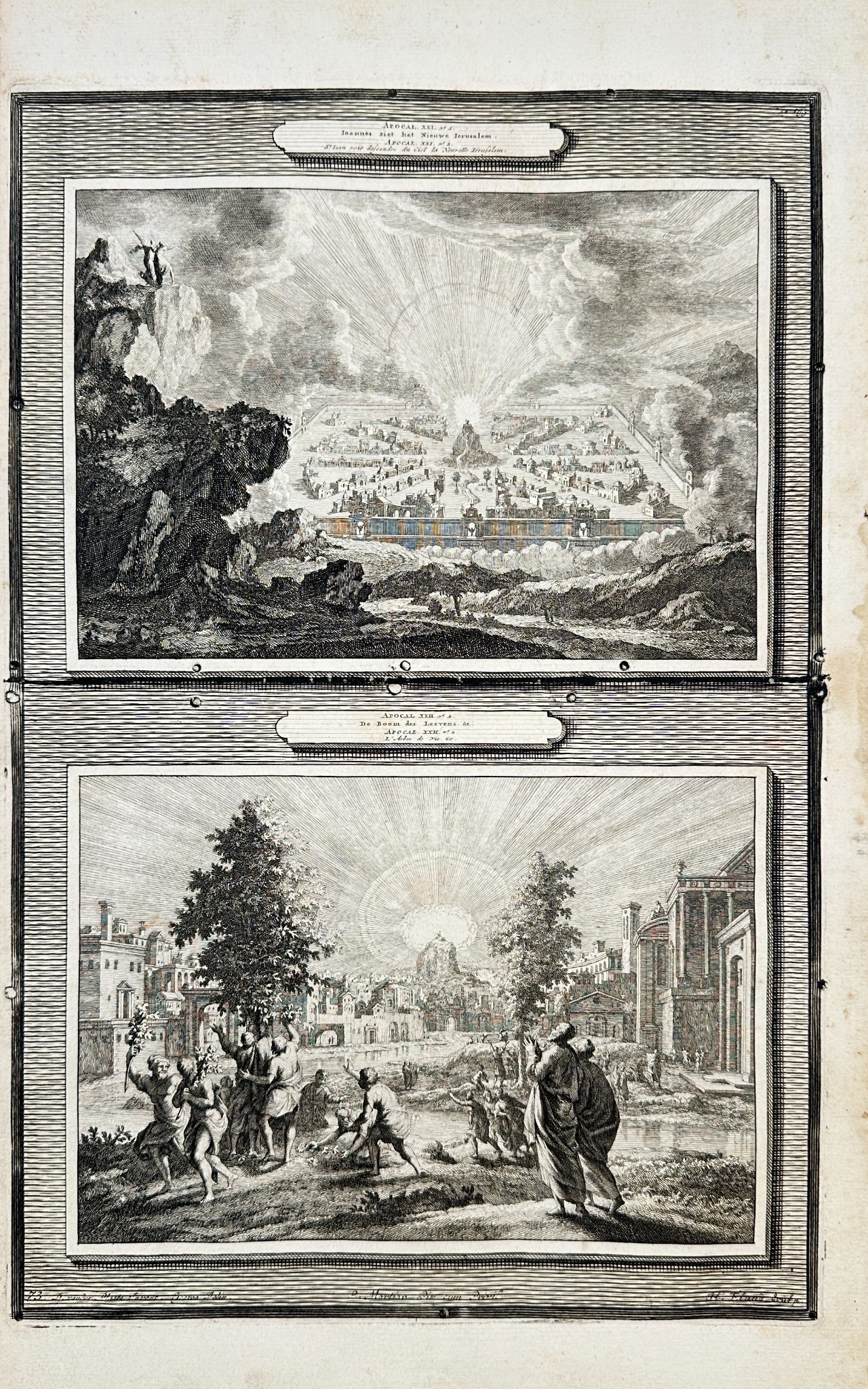
Which you can compare to our original first state: