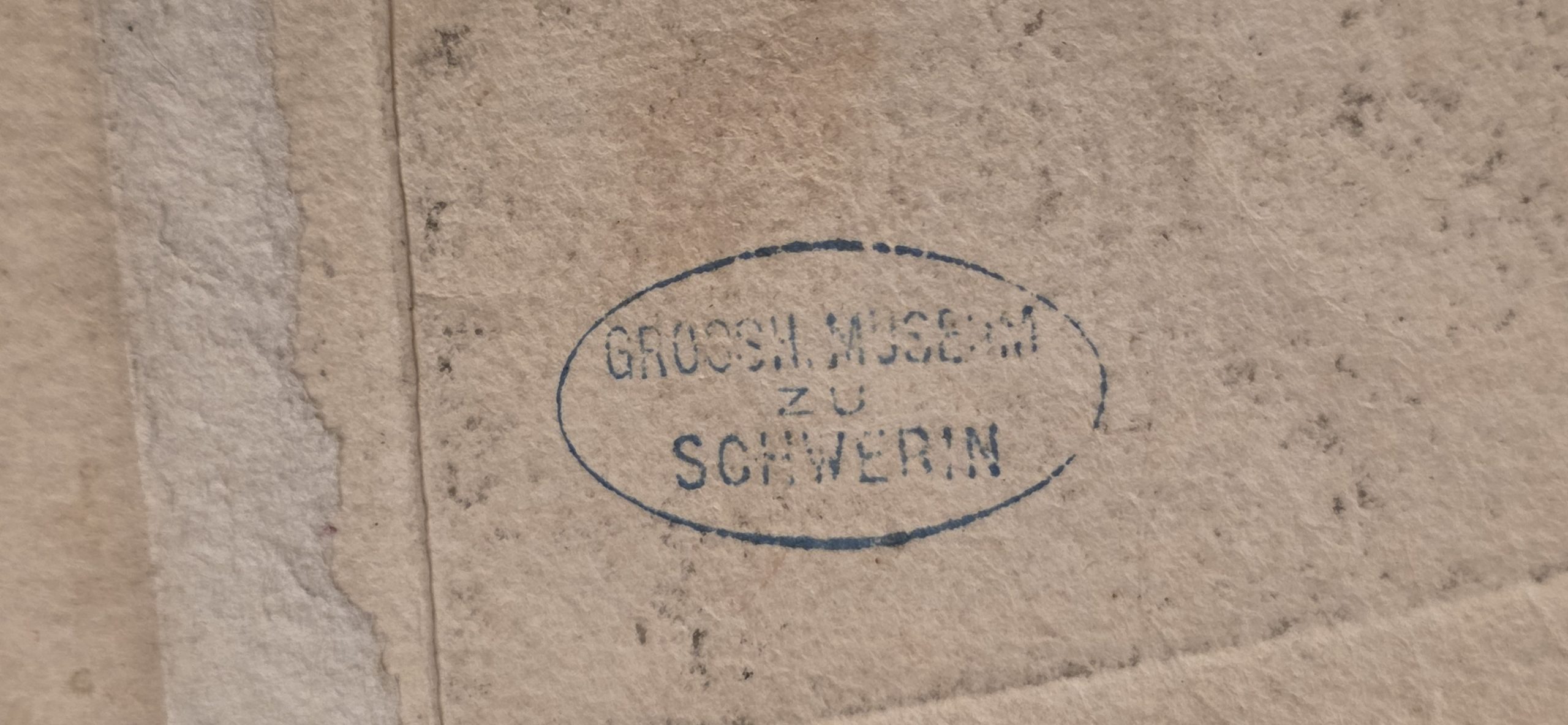
As we were accessioning a new series of prints recently of a large multi-sheet print, Gemini instantly spotted an institutional ownership stamp in the far corner of each sheet before we ourselves spotted it. A quick Google search for the text "grossh museum zu schwerin" (the traditional post-web pre-AI method of initial screening) brought up a few holdings in institutions like the British Museum and at auction, but nothing more about what institution this was, whether this is a deaccessioning stamp and when the institution might have sold this work into the private market.
In this case, we happened to be testing an automatic accessioning workflow in which Gemini was first asked to spot any former ownership marks and then for each, to automatically run the following prompt:
Tell me in detail about this provenance stamp and the collection/institution it belongs to.
Is this common?
Are there major sales known where this institution sold works with this stamp?
Before we had even spotted the stamp in the corner of the sheet, Gemini had picked it up and generated the brief below, both giving us the name of the institution and its modern instantiation, and confirming that this is a deaccessioning stamp from a lawful sale that likely took place in the 1920s, as well as providing us links to multiple institutional and major auction house sales confirming that information. It even tracked down an auction catalog from a decade ago that notes "Grossherzogliche Sammlung, Schwerin (Mecklenburg), Lugt 2273. Dieser Stempel in Gebrauch seit 1918, als Ersatz des bei Lugt aufgeführten Doublettenstempels Lugt 1079" ("Grand Ducal Collection, Schwerin (Mecklenburg), Lugt 2273. This stamp has been in use since 1918, as a replacement for the duplicate stamp listed by Lugt as Lugt 1079.").
Based on the visual evidence, here are the details regarding the provenance stamp, the institution, and its history on the art market.
The Stamp and the Institution
-
-
The stamp shown in the image features the text "GROSSH. MUSEUM ZU SCHWERIN" enclosed in an oval border.
-
This abbreviation stands for the Grossherzogliches Museum zu Schwerin (Grand Ducal Museum in Schwerin).
-
Located in Schwerin, Mecklenburg-Vorpommern, Germany, the institution is known today as the Staatliches Museum Schwerin (State Museum Schwerin).
-
The museum was established in 1882 by Grand Duke Frederick Francis II and is highly regarded for its 17th-century Dutch and Flemish paintings, as well as an extensive historical print room (Cabinet des Estampes).
-
In Frits Lugt’s definitive reference database for art provenance, Les Marques de Collections de Dessins & d'Estampes, this specific oval stamp is officially cataloged as Lugt 2273.
-
Is this common?
Yes, this specific provenance mark is quite common on the secondary art market. It is frequently found stamped on the verso (back) of Old Master prints, drawings, and copperplate engravings. Artworks bearing this mark regularly appear at international auction houses and can also be found in the permanent collections of major institutions worldwide, such as the National Gallery of Art in Washington, D.C., and the British Museum.
Sales and Deaccession History
There is a specific historical reason why artworks with this stamp are so prevalent on the market today:
-
-
The museum historically deaccessioned a large number of prints and drawings that were considered duplicates (Doubletten) of works they already held.
-
Following the fall of the German monarchy at the end of World War I, the museum began heavily selling off these duplicate works to raise funds, with a major wave of sales taking place throughout the 1920s.
-
Crucially, the specific stamp shown in your image (Lugt 2273) was introduced into use in 1918 expressly to serve as a deaccession or cancellation mark. It was created to replace the museum's earlier duplicate stamp (cataloged as Lugt 1079).
-
Therefore, the presence of this stamp on a piece of art serves as a dual marker: it verifies that the artwork was once part of the esteemed Grand Ducal collection, and it confirms that the piece was officially deaccessioned and legally sold off by the museum during or after 1918.
The ultimate authority on provenance stamps is the reference database "Les Marques de Collections de Dessins & d'Estampes" by Frits Lugt, maintained by the Fondation Custodia in Paris. It categorizes the Grand Ducal collection of Schwerin under several numbers, with Lugt 2273 representing this specific oval mark.
In professional provenance research and high-level market circulation, this mark is explicitly documented as a deaccession or duplicate cancellation mark. Here are authoritative references that confirm its exact use:
-
-
Galerie Kornfeld (Bern) In their official auction catalogs, Kornfeld, one of the leading Swiss auction houses for prints and drawings, defines the history of the mark precisely: "Grossherzogliche Sammlung, Schwerin (Mecklenburg), Lugt 2273. Dieser Stempel in Gebrauch seit 1918, als Ersatz des bei Lugt aufgeführten Doublettenstempels Lugt 1079."
-
Translation: "Grand Ducal Collection, Schwerin (Mecklenburg), Lugt 2273. This stamp in use since 1918, as a replacement for the duplicate stamp Lugt 1079 listed in Lugt."
-
-
Galerie Bassenge (Berlin) Another top-tier auction house specializing in Old Master prints, Bassenge formally catalogs artworks bearing this stamp with the following description: "Aus der Sammlung des großherzoglichen Museums, Schwerin (mit deren Tilgungsstempel, Lugt 2273 und 1079)."
-
Translation: "From the collection of the grand ducal museum, Schwerin (with their deaccession/cancellation stamp, Lugt 2273 and 1079)."
-
-
Swann Auction Galleries (New York) In major international sales of Old Master works (such as Rembrandt etchings), Swann catalogs routinely note when pieces are "Ex-collection Musée Grand Ducal, Schwerin" and cite both the original collection and duplicate/deaccession stamps together (e.g., "Lugt 2273 and 1079, verso"), showing how standard the deaccessioning marker is for authenticating pieces that left the museum in the 1920s.
-
When consulting with a curator or appraiser, referencing Frits Lugt 2273 and its status as the post-1918 "Tilgungsstempel" (cancellation stamp) or "Doublettenstempel" (duplicate stamp) will instantly establish the specific deaccession provenance of the piece.