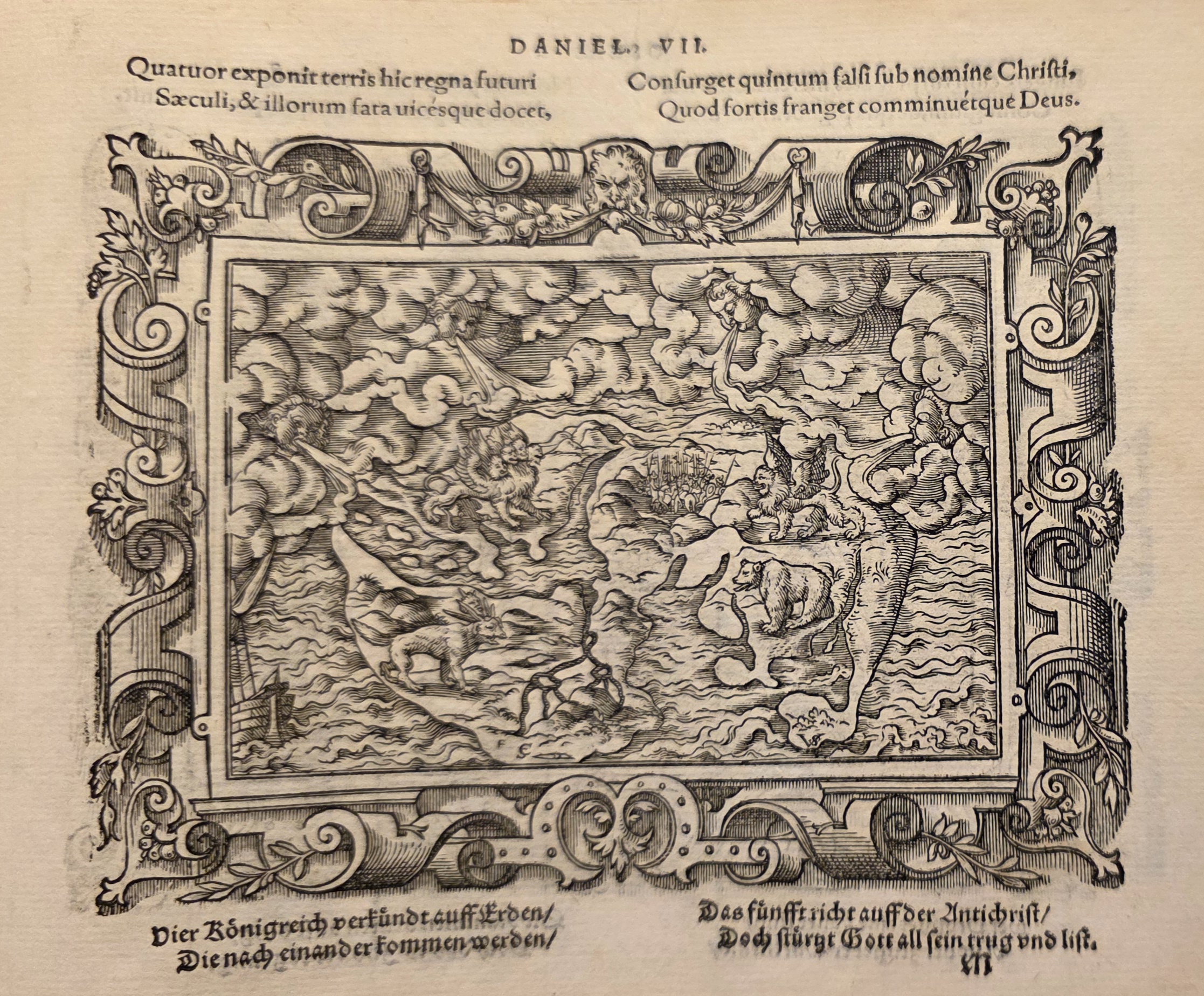
In this 1562 second edition of Virgil Solis's famous "Biblische Figuren des Alten und Neuen Testaments" we find a woodcut that looks like a map, with outlines of landmasses and water and various creatures. Let's ask Gemini to explain this in more detail.
Explain this image to me in detail.
It appears to be a map?
What is its source and Biblical meaning.
Explain in detail and justify.
1. Source and Context
This is a woodcut by the prolific German printmaker Virgil Solis (1514–1562), taken from his highly influential illustrated book, Biblische Figuren des Alten und Neuen Testaments (Biblical Figures of the Old and New Testaments), published in Frankfurt in 1560.
During the 16th-century Protestant Reformation, picture Bibles were vital educational tools used to teach scripture to the masses. The image is framed by an elaborate, swirling Mannerist border featuring strapwork, foliage, and a grotesque mask at the top—a famous hallmark of Solis's workshop that framed all the illustrations in this publication.
2. Is it a Map?
No, it is not a literal geographic map. However, your observation is very astute because the artist deliberately borrowed the visual language of 16th-century cartography.
It features elements commonly found on Renaissance maps: rolling sea waves, a jagged coastline, peninsulas, a contemporary sailing ship tossed in the water, and personified winds blowing from the edges of the known world. Rather than mapping real physical geography, it is an allegorical or visionary landscape. In Biblical prophecy, the "Great Sea" often represents the chaotic, churning mass of humanity or gentile nations, while the land represents the historical stage where world empires rise and fall. Solis composed the image to look like a map to convey that this prophecy concerns the fate and global dominion of the entire earth.
3. The Biblical Meaning and Visual Justification
The absolute key to unlocking this image is the text at the top center: "DANIEL. VII."
This artwork is a literal, point-by-point visual translation of the prophetic vision recorded in the Old Testament Book of Daniel, Chapter 7. In this chapter, the prophet Daniel has a terrifying nighttime dream regarding the succession of world empires. Here is how Solis meticulously justified his illustration using the Biblical text:
-
-
The Four Winds and the Sea (Daniel 7:2–3):
-
Scripture: "Daniel said: 'In my vision at night I looked, and there before me were the four winds of heaven churning up the great sea. Four great beasts, each different from the others, came up out of the sea.'"
-
Visual Justification: In the clouds at the top left, top right, and the sides, you can clearly see four human faces with puffed cheeks blowing fierce gusts of wind onto the tumultuous waters below, which toss a ship on the left.
-
-
The First Beast: The Winged Lion (Daniel 7:4):
-
Scripture: "The first was like a lion, and it had the wings of an eagle…"
-
Visual Justification: Located on the upper-right landmass, you can see a creature with the body of a lion standing on its feet, possessing large, feathered bird wings. Historically and theologically, this represents the Babylonian Empire.
-
-
The Second Beast: The Bear (Daniel 7:5):
-
Scripture: "And there before me was a second beast, which looked like a bear. It was raised up on one of its sides…"
-
Visual Justification: Just below the lion on the lower-right peninsula, a heavy bear is depicted lumbering onto the land. This represents the Medo-Persian Empire.
-
-
The Third Beast: The Four-Headed Leopard (Daniel 7:6):
-
Scripture: "After that, I looked, and there before me was another beast, one that looked like a leopard. And on its back it had four wings like those of a bird. This beast had four heads…"
-
Visual Justification: Located in the center-left, walking onto the shore. Solis clearly illustrates a spotted feline with four distinct heads and four wings. This represents the Greek/Macedonian Empire of Alexander the Great (which, upon his death, was split into four regions among his generals).
-
-
The Fourth Beast: The Terrifying Monster (Daniel 7:7):
-
Scripture: "After that… there before me was a fourth beast—terrifying and frightening and very powerful… and it had ten horns."
-
Visual Justification: Located at the bottom center, thrashing in the water, is a bizarre, scaly, and unidentifiable dragon-like monster with multiple horns protruding from its head. This traditionally represents the Roman Empire.
-
-
4. Textual Analysis & the 16th-Century Reformation Meaning
While the inner image strictly follows the Book of Daniel, the text surrounding it adds a heavy layer of 16th-century Protestant Reformation theology.
The Latin Text (Top):
Quatuor exponit terris hic regna futuri / Sæculi, & illorum fata uicesque docet, Consurget quintum falsi sub nomine Christi, / Quod fortis franget comminuetque Deus. Translation: "Here he sets forth to the earth four kingdoms of the future age, and teaches their fates and changes. A fifth will arise under the false name of Christ, which the strong God will break and crush."
The German Text (Bottom):
Vier Königreich verkündt auff Erden / Die nach einander kommen werden / Das fünfft richt auff der Antichrist / Doch stürtzt Gott all sein trug vnd list. VII Translation: "Four kingdoms are proclaimed on earth, / Which will come one after another. / The Antichrist establishes the fifth, / But God overthrows all his deceit and cunning."
The "Fifth Kingdom" Justification: If you read Daniel 7, the text only explicitly mentions four beasts. So why do both the Latin and German captions warn of a fifth kingdom?
In Daniel 7:8, the fourth beast sprouts a "little horn" that speaks boastfully and makes war against God's people. During the 16th-century Reformation in Germany, Protestant reformers (such as Martin Luther) firmly identified this "little horn" as the Papacy in Rome, labeling the Pope the "Antichrist" who operates under a "false name of Christ."
Therefore, this specific page is not merely an educational Bible illustration; it is a piece of contemporary Protestant commentary. It visually tells the history of the world through the four ancient empires, but uses the accompanying text to warn the 1560s reader about a "fifth" kingdom of the Antichrist, reassuring them that God will ultimately destroy its deceit.