

One of the largest and most detailed engravings ever produced, Pieter de Jode I's (whose father produced the first picture Bible, the Jode Thesaurus) massive 1615 engraving of Jean Cousin's 1585 The Last Judgement painting stands as a monumental work of art, measuring 56 x 48 inches (4 ft 8 in x 4 ft – totaling 18.6 square feet) and features detail so small it requires a magnifying glass in places to fully discern the extent of its detail. Absolutely breathtaking in person, even in digital form, the image depicts so many myriad scenes in so much detail everywhere the eye looks that it can be impossible to take it all in at once. Perhaps most importantly, the image is so rich in Biblical motifs and iconography and depicts such an incredibly wide range of scenes that a modern viewer can easily miss the importance of a given depiction or fail to understand the deeper Biblical meaning embodied by a particular element. How might Gemini allow us to offer a virtual Q&A with this massive engraving that helps contextualize and explain it for a modern audience? Here we use the just-released Gemini 3.8 Flash, which does an exceptional job at answering our questions below. The results below offer an incredible first glimpse at the power of Gemini-powered interactive Q&A with historical artworks and the potential for institutions to begin to leverage (with appropriate safeguards and human mediation) such tools to help broaden public interest, understanding and engagement with their art, as well as to help curators spot visual elements or symbolism even they may not have immediately recognized.
While cultural institutions will necessarily wish to be exceptionally cautious, given AI's propensity for hallucination, misattribution and other error, it is likely that the public is already beginning to use AI models to help them understand and explain artwork they see in museums and thus institutions should begin to explore how to meet their audiences where they are already heading and develop example prompts and integrations for the major models to help guide them towards the best results, especially tooling that allows models to draw more heavily and direct visitors to curator-created resources directly, rather than today's approach of forcing visitors to navigate complex websites filled with technical and curatorial jargon that rarely address the questions visitors want to ask about the artwork itself. As the results below demonstrate, the models already can produce extraordinary results right out of the box.
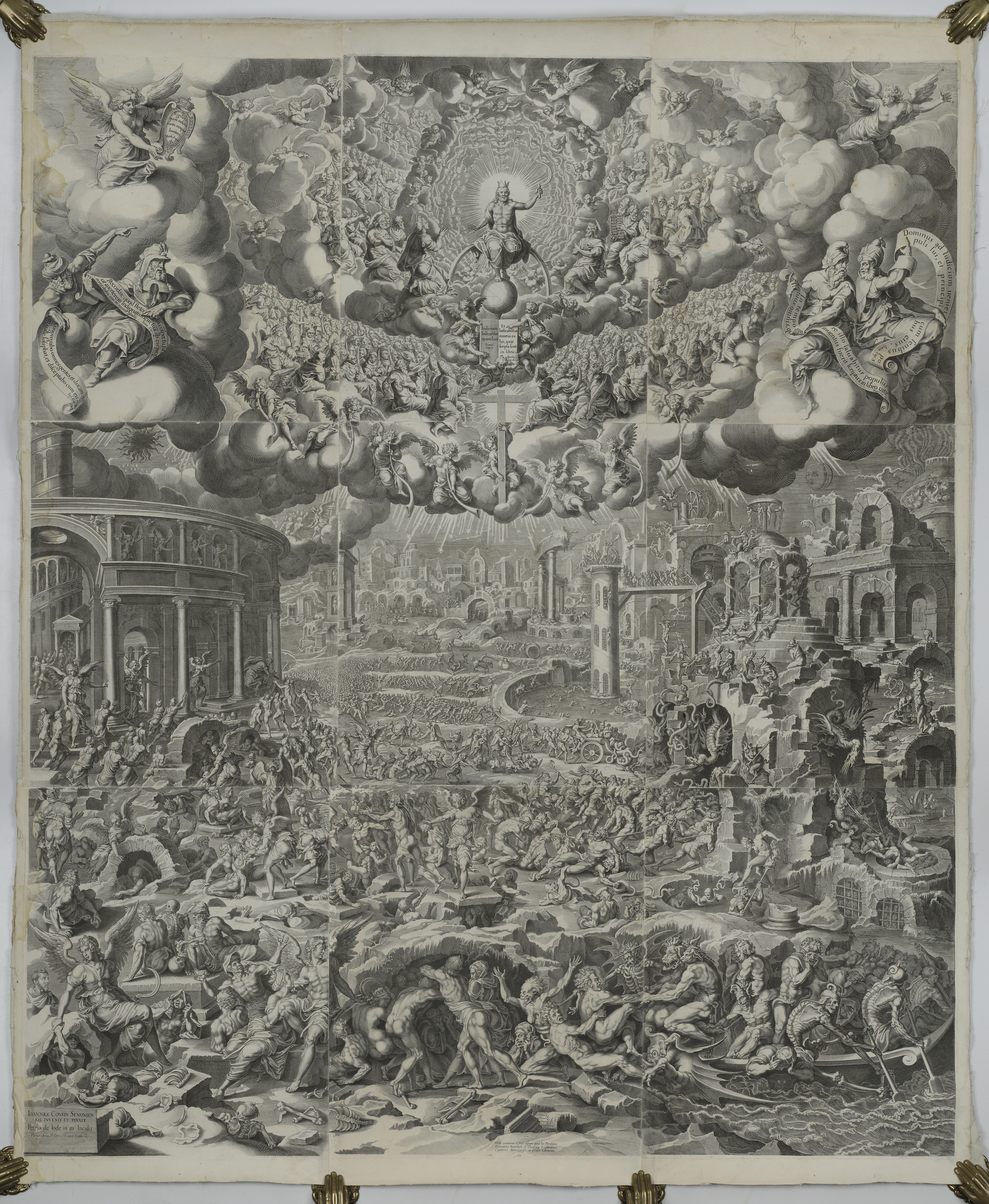
Below you can see the engraving in its full glory (this is the second state with enrichments by Pierre Drevet and printed in the late 1600s):
Let's start with a simple question and ask Gemini what this text at the top right says:
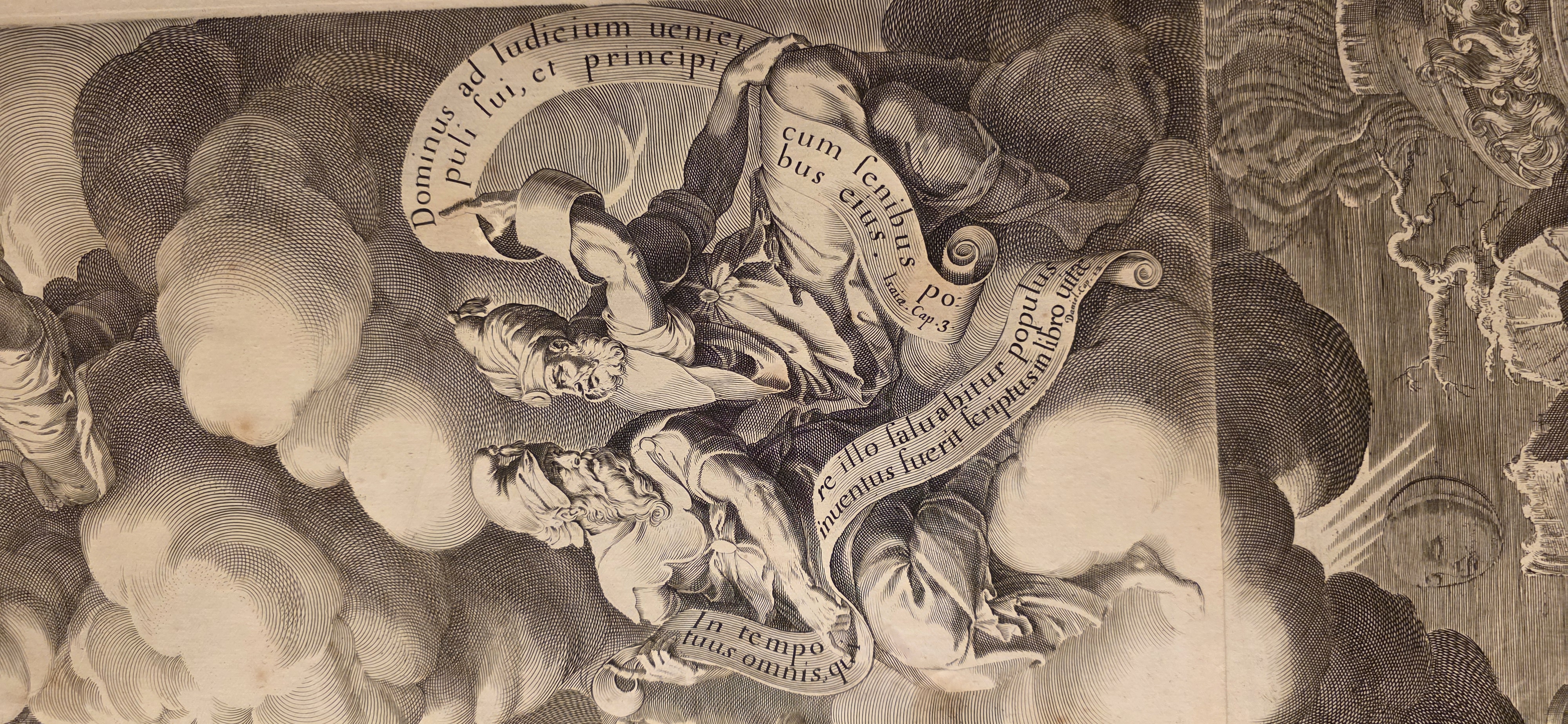
The image depicts two Old Testament prophets holding scrolls with Latin text, complete with citations pointing to the specific biblical chapters.
The Left Scroll (Prophet Daniel)
-
- Transcription: In tempore illo saluabitur populus tuus omnis, qui inuentus fuerit scriptus in libro uitae. Daniel. Cap. 12
- Translation: "At that time your people shall be saved, everyone who shall be found written in the book of life. Daniel Chapter 12." (This is from Daniel 12:1).
The Right Scroll (Prophet Isaiah)
-
- Transcription: Dominus ad iudicium ueniet cum senibus populi sui, et principibus eius. Isaiae. Cap. 3
- Translation: "The Lord will enter into judgment with the elders of his people, and its princes. Isaiah Chapter 3." (This is from Isaiah 3:14).
Meaning and Significance
-
- Theological Meaning: The juxtaposition of these two verses highlights the dual themes of the biblical End Times (eschatology): Divine Judgment and Ultimate Salvation. Isaiah's prophecy is a stern warning that God will bring strict judgment upon the corrupt, oppressive leaders of the earth. Daniel's prophecy counters this with a message of hope, promising that the righteous—those recorded in the "Book of Life"—will be spared and granted salvation during this time of great tribulation.
- Visual Significance: In the image, the prophets are depicted sitting peacefully on clouds, elevated above a chaotic scene of worldly destruction. Below them, you can see falling celestial bodies (like a face in the moon plummeting) and ruins, which visually represents the apocalyptic Day of Judgment they are prophesying. Placing these two specific prophets together over a scene of destruction was a common technique in Renaissance and Baroque religious art to unify different prophetic warnings into a single cohesive vision of the apocalypse.
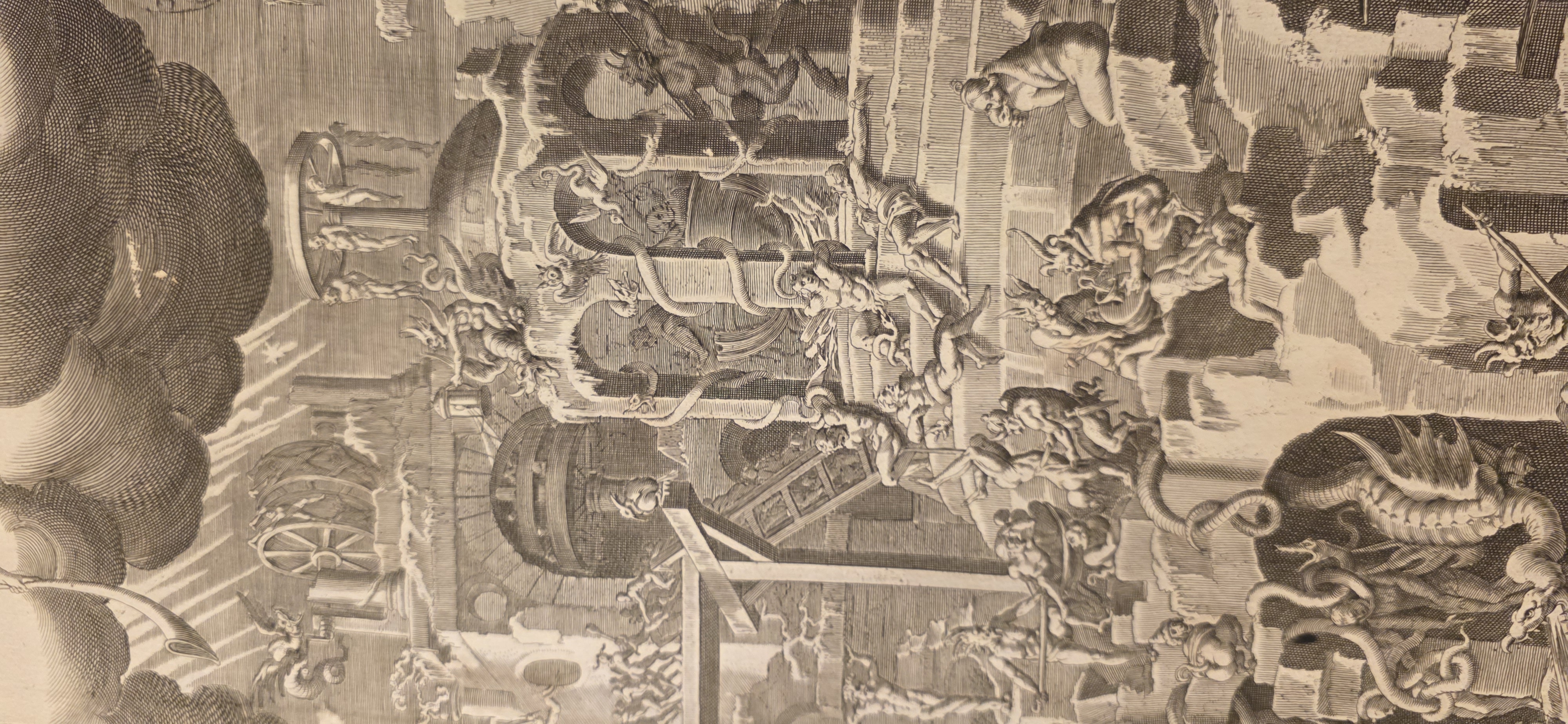
This scene is filled with a wide range of historical scenes of torment, some of which are well-known and others that are far less known. Let's see what Gemini is able to make of this corner of the engraving:
This is a scene from the Last Judgement.
Look EXTREMELY CAREFULLY.
There are a huge number of individual tortures and torments depicted.
I want a bulleted list of them all, where each bullet is one of the tortures/torments depicted, a visual description,
where it is in the image and its Biblical and Last Judgement significance.
Be COMPELTELY THOROUGH AND IDENTIFY *ALL* OF THEM.
Also explain the signficance of the creatures and scenery.
Torments and Punishments of the Damned
- The Angelic Trumpet of Doom and Ray of Wrath (Top Left, Breaking from the Clouds): An angelic arm thrusts through heavy cloud banks blowing an elongated curved horn that casts diagonal, piercing rays of divine light into the abyss. Biblically grounded in 1 Corinthians 15:52 ("For the trumpet will sound, the dead will be raised imperishable") and Matthew 24:31, this signifies Christ's final, irreversible verdict at the Last Judgment, awakening the dead and driving the condemned into eternal punishment.
- Breaking on the Vertical Spiked Wheel (Upper Left, Atop the Masonry Pillar): A massive vertical spoked wheel rotates high in the air while naked damned souls are bound, mangled, and broken across its rim and spokes, watched by a perching winged demon. In medieval vision literature (such as The Kalender of Shepherdes), breaking on the wheel was the designated punishment for Pride (Superbia), fulfilling Luke 14:11 ("For everyone who exalts himself will be humbled") by displaying those who were haughty on Earth at dizzying heights only to repeatedly shatter and debase them.
- The Revolving Carousel Gibbet / Hanging Wheel (Upper Right, Above the Domed Pavilion): A large horizontal, revolving wheel mounted on a central stone spindle suspends several naked sinners by ropes attached to their necks, limbs, and torsos, rotating them eternally in mid-air over the fiery roof. Derived from the early Christian apocryphal visions of the Apocalypse of Peter and Apocalypse of Paul, this punishment was assigned to blasphemers, slanderers, and perjurers, symbolizing perpetual strangulation, exposure, and eternal vertigo without the release of death (Revelation 9:6).
- The Infernal Screw-Press and Industrial Capstan (Upper-Middle Left, Inside the Masonry Arch): Within a dark, vaulted cavernous chamber, a giant mechanical screw-press or rotary mill with an upright shaft and heavy gear works operates, crushing condemned sinners caught in its mechanism. This embodies the apocalyptic motif of the "great winepress of God's wrath" (Revelation 14:19–20) as well as the crushing, mechanical futility of worldly labor and avarice turned into an eternal instrument of torment.
- Flagellation and Forced March across the Scaffolding (Mid-Left, on the Wooden Gangway and Ladder): Horned demons brandishing whips, scourges, and clubs beat a terrified procession of naked souls, driving them ruthlessly across a precarious wooden beam and forcing them down a steep ladder into the deeper chasms. This depicts the active expulsion of the wicked described in Matthew 25:41 ("Depart from me, you cursed, into the eternal fire"), while recalling the medieval Brig of Dread over which sinners are forced to stumble into the waiting abyss.
- Flaying and Crucifixion against the Wall (Far Mid-Left, beneath the Wooden Scaffolding): A naked sinner is bound and stretched out against a masonry pier in an agonized, splayed cruciform posture, having his skin sliced, flayed, and stripped by a demonic torturer. Flaying was traditionally reserved for the deceitful, hypocrites, and blasphemers, while the posture serves as a horrific, grotesque parody of Christ's Crucifixion, demonstrating that those who rejected the grace of the Cross are subjected to its bodily agony without redemptive hope.
- Boiling in the Great Cauldron of Pitch and Sulfur (Center, Inside the Middle Arch of the Pavilion): A massive iron vat sits directly over leaping flames beneath a stone archway, filled with boiling pitch, molten lead, and sulfur in which damned souls are immersed up to their chests and necks. Rooted in Ezekiel 24:3–5 (the allegory of the boiling pot) and Revelation 21:8 ("the lake that burns with fire and sulfur"), boiling alive is the classic retribution for Gluttony (Gula), violence, and murder, stewing the bodies that once indulged in excess or shed blood.
- Serpentine Binding and Pillar Constriction (Center Register, Inside the Left Arch): A standing soul is trapped inside a narrow alcove, bound to the architectural column and tightly coiled and crushed by a massive serpent winding up his legs, torso, and throat. This embodies the entangling snare of sin and the relentless bite of the "undying worm" (Isaiah 66:24; Mark 9:48), representing the ceaseless, suffocating remorse of conscience and the crushing burden of unrepented guilt.
- Demonic Impalement with Flesh-Hooks (Center Register, Inside the Right Arch): A muscular, horned, satyr-like demon stands inside the archway wielding a long three-pronged pitchfork or flesh-hook, actively stabbing and prodding sinners trapped in the alcove to keep them confined. Directly reminiscent of Dante’s Malebranche demons in the Inferno (Cantos XXI–XXII), this portrays devils as cruel, vigilant wardens ensuring that no soul can scale the architecture or evade their prescribed sentence.
- The Amphitheater of Writhing Agony and Biting Vipers (Center Foreground, across the Curved Stone Steps): Multiple naked souls are cast across stepped stone terraces in extreme contortions of suffering; one lies flat on his back as a serpent bites into his groin, while others are lashed to central posts or writhe backwards in screaming agony. This encapsulates the physical and public humiliation of the damned, fulfilling the biblical prophecy of eternal "weeping and gnashing of teeth" (Matthew 8:12, 13:42) where sinners are laid bare before God and their peers.
- Herding Sinners in the Trough / Pit of Fire (Lower-Left Foreground): A horned demon uses a heavy wooden punting pole to shove a pair of cowering sinners packed inside a wooden trough or boat into a fiery chasm, aided by an overseer demon. This merges the classical myth of Charon ferrying souls across the river Styx with medieval imagery of sinners cast like refuse or livestock into burning kilns, highlighting their complete dehumanization and loss of autonomy.
- Forced Anal Infusion of Boiling Pitch / Molten Metal (Lower Right, Directly below the Amphitheater Steps): Two grotesque, horned, goat-legged demons hold a condemned sinner pinned face-down and arched over the jagged rocks while one forcibly jams a spout or vessel against the sinner's anus and pours a scalding liquid (boiling oil, pitch, or molten metal) directly into his rectum. This specific, visceral torment was widely used in medieval and Renaissance depictions of Hell to punish Sodomy / Unnatural Lust (Luxuria) as well as Avarice (Avaritia), administering the boiling fluid through the orifice associated with carnal transgression or the hoarding and evacuation of filthy lucre, literalizing James 5:3 ("Their corrosion will testify against you and eat your flesh like fire").
- The Solitary Despair of the Damned / The Pain of Loss (Mid-Right, on an Isolated Rocky Outcrop): A lone naked figure sits huddled with bowed head, clutching her knees and breast in utter desolation, completely disconnected from the frantic activity around her. This visualizes the punishment of Sloth / Despair (Acedia / Tristitia) and the theological poena damni (the pain of loss)—the supreme psychological torment of recognizing that one is forever excluded from the beatific vision of God and trapped in eternal isolation (Luke 16:24–26).
- Constriction and Swallowing in the Dragon's Chasm (Bottom-Left Cavern): In the lowest subterranean grotto, a monstrous dragon with ribbed bat wings, scaled neck, and gaping jaws emerges, surrounded by coiled, writhing vipers that entangle an inverted, flailing sinner. This represents Leviathan and the biblical Hellmouth (Job 41; Revelation 12:9, 20:2), the ancient demonic serpent/dragon that swallows the wicked into the bottomless pit (abyssus), sealing their eternal damnation.
- The Sentry of the Nether Chasm (Bottom Right Edge): In a deep cleft at the bottom corner, a horned, satyr-featured demon grips a spear or staff and glares upward, patrolling the edge of the pit. This underscores that Hell’s boundaries are impassable and heavily guarded, fulfilling Luke 16:26 regarding the "great chasm fixed" that eternally bars any crossing or escape.
Significance of the Creatures and Grotesques
- The Owl Perched over the Center Arch: In Christian bestiaries and biblical prophecy (such as Isaiah 34:11–15 and Psalm 102:6), the owl is an unclean bird of prey that inhabits desolate ruins, actively shuns daylight, and thrives in darkness; it serves here as a direct emblem of spiritual blindness, heresy, and those who deliberately chose mortal sin over the light of Christ.
- Coiling Serpents and Vipers: Crawling across pillars, masonry, and human bodies, serpents represent the primordial deceit of Satan in the Garden of Eden (Genesis 3) and the inescapable venom of original sin. In the infernal realm, they become executioners, specifically biting and wrapping around the limbs, throats, and sexual organs that were the instruments of sin during earthly life.
- The Monstrous Dragon / Leviathan: Emerging from the deepest chasm, this beast represents the apocalyptic Great Dragon of Revelation 12:9 ("that ancient serpent called the devil, or Satan, who leads the whole world astray"). In medieval and Counter-Reformation theology, Leviathan's cavernous mouth is the literal entry to the bottomless pit from which no soul ever returns.
- Satyr-Like Horned Demons: Designed with goat horns, beastly snouts, cloven hooves, and shaggy caprine legs, these demons adapt the pagan iconography of Pan, satyrs, and fauns—emblems of base animal instincts, wild frenzy, and uncontrolled lust. They directly recall Matthew 25:32–33, where Christ at the Last Judgment divides humanity into the righteous "sheep" and the condemned "goats."
- Winged Chimeras and Harpies: Nestled along the cornices, arches, and ledges, these monstrous, hybrid bird-beast grotesques represent the unnatural perversion and corruption of God’s divine order, fulfilling Revelation 18:2, which describes the fallen realm as a "haunt for every unclean spirit, a haunt for every unclean and detestable bird."
Significance of the Infernal Scenery and Architecture
- The Ruined Classical Pavilion and Arches: The setting utilizes crumbling Roman arches, broken columns, and cracked domes to depict the infernal city (the Dantean City of Dis). In Counter-Reformation art, fractured classical architecture serves as a symbol of fallen paganism, human vanity, and the collapse of earthly empires (recalling the fall of Babylon in Revelation 18:2), emphasizing that earthly splendor ends in ruin without Christ.
- Dripping Stalactites and Icicles (Fire and Ice): The cornices and arches are encrusted with hanging, jagged formations that resemble frozen icicles as well as congealed brimstone and pitch. This visually unites the dual torments of Hell established by Dante and Christian theologians: extreme, unquenchable heat combined with extreme, petrifying cold, reflecting Job 24:19 ("Drought and heat consume the snow waters; so does the grave those who have sinned").
- Cataracts of Fire and Subterranean Waterfalls: The sheer drops across the middle and lower right depict vertical sheets of boiling bitumen, brimstone, and liquid pitch cascading into the abyss. This creates the literal "lake of fire burning with sulfur" described in Revelation 19:20 and 20:10, evoking the subterranean rivers of classical and Christian underworlds (Phlegethon and Acheron).
- Precipitous, Jagged Cliffs and Vertical Stratification: The stepped, broken, and chaotic rock ledges provide a stark visual antithesis to the harmonious, luminous geometry of the Heavenly Jerusalem. The steep, downward-plunging strata reinforce the irreversible descent of the soul, visually articulating the physical and spiritual collapse into the bottomless pit.
What is going on in this scene?
This is a scene from Pieter Jode's engraving of Jean Cousin's Last Judgement.
Look EXTREMELY CAREFULLY.
Explain what's going on here and its Biblical and Last Judgement significance and meaning.
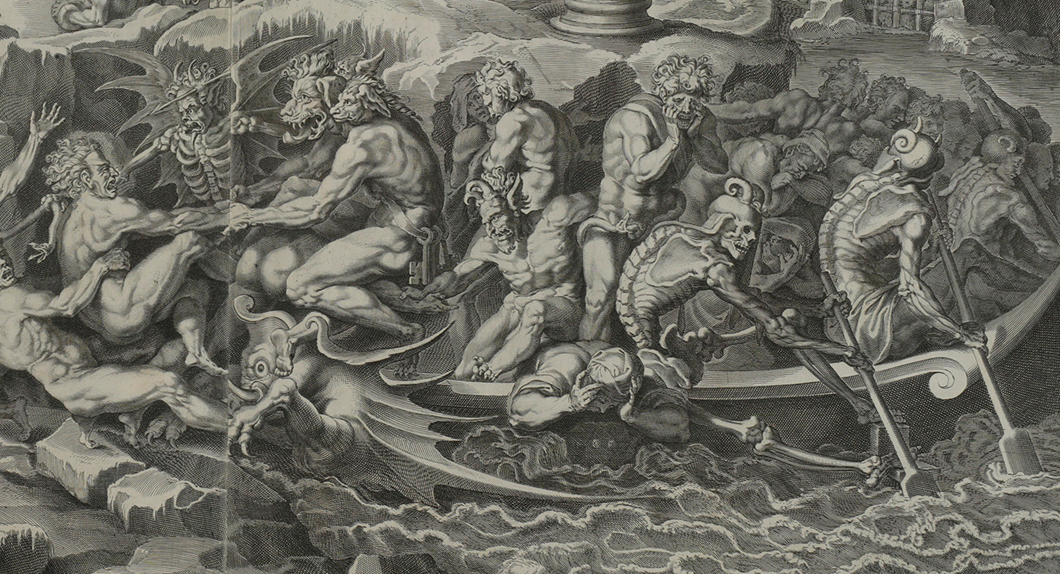
This detail from Pieter de Jode I’s engraving (after Jean Cousin the Younger’s late 16th-century painting The Last Judgment, ca. 1585, now in the Musée du Louvre) captures the terror of the ferry of the damned crossing into eternal perdition.
Located in the lower-right zone of the overall composition—the traditional position on Christ’s left hand reserved for the reprobate—the scene depicts the damned being ferried across the infernal waters (the classical Styx/Acheron transformed into Christian Hell).
Key Visual Details
- The Skeletal Ferrymen (The Charon Motif):
- On the far right, grotesque skeletal fiends with exposed ribcages and bizarre helmets (one spiraled like a shell or ram’s horn) propel the skiff with long oars.
- They embody death personified, acting as the infernal rowers delivering souls to the entrance of Hell.
- The Damned Souls in Agony:
- Packed tightly in the boat, the naked sinners embody pure terror and profound remorse.
- The Crouching Figure: At the bottom center of the boat, a man sits crouched, clutching his face in total despair. This figure is a direct Mannerist quotation of the famous damned soul in Michelangelo’s Sistine Chapel Last Judgment.
- Others clutch their heads and cheeks in grief, visually depicting the biblical expression of absolute hopelessness.
- Demonic Overseers and the Key to the Abyss:
- Seated boldly on the boat's edge is a muscular, horned, multi-faced demon (combining goat, lion, and grotesque features).
- The Key: Hanging from a strap around this demon’s hip is a large iron key, marking him as the demonic warden of the prison of the underworld, ready to lock away the souls forever.
- Behind him, a bat-winged, skeletal demon brandishes a barbed spear, driving the damned forward.
- The Violent Struggle at the Shore (Left):
- At the far left, damned souls desperately push back and wrestle against demons. They attempt to resist entering the skiff, but their muscular struggle is futile—they are inexorably hauled aboard and cast into damnation.
- The Leviathan / Sea Monster Beneath:
- Churning beneath the hull in the dark, frothing water is a spined, serpentine sea monster with webbed talons, fins, and a gaping mouth. It reinforces that the waters themselves are predatory and that no escape is possible.
Biblical and Last Judgement Significance
- Separation of the Sheep and the Goats (Matthew 25:31–46):
In Christian eschatology, Christ judges all humanity at the end of time, placing the righteous on His right and the wicked on His left: “Depart from me, you cursed, into the eternal fire prepared for the devil and his angels.” (Matt. 25:41). This boat represents the irreversible transition from judgment to everlasting punishment. - "Weeping and Gnashing of Teeth" (Matthew 13:42, 50; Luke 13:28):
The physical gestures of the damned—clutching faces, open-mouthed wailing, and gripping foreheads—give literal form to Christ's repeated warning of the psychological torment and remorse experienced by those cast into the "outer darkness." - The Key to the Bottomless Pit (Revelation 9:1, 20:1–3):
The Book of Revelation frequently mentions the key to the abyss / bottomless pit (shaft of the abyss). In Christian iconographic tradition, demons or the Angel of the Bottomless Pit possess keys to lock the condemned into Hell for eternity. - Leviathan and the Waters of Chaos (Job 41, Revelation 20:13):
The monster beneath the boat invokes Leviathan, the biblical embodiment of chaos, sin, and Satanic power lurking in the deep. Revelation 20:13 notes that at the judgment, "the sea gave up the dead that were in it," but here the infernal waters actively consume the reprobate. - Christian Syncretism with Classical Myth (Dante’s Charon):
The boat is not strictly from Scripture; it reflects the deep influence of Dante Alighieri’s Inferno (Canto III) and Michelangelo. Dante famously incorporated the classical ferryman Charon into Christian theology, turning him into a demon who herds reluctant souls across the Acheron. Jean Cousin and Pieter de Jode synthesized this classical-Dantesque motif with northern Renaissance grotesque realism.
Let's use the same prompt to take a closer look at this scene:
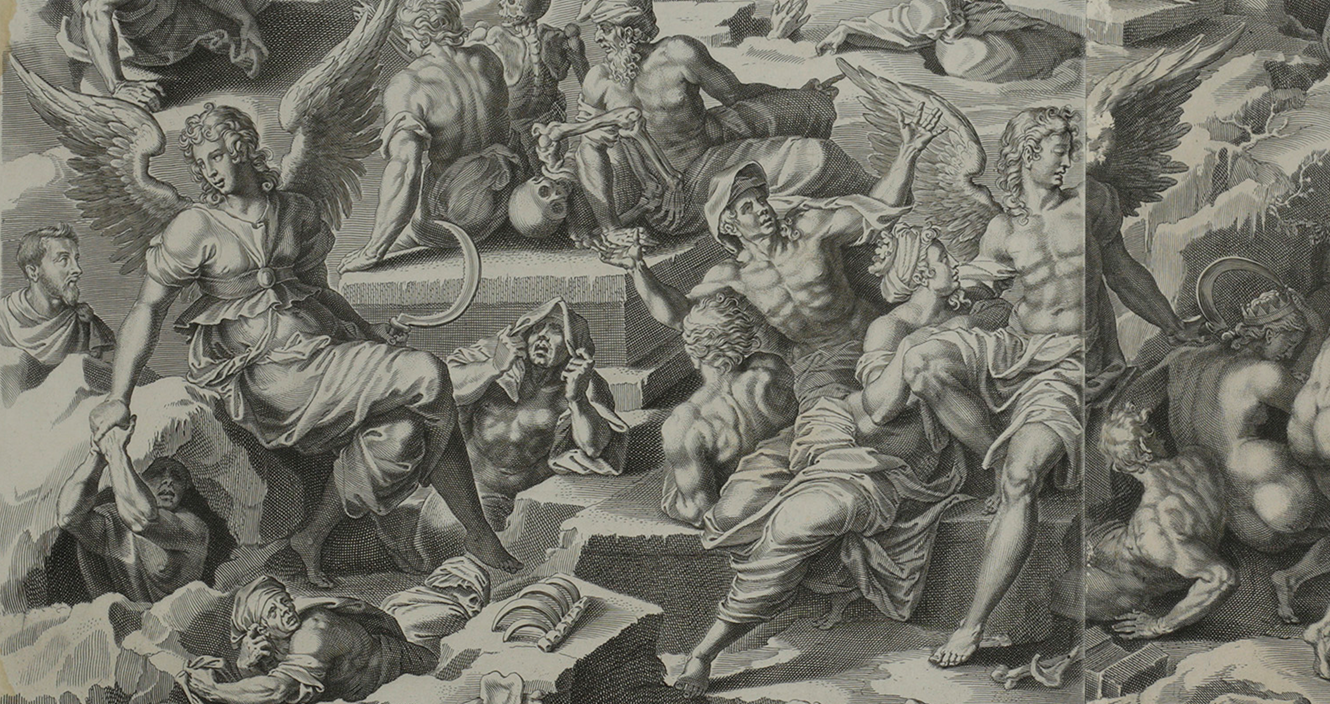
1. The Angel with the Sickle (The Great Eschatological Harvest)
- The Action: The large winged angel seated on the rock prominently holds a sharp sickle in his left hand, while leaning down with his right hand to grasp the wrist of a resurrecting man and pull him up from a rocky fissure/grave.
- Biblical Meaning: The sickle directly invokes Revelation 14:14–16:
“…and in his hand a sharp sickle. And another angel came out of the temple, crying with a loud voice to him that sat on the cloud, 'Thrust in thy sickle, and reap: for the time is come for thee to reap; for the harvest of the earth is ripe.'”
- In Christian eschatology, the end of the world is described as the universal harvest (as in the Parable of the Wheat and the Tares, Matthew 13:30, 39: “the harvest is the end of the world; and the reapers are the angels”). The sickle is the instrument of gathering the righteous "wheat" into the heavenly barn. Here, the angel literally reaps souls from the earth/graves.
2. Awakening from the Sleep of Death (Dormition to Resurrection)
- The Figures in Shrouds: At the bottom and middle ground, several figures are shown in various stages of emerging from broken stone tombs and burial shrouds:
- At the very bottom, a man still wrapped in grave clothes props himself up on his elbow, clutching his head in confusion, blinking as his senses return.
- In the center niche, another newly awakened soul pulls the shroud off his head, eyes squinting and mouth open in astonishment at the sudden, blinding divine light.
- Biblical Meaning: This visualizes Daniel 12:2:
“And many of them that sleep in the dust of the earth shall awake, some to everlasting life…”
It also references 1 Thessalonians 4:16 and 1 Corinthians 15:52: “for the trumpet shall sound, and the dead shall be raised incorruptible, and we shall be changed.”
3. Reconstitution of the Body (Ezekiel's Vision of the Dry Bones)
- The Skeletons and Relics: On the elevated stone ledge sits an elder accompanied by bare bones, a human skull, and a partial skeleton. Just beside him, flesh is visibly restored onto skeletal frames.
- Biblical Meaning: This is a direct depiction of the Resurrection of the Flesh based on Ezekiel 37:1–10 (The Valley of Dry Bones):
“…the bones came together, bone to his bone. And when I beheld, lo, the sinews and the flesh came up upon them, and the skin covered them above…”
Catholic theology strictly affirmed the literal bodily resurrection (credo in carnis resurrectionem), especially emphasized during the Counter-Reformation: God reunites each person's exact flesh and bone before Christ passes final judgment.
4. Angelic Guidance toward Salvation
- The Winged Herald on the Right: Another youthful angel gestures upward with raised arms and wings spread, guiding a group of newly resurrected, draped men and women.
- The Interaction: The resurrected souls gaze upward in awe and gratitude, turning their bodies away from the cracked earth below and looking toward the beatific vision above. This contrasts with the damned (who appear on the opposite side of Cousin’s grand composition), who are cast downward into torment.
Summary
Rather than a generic depiction of the afterlife, Cousin and de Jode carefully constructed a narrative of transition from death to eternal life: from dust, dry bones, and grave shrouds, through the angelic harvest of Revelation, to the physical reconstitution and elevation of the Elect into the Kingdom of Heaven.
What about the scene at top, using the same prompt:
This is a scene from Pieter Jode's engraving of Jean Cousin's Last Judgement.
Look EXTREMELY CAREFULLY.
Explain what's going on here and its Biblical and Last Judgement significance and meaning.
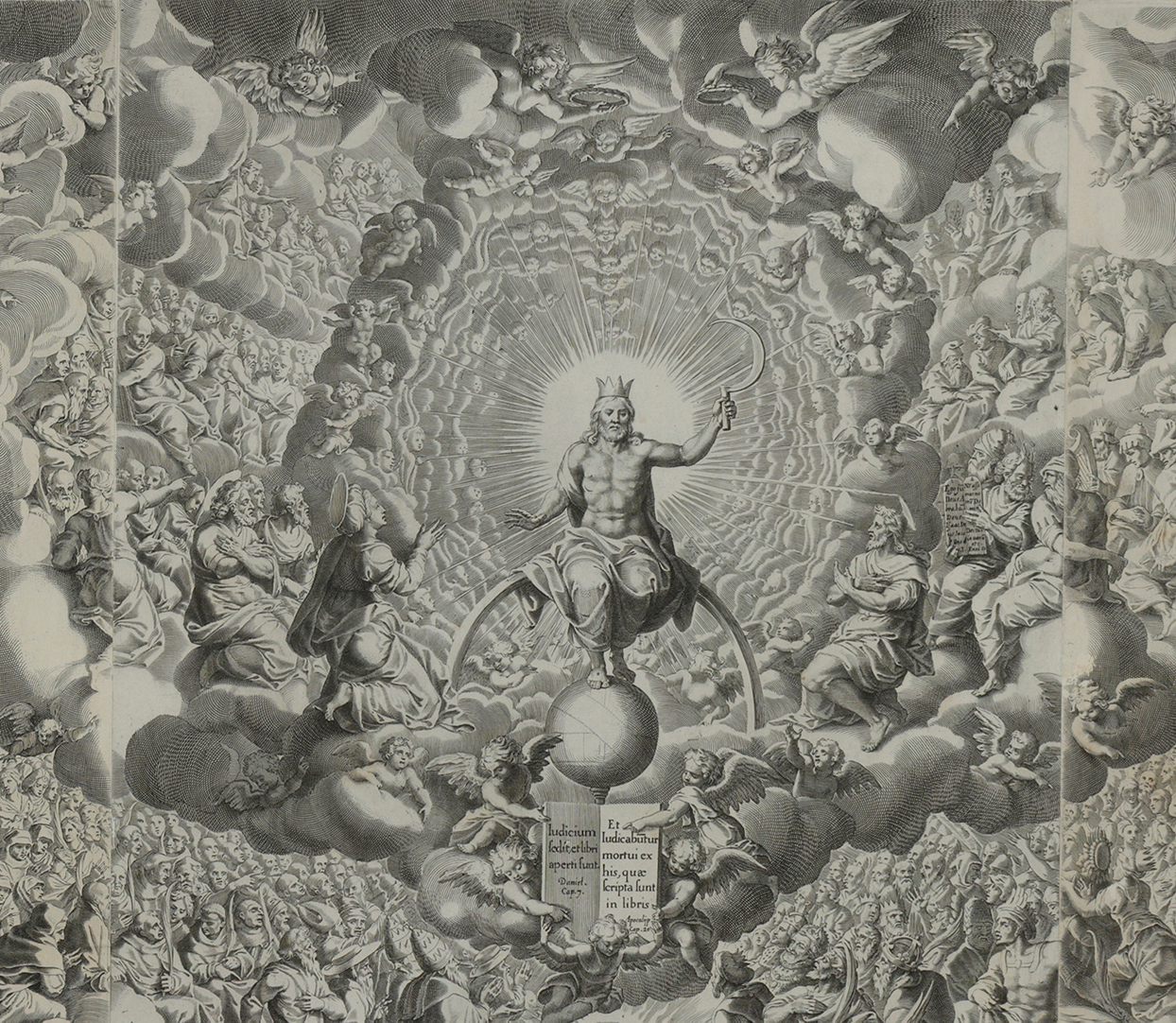
This engraving by Pieter de Jode after Jean Cousin’s famous Last Judgment depicts the heavenly court and Christ the Judge, but it incorporates a distinctive and rarely rendered combination of apocalyptic and biblical motifs:
1. Christ as the Apocalyptic Harvester (Revelation 14)
The most striking and unusual iconographical feature in this depiction is that Christ holds an upright, curved sickle in his left hand while wearing a crown.
- The Biblical Source: In standard Last Judgment iconography (like Michelangelo’s), Christ raises his right hand to summon the elect and gestures downward with his left to cast down the damned, or is shown with a sword and a lily flanking his mouth. Here, Cousin and de Jode draw directly from Revelation 14:14–16:
“And I looked, and behold a white cloud, and upon the cloud one sat like unto the Son of man, having on his head a golden crown, and in his hand a sharp sickle. And another angel came out of the temple, crying with a loud voice to him that sat on the cloud, Thrust in thy sickle, and reap: for the time is come for thee to reap; for the harvest of the earth is ripe. And he that sat on the cloud thrust in his sickle on the earth; and the earth was reaped.”
- Significance: The sickle symbolizes the final Eschatological Harvest—the separation of wheat from chaff, and the gathering of souls at the end of time. Combined with the wound visible in his side, Christ is presented simultaneously as the Sacrificial Lamb who redeemed humanity and the Sovereign King and Harvester who has come to claim and judge the earth.
2. Christ in Majesty over Creation
- The Celestial Sphere and Rainbow: Christ sits enthroned upon a celestial arc (a rainbow, referencing Genesis 9 and Revelation 4:3), and his feet rest upon a celestial/terrestrial globe marked with meridian lines. This signifies Christ’s cosmic dominion over heaven, earth, and time itself (Pantokrator).
- The Radiance and Heavenly Host: Christ is encircled by concentric tiers of radiant light filled with dense, innumerable choirs of cherubim and seraphim, visually translating the boundless glory of God (Shekinah).
3. The Traditional Deësis (Intercession)
Flanking Christ on either side are the two primary intercessors of traditional Christian art:
- The Virgin Mary (Christ’s right): Kneeling with hands raised or clasped toward her Son, pleading for mercy on behalf of the faithful.
- St. John the Baptist (Christ’s left): Draped in ascetic robes, also kneeling in prayerful supplication.
- Together with Christ, they form the classic Deësis composition, a visual balance of Christ's unbending justice with divine mercy.
4. The Heavenly Court and the Elect
Surrounding the central Deësis are tiers of saints, prophets, and martyrs seated upon billows of clouds:
- Directly to the right, behind John the Baptist, is Moses holding the Two Tablets of the Law (inscribed with Hebrew script), demonstrating the continuity and fulfillment of the Old Covenant in the New.
- Behind Moses are King David with his harp and the Old Testament patriarchs and prophets.
- On Christ’s right (behind Mary) sit the Apostles, who Christ promised would sit upon thrones judging the twelve tribes of Israel (Matthew 19:28).
- Below, crowds of the elect—including popes (with tiaras), cardinals, bishops (with mitres), kings, monks, and laypeople—look upward in awe, adoration, and relief. Above, flying angels hold laurel wreaths and crowns of victory to bestow upon the righteous.
5. The Book of Judgment and Prophetic Texts
Directly beneath Christ’s footstool, a group of putti/angels support an open monumental book with two Latin inscriptions that declare the scriptural authority for this moment:
- Left Page (Daniel 7:10):
“Iudicium sedit, et libri aperti sunt. Daniel. Cap. 7.”
(“The judgment was set, and the books were opened.”)- Links the scene to Daniel’s Old Testament vision of the Ancient of Days and the Son of Man coming to deliver final judgment.
- Right Page (Revelation 20:12):
“Et iudicabuntur mortui ex his, quae scripta sunt in libris. Apocalyp. Cap. 20.”
(“And the dead were judged out of those things which were written in the books, according to their works.”)- Affirms that every human deed has been recorded, establishing the divine transparency and absolute justice of the trial.
Summary
Rather than simply showing the physical sorting of souls into Heaven and Hell, this specific central plate captures the divine apparatus of the Last Judgment: Christ fulfills Old Testament prophecy (Daniel) and apocalyptic vision (Revelation) as King, Harvester, and Judge, holding the sickle of the final harvest before the open books of human destiny.
Finally, what about this statement seen at the bottom center?
This is at the bottom of Pieter Jode's engraving of Jean Cousin's Last Judgement.
Translate and explain its meaning and why it is there.
Use your knowledge of the time period and place in which the engraving was made to contextualize it.
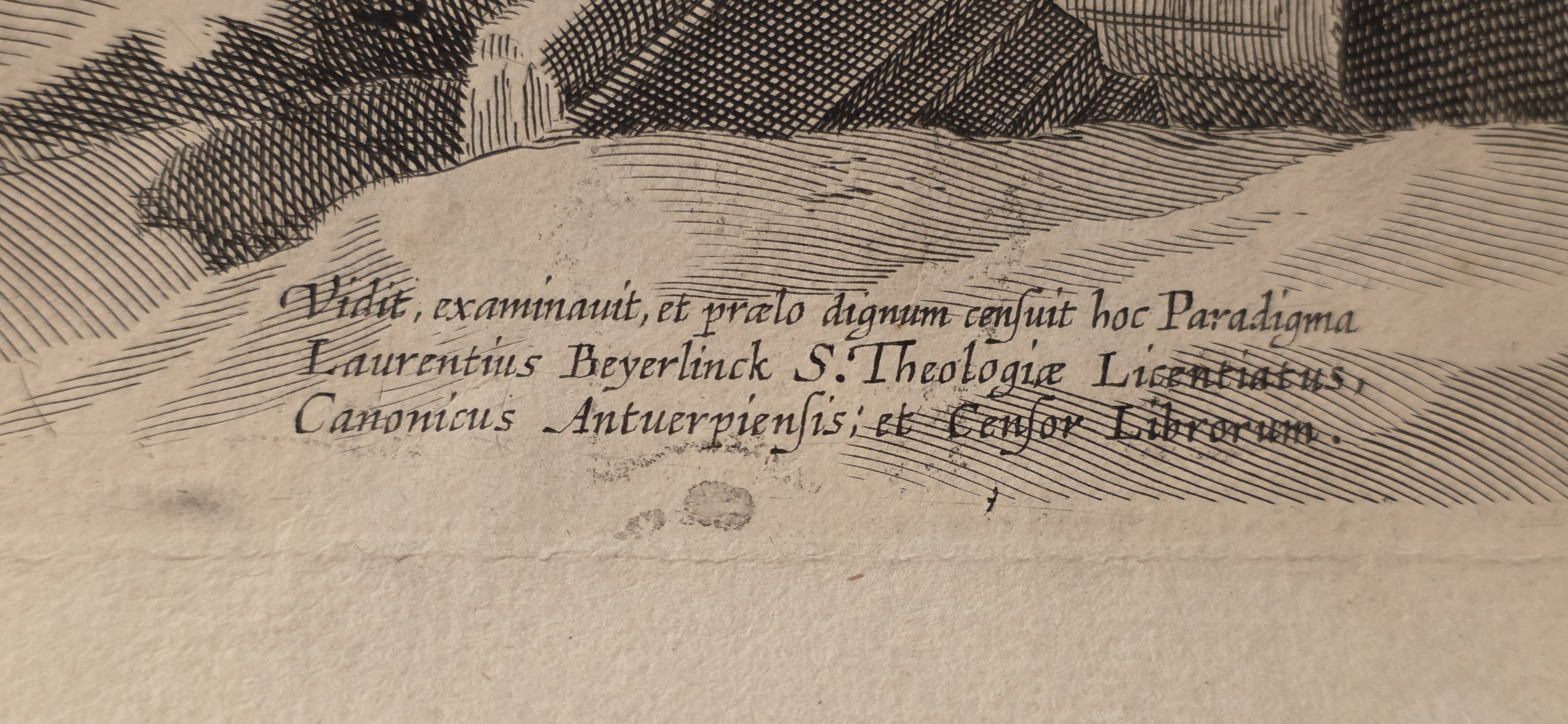
1. Transcription and Translation
Latin text:
“Vidit, examinavit, et prælo dignum censuit hoc Paradigma Laurentius Beyerlinck S. Theologiæ Licentiatus, Canonicus Antuerpiensis, et Censor Librorum.”
English translation:
“Laurentius Beyerlinck, Licentiate of Sacred Theology, Canon of Antwerp, and Censor of Books, has seen, examined, and deemed worthy of the press this model [representation/exemplar].”
2. Meaning of the Inscription
This inscription is an official ecclesiastical imprimatur (or ecclesiastical approbation).
- “Vidit, examinavit, et prælo dignum censuit” (has seen, examined, and deemed worthy of the press): This is a standard formal formula used by censors to confirm that the work contains nothing contrary to Catholic faith, morals, or church doctrine, and therefore may legally and licitly be published and printed.
- “hoc Paradigma” (this model/pattern/exemplar/image): Referring to the printed composition or design itself.
- “Laurentius Beyerlinck” (1578–1627): A real, prominent figure in 17th-century Antwerp—an encyclopedist, theologian, Canon of the Cathedral of Our Lady in Antwerp, and official ecclesiastical censor (censor librorum).
3. Historical Context: Antwerp and the Counter-Reformation
To understand why this statement is engraved directly onto the plate, we must look at early 17th-century Antwerp in the Spanish Netherlands (Southern Netherlands):
A. Strict Counter-Reformation Censorship
Following the Council of Trent (1545–1563) and the religious conflicts that shook the Low Countries (including the Calvinist Beeldenstorm or iconoclastic fury in Antwerp in 1566 and 1581), the Catholic Church and the Spanish Habsburg rulers enforced rigorous controls over printed media.
- Censorship applied not only to printed books, but also directly to devotional and religious prints.
- The decree of the Council of Trent on sacred images strictly mandated that no unusual or dogmatically questionable image could be placed in churches or published without episcopal oversight.
B. The Theological Sensitivity of the Subject Matter
The subject of this engraving—The Last Judgment (originally painted by Jean Cousin the Younger around the late 16th century and engraved by Pieter de Jode I in 1615)—depicts complex, doctrinally sensitive themes:
- Salvation, damnation, purgatory, the resurrection of the flesh, Christ’s justice, and the hierarchy of heaven and hell.
- Because imagery was considered a primary tool for teaching and defending Catholic dogma against Protestant theology, an ambitious, crowded composition of the Last Judgment had to be strictly checked to ensure it adhered to orthodox Catholic eschatology.
C. Legal Protection and Commercial Value
Including the censor’s approval prominently on the plate served two practical purposes for printmakers like Pieter de Jode:
- Legal Immunity: It protected the engraver, printer, and publisher from prosecution, confiscation, or fines under royal and episcopal edicts.
- Commercial Assurance / "Privilege": It functioned as a seal of orthodoxy and quality for buyers across the Catholic world (including Spain, Italy, and the Spanish Americas), reassuring consumers and religious institutions that the print was doctrinally pure and officially sanctioned.