

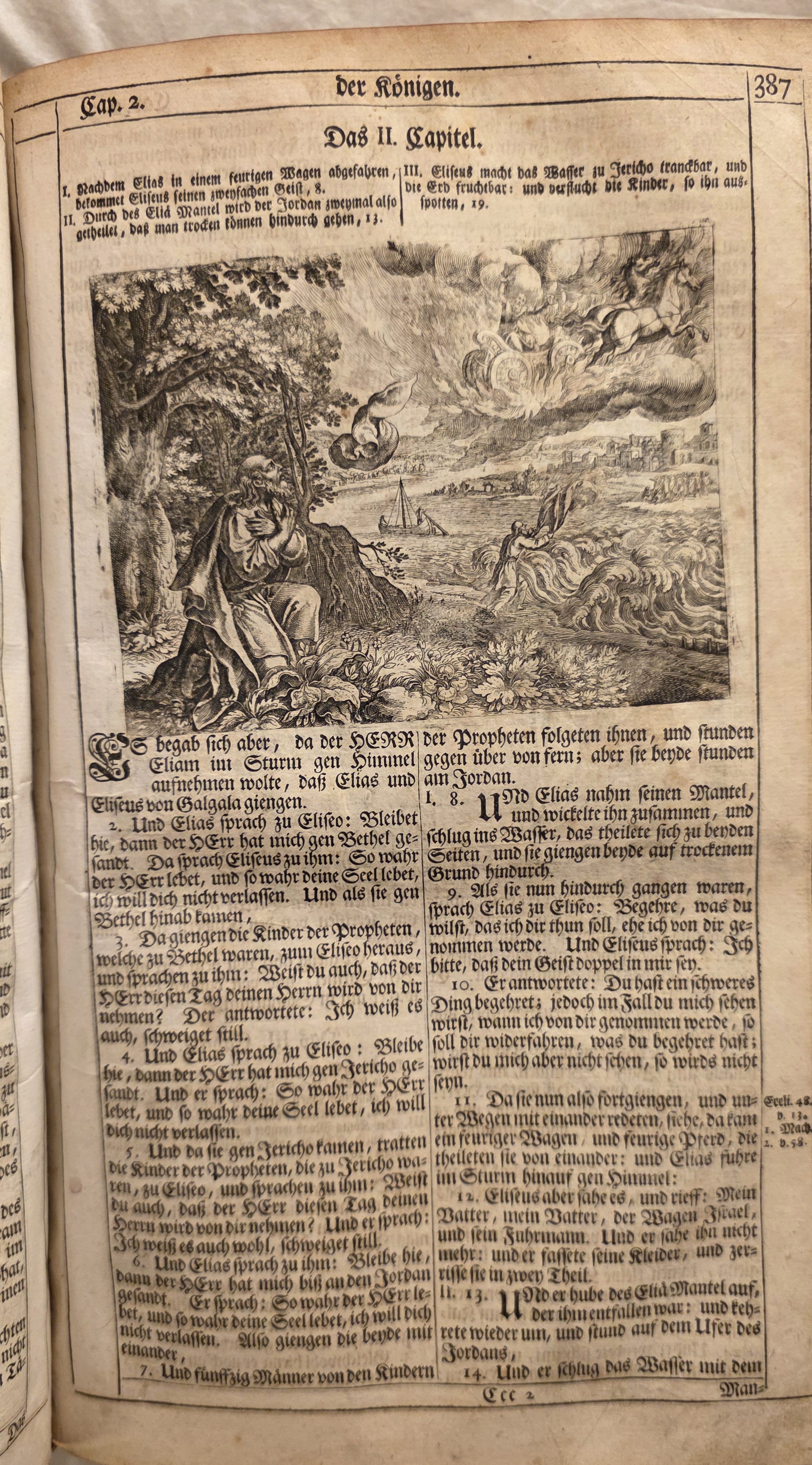
Going through the Collection's 1740 Catholische Mayntzische Bibel last night we stumbled across this fascinating page, in which the copperplate engraving is crooked and partially overlaps the text in its lower left corner. Immediately we thought of how this page could be used in a museum exhibit to teach book making and the two-part letterpress + copperplate intaglio printing process that was used at the time to produce illustrated works like this. That got us thinking about how a religious scholar curating an exhibit on the Bible or Biblical art might display this page because of its imagery and not even realize the significance of the crooked image, with visitors wondering about the misalignment but having nowhere to turn for more information. Let's imagine for a moment we are a visitor to a museum exhibition encountering this page in a display case – could we snap a photo of it with our phone and ask Gemini to explain what's going on? What if we are a teacher escorting a third grade elementary school class – how might we explain this complicated highly technical process in a way they could understand? As expected, Gemini passes both tests with flying colors, offering yet again another powerful reminder for museums and other cultural heritage institutions of how AI models can help their visitors engage with their collections in powerful new ways that advance their understanding and appreciation of those works.
Below is the photo we quickly snapped of the page and the prompt we used with Gemini to ask about it:
This page comes from the 1740 Catholische Mayntzische Bibel.
Explain why the engraving is crooked.
This was Gemini's response:
The engraving appears crooked relative to the page and outer text border because of how copperplate engravings had to be printed alongside movable type in the 18th century.
-
- Two Separate Printing Passes: In 1740, text and illustrations required two entirely different presses:
-
Relief printing (letterpress): The text and decorative borders were set from raised metal type and printed on a standard common screw press. A blank window was left in the typesetting layout for the image.
-
Intaglio printing (rolling press): The image was etched or engraved into a copper plate and printed using a heavy-pressure rolling press.
-
- Manual Registration Error: Because the sheet had to be fed into two different machines at two different times, aligning the copper plate inside the reserved gap relied entirely on the pressman's eye, pin registration, or paper guides. If the copper plate was placed slightly tilted on the bed or if the sheet shifted as it entered the rollers, the illustration printed at an angle relative to the straight letterpress frame.
-
Plate Mark Evidence: You can see the distinct indented rectangular bevel (the plate mark) running around the illustration. While the ruled borders of the page frame and type columns are square to each other, the plate mark itself sits noticeably tilted, confirming the misalignment occurred during this second, manual intaglio pass.
- Two Separate Printing Passes: In 1740, text and illustrations required two entirely different presses:
Now let's imagine you are a teacher escorting your third grade class through the museum and are trying to find a good way of explaining the complicated letterpress + intaglio copperplate process to them. Let's just ask Gemini to explain:
Explain this in a way my 3rd grade elementary school class can understand.
Be visual in your description for them.
Imagine you have a piece of paper, and you want to use two different rubber stamps on it.
Almost 300 years ago, printers couldn't print words and pictures at the exact same time—they didn't have modern printers like we do! Instead, they had to print this page in two separate steps, kind of like using two big stamps:
-
-
Stamp One (The Words): First, they lined up tiny metal letters like little puzzle pieces to print all the words and the straight black frame. But they left a big empty blank space in the middle, like an empty picture frame waiting for a photo.
-
Stamp Two (The Picture): Next, they took that same piece of paper over to a completely different, giant rolling machine to print the picture from a flat metal plate.
-
Here’s the catch: a person had to line up that metal picture plate by hand right into the empty blank spot.
Have you ever tried sticking a sticker or pressing a stamp straight into a box on a worksheet, and it went on a little sideways? That’s exactly what happened here! The printer tried their best to line it up, but the metal plate twisted just a tiny bit as it went through the heavy rollers, leaving the picture frozen at a tilt forever.
If you look super closely right around the edge of the picture, you can even see a dent pressed into the paper—that's the dent left by the corners of the heavy metal plate!
How about the opposite – a deeply technical graduate-level course that is already familiar with the underlying techniques, but perhaps hasn't seen how they can go wrong?
I'm teaching an advanced "art of the book" class to phd students with a deep knowledge of letterpress and copperplate intaglio techniques.
Give me a deeply technical explanation for my students with all of the relevant detail and terminology and be highly descriptive and visual as well.
The crooked orientation of the vignette illustrates the inherent physical and mechanical dissonance of eighteenth-century hybrid book production: marrying relief typography with intaglio rolling-press illustration within a single impression sheet.
Incompatible Technologies and the Two-Pass Dilemma
To produce this leaf, the pressmen could not run the sheet through a single press setup due to diametric mechanical requirements:
-
-
The Letterpress Form (First Pass): The Latin fraktur and Schwabacher type, marginalium, chapter summary, and structural brass rules were composed, locked into a chase with furniture and quoins, inked with viscous varnish-and-lampblack ink via ink-balls, and struck flat under a common wooden screw press (such as a Blaeu or traditional two-pull press). Within this forme, the compositor had to construct a literal void: a rectangular "window" built out of wooden furniture or blank metal spacing material (quads) corresponding to the planned dimensions of the copper plate.
-
The Intaglio Plate (Second Pass): The illustration depicts an etched/engraved copper plate—evidenced by the swelled burin lines, delicate cross-hatching, and tonal atmospheric rendering in the chariot-of-fire scene. Intaglio relies on capillary action to draw stiff oil ink from sunken furrows under immense, localized line pressure, requiring a wooden or iron rolling press (chalcographia / rolling cylinder press).
-
Because the copper plate sat proud of the bed and required direct cylinder contact, it could not be cast type-high (.918 in / ~contemporary regional equivalents) or locked into the typographic chase without instantly crushing under platen pressure or shattering type under the cylinder. The sheet was therefore subjected to two independent passes across two distinct presses.
Mechanics of the Registration Failure
The skew visible here represents an angular registration error (mis-en-page) during the second pass. Several manual friction points explain this torque:
-
-
Blind Registration & Tympan/Bed Placement: On the rolling press, the damp sheet was laid face-down onto the inked, wiped plate, backed with wool felts (blankets), and driven between the rollers. Because the operator had to register an opaque sheet of damp rag paper over the copper plate—aligning the image precisely within the blank typographic mortise printed during pass one—they relied on guide pins, scored marks on the rolling bed, or a paper mask/frisket. Placing the plate down onto the bed at even a 1.5°–2° deviation from true square against the alignment guide produced the severe visual tilt seen against the rigid, plumb rules of the typographic chase.
-
Plate Creep Under the Cylinder: The copper plate here is relatively small compared to the full folio/quarto leaf. As the upper cylinder caught the leading edge of the copper and forced the felt blankets into the incised lines, lateral shear forces (traction torque) were applied across the metal. If the bed was slick, the packing uneven, or the plate un-mortised into an under-bed board, the rolling cylinder would kick or twist the copper plate slightly as it made initial purchase.
- Paper Expansion and Hygroscopic Distortion:Both letterpress and intaglio required rag paper to be dampened to soften the sizing and relax the fibers. Intaglio demanded significantly wetter, more pliable paper than relief printing to force the sheet down into the incised grooves without rupturing. If the sheet dried, shrank, or was re-dampened unevenly between the relief pass and the rolling-press pass, dimensional instability altered the squareness of the sheet edges, throwing off any mechanical edge-guides or point-holes on the intaglio bed.
-
Physical Forensics: The Plate Mark
The smoking gun of this two-pass sequence is the cusp and plate mark (cuvette) clearly embossed into the paper substrate around the vignette:
-
-
Bevel & Compression: The distinct rectangular indentation marks the bevelled perimeter where the copper plate's planed edges crushed the sheet's laid-paper chain-lines and water-leaf matrix.
-
The Trajectory Divergence: The inner text frame rule—cast straight and true by metal furniture in the chase—runs parallel to the vertical margin of the sheet. In contrast, the plate mark diverges sharply: the gap between the plate mark's upper-left corner and the ruled line above it is visibly narrower than the gap at the upper-right corner.
-
Ink Tone & Surface Texture: Under close magnification, you can observe a faint planar tint (plate tone) within the plate mark boundary that terminates at the debossed edge, absent from the typography below—confirming the plate boundary sat askew while the typography beneath remained square to the chase.
-