
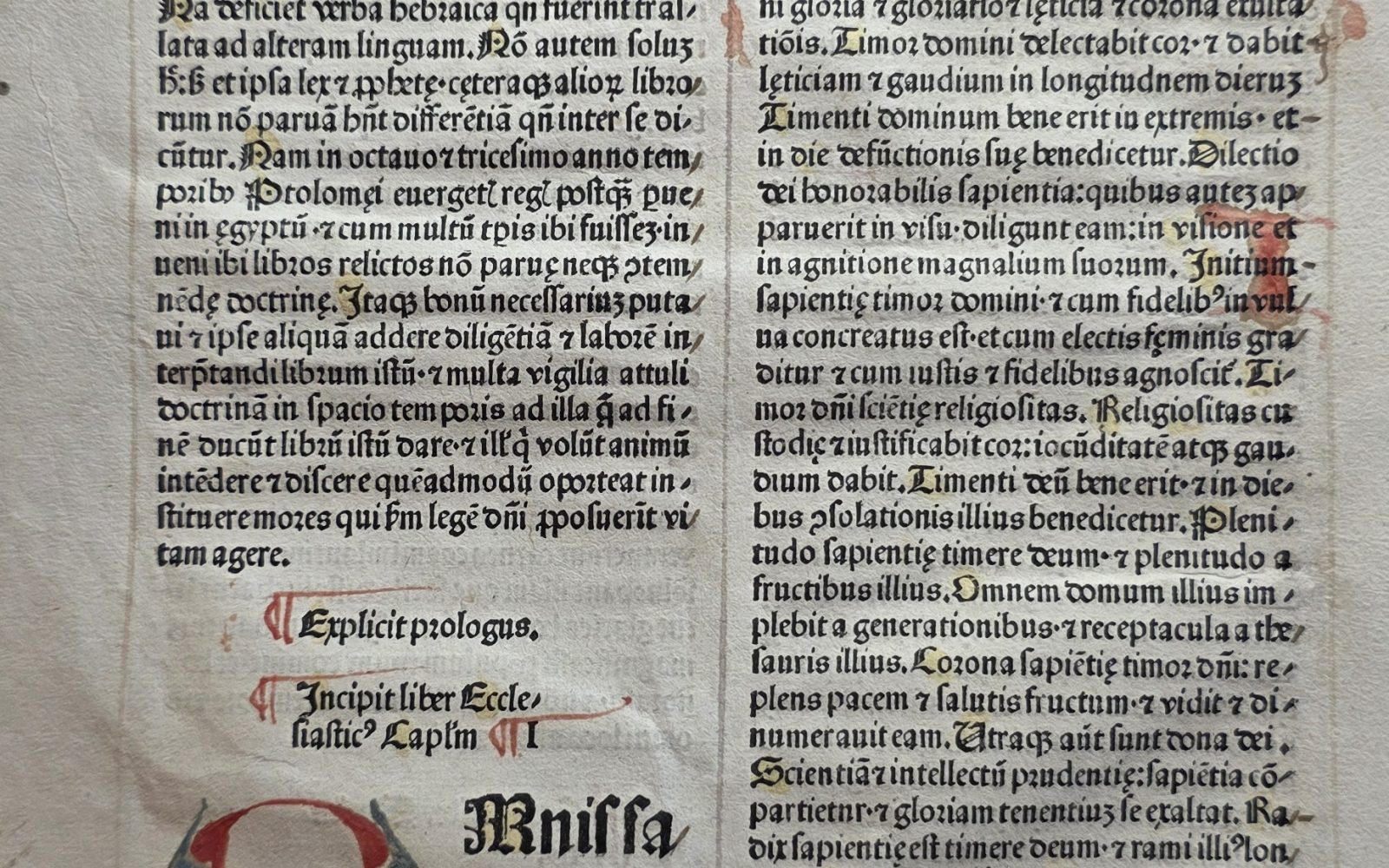
The Collection's "History of Printing" holdings include a wide array of individual leaves from milestone works through the early centuries of printing, capturing key works, typefaces, new printing innovations and other key landmarks. While each leaf was acquired with a detailed report from the original dealer or auction, subsequent reviews have led us to question some of those attributions and thus we are using Gemini to review all of our holdings to verify their attributions. Here, Gemini confirmed that this leaf is from Amerbach's 1486 Bible, published just 31 years after Gutenberg's, demonstrating the potential of frontier models for collection-scale atttribution verification. Gemini even located a digitized copy of the complete work, allowing us to visually confirm the attribution and page numbering!
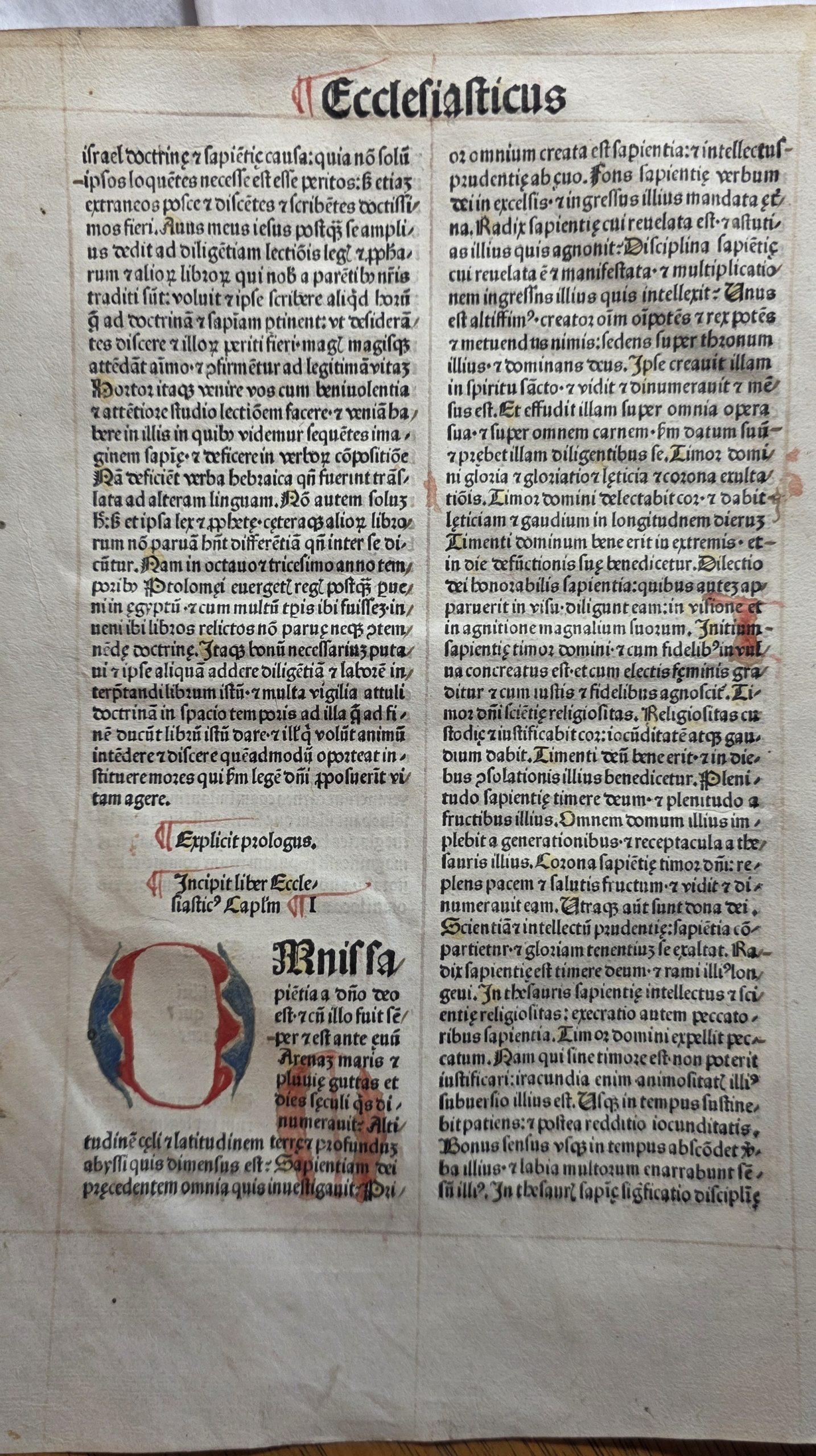
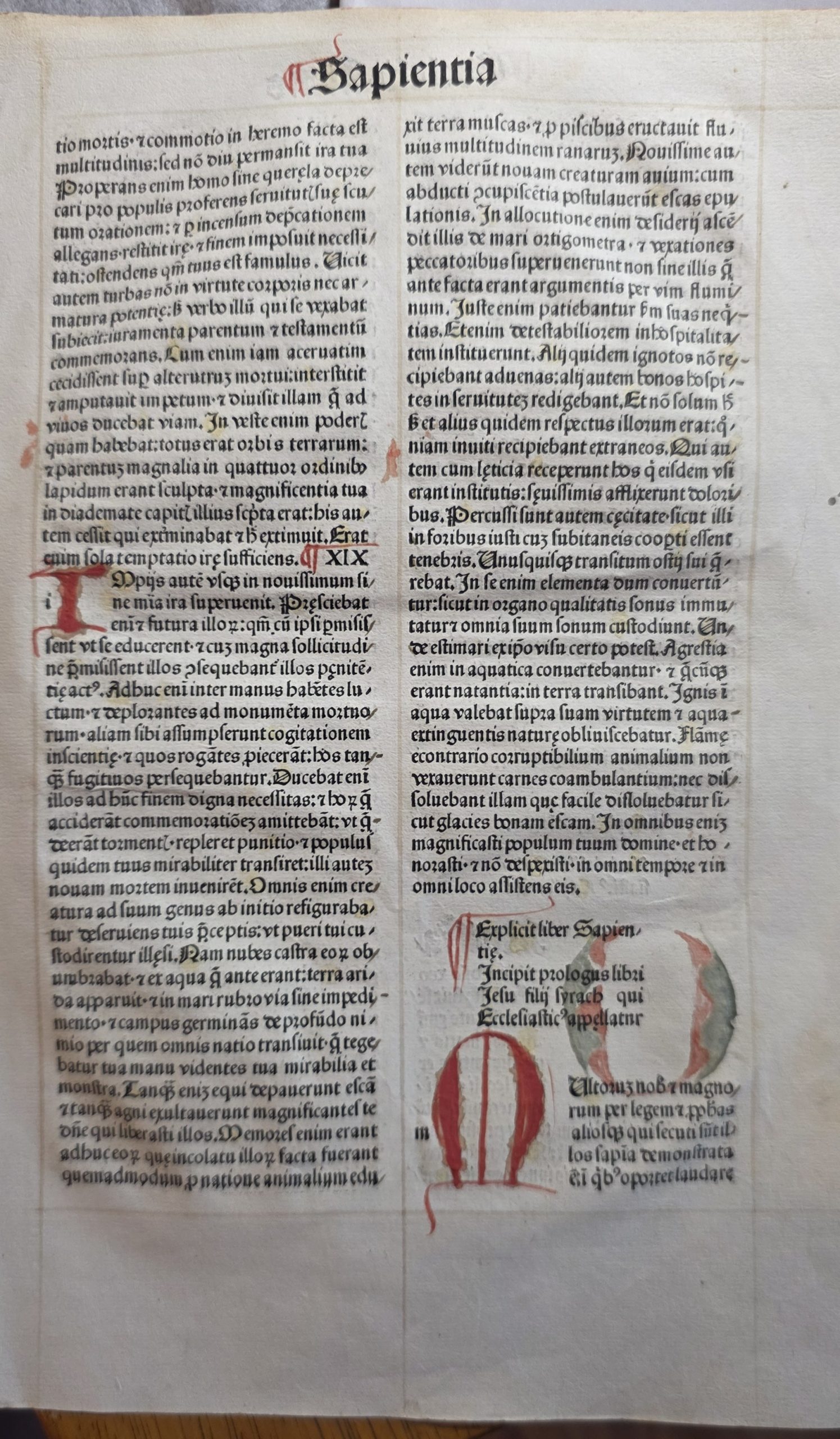
Identify the work this page comes from precisely and what page this is in that work. Give me a citation for it and a brief description of the work and its importance. Then transcribe and translate this page completely.
These two photographs show the recto (Sapientia) and verso (Ecclesiasticus) of a single leaf from the 1486 Biblia Latina ("Fontibus ex Graecis" edition) printed in Basel by Johann Amerbach.
Identification & Exact Location
-
Work: Biblia Latina (Latin Vulgate Bible, fourth "Fontibus ex Graecis" edition).
-
Printer, Place, and Date: Johann Amerbach, Basel, 1486.
-
Leaf / Page Position: Single leaf, ca. fol. [277]r–v (gathering
F, leaf[F7]or[F8], corresponding to pages [553–554]) out of 538 unnumbered leaves. Like most 1480s incunable Bibles, this edition was issued without printed page or folio numbers, using only quire signatures (a–y¹⁰, A–T¹⁰, U¹², X–Y¹⁰, 1–8¹⁰, 9–10⁸) in the first half of each gathering; the absence of a signature beneath the right column of the recto places this leaf in the unsigned second half of gatheringF. -
Physical Orientation & Contents:
-
Recto (
Sapientia— gutter at left, wide fore-edge margin at right): Contains the end of the Book of Wisdom, from Wisdom 18:20 (beginning mid-word at [tempta]tio mortis) through Wisdom 19:21 [modern 19:22, end of book], followed by the explicit/incipit rubric and the opening lines of the Prologue to Ecclesiasticus. -
Verso (
Ecclesiasticus— wide fore-edge margin at left, gutter at right, with faint show-through of the recto's redMinside theO): Contains the remainder of the Prologue to Ecclesiasticus, the incipit rubric, and Ecclesiasticus (Sirach) 1:1–32a in the Vulgate numbering (corresponding to 1:1–25a in modern Greek-based Bibles), breaking off mid-sentence at the bottom of Column 2.
-
-
Diagnostic Features: The page is set in double columns of 48 lines beneath a single-word running headline, printed in Amerbach's newly cut Venetian-style Gothic Rotunda text font (Type 82B, introduced in 1486) with printed lowercase guide letters (
i,m,o) still visible inside or beside the hand-painted red and red-and-blue Lombardic initials. Most distinctively, the Gothic font incorporates a specially castę(e-caudata) sort to mark classical Latin ae and oe diphthongs (suę,pęnitētię,Sapientię,ęgyptū,ętna)—the unmistakable typographic signature of Amerbach's Basel press. This copy was subsequently rubricated by hand with red paragraph marks (¶), painted initials, and plum-red ink ruling around the columns and headlines. (Note: Johann Prüss issued a 538-leaf, 48-line reprint in Strassburg the same year [GW 4260], but used Upper-Rhenish Gothic types lacking Amerbach'sęsort.)
Standard Bibliographic Citation
Biblia Latina ["Fontibus ex Graecis" recension]. [Basel: Johann Amerbach], 1486. Chancery folio, [538] leaves; fol. [F7] or [F8] (ca. fol. [277]r–v).
Bibliographic References: ISTC
ib00581000; GW4258; GoffB-581; BMC III, p. 749 (IB. 37297); Hain-Copinger*3094; BSB-InkB-455; Bod-incB-291.
Description & Historical Importance
First published by Johann Amerbach in 1479 and revised in 1481, 1482, and this 1486 edition, the "Fontibus ex Graecis" Bibles take their name from a Latin poetic colophon declaring that St. Jerome's Latin Vulgate text had been diligently emended with reference to the original Greek and Hebrew sources (Fontibus ex Graecis Hebraeorumque libris). Amerbach—who earned his Master of Arts at Paris before spending five years learning the printing trade in Venice—produced these Bibles in collaboration with his former Sorbonne teacher, the humanist theologian Johann Heynlin von Stein (Johannes de Lapide).
This edition stands at a pivotal crossroads in both book design and biblical scholarship:
-
Rise of the Portable Study Bible: Moving away from massive lectern folios built strictly for liturgical reading (such as the Gutenberg and 1462 Mainz Bibles), Amerbach's chancery folios were engineered as working reference tools for scholars and clergy, integrating running book headers, New Testament marginal concordances, and an extensive glossary of Hebrew names (Interpretationes Hebraicorum nominum).
-
Humanism Meets Gothic Print: Under Heynlin's influence, Amerbach blended Northern Gothic readability with Italianate Rotunda letterforms, systematic clause punctuation, and classicized Latin orthography (
ęfor ae/oe), bridging medieval manuscript conventions and Renaissance philology. -
Foundation of Basel Biblical Humanism: Widely imitated across Strassburg, Lyon, and Germany, Amerbach's Bibles established Basel as a premier European center of scholarly publishing—directly laying the groundwork for his partnership with Johann Froben and, a generation later, Desiderius Erasmus's landmark 1516 Greek-Latin New Testament.
Complete Latin Transcription
Conventions: Standard printer's abbreviations and contractions (⁊ = et, macrons for m/n, 9 = -us, 4 = -rum, 3 = -que/-m, p/p̄ = per/pro/prae) are silently expanded for readability, while preserving the edition's exact orthography (including ę, u/v, and j/i) and pre-Clementine Vulgate variants. Bracketed verse numbers follow the Latin Vulgate; painted initials and red paragraph marks (¶) are noted in brackets.
Recto — Header: [¶] Sapientia
Column 1
**** *[tempta]*tio mortis, et commotio in heremo facta est multitudinis: sed non diu permansit ira tua. **** Properans enim homo sine querela deprecari pro populis proferens seruitutis suę scutum orationem: et per incensum deprecationem allegans, restitit irę, et finem imposuit necessitati: ostendens quoniam tuus est famulus. **** Uicit autem turbas non in virtute corporis nec armatura potentię: sed verbo illum qui se vexabat subiecit: iuramenta parentum et testamentum commemorans. **** Cum enim iam aceruatim cecidissent super alterutrum mortui: interstitit et amputauit impetum, et diuisit illam quę ad viuos ducebat viam. **** Jn veste enim poderis quam habebat: totus erat orbis terrarum: et parentum magnalia in quattuor ordinibus lapidum erant sculpta, et magnificentia tua in diademate capitis illius scripta erat: **** his autem cessit qui exterminabat et hęc extimuit. Erat enim sola temptatio irę sufficiens. [¶] XIX
[19:1] [I]Mpijs autem vsque in nouissimum sine misericordia ira superuenit. Pręsciebat enim et futura illorum: [19:2] quoniam cum ipsi permisissent vt se educerent, et cum magna sollicitudine pręmisissent illos, persequebantur illos pęnitentię actus. [19:3] Adhuc enim inter manus habentes luctum, et deplorantes ad monumenta mortuorum, aliam sibi assumpserunt cogitationem inscientię, et quos rogantes proiecerant: hos tanquam fugitiuos persequebantur. [19:4] Ducebat enim illos ad hunc finem digna necessitas: et horum quę acciderant commemorationem amittebant: vt quę deerant tormentis, repleret punitio, [19:5] et populum [sic, pro populus] quidem tuus mirabiliter transiret: illi autem nouam mortem inuenirent. [19:6] Omnis enim creatura ad suum genus ab initio refigurabatur deseruiens tuis pręceptis: vt pueri tui custodirentur illęsi. [19:7] Nam nubes castra eorum obumbrabat, et ex aqua quę ante erant: terra arida apparuit, et in mari rubro via sine impedimento, et campus germinans de profundo nimio per quem omnis natio transiuit, quę tegebatur tua manu [19:8] videntes tua mirabilia et monstra. [19:9] Tanquam enim equi depauerunt escam, et tanquam agni exultauerunt magnificantes te domine qui liberasti illos. **** Memores enim erant adhuc eorum quę incolatu illorum facta fuerant, quemadmodum pro natione animalium edu-
Column 2
xit terra muscas, et pro piscibus eructauit fluuius multitudinem ranarum. **** Nouissime autem viderunt nouam creaturam auium: cum abducti concupiscentia postulauerunt escas epulationis. **** Jn allocutione enim desiderij ascendit illis de mari ortigometra, et vexationes peccatoribus superuenerunt non sine illis quę ante facta erant argumentis per vim fluminum. **** Juste enim patiebantur secundum suas nequitias. Etenim detestabiliorem inhospitalitatem instituerunt. **** Alij quidem ignotos non recipiebant aduenas: alij autem bonos hospites in seruitutem redigebant. **** Et non solum hęc, sed et alius quidem respectus illorum erat: quoniam inuiti recipiebant extraneos. **** Qui autem cum lęticia receperunt hos qui eisdem vsi erant institutis: sęuissimis afflixerunt doloribus. **** Percussi sunt autem cęcitate, sicut illi in foribus iusti, cum subitaneis cooperti essent tenebris: Unusquisque transitum ostij sui quęrebat. **** Jn se enim elementa dum conuertuntur: sicut in organo qualitatis sonus immutatur et omnia suum sonum custodiunt. Unde estimari ex ipso visu certo potest. **** Agrestia enim in aquatica conuertebantur, et quęcunque erant natantia: in terra transibant. **** Jgnis in aqua valebat supra suam virtutem, et aqua extinguentis naturęque obliuiscebatur. Flammę econtrario corruptibilium animalium non vexauerunt carnes coambulantium: nec dissoluebant illam quę facile dissoluebatur sicut glacies bonam escam. **** Jn omnibus enim magnificasti populum tuum domine, et honorasti, et non despexisti, in omni tempore et in omni loco assistens eis.
[¶] Explicit liber Sapientię.
Incipit prologus libri Jesu filij syrach qui Ecclesiasticus appellatur
[M]Vltorumque nobis et magnorum per legem et prophetas aliosque qui secuti sunt illos sapientia demonstrata est: in quibus oportet laudare
Verso — Header: [¶] Ecclesiasticus
Column 1
israel doctrinę et sapientię causa: quia non solum ipsos loquentes necesse est esse peritos: sed etiam extraneos posse et discentes et scribentes doctissimos fieri. Auus meus iesus postquam se amplius dedit ad diligentiam lectionis legis et prophetarum et aliorum librorum qui nobis a parentibus nostris traditi sunt: voluit et ipse scribere aliquid horum quę ad doctrinam et sapientiam pertinent: vt desiderantes discere et illorum periti fieri, magis magisque attendant animo, et confirmentur ad legitimam vitam. Hortor itaque venire vos cum beniuolentia et attentiore studio lectionem facere, et veniam habere in illis in quibus videmur sequentes imaginem sapientię, et deficere in verborum compositione. Nam deficient verba hebraica quando fuerint translata ad alteram linguam. Non autem solum hęc: sed et ipsa lex et prophetę, cęteraque aliorum librorum non paruam habent differentiam quando inter se dicuntur. Nam in octauo et tricesimo anno temporibus Ptolomei euergetis regis postquam perueni in ęgyptum, et cum multum temporis ibi fuissem, inueni ibi libros relictos non paruę neque contemnendę doctrinę. Jtaque bonum necessarium putaui et ipse aliquam addere diligentiam et laborem interpretandi librum istum, et multa vigilia attuli doctrinam in spacio temporis ad illa quę ad finem ducunt librum istum dare, et illis qui volunt animum intendere et discere quemadmodum oporteat instituere mores qui secundum legem domini proposuerint vitam agere.
[¶] Explicit prologus.
[¶] Incipit liber Ecclesiasticus Capitulum [¶] I
[1:1] [O]Mnis sapientia a domino deo est, et cum illo fuit semper, et est ante euum. [1:2] Arenam maris et pluuię guttas et dies seculi quis dinumerauit? [1:3] Altitudinem cęli et latitudinem terrę et profundum abyssi quis dimensus est? [1:4] Sapientiam dei pręcedentem omnia quis inuestigauit? [1:5] Pri-
Column 2
or omnium creata est sapientia: et intellectus prudentię ab ęuo. [1:6] Fons sapientię verbum dei in excelsis, et ingressus illius mandata ęterna. [1:7] Radix sapientię cui reuelata est, et astutias illius quis agnouit? [1:8] Disciplina sapientię cui reuelata est et manifestata, et multiplicationem ingressus illius quis intellexit? [1:9] Unus est altissimus, creator omnium omnipotens et rex potens et metuendus nimis: sedens super thronum illius, et dominans deus. **** Jpse creauit illam in spiritu sancto, et vidit et dinumerauit et mensus est. **** Et effudit illam super omnia opera sua, et super omnem carnem, secundum datum suum, et prębet illam diligentibus se. **** Timor domini gloria et gloriatio et lęticia et corona exultationis. **** Timor domini delectabit cor, et dabit lęticiam et gaudium in longitudinem dierum. **** Timenti dominum bene erit in extremis, et in die defunctionis suę benedicetur. **** Dilectio dei honorabilis sapientia: **** quibus autem apparuerit in visu, diligunt eam: in visione et in agnitione magnalium suorum. **** Jnitium sapientię timor domini, et cum fidelibus in vulua concreatus est, et cum electis fęminis graditur, et cum iustis et fidelibus agnoscitur. **** Timor domini scientię religiositas. **** Religiositas custodię [sic, pro custodiet] et iustificabit cor: iocunditatem atque gaudium dabit. **** Timenti deum bene erit, et in diebus consolationis illius benedicetur. **** Plenitudo sapientię timere deum, et plenitudo a fructibus illius. **** Omnem domum illius implebit a generationibus, et receptacula a thesauris illius. **** Corona sapientię timor domini: replens pacem et salutis fructum: **** et vidit et dinumerauit eam. Utraque autem sunt dona dei. **** Scientiam et intellectum prudentię: sapientia compartietur, et gloriam tenentium se exaltat. **** Radix sapientię est timere deum, et rami illius longeui. **** Jn thesauris sapientię intellectus et scientię religiositas: execratio autem peccatoribus sapientia. **** Timor domini expellit peccatum. **** Nam qui sine timore est, non poterit iustificari: iracundia enim animositatis illius subuersio illius est. **** Usque in tempus sustinebit patiens: et postea redditio iocunditatis. **** Bonus sensus vsque in tempus abscondet verba illius, et labia multorum enarrabunt sensum illius. [1:32a] Jn thesauris sapientię significatio disciplinę [text continues onto next leaf]
Complete English Translation
Translated directly from the Latin Vulgate text and variants printed on this leaf.
Recto — Header: Wisdom
Column 1
**** …[the trial] of death, and a disturbance of the multitude took place in the wilderness; yet your wrath did not endure for long. **** For a blameless man hastened to intercede for the peoples, bringing forward the shield of his ministry—prayer—and offering supplication by incense; he withstood the wrath and set an end to the calamity, showing that he was your servant. **** He overcame the crowds not by bodily strength nor by the armor of power, but by a word he subdued the avenger, recalling the oaths made to the fathers and the covenant. **** For when the dead had already fallen in heaps upon one another, he stood between and cut off the assault, and parted the way that led to the living. **** For upon the long priestly robe that he wore was the whole world, and the glorious deeds of the fathers were engraved upon four rows of stones, and your majesty was written upon the diadem of his head. **** To these the destroyer yielded, and these he feared; for the trial of wrath alone was sufficient. Chapter 19
[19:1] But upon the ungodly, wrath came without mercy unto the very end. For he foreknew also their future deeds: [19:2] that when they themselves had permitted them to lead themselves out, and had sent them forth with great haste, acts of regret pursued them. [19:3] For while they were still holding mourning in their hands and lamenting at the tombs of the dead, they took up another foolish thought, and those whom they had cast out with entreaties they pursued as fugitives. [19:4] For a deserved necessity was drawing them to this end, and they lost the remembrance of the things that had happened, so that punishment might fill up whatever was lacking to their torments, [19:5] and that your people might indeed pass through wondrously, while they themselves might find a new kind of death. [19:6] For every creature from the beginning was fashioned anew in its own kind, obeying your commands, so that your children might be kept unharmed. [19:7] For a cloud overshadowed their camp, and out of what had previously been water, dry land appeared—an unhindered way in the Red Sea, and a grassy plain out of the mighty deep—through which the whole nation passed, sheltered by your hand, [19:8] beholding your wonders and marvels. [19:9] For like horses they fed upon their food, and like lambs they leaped for joy, magnifying you, O Lord, who delivered them. **** For they were still mindful of the things that had happened during their sojourn: how instead of the breeding of cattle the earth brought
Column 2
forth flies, and instead of fishes the river spewed out a multitude of frogs. **** And at the last they saw a new creation of birds, when, led away by craving, they demanded meats of luxury. **** For to satisfy their desire, quails came up for them from the sea; and punishments came upon the sinners, not without the tokens that had previously occurred through the violence of the floods. **** For justly did they suffer according to their own wickedness, since they instituted a yet more detestable inhospitality. **** Some indeed would not receive unknown strangers, while others reduced good guests into slavery. **** And not only these things, but indeed there was another regard for those others, since they received foreigners unwillingly; **** whereas these, having received with joy those who shared the very same rights, afflicted them with the cruelest pains. **** Moreover, they were struck with blindness, just like those at the doors of the righteous man, when they were covered with sudden darkness; each one sought the passage of his own door. **** For as the elements are transposed among themselves—just as on a stringed instrument the quality of the sound is changed, yet all keep their own tone—this may be accurately judged from the sight itself. **** For land animals were turned into aquatic ones, and whatever things swam crossed over upon the land. **** Fire had power in water beyond its own virtue, and water forgot even its quenching nature. Flames, on the contrary, did not harm the flesh of perishable creatures walking amid them, nor did they melt that good food which was easily melted like ice. **** For in all things, O Lord, you magnified your people and honored them, and did not despise them, standing by them at every time and in every place.
Here ends the Book of Wisdom.
Here begins the Prologue of the book of Jesus son of Sirach, which is called Ecclesiasticus.
The wisdom of many and great things has been shown to us through the Law and the Prophets and others who followed them, for which one ought to praise
Verso — Header: Ecclesiasticus
Column 1
Israel on account of instruction and wisdom; because not only must those who speak themselves be skilled, but outsiders too, both learners and writers, are able to become most learned. My grandfather Jesus, after he had devoted himself more fully to the diligent reading of the Law and the Prophets and the other books that have been handed down to us by our ancestors, wished also himself to write something of those matters that pertain to instruction and wisdom, so that those desiring to learn and to become skilled in them might apply their minds more and more, and be strengthened toward a lawful life. I exhort you therefore to come with goodwill and to read with closer study, and to grant pardon in those places where, though following the image of wisdom, we seem to fall short in the composition of words. For Hebrew words will fail in force when they have been translated into another language. And not only these things, but even the Law itself, and the Prophets, and the rest of the other books have no small difference when they are spoken in their own original tongue. For in the thirty-eighth year, in the times of King Ptolemy Euergetes, after I arrived in Egypt and had remained there a considerable time, I found books left there of no small nor contemptible instruction. Therefore I myself also thought it a good, necessary thing to add some diligence and labor to translating this book; and with much wakeful study over the course of time I brought forth the learning to bring this book to completion and to give it to those who wish to apply their mind and learn how one ought to order one's conduct, who have purposed to live their life according to the Law of the Lord.
Here ends the Prologue.
Here begins the Book of Ecclesiasticus, Chapter 1.
[1:1] All wisdom is from the Lord God, and has been with him always, and is before eternity. [1:2] The sand of the sea, and the drops of rain, and the days of the world—who has numbered them? [1:3] The height of heaven, and the breadth of the earth, and the depth of the abyss—who has measured them? [1:4] The wisdom of God that goes before all things—who has searched it out? [1:5] Before
Column 2
all things wisdom was created, and the understanding of prudence from eternity. [1:6] The fountain of wisdom is the word of God on high, and her ways are everlasting commandments. [1:7] To whom has the root of wisdom been revealed, and who has known her subtleties? [1:8] To whom has the discipline of wisdom been revealed and made manifest, and who has understood the multiplicity of her ways? [1:9] There is one Most High, the almighty Creator of all things, and a mighty King, and greatly to be feared, sitting upon his throne, and a governing God. **** He himself created her in the Holy Spirit, and saw, and numbered, and measured her. **** And he poured her out upon all his works, and upon all flesh according to his gift, and he grants her to those who love him. **** The fear of the Lord is glory, and boasting, and gladness, and a crown of exultation. **** The fear of the Lord will delight the heart, and will give gladness and joy unto length of days. **** With him who fears the Lord it will go well at the last, and on the day of his death he will be blessed. **** The love of God is honorable wisdom; **** and those to whom she appears in sight love her, in the vision and in the recognition of his great works. **** The beginning of wisdom is the fear of the Lord, and it was created together with the faithful in the womb; it walks with chosen women, and is known with the righteous and faithful. **** The fear of the Lord is the devoutness of knowledge. **** Devoutness of keeping [printed custodię for custodiet, "will guard"] and will justify the heart; it will give cheerfulness and joy. **** With him who fears God it will go well, and in the days of his consolation he will be blessed. **** The fullness of wisdom is to fear God, and fullness is from her fruits. **** She will fill her whole house from the generations, and the storehouses from her treasures. **** The crown of wisdom is the fear of the Lord, filling up peace and the fruit of salvation: **** and he saw and numbered her; yet both are gifts of God. **** Wisdom will distribute knowledge and understanding of prudence, and she exalts the glory of those who hold her fast. **** The root of wisdom is to fear God, and her branches are long-lived. **** In the treasures of wisdom are understanding and devoutness of knowledge; but to sinners wisdom is an abomination. **** The fear of the Lord drives out sin. **** For he who is without fear cannot be justified, since the wrath of his rashness is his downfall. **** A patient man will endure until the proper time, and afterward comes a restoration of cheerfulness. **** Good sense will hide its words until the proper time, and the lips of many will declare its understanding. [1:32a] In the treasures of wisdom is the signification of discipline… [sentence continues on the following leaf: "…but to a sinner the worship of God is an abomination."]