In accessioning a 1689 Livonian law book owned by Gustav Adolf Strömfelt, we noticed several pages that had underlined or annotated passages. Gemini flagged those pages for us and we asked it to not only identify and translate the highlighted passages (both ones that were underlined directly in the text and those annotated in the margins), but also to explain why those particular passages might have been highlighted. Incredibly, Gemini is able to leverage its deep contextual knowledge of the turn of the 17th century Livonia to offer plausible explanations for why these particular passages were highlighted.
Identify all of the highlighted passages (both underlined and highlighted in the margin).
Make a bulleted list of all of these highlighted passages, translate each and explain
why it may have been highlighted in this 1689 Livonian law book.
The reader who annotated this 1689 volume of Livonian territorial statutes (Lieffländische Landes-Ordnungen, issued under Swedish royal authority) focused heavily on the practical intersection of estate management, church governance, and local court administration. Below is an analysis of every underlined and margin-marked passage across the provided pages, ordered by page number.
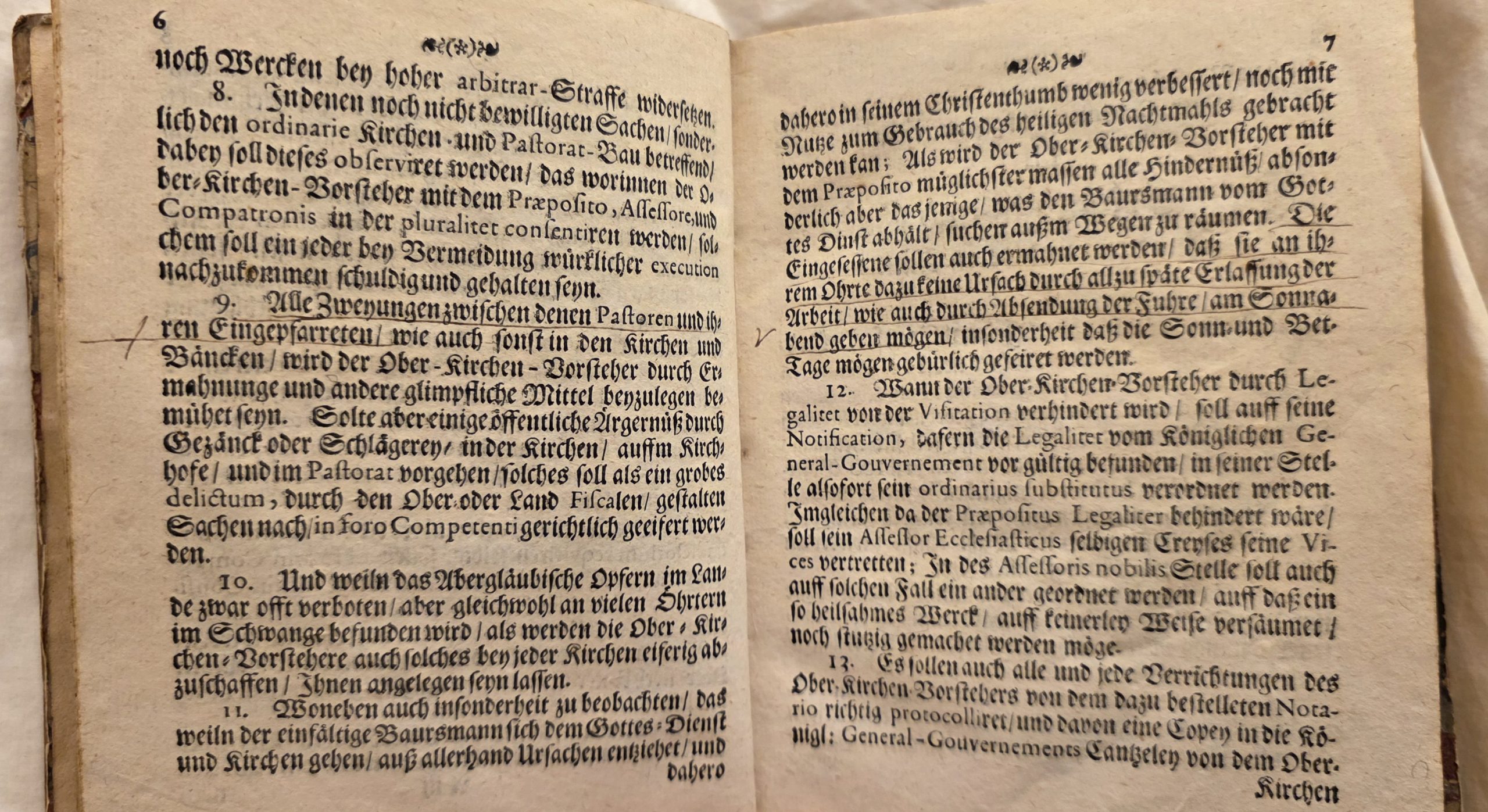
Page 6 (Section 9)
-
Location & Marking: Underlined across several lines with a cross/hash mark in the left margin.
-
Paraphrased Translation: Any disputes arising between pastors and their parishioners—including disagreements over church seating and pews—are to be settled gently through admonition by the Chief Church Warden (Ober-Kirchen-Vorsteher). However, if a public scandal breaks out involving brawling or heated quarreling inside the church, in the churchyard, or at the pastorate, it shall be treated as a serious offense (grobes delictum) and prosecuted in the proper court by the Chief or District Fiscal.
-
Why It Was Highlighted: Church pews in 17th-century Livonia were rigidly tied to social rank and estate ownership, making "pew wars" a frequent source of public feuding among local nobility and burghers. Furthermore, this passage establishes the clear jurisdictional boundary between minor ecclesiastical mediation and serious criminal prosecution by royal prosecutors (Fiscals).
Page 7 (Section 11)
-
Location & Marking: Underlined in the upper half of the page with a checkmark in the left margin.
-
Paraphrased Translation: Local landowners and estate residents (Eingesessene) must be warned not to give peasants any excuse to miss church services—specifically by releasing them from their manorial labor too late, or by sending them out on transport/carting duties (Fuhre) on Saturdays—so that Sundays and prayer days may be properly observed.
-
Why It Was Highlighted: Under Swedish rule, the Lutheran Church and the Crown sought to enforce peasant religious education, which directly clashed with the economic demands of Baltic German manor lords (Erbherren). A landowner or church warden would mark this passage because it penalized lords who worked their serfs late into Saturday evening or sent them on long weekend hauling trips to port cities like Riga.
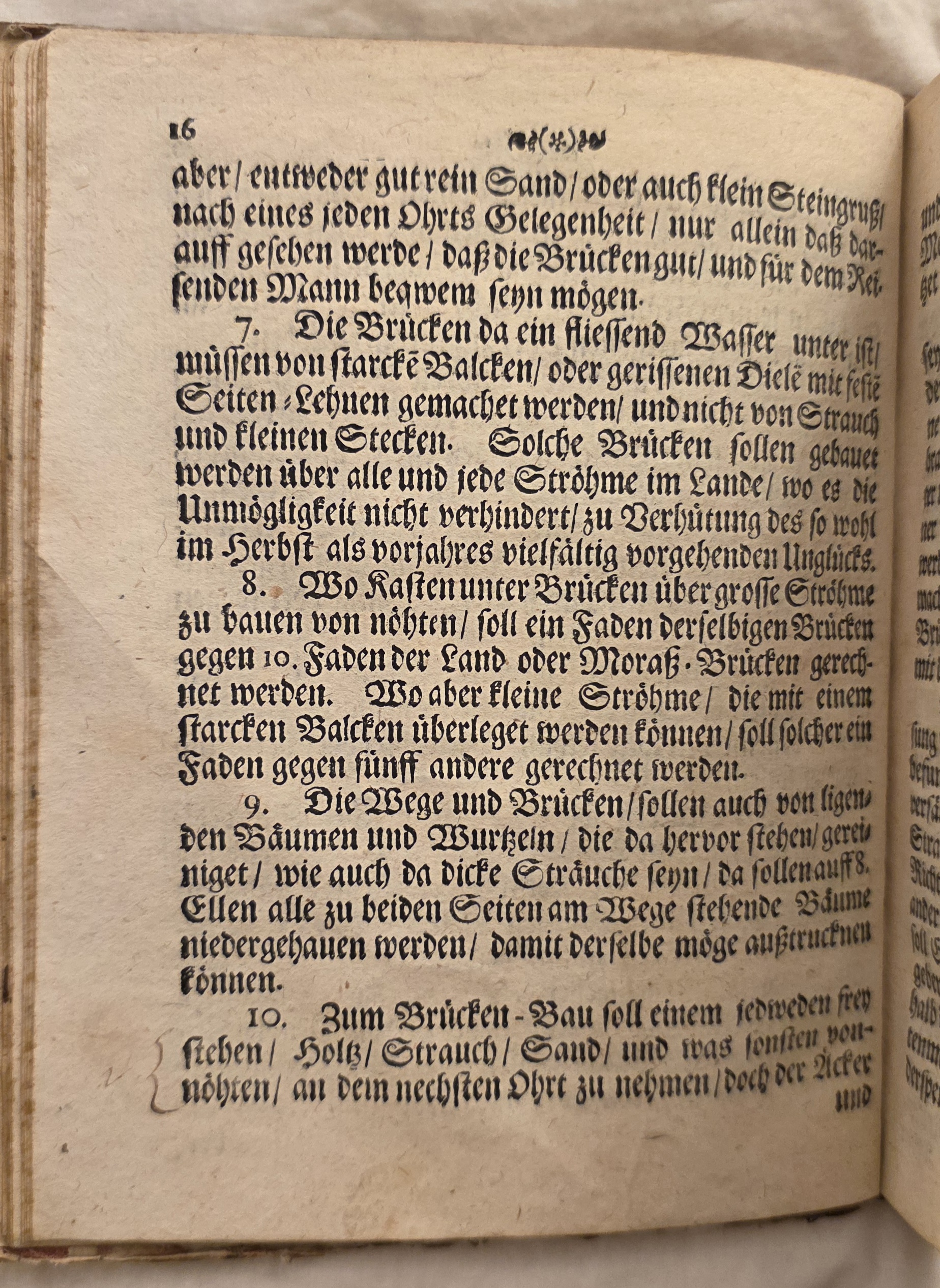
Page 16 (Section 10)
-
Location & Marking: Marked in the left margin with a hand-drawn curly bracket and a small check/tick mark.
-
Paraphrased Translation: For the construction and repair of bridges, everyone is permitted to freely gather timber, brushwood, sand, and whatever else is necessary from the nearest available location (though cultivated fields and meadows must be spared, as the sentence continues onto the next page).
-
Why It Was Highlighted: Road and bridge maintenance was a mandatory public burden placed on Livonian estates. This clause was vital for estate managers because it granted a statutory easement to harvest timber and sand from a neighbor's adjacent land if that land was closest to the bridge site, overriding standard property boundaries.
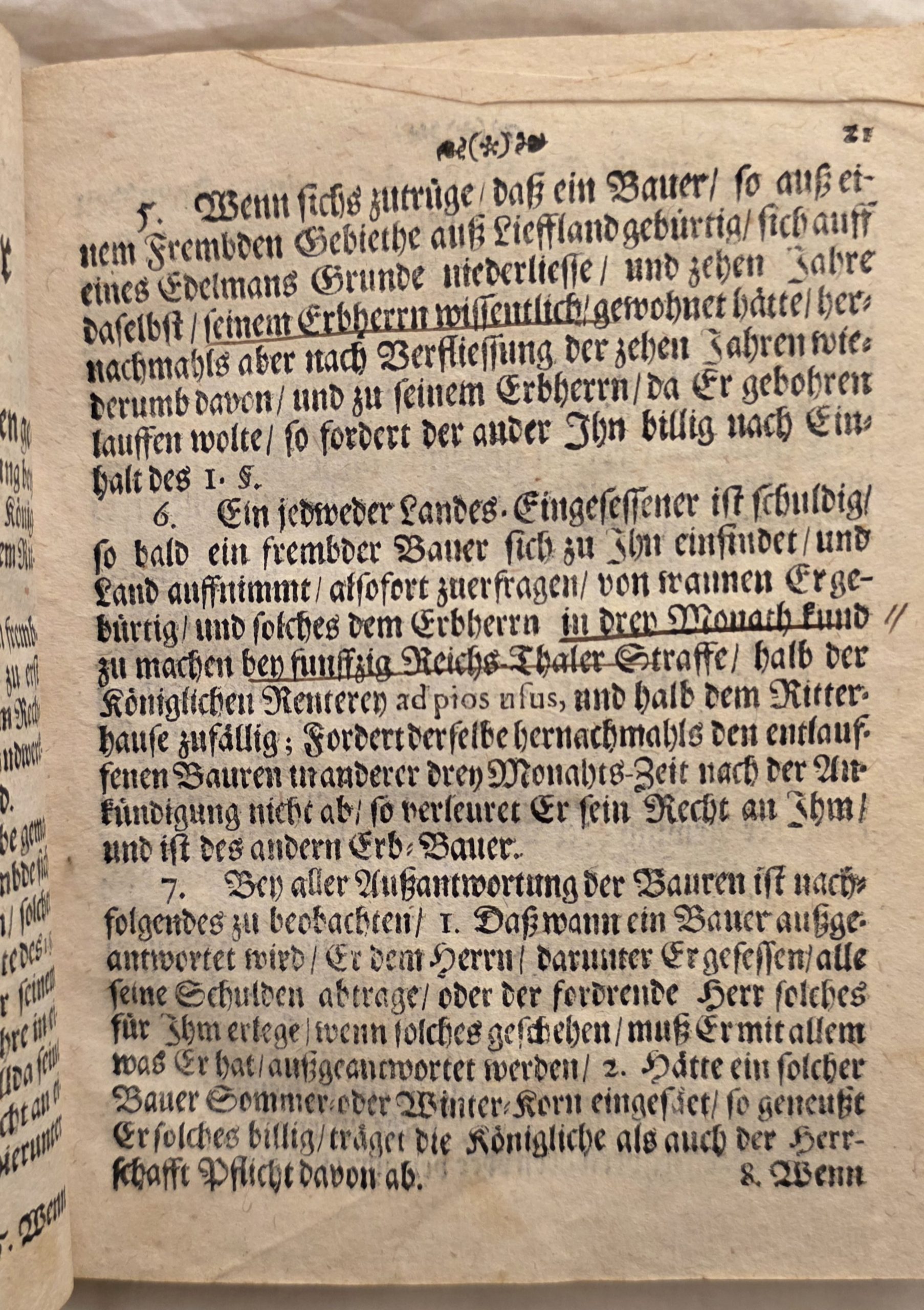
Page 21 (Section 5)
-
Location & Marking: Two words underlined in the middle of the paragraph.
-
Paraphrased Translation: In a law concerning a peasant born in a foreign territory outside Livonia who settles on a nobleman's estate for ten years and then tries to flee back to his original lord, the reader specifically underlined the condition: "with his hereditary lord's knowledge" (seinem Erbherrn wissentlich).
-
Why It Was Highlighted: Control over serf labor was the foundation of the Livonian manorial economy. A ten-year statute of limitations transferred legal ownership of a peasant to the new lord, provided the original lord knew where the peasant was living and failed to reclaim him. Underlining these three words highlights the exact legal burden of proof required in serf-reclamation lawsuits.
Page 21 (Section 6)
-
Location & Marking: Underlined in the middle of the paragraph with a double slash (
//) in the right margin. -
Paraphrased Translation: Whenever an unfamiliar peasant arrives and takes up land, the local estate owner must immediately interrogate him about his origins and notify the peasant's rightful hereditary lord "within three months, under penalty of a 50 Reichsthaler fine" (split equally between the Royal Treasury for pious uses and the Noble Corporation).
-
Why It Was Highlighted: Because of chronic labor shortages, estate owners were often tempted to quietly harbor runaway serfs. This annotation flags the strict 90-day reporting deadline and the hefty 50-Reichsthaler financial penalty for failing to notify a neighboring lord.
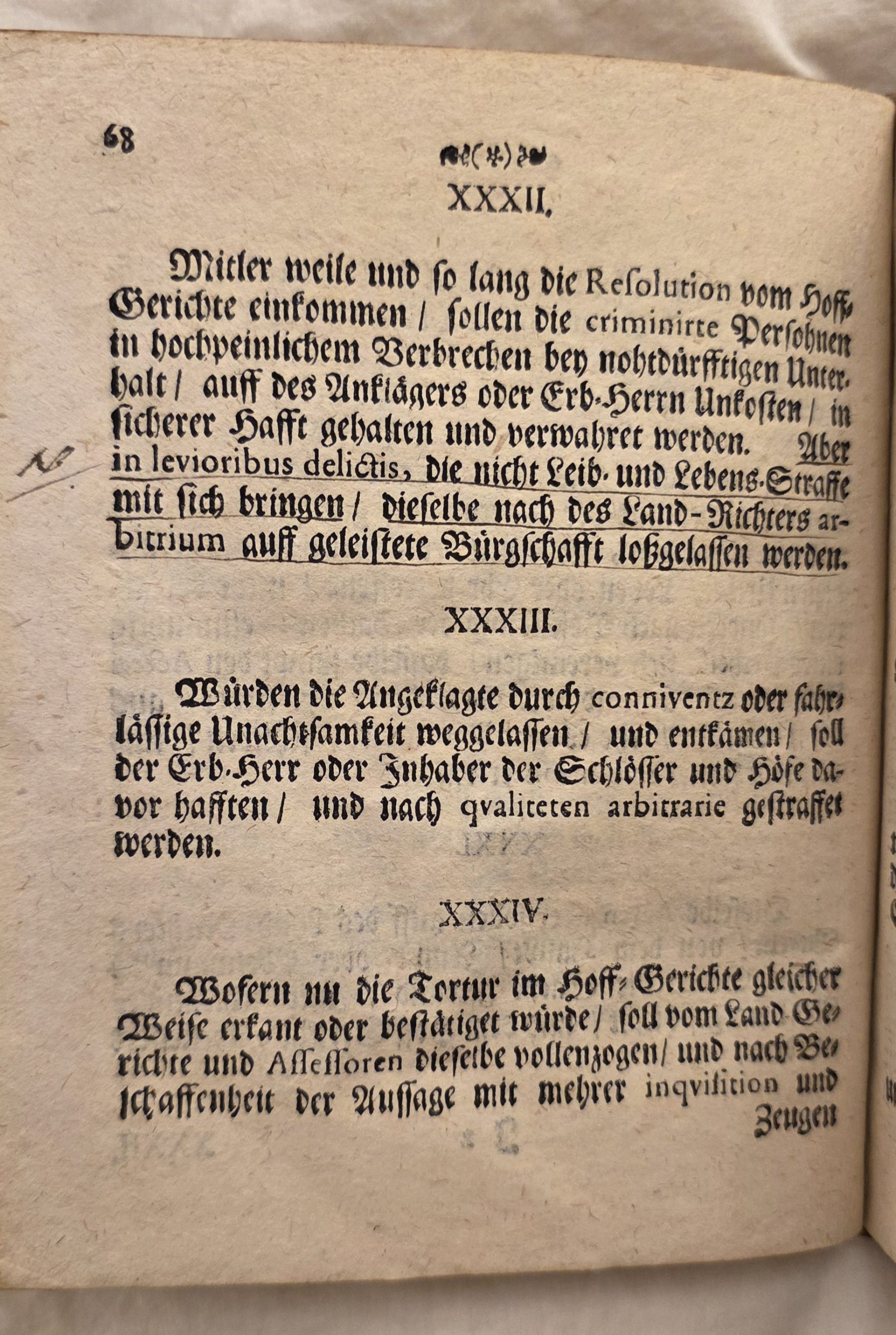
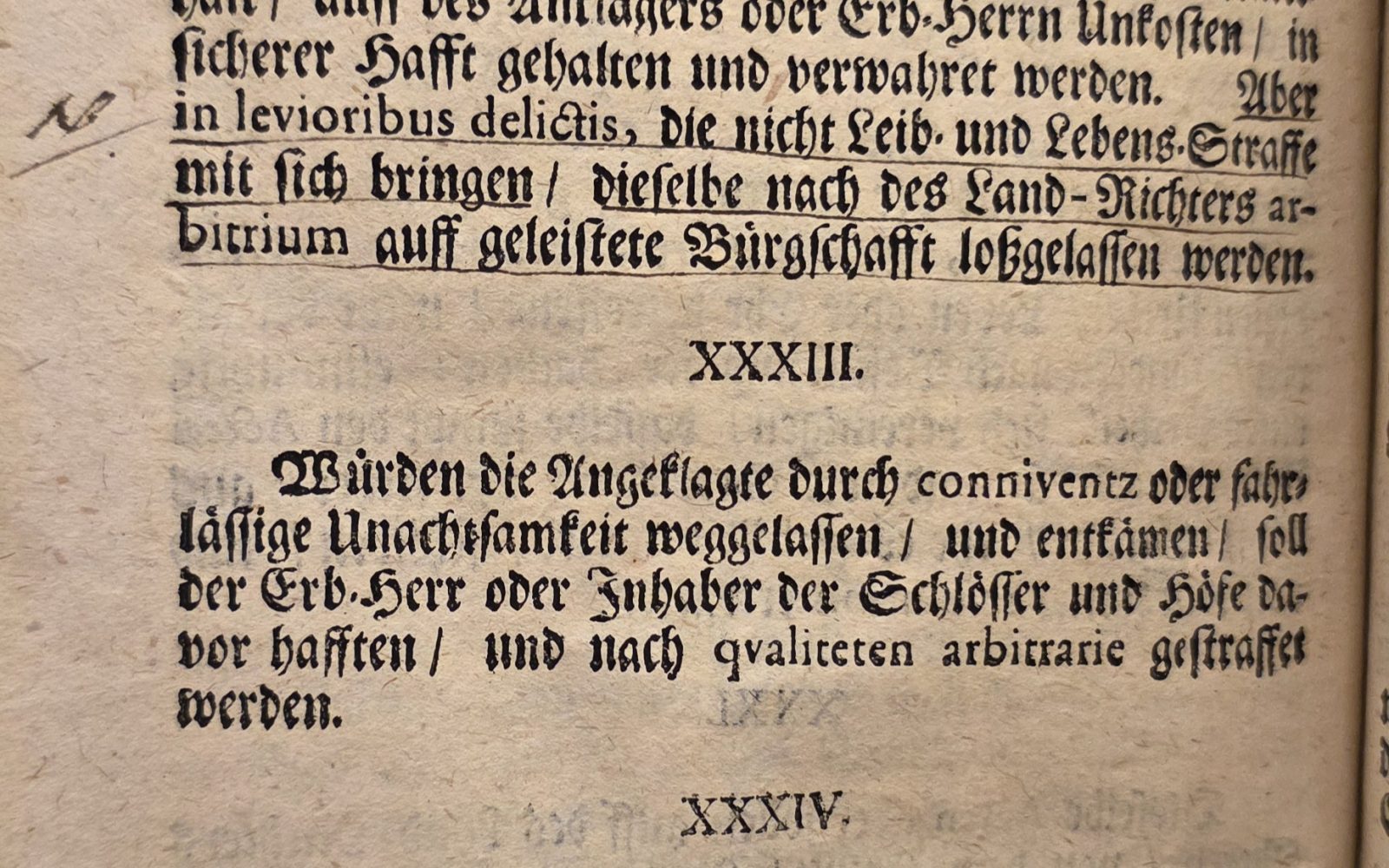
Page 68 (Article XXXII)
-
Location & Marking: Underlined across the bottom four lines of the paragraph with an "NB" (Nota Bene, "note well") in the left margin.
-
Paraphrased Translation: While suspects accused of capital crimes must be kept in secure custody at the expense of the accuser or hereditary lord while awaiting a verdict from the High Court, "in minor offenses (in levioribus delictis) that do not carry a punishment of life or limb, the accused may be released upon posting bail at the discretion (arbitrium) of the District Judge (Land-Richter)."
-
Why It Was Highlighted: Pre-trial detention was expensive, as the local lord or accuser had to pay for the prisoner's upkeep. This passage was marked because it provided the legal mechanism to release non-capital offenders on bail, saving the estate money and defining the discretionary power of the local Land-Richter.
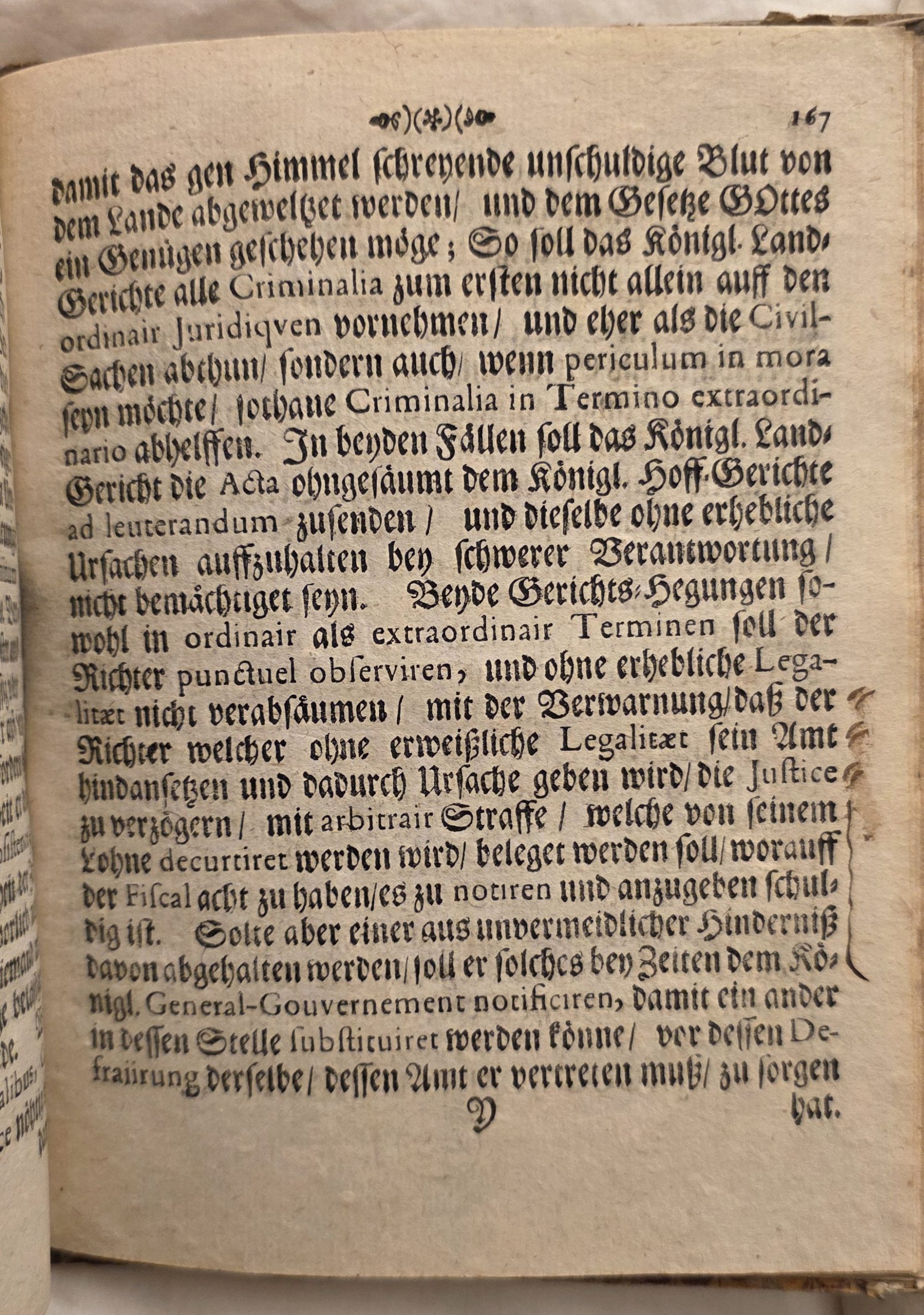
Page 167 (Top Continuation)
-
Location & Marking: Marked along the right margin with three diagonal tick marks and a long vertical bracket spanning the lower half of the paragraph.
-
Paraphrased Translation: A judge who neglects his duty without a provable legal excuse (erweißliche Legalität) and thereby delays justice shall be punished with an arbitrary fine deducted directly from his salary, which the royal prosecutor (Fiscal) is obligated to monitor and report. However, if a judge is prevented from attending court by an unavoidable hindrance, he must notify the Royal General-Government in good time so a substitute can be appointed, and the absent judge must arrange to cover the substitute's expenses.
-
Why It Was Highlighted: This passage strongly suggests the book's owner was a Land-Richter (District Judge), an Assessor, or a Fiscal. It outlines the personal financial liabilities of holding judicial office under strict Swedish administrative oversight—specifically, salary deductions for unexcused delays and the requirement to pay out-of-pocket for a substitute's board and expenses (Defrajirung) when legitimately absent.