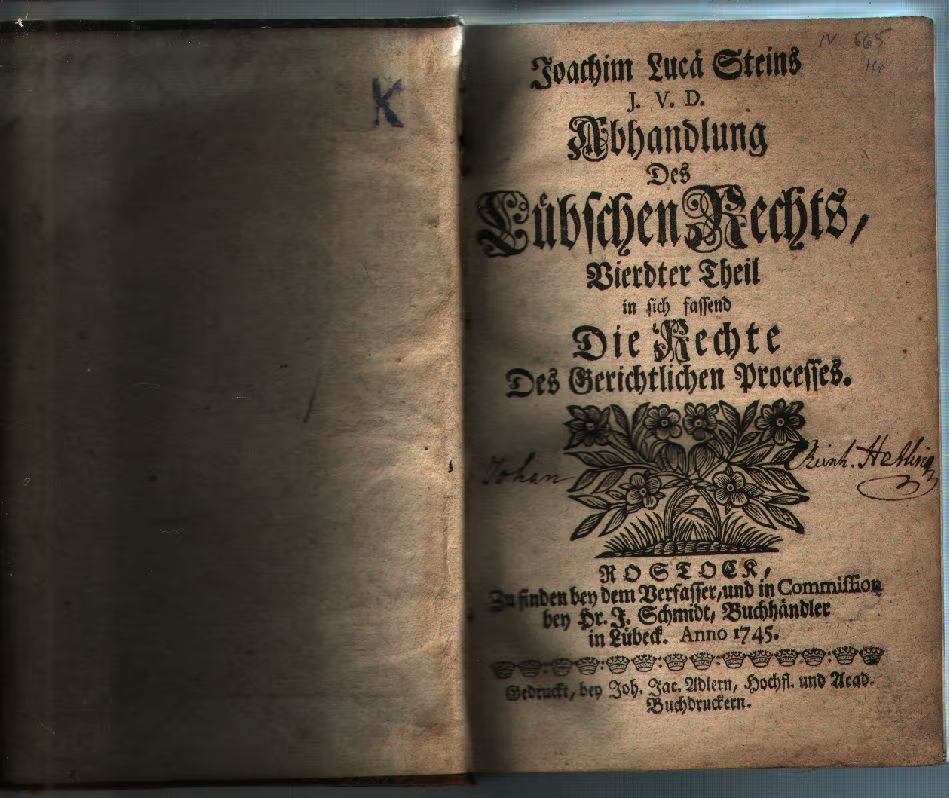
Last week Gemini discovered that our rare 1689 Livonian law book, one of the earliest printed books of the laws of Swedish Livonia, was owned by Gustav Adolf Strömfelt, the last high-ranking civilian Swedish Crown administrator in Estonia before it fell. Today we discovered that our 1745 book on Lubeck Law in Tallinn was owned by none other than Johann Reinhold Hetling, Tallinn's mayor.
Whose signature is that? How confident are you? Who is he and what is his importance to Estonia?
The signature on the title page belongs to Johann Reinhold Hetling (1718–1799), written across the central floral woodcut ornament as "Johan Reinh. Hetling".
Confidence Level: Very High (99%+)
-
Paleographic Match: The handwriting uses standard 18th-century Latin humanist script (commonly used by German speakers of the era specifically for signing proper names and Latin words, even within German texts). The left side of the ornament clearly reads "Johan" and the right side reads "Reinh. Hetling" with a period after the abbreviated middle name and a characteristic 18th-century flourish (Schnörkel) beneath the surname.
-
Contextual & Chronological Match: The book is Volume 4 of Joachim Lucas Stein's Abhandlung des Lübschen Rechts (Treatise on Lübeck Law), published in Rostock in 1745. In 1745, Johann Reinhold Hetling was 27 years old and at the beginning of his legal and administrative career in Reval (modern-day Tallinn), where Lübeck Law served as the foundational municipal legal code.
Who He Was
Johann Reinhold Hetling (baptized June 15, 1718, in Reval – died December 29, 1799, in Reval) was a prominent Baltic German jurist, municipal politician, and Mayor (Bürgermeister) of Reval (Tallinn).
-
Family Background: He belonged to the influential Hetling patrician and merchant dynasty of Reval. His grandfather, Wilhelm Hetling (1653–1710), served as Justice Mayor (Justizbürgermeister) of Reval during the Great Northern War and died in the 1710 plague epidemic, while his cousin Wilhelm Hetling (1740–1798) later served as the head of the city (Stadthaupt) from 1786 to 1796.
-
Career: Trained in law and municipal administration, Hetling rose through the ranks of the Reval Town Council (Tallinna raad / Revaler Rat), serving as a town councilor (Ratsherr) and later as Mayor (Bürgermeister) of Tallinn from 1781 to 1786.
His Importance to Estonia
-
Steward of Lübeck Law in Tallinn (The Direct Link to This Book): From 1248 until the late 19th century, Tallinn was governed as an autonomous Hanseatic-style city under Lübeck Law (Lübisches Recht). Because the Reval Town Council functioned simultaneously as the city's executive government and its supreme court of justice, its members needed authoritative commentaries on Lübeck Law. Joachim Lucas Stein's five-volume Abhandlung des Lübschen Rechts—specifically this 4th volume covering judicial procedure (Die Rechte des Gerichtlichen Processes)—was the foremost contemporary manual used by Tallinn's magistrates to adjudicate civil and commercial disputes in 18th-century Estonia.
-
Defense of Tallinn's Municipal Autonomy: During the 18th century, following Estonia's incorporation into the Russian Empire in 1710, Tallinn's local governance operated under the Baltic Special Order (Balti erikord), which guaranteed the preservation of local German laws, Lutheranism, and civic privileges. As a councilor and Bürgermeister, Hetling was one of the key magistrates responsible for upholding Tallinn's self-governance and legal traditions prior to and during the sweeping administrative reforms of Empress Catherine the Great.
-
Transition to the Regency Era (Statthalterschaftszeit, 1783–1796): Hetling's tenure as Bürgermeister (1781–1786) coincided with a major constitutional upheaval in Estonian history: Catherine the Great's introduction of the All-Russian Provincial Reform to Estonia in 1783–1786. In 1786, the centuries-old Reval Town Council (Raad) was temporarily dissolved and replaced with an imperial city magistrate system (Linnamagistraat), bringing an end to Hetling's term as Bürgermeister (though the traditional council was later restored by Tsar Paul I in 1796, three years before Hetling's death).
-
Provenance & Estonian Book History: Books bearing Hetling's ownership signature are prized artifacts of 18th-century Estonian legal and cultural history, illustrating how legal scholarship from northern German university towns (like Rostock and Lübeck) directly shaped daily judicial practice in Tallinn. (Note: The pencil shelfmark at the top right of the page, "IV 665", is typical of historical Baltic institutional collections, such as the former library of the Revaler Rat or the Estländische Literärische Gesellschaft).
How important was Hetling to Estonia's history? What is he known for?
In the grand sweep of Estonian national history, Johann Reinhold Hetling (1718–1799) is not a household name on the level of national awakening figures or military commanders; rather, he is an important municipal, legal, and institutional figure in the history of 18th-century Tallinn (then Reval).
To historians of Estonia, he is best understood both as a prominent individual magistrate and as a central link in the Hetling dynasty—arguably the single most powerful civic family governing Tallinn throughout the 18th century.
1. A Pillar of the "Hetling Era" in Tallinn Governance
During the 1700s, Tallinn was an autonomous merchant republic within the Russian Empire, governed by the Reval Town Council (Tallinna raad). The council was headed by four co-equal Bürgermeisters (mayors/consuls) who served for life.
What makes the Hetling name famous in Tallinn’s municipal archives is their remarkable, century-long grip on the city's highest office:
-
Bernhard Hetling (d. 1661): Served as Bürgermeister (1654–1661) during the Swedish era.
-
Wilhelm Hetling I (1653–1710): Johann Reinhold's grandfather; served as Justice Mayor (Justizbürgermeister, 1708–1710) during the final siege of the Great Northern War before dying in the devastating plague of 1710.
-
Carl Nicolaus Hetling (1707–1781): Johann Reinhold’s older brother; served as Bürgermeister from 1767 until his death in 1781.
-
Johann Reinhold Hetling (1718–1799): Directly succeeded his brother as Bürgermeister (1781–1786) after decades as a town councilor (Ratsherr).
-
Wilhelm Hetling II (1740–1798): Carl Nicolaus's son (and Johann Reinhold's nephew); served as Tallinn's very first Stadthaupt (City Head / Linnapea) during the Regency Era (1786–1796) and again as Bürgermeister (1796–1798). Today, official City of Tallinn records list Wilhelm Hetling (#1 on the modern roster of mayors) as the institutional predecessor to the modern office of Mayor of Tallinn.
2. What Johann Reinhold Hetling Specifically Is Known For
-
Chief Magistrate & Guardian of Lübeck Law: Under Tallinn's medieval constitution, the Town Council wasn't just a city council—it was the supreme court of appeal for the lower town. As a trained jurist (Literat) and Bürgermeister, Johann Reinhold Hetling was one of the chief judges of Tallinn. Because Tallinn operated under Lübeck Law (Lübisches Recht) rather than Russian imperial law, magistrates like Hetling relied on German legal treatises (like the exact 1745 volume of Joachim Lucas Stein you have here) to issue rulings on trade, inheritance, maritime disputes, and criminal cases.
-
Standing at the Crossroads of the 1786 Constitutional Crisis: Johann Reinhold Hetling is historically notable as one of the last Bürgermeisters of the Old Regime before Empress Catherine the Great temporarily abolished Tallinn’s centuries-old Hanseatic constitution.
-
For over 500 years, the Tallinna raad had fiercely guarded its privileges under the "Baltic Special Order" (Balti erikord).
-
In 1783–1786, Catherine the Great imposed the Regency Regime (asehalduskord / Statthalterschaftsverfassung) on Estonia to standardize taxation and governance across the Russian Empire.
-
In April 1786, the ancient Town Council over which Johann Reinhold Hetling presided was dissolved and replaced by an elected Imperial City Magistrate (Linnamagistraat). While Johann Reinhold stepped down with the old council in 1786, his nephew Wilhelm Hetling stepped in to lead the new body—a diplomatic transition within the same family that historians credit with preventing a major political clash between Tallinn's elites and the Russian crown.
-
-
Patrician Network & Economic Legacy: Through marriage and commerce, Johann Reinhold and his siblings cemented the Baltic German merchant elite that shaped Tallinn's economy. For instance, the Hetling family intermarried with the Girard (later Girard de Soucanton) and Clayhills families—the founders of Thomas Clayhills & Son, the oldest continuously operating trading house in Estonia's history.
Why His Signature Matters to Collectors & Historians
In Estonia today, Johann Reinhold Hetling is primarily remembered in provenance research, legal history, and Baltic German prosopography (such as Friedrich Georg von Bunge’s famous Die Revaler Ratslinie).