

In an page-by-page accession and collation review of our 1672 Stern/Scheits Bible, we uncovered two fascinating pieces of ephemera tucked between the pages: a colored devotional print and a calendar page, both printed in German in Fraktur. Historically, identifying, translating and researching such ephemera took considerable time, but now all that is needed is a single cellphone photo. Let's see what Gemini makes of these two items.
This vivid devotional print is single-sided:
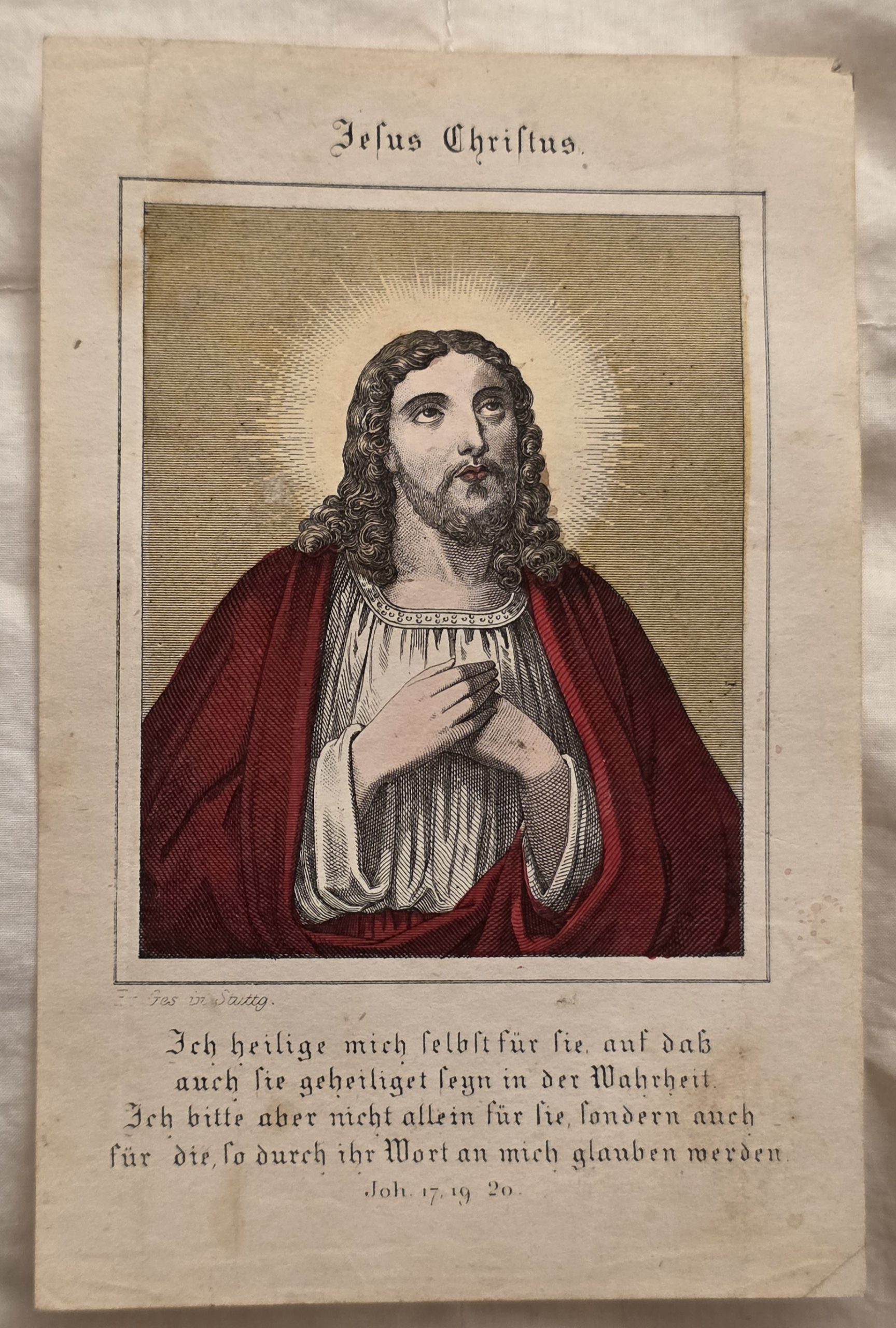
Let's translate it:
translate this in its entirety.
Top Title:
-
-
Original German: Jesus Christus.
-
English: Jesus Christ.
-
Publisher / Printer Line (bottom left of frame):
-
-
Original German: [Verlag/Druck von …] in Stuttg.
-
English: [Published/Printed by …] in Stuttgart.
-
Bottom Inscription (John 17:19–20):
-
-
Original German (Fraktur):
Ich heilige mich selbst für sie, auf daß auch sie geheiliget seyn in der Wahrheit.
Ich bitte aber nicht allein für sie, sondern auch für die, so durch ihr Wort an mich glauben werden.
Joh. 17. 19. 20.
-
English Translation (Literal / Modern):
"I sanctify myself for them, that they also may be sanctified in the truth. But I pray not for them alone, but also for those who will believe in me through their word." — John 17:19–20
-
(Note: In the traditional King James Version, this passage reads: "And for their sakes I sanctify myself, that they also might be sanctified through the truth. Neither pray I for these alone, but for them also which shall believe on me through their word.")
Now let's explore what this is:
Explain in detail what this is and its meaning.
Try to identify its original source/publication.
Meaning & Context
-
-
The High Priestly Prayer: These verses come from John chapter 17, uttered by Christ in the Upper Room immediately before his arrest and Passion.
-
Christ as Intercessor: In verse 19, Christ speaks of offering Himself up in holiness/sacrifice so that His disciples will be consecrated in divine truth.
-
The Universal Believer: Verse 20 broadens this prayer from the original Apostles to all future Christians who come to faith through the preaching of the Gospel.
-
Iconographic Gesture: Christ is depicted in half-length profile with upturned eyes and clasped hands against a radiating golden nimbus. This posture directly embodies His intercessory prayer—gazing heavenward toward the Father on behalf of humanity.
-
Origin, Technique, and Publication Source
-
-
Medium & Production Period: Circa 1840–1865. It is an intaglio print (most likely a steel engraving, Stahlstich, popular in Germany during the Biedermeier era for its crisp detail) finished with delicate watercolor stencil or hand-applied gouache coloring.
-
Origin/Publisher Location: Directly below the bottom-left corner of the image border is the publisher or engraver slug reading:
„…fes in Stuttg.-
"in Stuttg." stands for Stuttgart, the capital of the Kingdom of Württemberg. Stuttgart was one of 19th-century Germany’s primary hubs for theological, biblical, and devotional publishing (most notably home to the Württembergische Bibelanstalt / Privilegierte Württembergische Bibelanstalt and publishers like J.F. Steinkopf and Ebner & Seubert).
-
-
Artistic Prototype: The depiction is closely derived from 17th-century Italian Baroque devotional paintings of Christ Praying or Salvator Mundi (in the tradition of Guido Reni, Carlo Dolci, or Lodovico Carracci), which were widely adapted into engraving plates by 19th-century German Nazarene-influenced engravers.
-
Original Function: Prints of this exact format were produced either as:
-
A standalone frontispiece or devotional plate inserted into a luxury family Bible (Prachtbibel) or devotional hymn book (Gesangbuch).
-
A memento card presented to young people upon their Protestant Confirmation (Konfirmationsschein / Andachtsbild).
-
-
Now let's look at this double-sided calendar page:
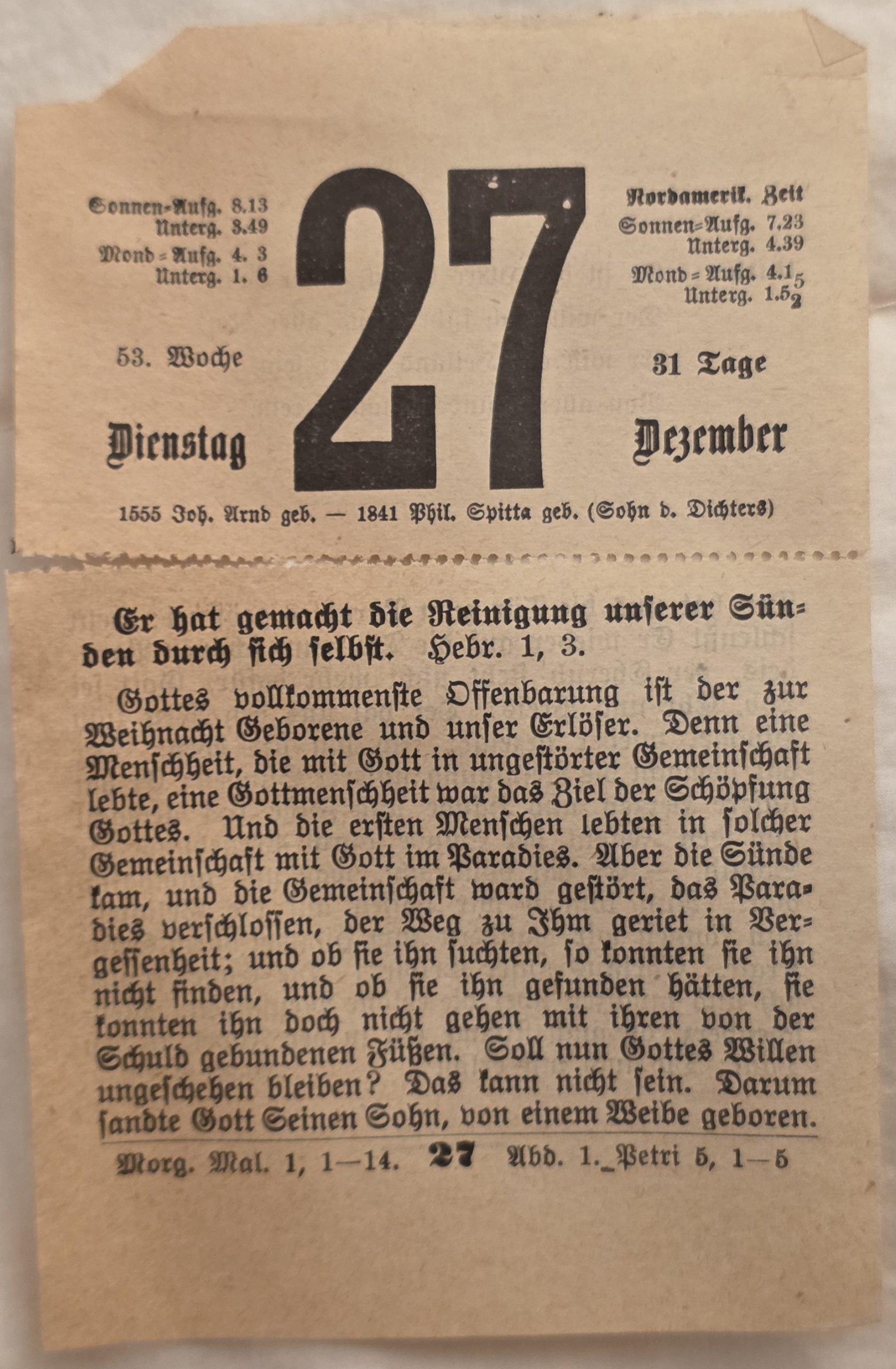
Let's translate it:
translate this in its entirety.
Front Side
Header & Calendar Details
-
-
Date: 27 December (31 days)
-
Day of the week: Tuesday
-
Week: 53rd Week
-
Sun & Moon times (Europe): Sunrise 8:13, Sunset 3:49; Moonrise 4:03, Moonset 1:06
-
North American Time: Sunrise 7:23, Sunset 4:39; Moonrise 4:15, Moonset 1:58
-
Historical Notes:
-
1555: Johann Arndt born
-
1841: Philipp Spitta born (Son of the poet)
-
-
Scripture Verse
"He has by Himself purged our sins." — Hebrews 1:3
Devotional Text
God’s most perfect revelation is the One born at Christmas, our Redeemer. For a humanity living in undisturbed communion with God—a divine-humanity—was the goal of God's creation. And the first humans lived in such communion with God in Paradise. But sin came, and the communion was broken, Paradise was closed, and the way to Him fell into oblivion; and even if they sought it, they could not find it; and even if they had found it, they could not walk it with feet bound by guilt. Shall God’s will now remain unfulfilled? That cannot be. Therefore God sent His Son, born of a woman.
Daily Bible Readings
-
-
Morning: Malachi 1:1–14
-
Evening: 1 Peter 5:1–6
-
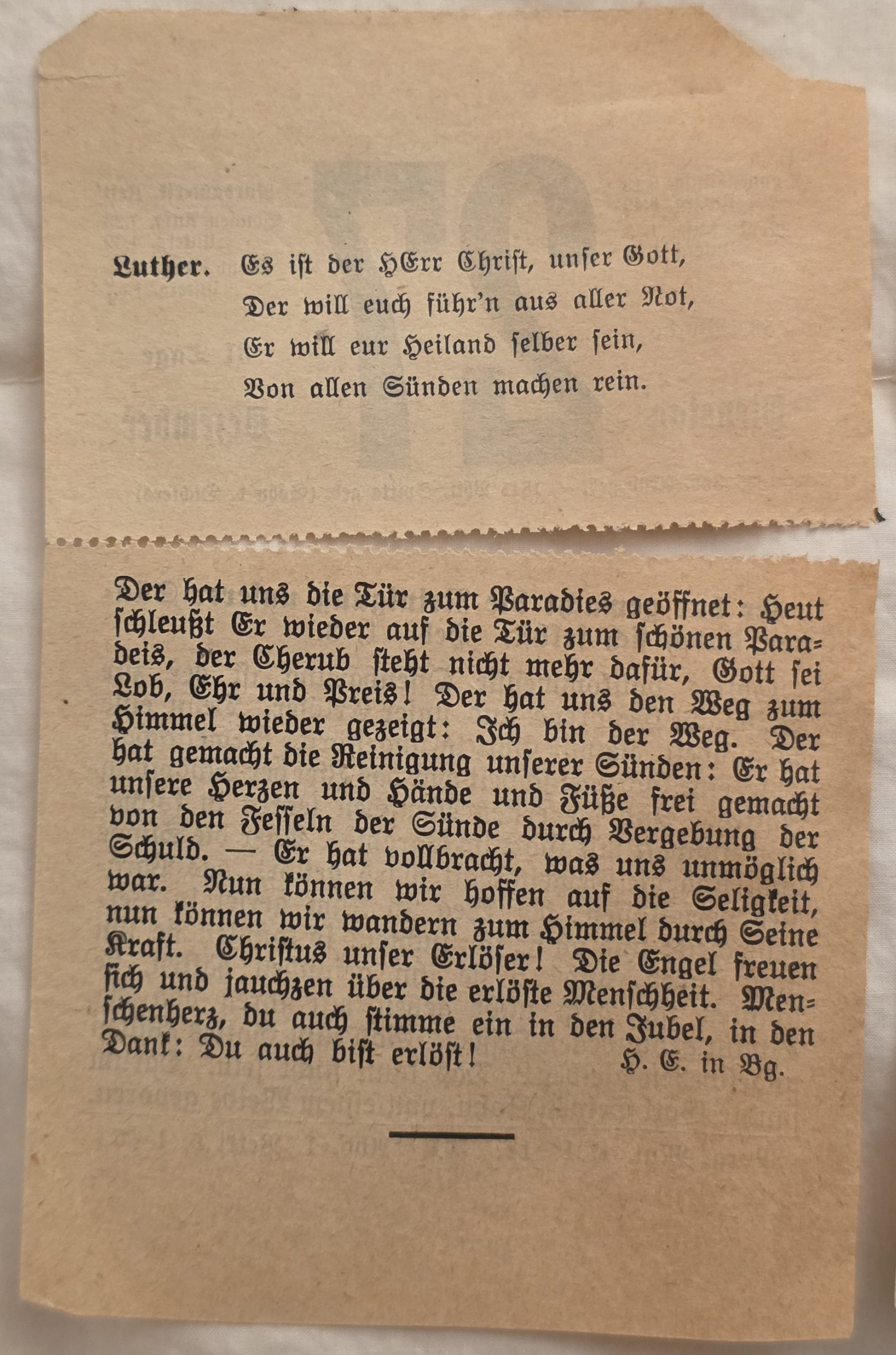
Back Side
Upper Verse (Martin Luther)
He is the Lord Christ, our God,
Who will lead you out of all distress,
He Himself will be your Savior,
To make you clean from all sins.
Devotional Continuation
He has opened the door to Paradise for us: "Today He unlocks again the door to fair Paradise; the cherub no longer stands before it; praise, honor, and adoration be to God!" He has shown us the way to Heaven once more: "I am the Way." He has purged our sins: He has freed our hearts, hands, and feet from the bonds of sin through the forgiveness of guilt. He accomplished what was impossible for us. Now we can hope for salvation; now we can journey toward Heaven through His power. Christ our Redeemer! The angels rejoice and exult over redeemed humanity. Human heart, join in the jubilation, in thanksgiving: You, too, are redeemed!
— H. E. in Bg.
What is it precisely?
Explain in detail what this is and its meaning.
Try to identify its original source/publication.
These images show the front and back of a single page from a vintage, German-language daily devotional tear-off calendar (an Abreißkalender or Andachtskalender). Based on the theological content and specific geographical markings, it was produced for German-speaking Christian immigrants living in North America, likely by a Lutheran publishing house in the late 19th or first half of the 20th century.
Here is a detailed breakdown of each side:
Front Side ("20260924_180612.jpg")
-
Date and Calendar Data: The page is for Tuesday, December 27 (Dienstag, 27 Dezember). It notes that this falls in the 53rd week of the year and that December has 31 days.
-
Historical Anniversaries: Just below the date, it lists two historical birthdays: Johann Arndt in 1555 (a prominent German Lutheran theologian) and Philipp Spitta in 1841 (a German hymn writer and son of a famous poet).
-
Astronomical Data (The Key Clue): The top left and right corners provide sunrise, sunset, moonrise, and moonset times. The top right corner explicitly says "Nordamerik. Zeit" (North American Time). This proves the calendar was printed specifically for the German diaspora in the United States or Canada, not for domestic use in Germany.
-
Devotional Content: The bottom half features a Bible verse, Hebrews 1:3 ("He has by Himself purged our sins…"), followed by a short theological reflection on the purpose of Christmas. It discusses how humanity's original communion with God in Paradise was broken by sin, and how God sent His Son to restore it.
-
Daily Readings: The very bottom line provides suggested Bible reading passages for the morning (Morg. Malachi 1:1-14) and evening (Abd. 1 Peter 5:1-5).
Reverse Side ("20260924_180518.jpg")
-
Martin Luther Quote: The top section features a famous stanza from Martin Luther's classic Christmas hymn, Vom Himmel hoch, da komm ich her ("From Heaven Above to Earth I Come"). The stanza translates to: "He is the Lord Christ, our God, / Who will lead you out of all distress, / He Himself will be your Savior, / To wash you clean from all sins."
-
Continued Devotional: The bottom section continues the theological reflection from the front, expanding on the joy of salvation. It speaks about Christ reopening the doors to Paradise, freeing humanity from the shackles of sin, and allowing believers to hope for heaven. It ends with an exhortation for humanity to join the angels in jubilation.
-
Attribution: The text is signed with the initials "H. E. in Vg." at the bottom right.
Original Source and Publication Context This artifact is printed in Fraktur, a heavy blackletter typeface that was the standard for German printing until the early 1940s. The strong emphasis on Martin Luther, Johann Arndt, and the specific theology of grace indicates it is a Lutheran publication.
During the late 1800s through the 1930s, millions of German immigrants settled in the American Midwest. To serve these communities, institutions like the Lutheran Church–Missouri Synod (through Concordia Publishing House) or the Wartburg Press published vast amounts of German-language materials, including Bibles, hymnals, and daily tear-off calendars just like this one. Congregants would hang a thick pad of these pages on a decorative cardboard backing in their homes, tearing off one page each morning for their daily scripture and prayer.