


Among the collection we are examining is a 1698 Amsterdam printing by Chez George Gallet of Louis Moreri's Le Grand Dictionaire Historique, ou le Mélange Curieux de l’Histoire Sacrée et Profane, arguably one of the first encyclopedias and preceding Diderot's Encyclopedia by almost a century. This 328-year-old set is complete and amazingly survives in its original temporary thick wove paper wrappers with deckle edges just as it left the Amsterdam printing house three and a quarter centuries ago.
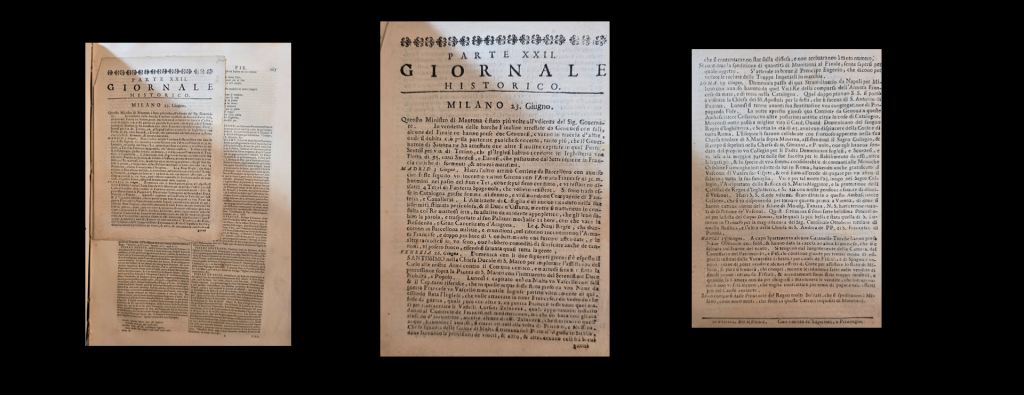
While browsing through it recently we discovered a single unknown page from another work tucked carefully between two pages of the fourth volume. Such discoveries are always exciting with works this old, especially when the discovered leaf itself appears to be nearly as old, but what precisely is this page and what work does it come from? Historically such analyses took considerable time to track down the source work, especially with uncommon ephemerals. Instead, in our modern AI world, we can simply snap a cellphone photo of the front and back and hand it to Gemini, which produces this detailed overview in seconds, showcasing the immense power of AI tools for archives to track down history and significance of such errant discoveries. In this case, not only does Gemini compile a list of all of the events described in this page, it even contextualizes each and tells us its historical importance!
Based on the text, language, typography (such as the use of the "long s" or ſ), and the specific historical events described, this is a page from an early printed Italian newspaper—often called a gazzetta, coranto, or avviso—dating specifically to the summer of 1694.
The publication is titled "GIORNALE HISTORICO" (Historical Journal), Part XXII. During the 17th century, these early periodicals were printed to keep merchants, diplomats, and the nobility informed of the fast-moving military, political, and commercial events across Europe.
While the front page carries a lead dateline of Milan, June 23, the colophon at the very bottom of the second page notes it was printed in Ferrara by Filoni ("In Ferrara, per il Filoni. Con licenza de' Superiori, e Priuilegio"). This indicates it was a compilation of news dispatches gathered from various cities and reprinted locally for the people of Ferrara. By analyzing the specific battles and deaths reported, we can firmly date this document to June or early July of 1694.
Here is a detailed breakdown of the dispatches on this page and their historical context, which reveals a fascinating real-time snapshot of Europe during the Nine Years' War (1688–1697).
1. The Milan Dispatch (Dated June 23, 1694)
-
- Local Disputes: The page begins with news from Milan. It mentions a minister from Mantua meeting with the Governor of Milan (at the time, Diego Fílipez de Guzmán). It then details a regional skirmish: Genoese forces had arrested boats from the Spanish-controlled Marquisate of Finale ("barche Finaline") carrying salt. In retaliation, Finale captured Genoese boats, and the Governor of Savona captured more Finale boats. This highlights the constant jurisdictional friction in the region.
- The Blockade of France: The most significant news here arrives via Turin: "It is heard… that the English have led into England a fleet of 95 Swedish and Danish ships, which were passing from the North into France laden with grain and maritime equipment."
Historical Context: France was suffering from a catastrophic famine in 1693–1694. To survive, they desperately tried to import grain using neutral Danish and Swedish fleets. The English and Dutch navies blockaded French ports and ruthlessly captured these neutral supply ships, an exact event captured perfectly in this news report.
2. The Madrid Dispatch (Dated June 3, 1694)
-
- The Battle of Torroella: The dispatch reports that a courier arrived from Barcelona with news of a fierce battle near Girona at the crossing of the Ter river ("nel passo del fiume Ter"), where a French army of 30,000 men defeated four regiments of Spanish infantry ("4 Terzi di Fanteria Spagnuola").
Historical Context: This is a highly accurate, real-time report of the Battle of the River Ter (fought on May 27, 1694). The French Marshal de Noailles crushed the Spanish forces in Catalonia, and the news reached Madrid exactly a week later. - Death of the Duke of Osuna: The report mentions that while consulting with King Charles II of Spain on Tuesday evening, the Duke of Osuna suffered an apoplectic fit ("accidente appopletico"), lost his speech, was carried to his palace, and died at 11 o'clock. It notes this left his position as President and Grand Chancellor of the Council of Aragon vacant ("vaca la Presidenza, e Gran Cancelirato d'Aragona").
Historical Context: Gaspar Téllez-Girón, 5th Duke of Osuna and President of the Council of Aragon, died on exactly June 2, 1694 [1]. The accuracy of the day, time, and cause of death proves the high reliability of these early news couriers.
- The Battle of Torroella: The dispatch reports that a courier arrived from Barcelona with news of a fierce battle near Girona at the crossing of the Ter river ("nel passo del fiume Ter"), where a French army of 30,000 men defeated four regiments of Spanish infantry ("4 Terzi di Fanteria Spagnuola").
3. The Venice Dispatch (Dated June 26, 1694)
-
- Prayers for War: The dispatch reports that the Holy Sacrament was exposed in St. Mark's Basilica to pray for the success of their armies against the "Common Enemy" ("Comune nemico"—the Ottoman Empire). A grand procession was held, attended by the Doge ("Duce"), nobility, and the public.
Historical Context: Venice was heavily engaged in the Morean War (The Sixth Ottoman-Venetian War) and frequently held public masses to pray for naval and land victories. - Mediterranean Privateers: The report concludes with news brought by a ship from Malta. It details a naval skirmish between French warships and an English merchant vessel. The French were actively patrolling the waters to hunt down Dutch privateers from Zeeland ("Corsari Zelandesi"), who were devastating French commerce in the Mediterranean. It notes the Dutch privateers fled toward Palermo and Messina to hide.
- Prayers for War: The dispatch reports that the Holy Sacrament was exposed in St. Mark's Basilica to pray for the success of their armies against the "Common Enemy" ("Comune nemico"—the Ottoman Empire). A grand procession was held, attended by the Doge ("Duce"), nobility, and the public.
Importance of this Document
-
- The Birth of Journalism: This page is a prime example of the genesis of modern news media. Before daily newspapers existed, these printed avvisi wove together intelligence from across the continent.
- A Snapshot of Global Conflict: On a single page, the publisher connects multiple theaters of the Nine Years' War: grand land battles in Catalonia, the naval blockade and starvation tactics against France in the North Sea, and the chaos of state-sponsored piracy (privateering) in the Mediterranean.
- Incredible Accuracy: The factual precision of the document—accurately reporting the death of a Spanish Duke down to the hour, or the exact troop numbers at a battle that took place only days prior—shows how highly developed and efficient Europe's courier and intelligence networks had become by the late 17th century.