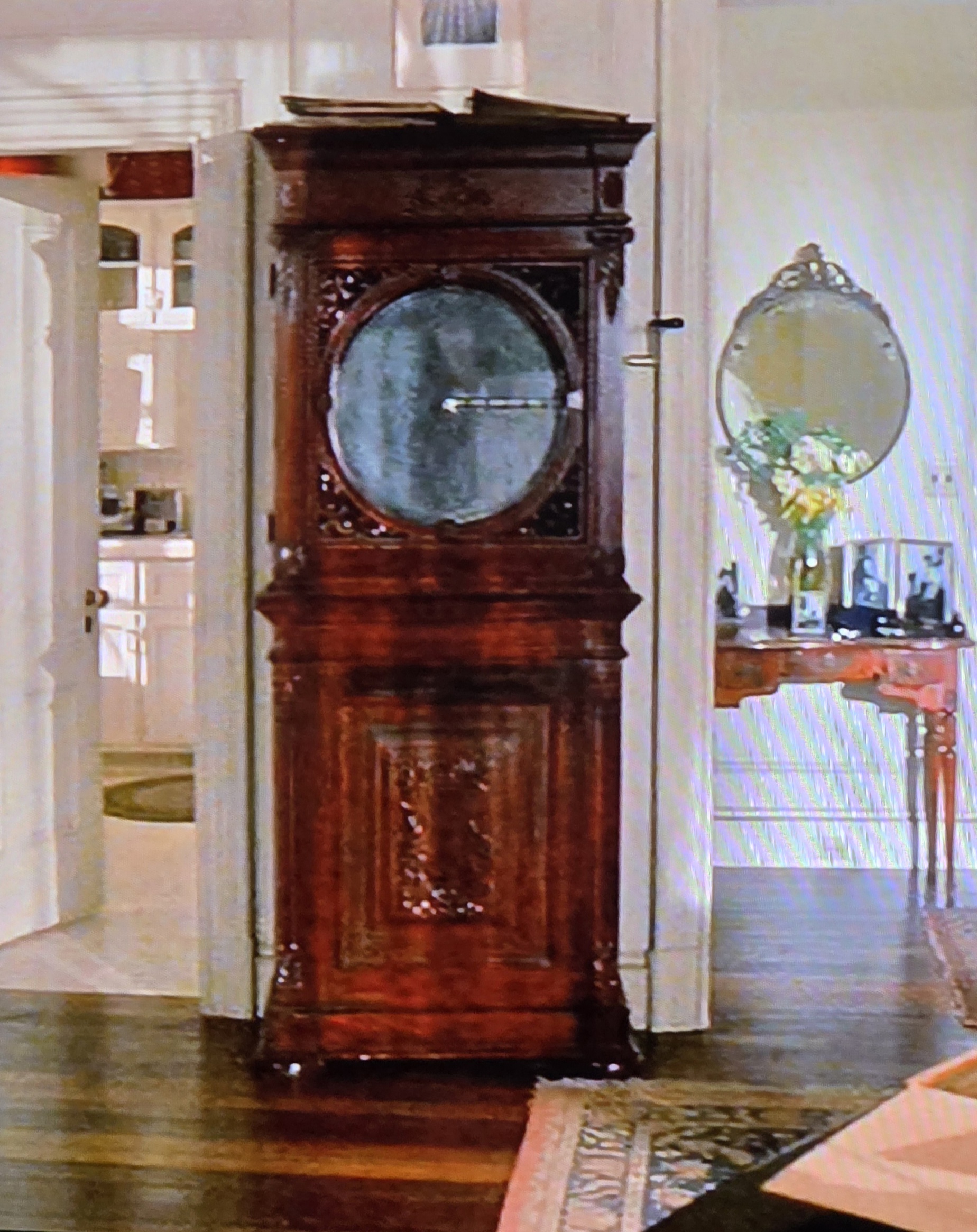
As we continue to explore how consumer AI models like Gemini could help museum visitors better interact with and understand the exhibits they visit, we came across a brief clip from the 1985 movie "The Man With One Red Shoe" playing in a museum recently and were curious what that unique cabinet was against the wall in Richard Drew's Georgetown apartment. We've noticed it ever since we first watched the movie, but were never able to find what it was. This time, however, a quick cellphone snap and a Gemini prompt away was our answer: an antique upright disc music box. Many museums play clips from various movies – Gemini can help visitors make sense of the details that interest them!
Explain in detail what this cabinet is.
The cabinet shown in the photo is an antique upright disc music box, an ingenious automated musical instrument from the late 19th and early 20th centuries. Produced by renowned manufacturers of the era—most notably Regina (American), Polyphon (German), and Symphonion (German)—these tall, freestanding instruments functioned as the Victorian predecessors to the modern jukebox.
Design and Mechanics:
-
-
The Cabinet: The piece is housed in a richly finished, heavy wood casing (typically mahogany, walnut, or quarter-sawn oak) that acts as a natural acoustic amplifier. It features classical architectural details, including a molded cornice top, decorative side columns or pilasters, and a heavily paneled lower section.
-
The Display: The focal point of the upper half is a large, circular glass-fronted door that frames the instrument’s core component: a large, interchangeable, flat metal music disc.
-
The Mechanism: The visible metal disc features hundreds of tiny, precisely placed punched holes or stamped projections (similar in concept to a player piano roll, but on a flat metal plate). As a spring-wound motor rotates the disc, these projections catch against small star wheels that pluck the tuned teeth of a steel comb positioned horizontally across the disc. This mechanical plucking produces a rich, resonant, and remarkably loud chiming sound.
-
Function of the Lower Section:
-
-
The solid paneled base of the cabinet typically serves a highly practical purpose. In standard upright models, it acts as a storage bin for holding a library of extra metal discs, allowing the owner to swap out songs.
-
In more advanced, expensive "automatic changer" models (such as the famous Regina Corona), the base houses a complex mechanical rack that stores multiple discs and can automatically retrieve, load, and play a specific disc when selected.
-
During their peak popularity from the 1890s through the 1910s, large upright music boxes like this one were often coin-operated and served as a major source of automated entertainment in hotel lobbies, parlors, train stations, and affluent private homes before the phonograph ultimately replaced them.