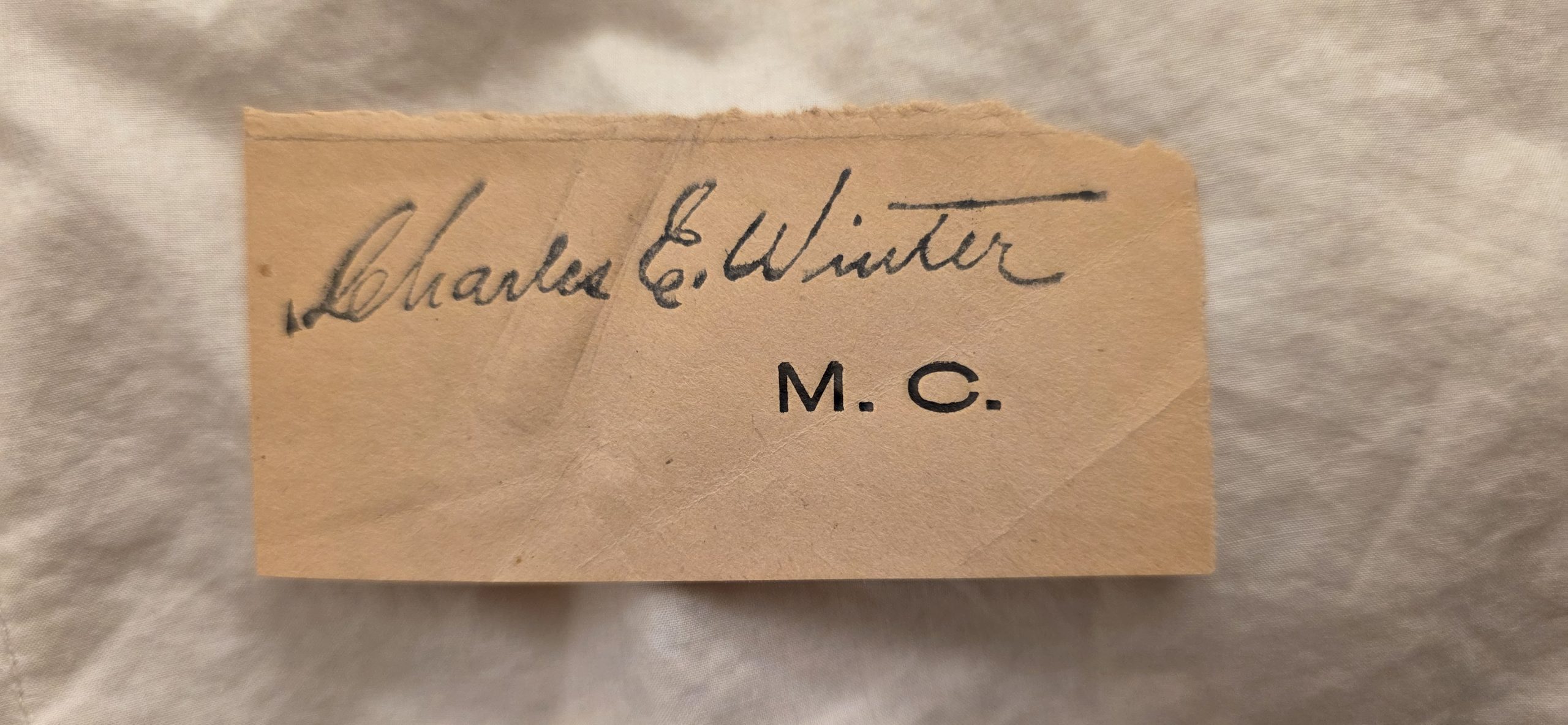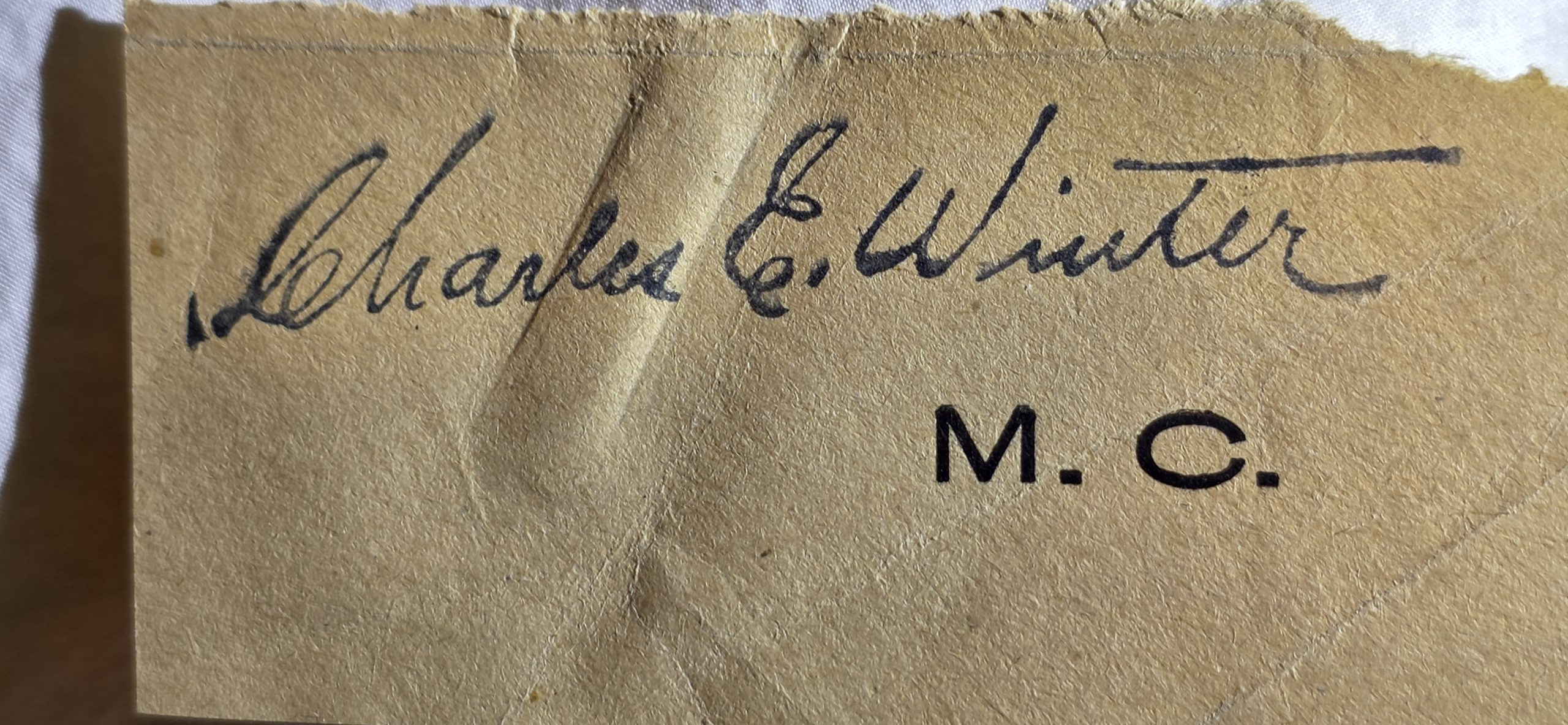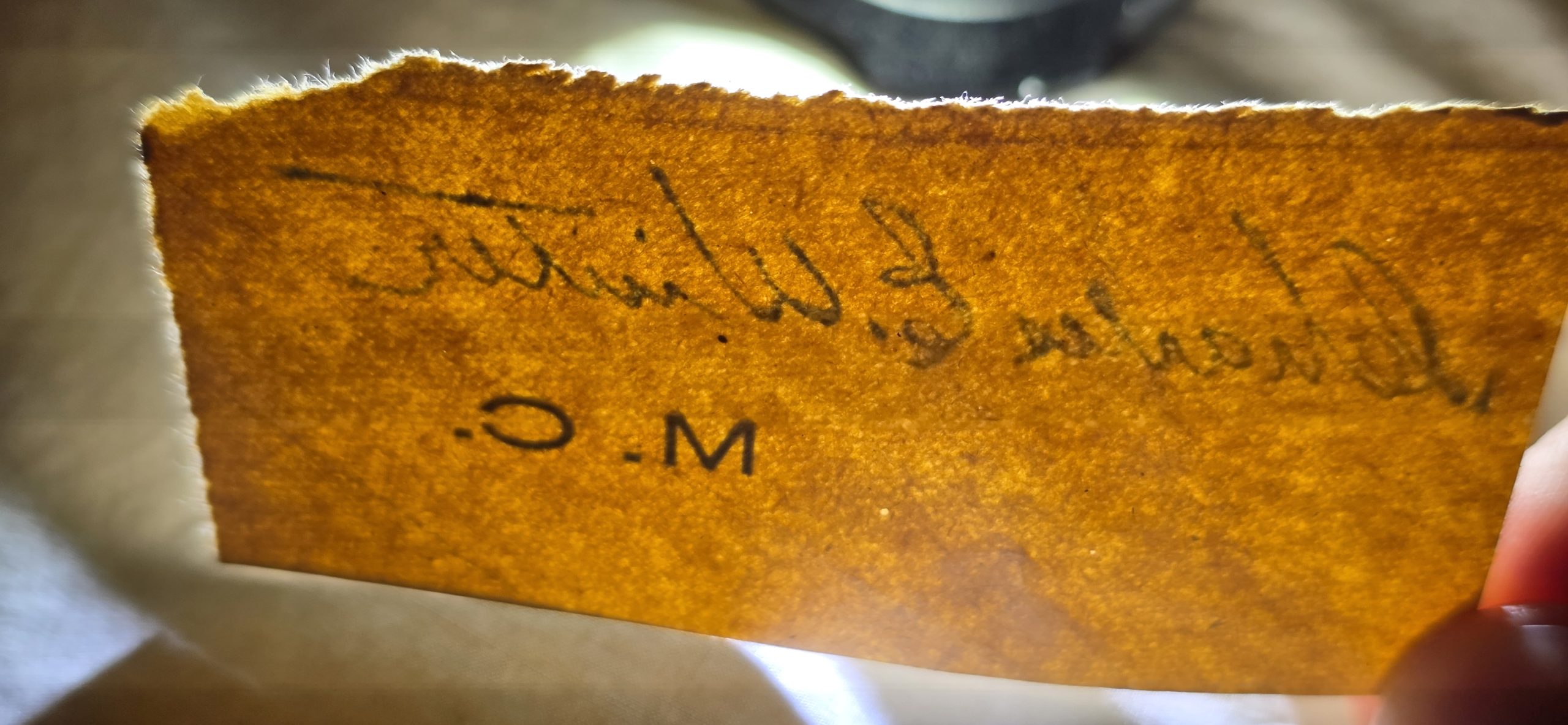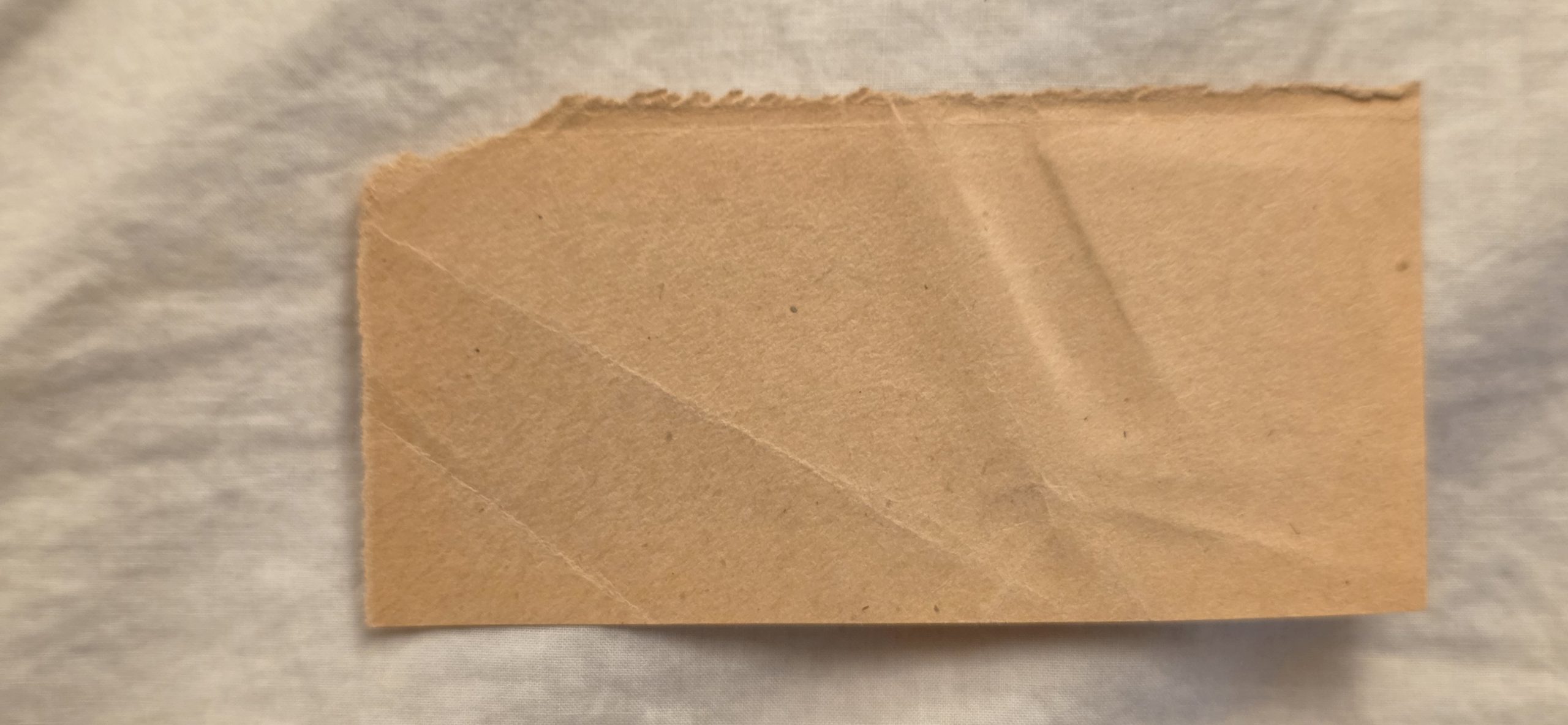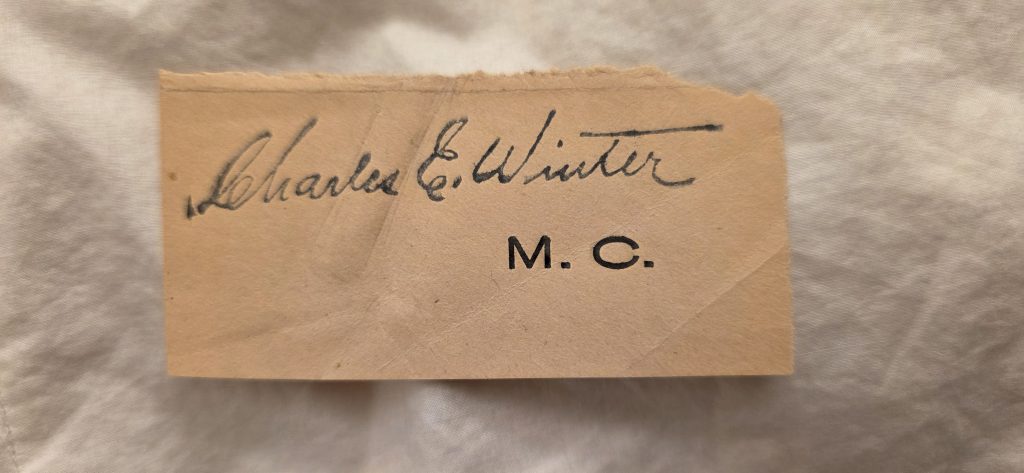
While accessioning our new 1926 Declaration of Independence pamphlet, we discovered a small fragement of paper tucked inside the cover with the signature of a "Charles E. Winter" and "M.C." on what apperas to be a manilla envelope fragment. The signature is of a different ink from the initial and has the appearance of a rubber stamp, especially the edge artifact at bottom left. Let's ask Gemini what this fragment is likely from, whose signature that is and whether it is an original or a stamped signature.
What is this? Is that signature handwritten or a stamp or what exactly is it?
Look very carefully and explain your reasoning in detail.
This item is a cut-corner Congressional "free frank" clipped from the upper-right corner of an official U.S. House of Representatives manila mailing envelope from the 1920s, bearing the name of Charles E. Winter (1870–1948), who served as the U.S. Representative from Wyoming from 1923 to 1929.
The signature is not handwritten; it is a facsimile signature (applied via a photo-engraved printing block or rubber hand stamp) paired with a letterpress-printed "M. C." (Member of Congress) designation.
1. What the Item Is
-
Congressional Franking Privilege: Instead of using postage stamps for official correspondence, Members of Congress place their signature (or an authorized facsimile) and the initials "M. C." in the upper-right corner of the envelope. Notice the faint horizontal ruled line across the very top edge, which is part of the standard U.S. Government Printing Office (GPO) envelope template from that era.
-
Cut-Square Collecting: In early-to-mid 20th-century philately and autograph collecting, it was common practice to clip the franked corner ("cut square") from envelopes rather than saving the entire bulky envelope.
2. Forensic Evidence: Why It Is a Facsimile (Not Live Ink)
A close inspection of the front, reverse, and backlit images reveals several clear physical traits that distinguish this from a live fountain-pen or dip-pen signature:
-
Absence of Nib Tracks (Tine Indentation): In the 1920s, a live signature would have been written with a steel dip pen or fountain pen. On heavy, coarse kraft/manila paper, a metal nib physically parts the paper fibers, leaving two parallel microscopic grooves (tine tracks) inside the ink line—especially on heavy downstrokes like the C, h, E, and W. Here, the paper fibers inside the strokes are completely unparted and flat.
-
"Ink Squeeze" (Haloing) Along the Stroke Edges: Look closely at the thicker strokes in Charles, the E, and Winter in the close-up photo. The ink is slightly darker and denser along the outer borders of the lines with a lighter, mottled interior. This happens when a flat relief surface (a rubber stamp or metal electrotype printing plate) presses viscous ink onto paper, squeezing excess ink outward to the edges of the raised letters.
-
Surface Skipping Over Paper Grain: Liquid fountain-pen ink flows into the valleys between paper fibers by capillary action. In contrast, the strokes here—especially the thin upstrokes of the C and h, the bottom of the W, and the long crossbar of the t—skip over the microscopic pits in the rough paper, leaving tiny un-inked pinholes where the stamp or plate did not make full contact with the recessed fibers.
-
Plate/Stamp Edge Artifact Before the "C": Just to the left of the initial loop of the C, there is a small, vertical wedge-shaped mark. This is a classic "shoulder" artifact where the trimmed edge of a rubber stamp matrix or a photo-engraved zinc/copper line block caught ink and transferred to the paper.
-
Different Ink Density from "M. C.": The "M. C." below the signature is printed in dense, jet-black typographic ink with crisp letterpress edges pre-printed by the Government Printing Office. The signature above it has a slightly softer, grayish-black tone and rougher edge definition, typical of a rubber hand stamp or secondary facsimile plate used by a Congressman's staff to frank bulk mail.
-
Zero Bleed-Through or Embossing on the Reverse: As seen on the back of the slip and in your transmitted-light (backlit) photo, the ink sits entirely on the top surface of the paper. Liquid fountain-pen ink thick enough to make strokes as wide as the W or E would penetrate deep into the paper fibers and show dark saturation spots when backlit, whereas this shows a flat, uniform surface silhouette.
Let's learn a bit about this person and their role in the history of our nation:
Who was Winter and what is his importance in American history?
Charles Edwin Winter (September 13, 1870 – April 22, 1948) was an American jurist, politician, Western novelist, and lyricist who helped shape early 20th-century Wyoming politics and Western public-land debates.
Born in Muscatine, Iowa, and educated at Nebraska Wesleyan University, Winter practiced law in Omaha before moving to the copper-mining boomtown of Grand Encampment, Wyoming, in 1902, and settling permanently in Casper in 1908.
Political and Judicial Career
-
Wyoming District Judge (1913–1919): Appointed to the bench for Wyoming's Sixth Judicial District, he served six years before resigning to resume private law practice and pursue federal office.
-
U.S. Representative (1923–1929): Elected as Wyoming's sole, at-large Congressman for three consecutive terms (the 68th, 69th, and 70th Congresses), Winter represented the state during the Coolidge administration. Rather than seeking a fourth House term in 1928, he ran unsuccessfully for the U.S. Senate against incumbent Democrat John B. Kendrick.
-
Attorney General of Puerto Rico (1932–1933): President Herbert Hoover appointed Winter Attorney General of Puerto Rico in March 1932, where he oversaw the territory's justice department and briefly served as Acting Governor before returning to Casper in late 1933.
Historical Importance and Legacy
-
Western Public Lands Advocate: Winter was one of the era's most vocal champions of transferring federal public domain lands and mineral rights to Western states. His 1932 book, Four Hundred Million Acres: The Public Lands and Resources, argued that federal lockups of timber, grazing, and mineral lands stifled Western economic sovereignty—an early intellectual precursor to late-20th-century Western land-rights movements like the Sagebrush Rebellion.
-
Colorado River and Reclamation Projects: In Congress, he worked closely with fellow Western legislators on water reclamation, advocating for the Casper-Alcova irrigation project in Wyoming and participating in the legislative debates surrounding the Boulder Canyon Project Act (which authorized the Hoover Dam).
-
Author of Wyoming's Official State Song: In the summer of 1903, while riding on a train back to Wyoming from the East, Winter penned a five-stanza poem titled "Wyoming" ("In the far and mighty West…"). Set to march music first by Earle R. Clemens and later by University of Wyoming professor George Edwin Knapp, it was officially adopted by the state legislature in 1955 as the Wyoming State Song.
-
Frontier Novelist: Unlike most politicians of his day, Winter had a parallel career writing popular Western fiction that captured the transition of the frontier into the modern industrial West. His books include Grandon of Sierra (1907), set during the Encampment copper rush; Ben Warman (1917), which was adapted into the 1920 silent film Dangerous Love; and Gold of Freedom (1944), centered on the historic South Pass gold fields.