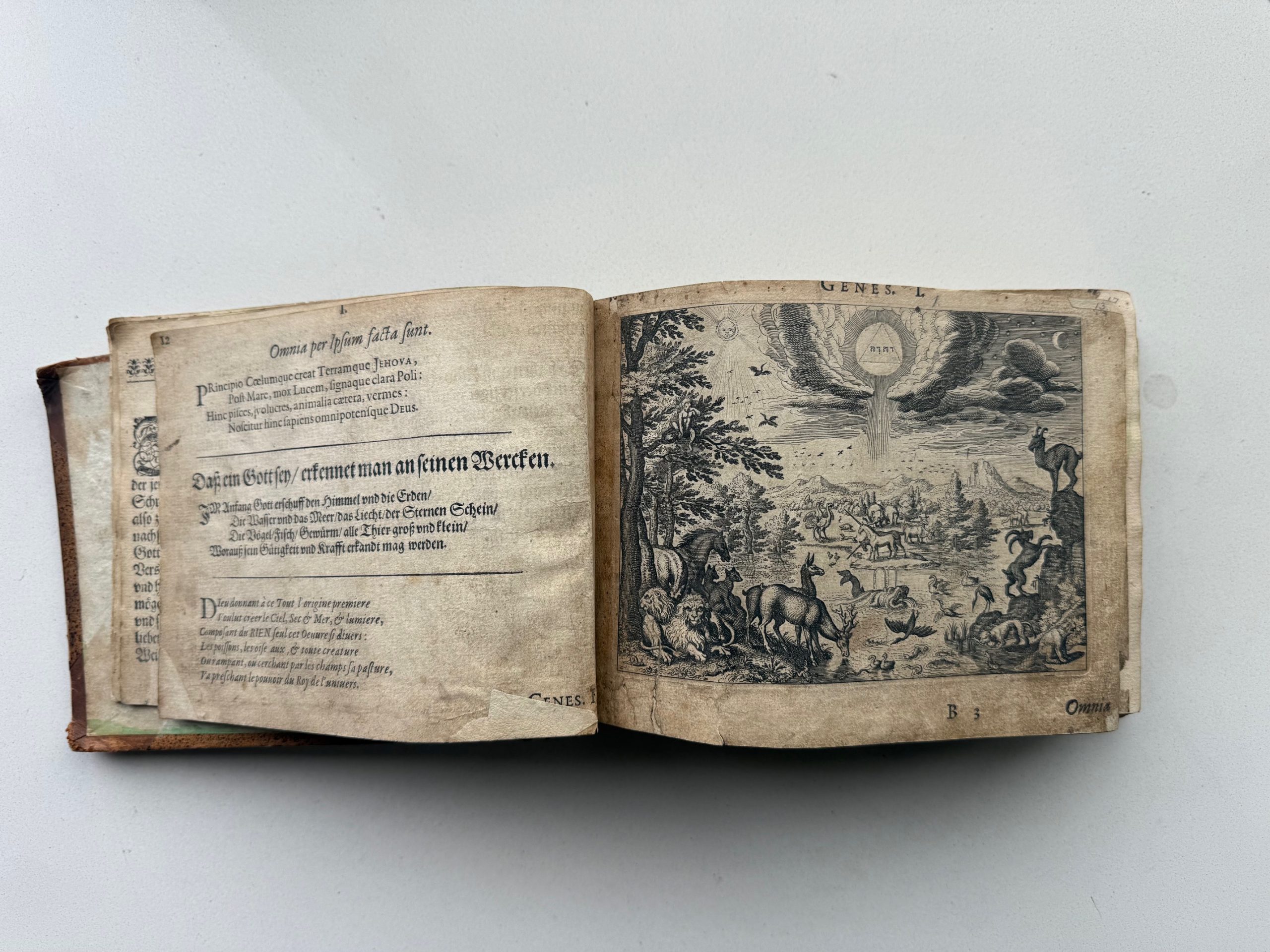
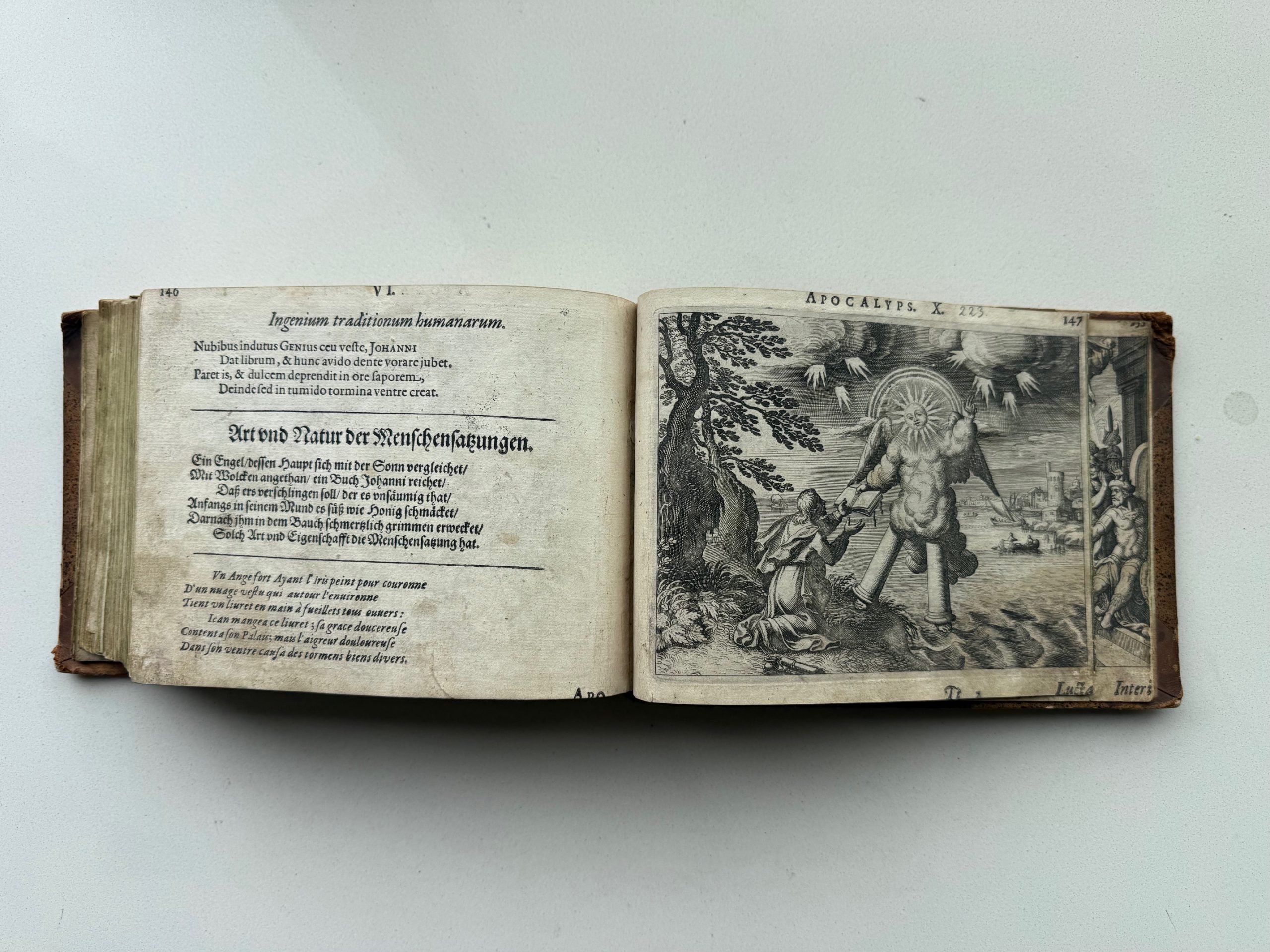
Accession catalogers in rare books archives are frequently confronted with works whose title pages have been lost, damaged or are questionable or where a sammelband is suspected. Gemini has proven uniquely adept at identifying works down to the level of a specific edition, based purely on a photograph of a single page, giving a cataloger sufficient information to track down a known digitized copy of the suspected work to confirm. Here we have a second printing (the Strasbourg edition) of one of the most famous and reprinted Biblical series of the 1600s: the Merian suite. In this case we have three of the four title plates intact so we know precisely which edition we have, but let's see if Gemini can identify our copy based purely on photographs of two pages. As usual, from just two images, Gemini was able to carefully identify not only the two engravings, but the facing text and page numbering and signatures and catchwords to precisely and correctly identify this as the second edition!
Identify this book precisely.
Which year and edition is it?
Explain your reasoning in detail.
This book is the 1629–1630 Strasbourg edition (second edition overall, and first complete Strasbourg edition) of Matthäus Merian the Elder’s Icones Biblicae (Icones Biblicae praecipuas Sacrae Scripturae historias eleganter & graphice repraesentantes / Biblische Figuren…), containing all four parts (Old Testament Parts I–III and the New Testament as Part IV) bound together in a single oblong quarto (4° obl.) volume, published in Strasbourg by the Heirs of Lazarus Zetzner (In Verlegung Lazari Zetzners Seeligen Erben), with trilingual verses by Johann Ludwig Gottfried.
1. Work Identification & Trilingual Structure
The volume is the foundational emblem-style picture Bible etched and engraved by Matthäus Merian the Elder (1593–1650) after he settled in Frankfurt and collaborated with the Strasbourg publishing house of Lazarus Zetzner’s heirs. Each opening is designed as a two-page unit: letterpress verses on the left (verso) facing a full-page copperplate engraving on the right (recto).
-
Spread 1 — Part I, Plate I (Creation, Genesis 1):
-
Latin (top): The Johannine motto Omnia per Ipsum facta sunt (John 1:3) in italics above a four-line epigram in roman type ("Principio Cœlumque creat Terramque JEHOVA…").
-
German (middle): The bold Fraktur header "Daß ein Gott sey / erkennet man an seinen Wercken." above a four-line Alexandrine quatrain ("JM Anfang Gott erschuff den Himmel vnd die Erden/…") using early 17th-century virgules (
/) for punctuation and initialvforu(vnd). -
French (bottom): A six-line italicized stanza ("Dieu donnant à ce Tout l'origine premiere…") retaining pre-classical French orthography (cerchant for cherchant).
-
-
Spread 2 — Part IV (New Testament), Apocalypse 10 (St. John Eating the Little Book):
-
Latin (top): The motto Ingenium traditionum humanarum above a four-line epigram ("Nubibus indutus GENIUS ceu veste, JOHANNI…").
-
German (middle): The Fraktur header "Art vnd Natur der Menschensatzungen." above a six-line stanza ("Ein Engel / dessen Haupt sich mit der Sonn vergleichet/…").
-
French (bottom): A six-line italicized stanza ("Vn Ange fort Ayant l'Iris peint pour couronne…") with early 17th-century spellings (vestu, fueillets, ouvers, tormens).
-
How the text distinguishes this edition from later issues:
-
Language configuration: The presence of strictly three languages (Latin, German, and French) in this three-tier verso layout rules out the Amsterdam editions published by Cornelis Danckerts and Jan Philipsz Schabaelje (from c. 1640 onward), which added a fourth language (Dutch) or replaced the German/French letterpress with Dutch typography.
-
Independence from the 1630 Folio Bible: In 1630, Zetzner’s heirs reused these exact copperplates inside their monumental folio German Luther Bible (Merian-Bibel), where the plates were printed directly within two-column biblical text. Here, the plates appear in their dedicated oblong quarto format with letterpress headers, signatures, and catchwords outside the plate mark.
2. Page Numbering, Signatures, and Collation Analysis
The pagination, signature marks, and catchwords on the two spreads establish the exact oblong quarto collation (A–Z⁴, Aa–Vv⁴, gathered in 4s = 8 pages per quire) and distinguish this edition from both unpaginated suite printings and later reprints:
Part I: Pages 12–13 and Signature B 3
-
Collation Math: In a quarto in fours, quire
Acomprises pages 1–8 (A1r–A4v) and quireBbegins on page 9 (B1r). In this edition, the preliminary leaves—comprising the engraved title page and the German preface (Vorrede), the final leaf of which (B2r, p. 11) is visible peeking out to the left of page 12 with its type-ornament border and Fraktur text ("der je…", "Sch…", "Gott…")—occupy pages 1–11 (A1r–B2r). -
First Emblem Placement: Because the preliminaries are paginated continuously with the main text, the very first biblical text page falls on
B2v(page12), markedI.at top center, and its facing Creation plate falls onB3r(page13), signedB 3below the lower right corner of the engraving. -
Catchwords & Unnumbered Copperplates: Page 12 ends with the catchword
GENES. I(matching the letterpress headerGENES. I.above the plate on p. 13), while page 13 ends with the catchwordOmnia(leading into the Latin motto onB3v, p. 14). Crucially, the copperplate itself has no engraved number inside the plate border, proving an early impression prior to the addition of engraved plate numbers in later 17th-century restrikes.
Part IV (New Testament): Pages 146–147, Signature Tt 2, and Page 159
-
Doubled Signatures (
Aa–Vv⁴): To prevent the binder from confusing sheets of the New Testament (Part IV) with Part I, the printer signed Part IV with doubled letters (Aa, Bb, Cc...) while restarting the page numbering at 1. -
Signature Math (
Tt 2= Page 147): Using the 23-letter early modern Latin alphabet (A–ZomittingJ,U, andW), the first 18 quires (AathroughSs) contain $18 \times 8 = 144\text{ pages}$. The 19th quire (Tt) therefore collates as follows:-
Tt1r= p. 145 -
Tt1v= p. 146 (text for Revelation 10, with catchwordAPO-) -
Tt2r= p. 147 (plate forAPOCALYPS. X., with printed page number147at upper right, signatureTt 2at lower right, and catchwordLuctaleading to Lucta Michaelis & Draconis on p. 148).
-
-
Visible Terminal Leaves (
Interiand Page159): Because leafTt2(p. 147) has a trimmed fore-edge, the underlying leaves of the final two quires (TtandVv) are visible to its right. Immediately beneathLuctaappears the catchwordInterionTt3r(p. 149, leading to Interitus Babylonis on p. 150), and at the upper right corner of the last leaf (Vv4r) is the printed page number159—confirming the exact 160-page collation (pp. 1–159, withp. 160blank) of the Strasbourg New Testament part. -
The
VL.Misprint and Manuscript Plate Count (223.): Part IV contains 78 plates beginning on pp. 4–5 (following the title leafAa1and preface leafAa2r), which makes pp. 146–147 the 72nd emblem (LXXII.) of the New Testament ($4 + 71 \times 2 = 146$). At the top center of page 146, however, the Roman numeral is misprinted asVL.—a distinctive compositor's setting error in this Strasbourg printing. Meanwhile, the early manuscript ink number223.besideAPOCALYPS. X.on p. 147 (along with the faint13on p. 13) shows an early owner numbering the plates sequentially across all four parts bound in one volume.
3. Distinguishing the 1629–1630 Edition from the 1625–1627 First Edition
Merian’s Icones Biblicae was first published piecemeal between 1625 and 1627 across different imprints in Strasbourg and Frankfurt, and was then consolidated into this 1629–1630 second edition in Strasbourg by the Heirs of Lazarus Zetzner:
| Component | First Edition (1625–1627) | This Edition: Second / Strasbourg Edition (1629–1630) |
| Part I (Genesis–Ruth) | Published 1625 (Strasbourg: Heirs of Lazarus Zetzner / Frankfurt). | Reissued c. 1629–1630 by Zetzner's heirs in Strasbourg; prelims on pp. 1–11 (A1r–B2r), Plate I on pp. 12–13 (B2v–B3r). |
| Part II (Iconum Biblicarum Pars II) | Published 1625/1626 with engraved architectural title border ("Durch Matthæum Merian von Basel"). | Retains the undated engraved title plate ("Iconum Biblicarum Pars II… Durch Matthæum Merian von Basel"), printed with reset Strasbourg letterpress. |
| Part III (Iconum Biblicarum Pars III) | Published in Frankfurt am Main by Erasmus Kempffer in 1627 ("Dritter Theyl Biblischer Figurn… Franckfurt am Mayn/ bey Erasmo Kempffern MDCXXVII"). | Completely reset letterpress title page reading "Dritter Theil Biblischer Figuren…" with modernized spelling (geschichtmässig, Kunstverständigen Personen) and the Strasbourg imprint: "Straßburg / In Verlegung Lazari Zetzners Seeligen Erben. Im Jahr M. DC. XXX." (1630). |
| Part IV (Noui Testamenti D. N. Iesu Christi) | Self-published by Merian in Frankfurt in 1627 ("Franckfurt bei dem Auctore zufinden. 1627"). | Engraved title plate reworked at the bottom of the central cartouche to read "In verlegung Lazari Zetzners S. Erben 1629." (1629), with 160 pages (Aa–Vv⁴) printed in Strasbourg. |
Because Part IV (the New Testament) was reissued by Zetzner's heirs in 1629 and Part III was reprinted by Zetzner's heirs to complete the set in 1630, complete bound volumes of this second edition carry the 1629 imprint on the New Testament title plate and the 1630 (M. DC. XXX.) imprint on the Part III title page, fixing the completion and publication of this volume precisely to 1629–1630.