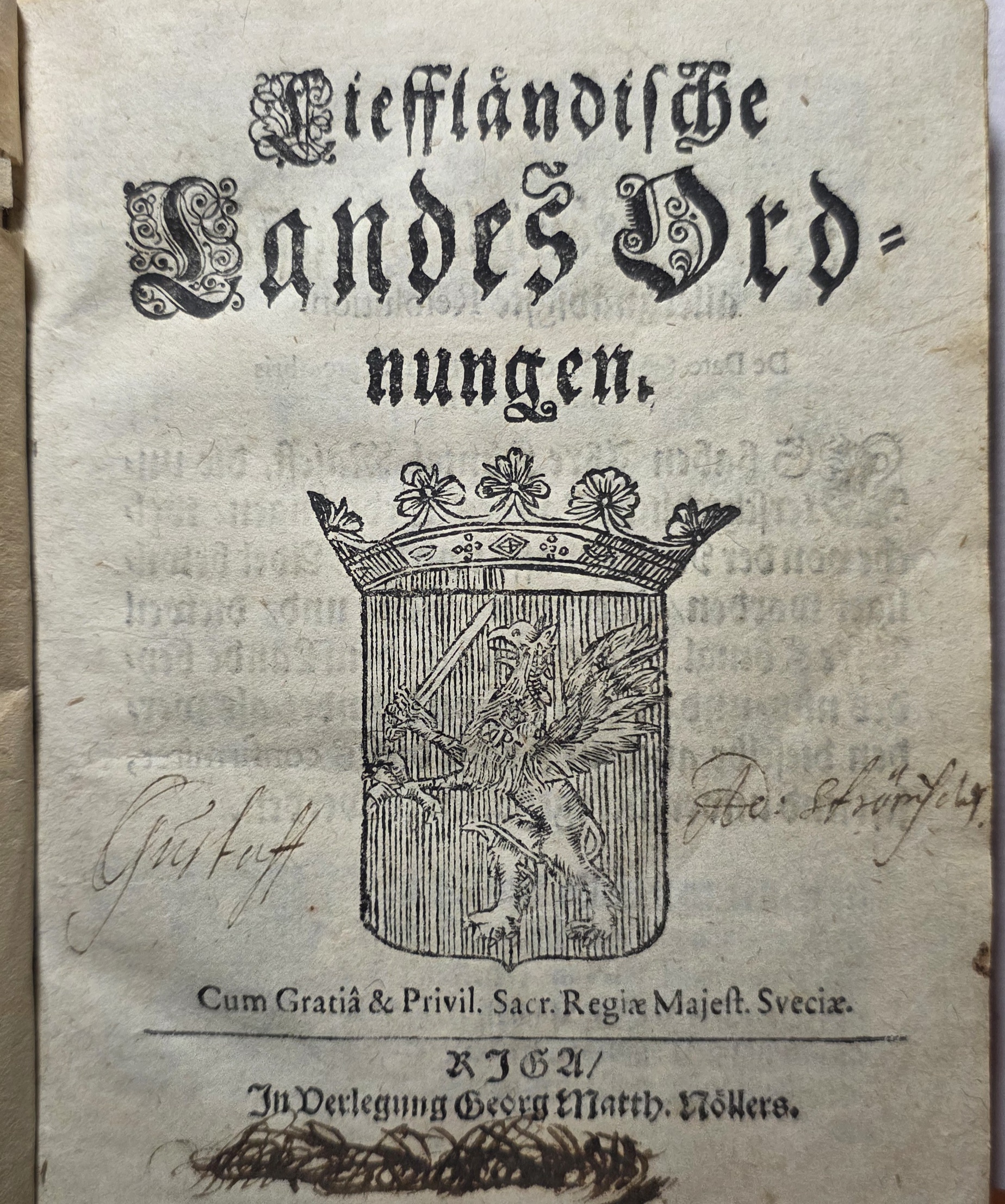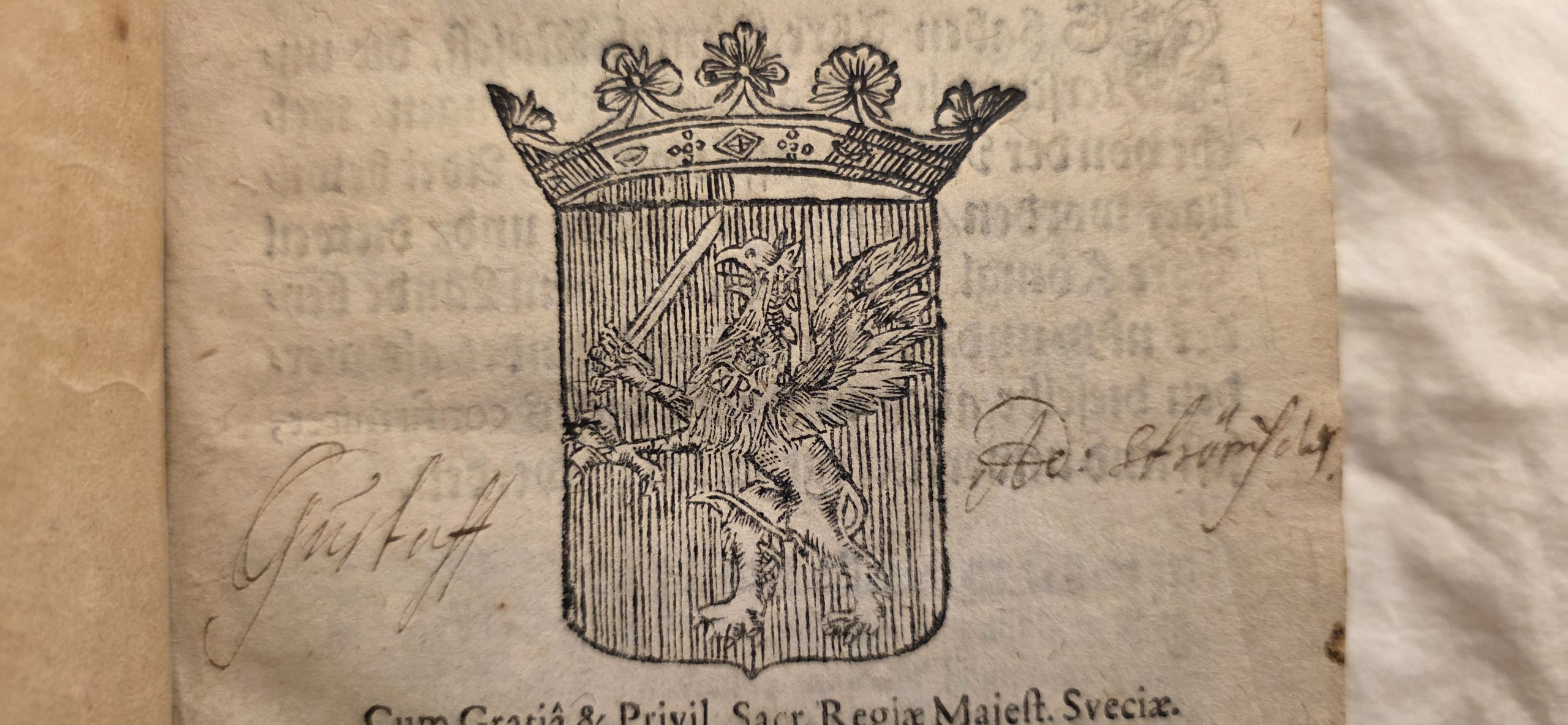
In accessioning this 1689 book from Swedish Livonia, we were curious about the coat of arms on its title page. As usual, Gemini tracked it down for us in seconds and even spotted the XRS/CRS crowned cipher on its chest!
tell me about this center image in detail. explain your reasoning and cite your sources.
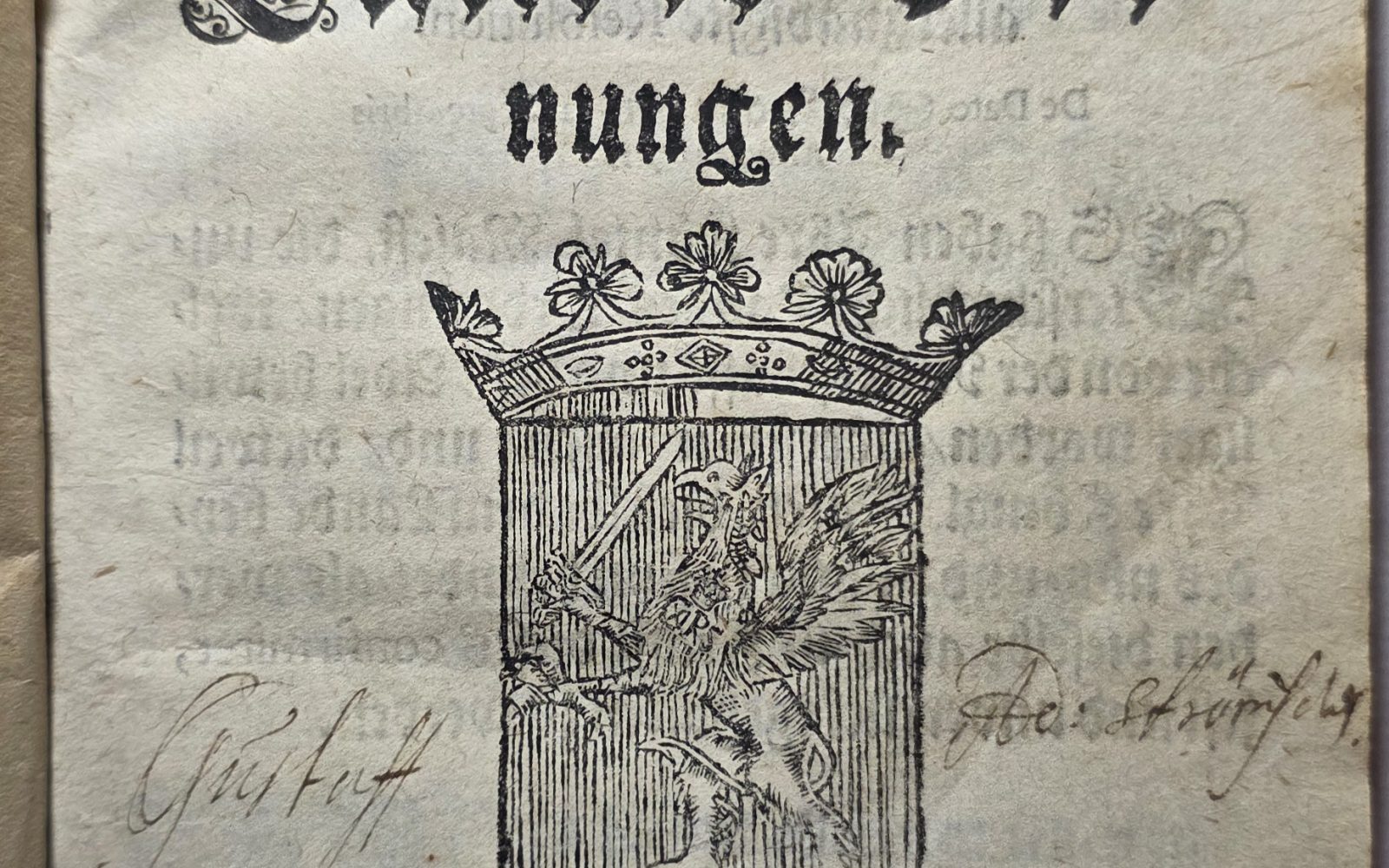
The central woodcut illustration on the title page of "Lieffländische Landes Ordnungen" (Livonian Territorial Ordinances) is the historical Coat of Arms of Swedish Livonia—a Baltic province ruled by the Swedish Empire from 1629 to 1721, covering modern-day northern Latvia (Vidzeme) and southern Estonia.
1. Visual Breakdown of the Coat of Arms
-
The Heraldic Beast (The Livonian Griffin): At the center of the shield stands a griffin rampant (rearing on its hind legs, facing the viewer's left, or heraldic dexter). This mythical creature—with the head, wings, and front talons of an eagle and the hindquarters and tail of a lion—holds a raised broadsword in its right front talon. Notice the griffin's tail tucked downward between its hind legs; in heraldry, this specific posture is termed "coward" (from the Old French couard, referring to the tail) and is a traditional feature of the Livonian griffin.
-
The Shield Background (Petra Sancta Hatching): The field behind the griffin is filled with dense vertical parallel lines. In early modern black-and-white woodcut and copperplate engraving, vertical lines are not merely decorative shading—they follow the Petra Sancta heraldic hatching system to represent the color red (Gules), contrasting with the unshaded white/silver (Argent) griffin.
-
The Royal Monogram on the Chest: Engraved directly onto the griffin's breast is a small crowned cipher reading CRS (or an intertwined XRS / CRS). Historically, when King Sigismund II Augustus of Poland granted the griffin coat of arms to the Duchy of Livonia on December 26, 1566, the griffin bore his golden monogram (SA) on its chest. Under Swedish rule in the late 17th and early 18th centuries, printer woodcuts adapted this tradition to display the Latin royal monogram of the reigning Swedish monarch: Carolus Rex Sveciae (King Charles of Sweden—specifically Charles XI, r. 1660–1697, or Charles XII, r. 1697–1718).
-
The Coronet (Ducal Crown): Resting atop the shield is an open ducal coronet decorated with five visible strawberry-leaf (fleuron) points and a jewel-studded circlet, signifying Livonia's status as a duchy (Herzogtum) within the Swedish royal titles.
2. Reasoning & Contextual Evidence from the Page
Every piece of text surrounding the woodcut directly corroborates the identity and era of the emblem:
-
The Title ("Lieffländische Landes Ordnungen."): Written in German Fraktur (blackletter) type, this translates to "Livonian Land Ordinances" (the legal and administrative code of Livonia). German was the administrative language of the local Baltic German nobility (Livländische Ritterschaft).
-
The Royal Privilege ("Cum Gratiâ & Privil. Sacr. Regiæ Majest. Sveciæ."): Printed in Roman type just below the shield, this Latin phrase translates to "With the Grace and Privilege of His Sacred Royal Majesty of Sweden." This confirms the book was printed under Swedish royal authority while Riga was the capital of Swedish Livonia (and the largest city in the Swedish Empire).
-
The Imprint ("RIGA / In Verlegung Georg Matth. Nöllers."): Located at the bottom, this identifies the city of publication (Riga) and the publisher, Georg Matthias Nöller, who served as the official royal and municipal book printer in Riga from the late 1680s until the Russian siege and capture of Riga in 1710 (with editions of the Lieffländische Landes-Ordnungen issued around 1689, 1705, and 1707).
-
Provenance Inscriptions: Flanking the shield are two early 18th-century Swedish ownership signatures in brown iron-gall ink ("Gustaff" on the left and "Strömfelt"—a prominent Swedish-Livonian noble family—on the right), with an earlier ownership line or date at the bottom heavily crossed out in ink swirls.
3. Reference Sources & Heraldic Documentation
-
Baltic Heraldry & The Livonian Griffin: Klingspor, Carl Arvid von. Baltisches Wappenbuch (Stockholm: F & G Beijer, 1882). Documents the historical evolution of the Livonian coat of arms (Gules, a griffin rampant Argent armed with a sword) from its 1566 grant by Sigismund II Augustus through the Swedish and Imperial Russian eras (today preserved as the regional coat of arms of Vidzeme and in the national coat of arms of Latvia).
-
Bibliographic & Archival Record: Lieffländische Landes-Ordnungen, nebst darzu gehörigen Placaten und Stadgen (Riga: Georg Matthias Nöller, editions of c. 1689, 1705, and 1707), cataloged in the Universal Short Title Catalogue (USTC), the National Library of Latvia (Latvijas Nacionālā bibliotēka), the National Archives of Estonia (Rahvusarhiiv), and the Bavarian State Library (Bayerische Staatsbibliothek, VD18 14779180 / BSB 00108661).
-
Heraldic Hatching System: Pietrasanta, Silvestro (Petra Sancta). Tesserae Gentilitiae (Rome, 1638), which established the standard engraving convention of vertical lines for Gules (red).