
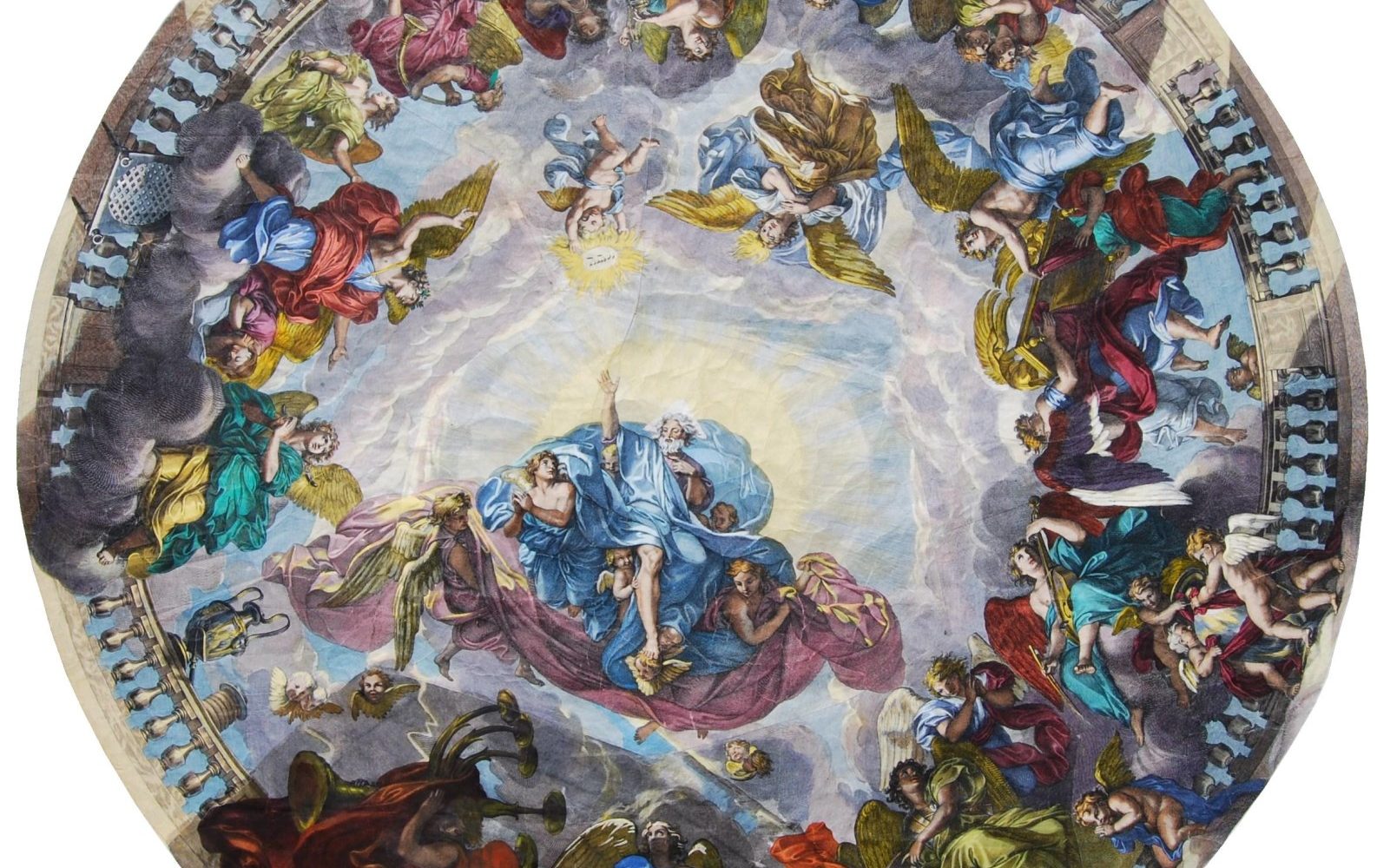
The Collection holds 3 of the 5 plates that make up Gerard Audran's monumental engraving (nearly 4 feet in diameter) of Charles Le Brun's now-lost ceiling fresco of the Chapel at the Château de Sceaux, painted around 1672–1674 for Louis XIV's minister of finance, Jean-Baptiste Colbert and destroyed after the French Revolution. We recently acquired a complete copy of the engraving with modern hand coloring, but in the process of comparing it to our 3 existing plates, we kept struggling to arrange our existing plates to match this new engraving until we realized that this colored copy is exactly reversed from our 3 plates and other major institutional copies of the engraving. With the help of Gemini, we embarked upon a fascinating journey of discovery that discovered this is a far rarer Kleinschmidt/Wolff Augsburg copy of Audran! Even better, Gemini helped us uncover this incredible history through the help of the Internet Archive, relying heavily on multiple key digitized historical reference and inventory books available on the Archive's website, offering a powerful glimpse at how AI models can leverage digitized archives for new scholarship and research!
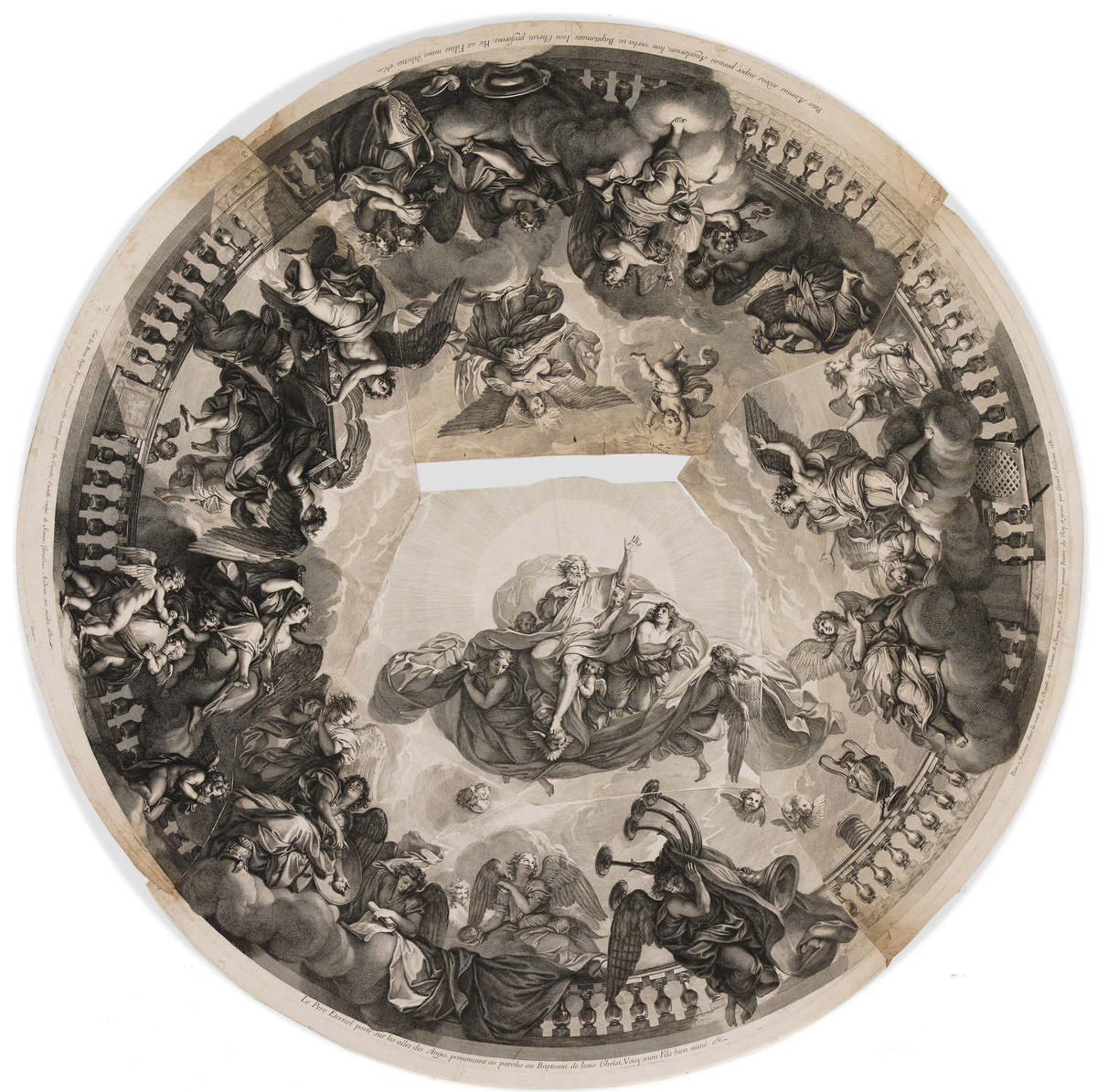
Below you can see our complete copy of this stunning monumental engraving, stretching nearly 4 feet in diameter and printed on thin contemporary laid paper. It is hand colored, with the coloring believed to date from the early 1900s. This cropped image is what was originally provided to us as the reference image when we were acquiring the engraving:
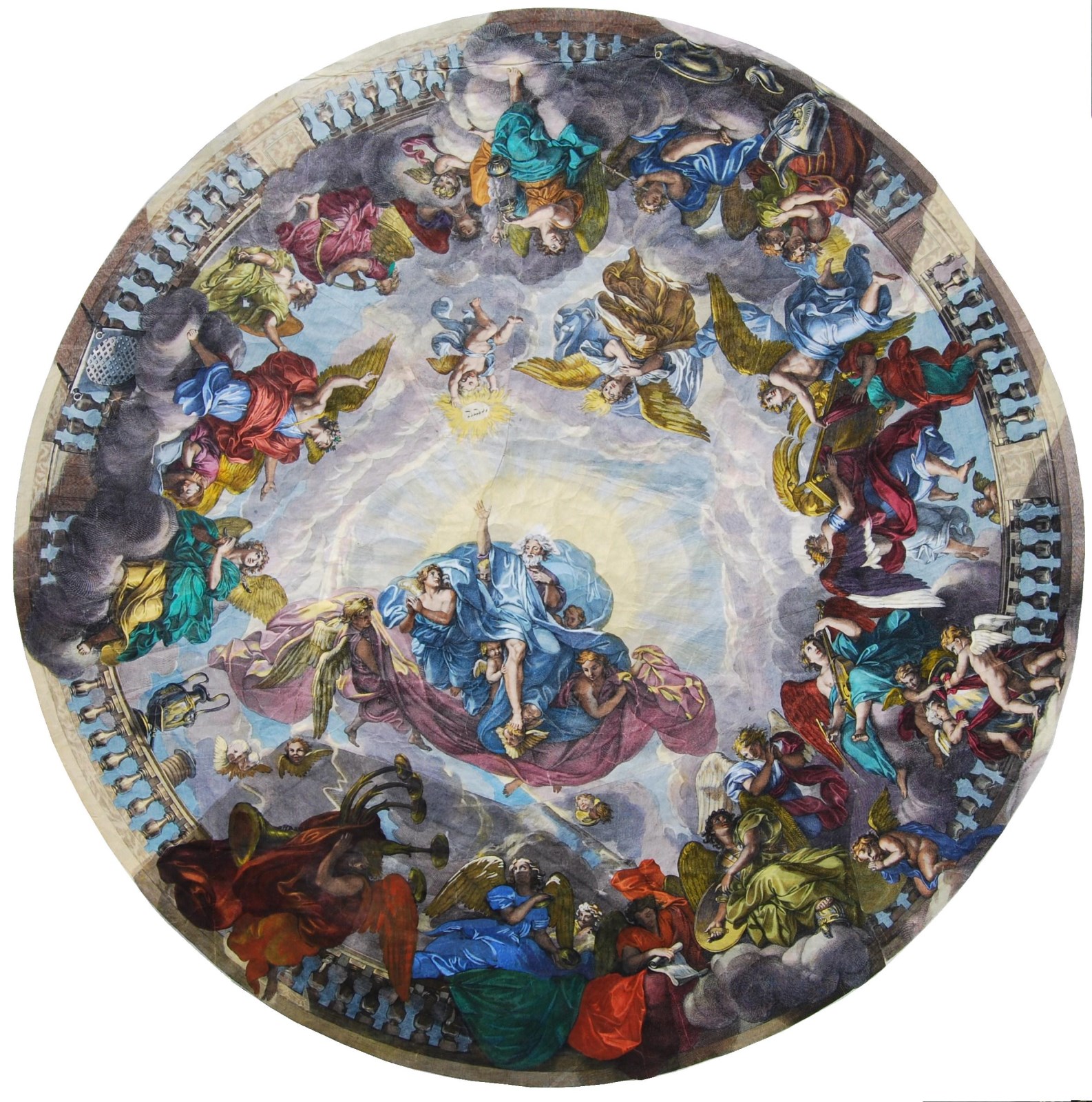
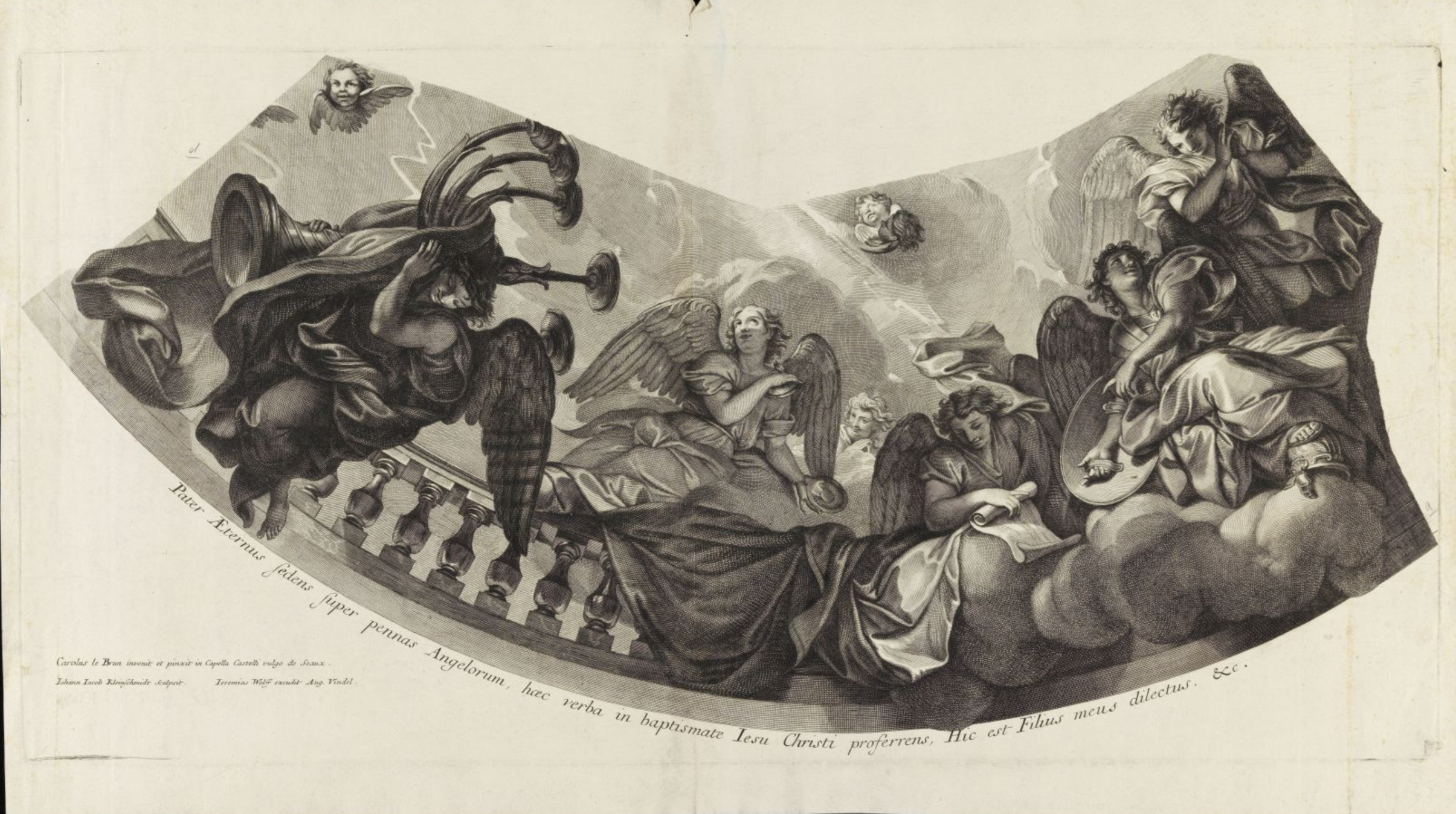
Below you can see one of the 3 plates we already hold from the original Audran engraving and which we know definitively to be Audran prints. If you look closely at the top left of the colored engraving above, you'll notice that it is mysteriously exactly reversed from this image, which automatically tells us that the colored copy above was actually a traced copy of the original (since tracing a print onto a copperplate reverses it):
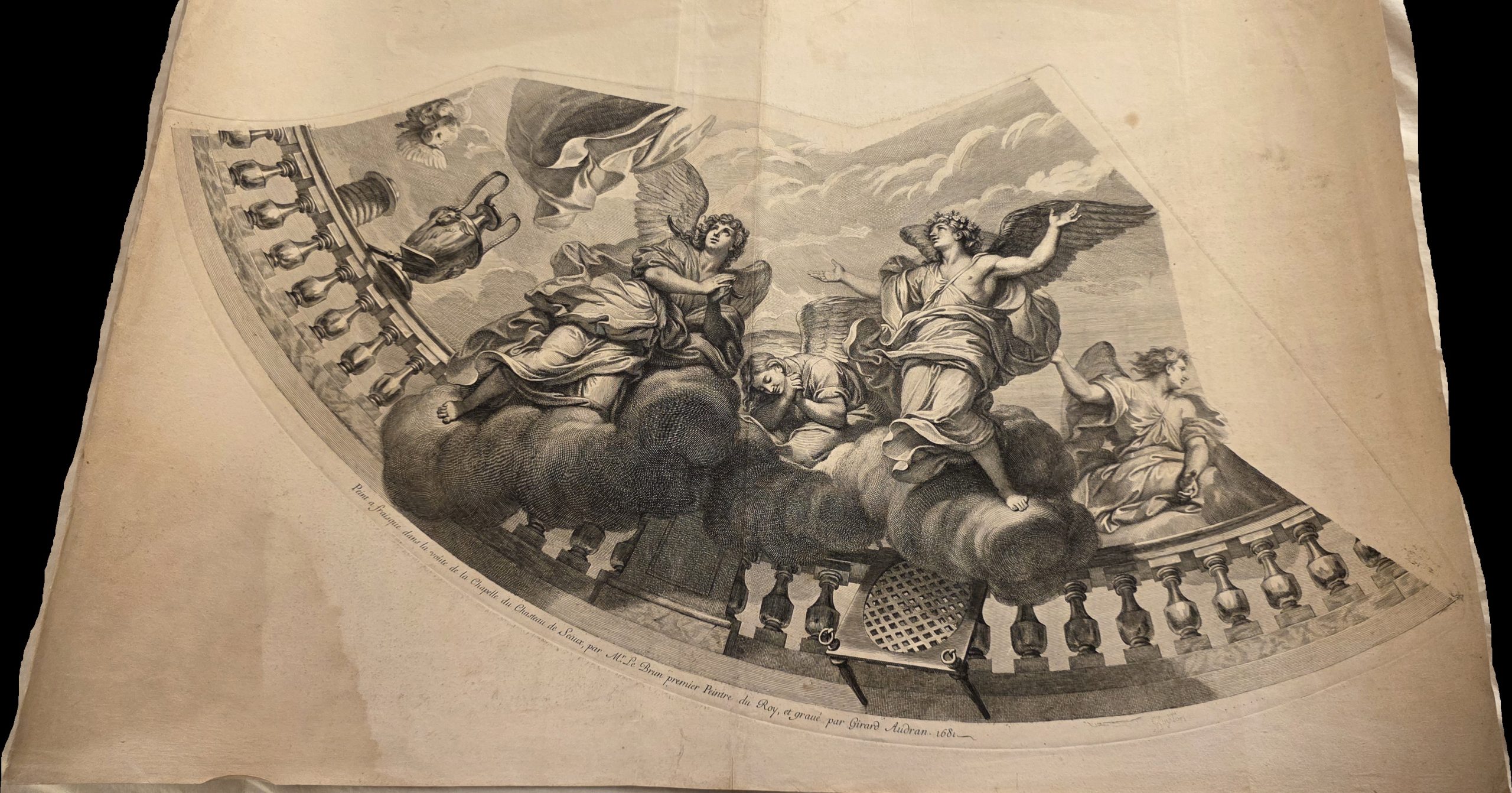
If we look carefully at Princeton's copy, we can see that it matches our uncolored plates in orientation, confirming that something is afoot here:
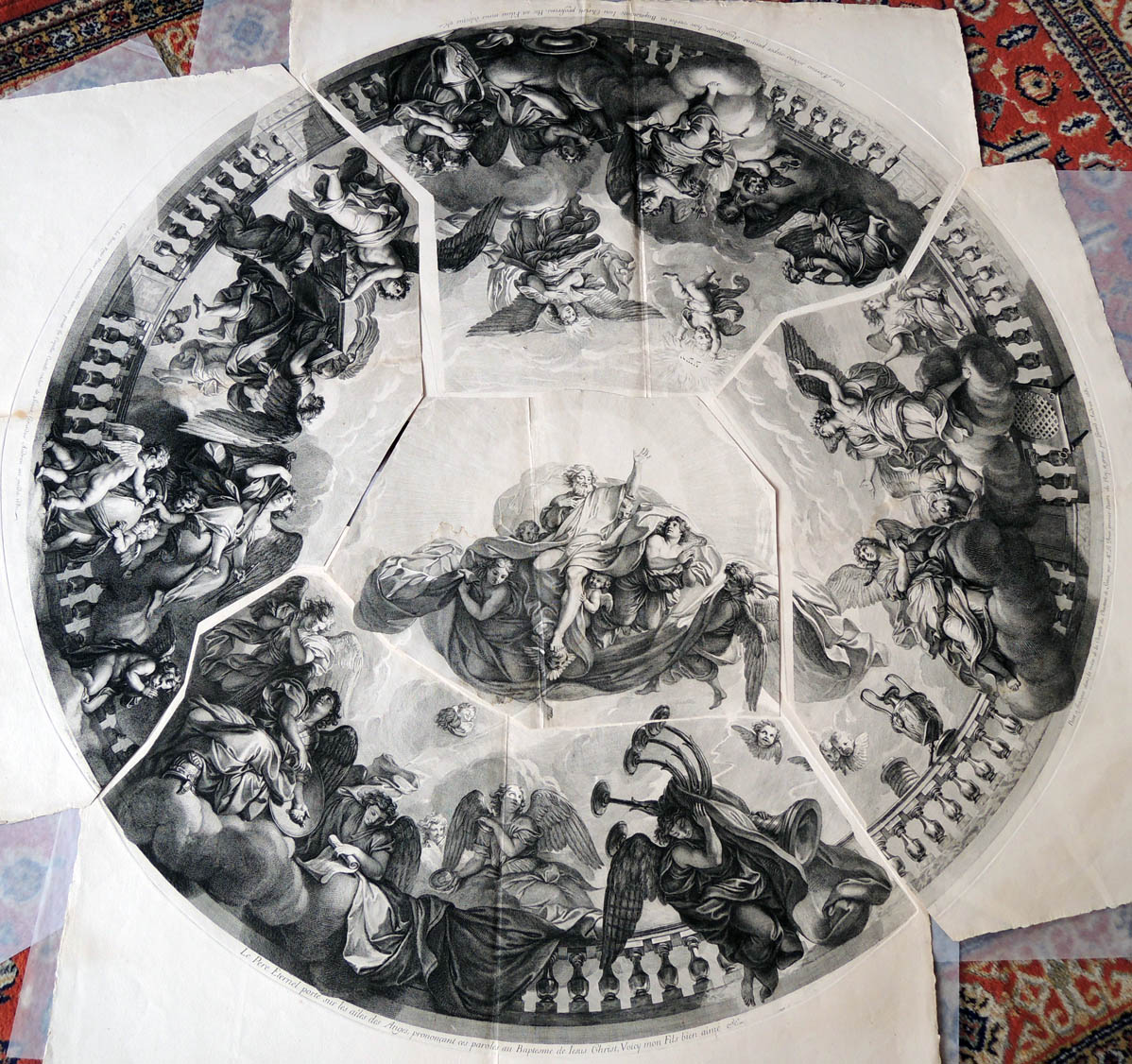
Similarly, if we look at the Musée d'art et d'histoire (MAH)'s copy in Geneva, Switzerland, we see that it, too, matches Princeton's copy and our trio of plates and is exactly reversed from our new colored copy:
By this point the engraving had arrived and we noticed a credit line at bottom left that isn't present in the other copies:
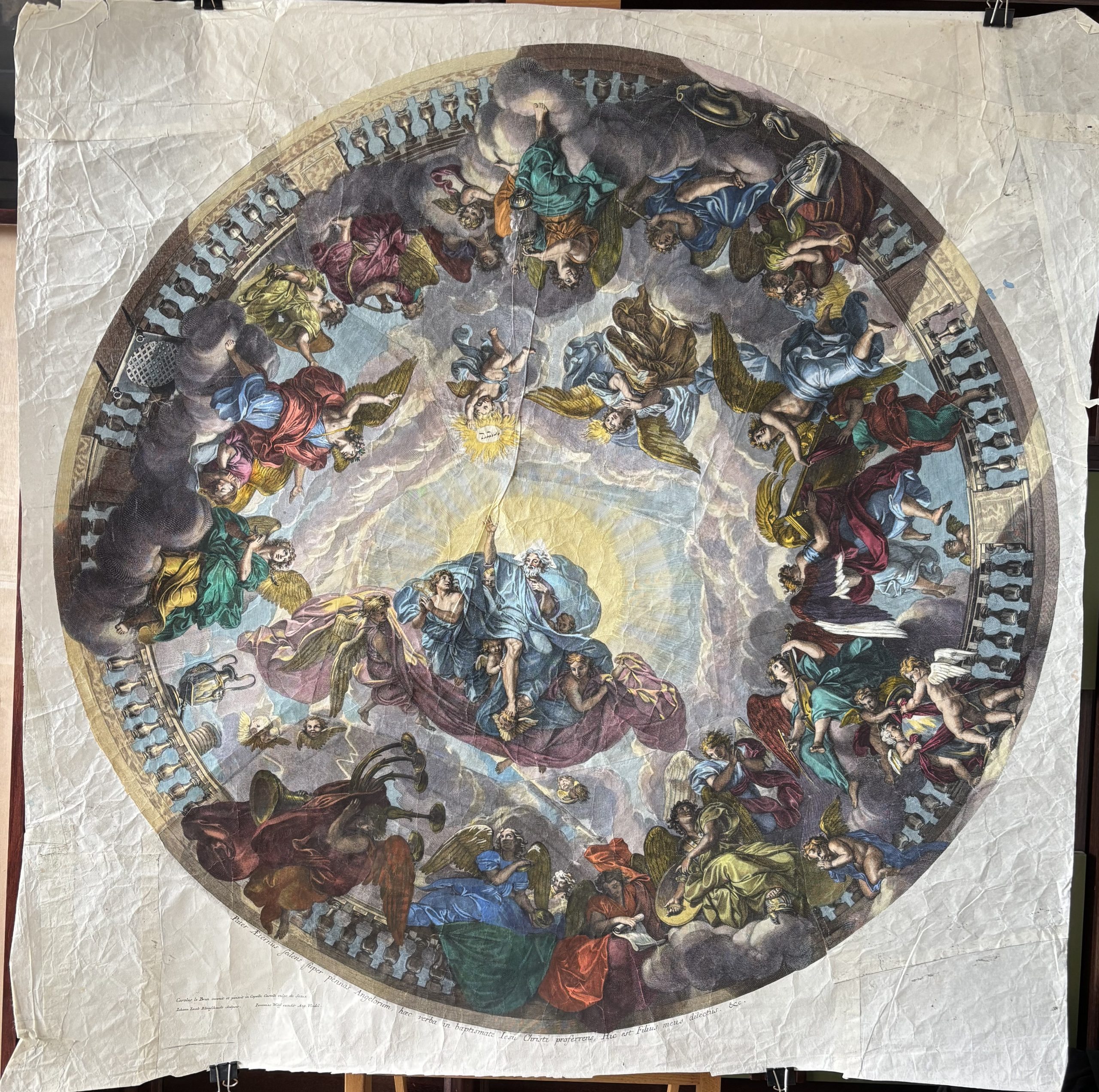
We can also see a mismatch in the text as well. So what exactly is going on here? Let's ask Gemini to compare the Princeton and our colored copy:
Ignoring the differences in color and the fact that one is assembled and the other not, what are the major differences between these two copies?
The second image is a reversed German copy of the French original shown in the first image. Specifically, the major differences are:
-
Mirror Reversal (Left-to-Right Flip): The entire composition is horizontally reversed between the two prints (a common result when a copyist engraves directly onto a new plate by looking at an existing print).
-
In the first print, God the Father raises his left arm (on the viewer's right), whereas in the second print he raises his right arm (on the viewer's left).
-
The entire outer ring is likewise flipped: for example, the multi-horn angel and the large classical urn on the right side of the first print appear on the left side of the second print, while the harp-playing angel moves from the left side to the right.
-
-
Different Engravers, Publishers, and Inscriptions:
-
First print (French original, 1681): Engraved by Gérard Audran after Charles Le Brun's ceiling fresco at the Chapel of the Château de Sceaux. It features inscriptions along all four outer curved margins—French at the bottom ("Le Pere Eternel porté sur les ailes des Anges…") and right ("Peint a fresque… par M.r le Brun… et gravé par Girard Audran 1681"), and Latin at the top and left.
-
Second print (German copy, early 18th century): Engraved by Johann Jacob Kleinschmidt and published in Augsburg by Jeremias Wolff. The French text and three of the border inscriptions are omitted; only the Latin title remains along the bottom curve ("Pater Æternus sedens super pennas Angelorum…"), accompanied by a horizontal three-line credit block in the lower-left corner ("Carolus le Brun invenit et pinxit… / Johann Jacob Kleinschmidt sculpsit / Jeremias Wolff excudit Aug. Vindel.").
-
What's going on here then? Does that mean this colored edition is not by Audran after all and is a different edition entirely? Amazingly, when we ask Gemini to help us understand what edition we have, it tracks down a digitized Louvre inventory from 1912 on the Internet Archive to identify a second copy that could be the one we have!
What edition of this engraving is this?
An engraving of Charles Le Brun's decorations for the Château de Sceaux—specifically the ceiling of the Pavillon de l'Aurore or the Chapel—belongs to one of two main historical printings identified in the Louvre's drawing inventory (backup copy on Wikipedia):
-
Catalog Reference: Jean Guiffrey and Pierre Marcel, Inventaire général des dessins du Musée du Louvre et du Musée de Versailles: École française, Tome VII (Isabey – Le Brun), Paris: Librairie centrale d'art et d'architecture, 1912, pp. 127–128 (nos. 5885–5894).
-
Embedded Print Reference: Karl Heinrich von Heinecken, Dictionnaire des artistes, dont nous avons des estampes, Vol. III, Leipzig, 1789, p. 417.
Likely Editions of the Engraving
According to Guiffrey and Marcel's note under Décoration du Château de Colbert, à Sceaux (p. 127), engravings of the Sceaux decorations exist in two distinct editions:
1. The First (Original French) Edition — Engraved by Gérard Audran and Louis Simonneau (late 17th century)
The original suite of decorations was engraved on five plates by two premier French printmakers of Louis XIV's reign: Gérard Audran (1640–1703, who engraved the famous cupola of the Pavillon de l'Aurore in four plates around 1681) and Louis Simonneau (1654–1727). An impression from this edition will be large-scale, finely executed on heavy late-17th-century French laid paper, and bear the signatures of G. Audran sculp. or L. Simonneau sculp. alongside a Paris publication line (often with Cum Privilegio Regis / Avec Privilège du Roi).
2. The Second (Copied German) Edition — Engraved by Johann Jacob Kleinschmidt (early 18th century)
As the catalog specifically notes, those five original French plates were subsequently copied by "Kleinschmid"—referring to the Augsburg engraver Johann Jacob Kleinschmidt (c. 1687–1772), who frequently reproduced grand French architectural and ornamental suites for German publishers like Jeremias Wolff and Johann Balthasar Probst. An impression from this later German edition will either carry Kleinschmidt's signature (I. I. Kleinschmidt sculp.), have an Augsburg (Augustae Vindelicorum) publisher's imprint, or appear in reverse/slightly reduced dimensions compared to Audran and Simonneau's originals.
(Note: If the engraving depicts L'Apothéose d'Hercule from the left-hand column of page 127—the Hôtel Lambert—it comes from the undated oblong folio album engraved by and under the direction of Bernard Picart from his own drawings after Le Brun, which was co-published in Paris by Gaspard Duchange on the rue Saint-Jacques and in Amsterdam by Bernard Picart at the sign of l'Étoile.)
How to Tell Which Edition You Have
-
Check the lower margin (the letter): Look at the bottom left and right corners just below the image border. If it names G. Audran or L. Simonneau (or mentions Paris), it is the original 17th-century French edition. If it names Kleinschmid / Kleinschmidt (or mentions Augsburg / Aug. Vind.), it is the early 18th-century German copy.
-
Check the orientation and scale: Because copyists often worked directly from an existing print onto their copperplate without re-reversing the image, Kleinschmidt's copies are frequently mirror images of Audran's and Simonneau's originals or slightly smaller in plate mark.
What does the Louvre's 1912 catalog entry say about the engraving?
Find the section about the engraving and translate exactly.
DECORATION OF COLBERT'S CHÂTEAU, AT SCEAUX. The château has been destroyed; its decoration was engraved by G. Audran and L. Simonneau on five plates, which Kleinschmid copied (See Heinecken, Vol. III, p. 417). All the cartoons from no. 5890 to no. 5894 are in black chalk, heightened with white, on gray paper. CHAPEL. 5889. — Head of a cherub. Three chalks, on gray paper. — H. 0.383. W. 0.293 (27716 / RF). Boulle and Mariette Collections. Cartoons for the Chapel. 5890. — The Eternal Father borne by two angels. H. 1.690. W. 1.380. See Reiset, no. 883 (29900). 5891. — Two intertwined angels. H. 0.950. W. 1.190. See Reiset, no. 871 (29889). 5892. — An angel. H. 0.751. W. 1.080. See Reiset, no. 929 (29947). 5893. — An angel. H. 1.340. W. 1.830. See Reiset, no. 915 (29933). 5894. — An angel. H. 1.260. W. 1.540. See Reiset, no. 867 (29885).
What does that Heinecken volume the Louvre cites tell us? Gemini tracks down a digitized copy on the Internet Archive and gives us what it says:
Find a digitized copy of that Heinecken volume and translate what it says exactly.
-
The Vault of the Chapel of Sceaux, the subject of which is the Old Law, fulfilled by the New, engraved in 5 large pieces, by G. Audran. 1681.
-
The same Vault in a single plate, a large circular piece, engraved under the direction of Picart.
-
The same, copied by Kleinschmid.
-
The same in 6 pieces, copied in Augsburg [Augsb.], same size as the original.
-
Aurora [The Dawn], Ceiling in one of the pavilions of the Château of Sceaux, in 4 pieces, by L. Simonneau.
-
The same Ceiling, by Kleinschmid.
-
The Nymph of Sceaux, by L. Simonneau.
So which of these is our copy? Let's give Gemini a photo of our copy and ask it to determine which of the above editions is ours:
Which of these is this copy?
This print corresponds to the fourth catalog entry—"La même en 6 pieces, copiées à Augsb. même grandeur que l'original" (The same in 6 pieces, copied in Augsburg, same size as the original)—because it is a full-scale, multi-plate Augsburg edition of the vault rather than the reduced single-sheet composition listed directly above it. Although the cataloger records this full-size Augsburg copy as six pieces, it was in fact produced in five sheets matching the five-piece format of Gerard Audran’s 1681 original (four outer sections for the lower ring of figures and this circular plate for the central medallion of God the Father and the angels). Furthermore, while the catalog omits the engraver's name on the fourth line, the lower-left signature confirms that this full-scale five-sheet Augsburg set was also engraved by Johann Jacob Kleinschmidt ("Iohann Iacob Kleinschmidt sculpsit").
What does the credit line at lower left in our engraving say? We don't see that on the other known copies we've seen of the engraving and it is not present on our existing trio of plates. Indeed, this confirms that we have the Kleinschmidt copy published in Augsburg!
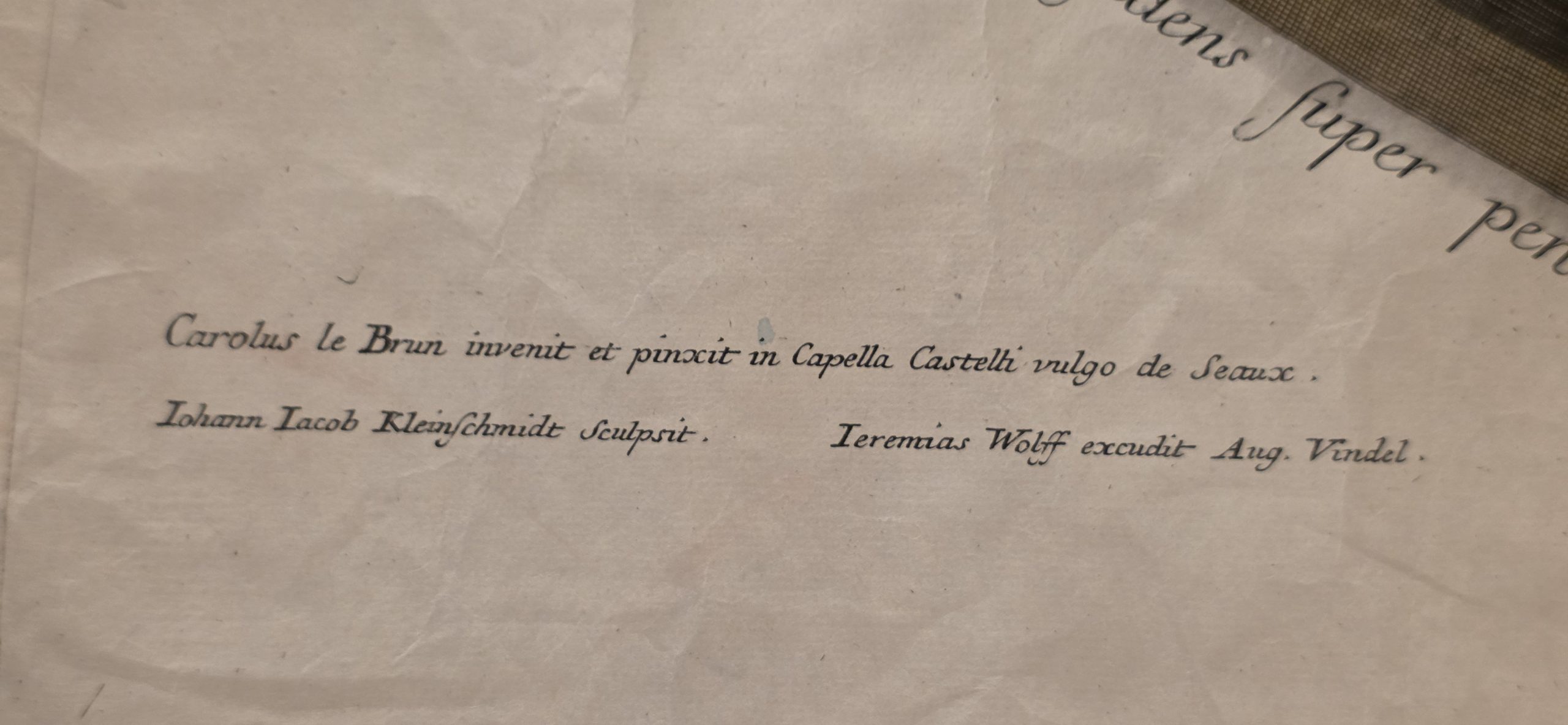
transcribe and translate entirely
Original: Carolus le Brun invenit et pinxit in Capella Castelli vulgo de Seaux. Iohann Iacob Kleinschmidt sculpsit. Ieremias Wolff excudit Aug. Vindel.
Translation: Charles Le Brun designed and painted [this] in the Chapel of the Château commonly called Sceaux. Johann Jacob Kleinschmidt engraved [it]. Jeremias Wolff published [it] in Augsburg (Augusta Vindelicorum).
We have the Kleinschmidt copy! But, when we do a Google search for Kleinschmidt and the engraving, we get only entries that look like this, which is a much reduced size single-plate engraving published by Bock. What's going on here?
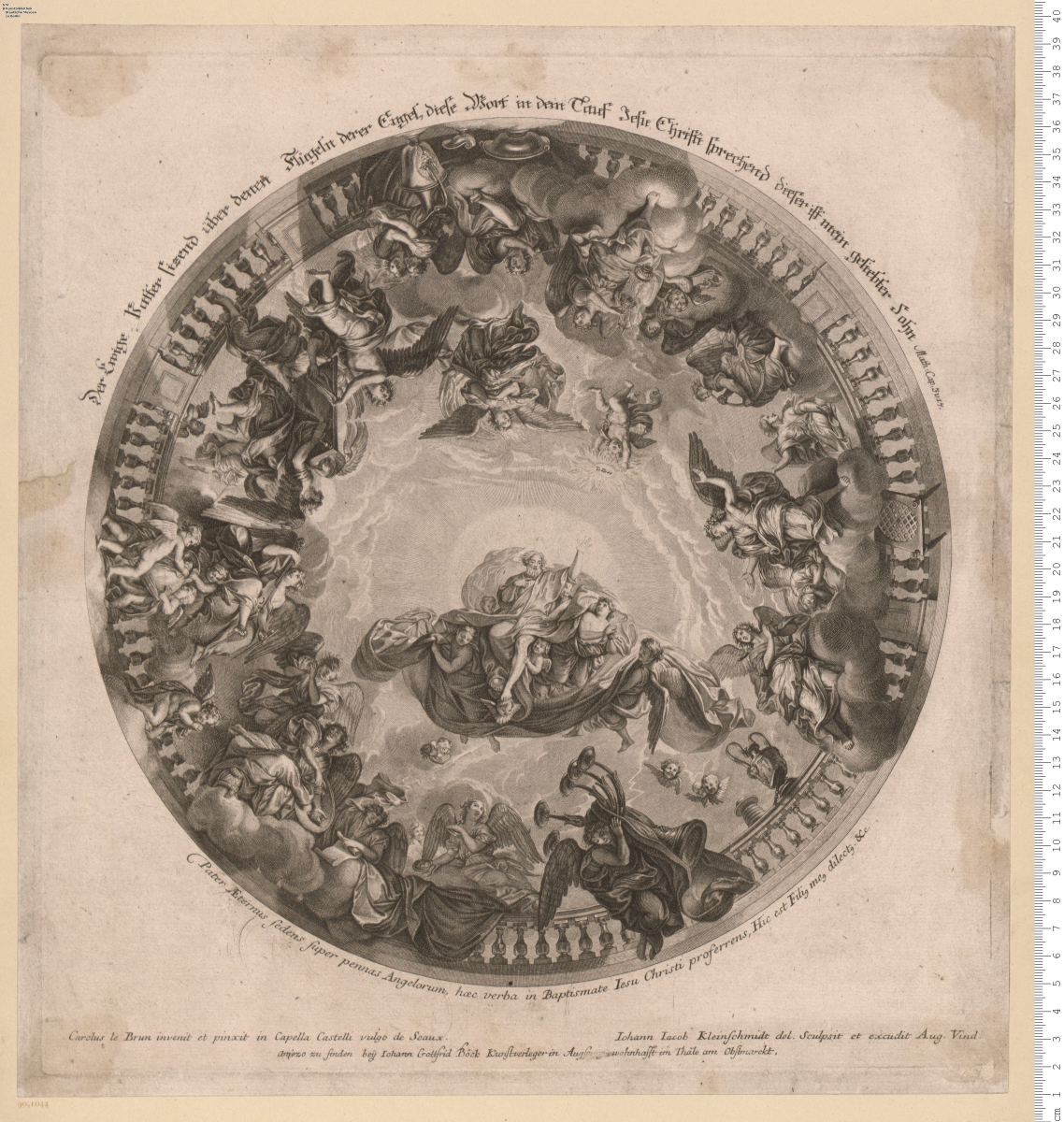
What's going on here?
What is this copy?
Which Gemini tracks down to this single-page reproduction which we see mentioned in the earlier list.
Can Gemini track down more information on the 5 vs 6 plate confusion? Indeed, Gemini tracks it down from a digitized work on the Internet Archive!
Can you find a Kleinschmidt reference for a full-size 5-plate edition?
Standard Catalogue Raisonné Reference: On page 461 of the digitized volume, the entry header reads: « KLEINSCHMIDT (Johann-Jakob). Grav. au bur., élève de Heckenauer, trav. à Augsbourg vers 1700. — Fuessli, 347. — Paignon. — Bryan, I, 605. — Brulliot, II, n° 1513. — Nagler, VII, 51. » ("Line engraver, pupil of Heckenauer, working in Augsburg around 1700…"). Directly beneath this biographical header, the first catalogued print is recorded verbatim as: « 1. Dieu le Père au milieu d'une Gloire d'Anges. Plafond. 5 grandes feuilles. » ("1. God the Father in the midst of a Glory of Angels. Ceiling. 5 large sheets."). The entry then continues across the bottom of page 461 and the top of page 462 to list Kleinschmidt's remaining prints through number 38 (15-38).
Gemini then goes further and actually tracks down an exact copy of our edition at the Herzog Anton Ulrich Museum, confirming the citation! Amazingly, this is the only copy we've been able to locate thus far, whereas the Audran engraving, while extremely rare, is held by several institutions.
Let's ask Gemini to put this all together and tell us about our engraving:
Tell me in detail about this engraving and cite your sources.
1. The Original Fresco (Charles Le Brun, 1674)
-
Commission & Subject: In the early 1670s, Jean-Baptiste Colbert, Minister of Finance to King Louis XIV, commissioned Charles Le Brun (First Painter to the King) to paint the dome of the chapel at his country estate, the Château de Sceaux, south of Paris. Completed in 1674, the fresco depicted the Triumph of the New Testament over the Old Testament (also known as God the Father Borne on the Wings of Angels).
-
Composition & Fate: Painted in illusionistic sotto in sù ("from below upward") perspective, the fresco showed God the Father and the Dove of the Holy Spirit at the center of an open heavenly cupola. Around the stone balustrade perimeter, angels carried away the symbols of the Old Covenant (such as the Ark of the Covenant wrapped in storm clouds) while welcoming the New Covenant (the Cross and the Four Evangelists). The original château and its chapel fresco were demolished during the French Revolution, leaving reproductive engravings as the primary visual record.
2. The French Prototype (Gérard Audran, 1681)
-
The 5-Plate Masterpiece: In 1681, the renowned French engraver Gérard Audran published a monumental five-plate reproductive engraving of Le Brun’s cupola in Paris.
-
Format: Because no single copperplate or press could accommodate a print nearly four feet across, Audran engraved the composition on four outer curved sector plates and one central circular plate, intended to be trimmed and pasted together into a 46-inch circle (~117 cm).
3. The German Counterpart (Kleinschmidt & Wolff, c. 1710–1724)
-
Why It Is Reversed (A Copy of Audran): Your engraving was executed by Johann Jacob Kleinschmidt and published in Augsburg by Jeremias Wolff. Because Kleinschmidt never saw the ceiling in France, he copied Audran’s 1681 print directly onto his copperplates without using a reversing mirror. When Kleinschmidt's plates were run through the press, the resulting impression printed in mirror-reverse compared to Audran’s engraving:
-
In Kleinschmidt’s print, God the Father raises his right hand ( appearing on the viewer's left), the trumpeting angel is at the lower left, and the dark storm clouds of the Old Covenant sweep up the left side—the exact opposite of Audran’s orientation.
-
-
Adaptation for the German Market: While copying Audran's five-plate structure at full scale, Wolff and Kleinschmidt stripped away Audran’s French captions, retained only Latin for the Holy Roman Empire market, and slightly modified the Latin phrasing along the lower rim (changing Audran’s "Pater Aeternus" to "Deus Æternus").
4. What Is Known About Your Specific Impression & Its Dating
-
5-Sheet Wall Print (Wanddruck) vs. Single-Sheet Edition: While Kleinschmidt also produced a small single-sheet reduction (36.8 × 34.5 cm) that survives in several museums, your example is the monumental five-sheet assembled edition (~117 × 120 cm). You can see the circular paper seam around the central sunburst (the fifth plate) and the radial seams where the four outer sheets were joined and backed onto a square support.
-
Precise Dating (c. 1710–1724): Kleinschmidt (c. 1687–1772) began signing major plates for Jeremias Wolff around 1710. Because Wolff died in 1724—after which his firm changed its imprint to "Haeredes Ieremiae Wolffii" ("The Heirs of Jeremias Wolff")—the lifetime publisher line on your print ("Ieremias Wolff excudit Aug. Vindel.") firmly dates this impression between c. 1710 and 1724.
-
Purpose & Rarity: Issued in Augsburg—Europe's leading center for Baroque architectural prints—these massive five-sheet dome prints were sold either to Central European fresco painters as ceiling models or to wealthy collectors who had them illuminated by professional Augsburg hand-colorists (Briefmaler) to hang as surrogate paintings. Because assembled wall prints were exposed to light, dampness, and physical stress along their glued seams, surviving five-sheet examples with period hand-coloring are exceptionally rare.
Finally, let's ask Gemini Deep Research to give us a complete history of this engraving:
Tell me all about this engraving.
It is Kleinschmidt's Augsburg Edition, the 5-sheet full-sized copy that is an exact reverse of Audran's copy, not the single sheet reduced version.
What can you find about Kleinschmidt's Augsburg edition and its history?
This copy is on laid tissue paper.
Explain why and what's known about it.
You can read the final report here: