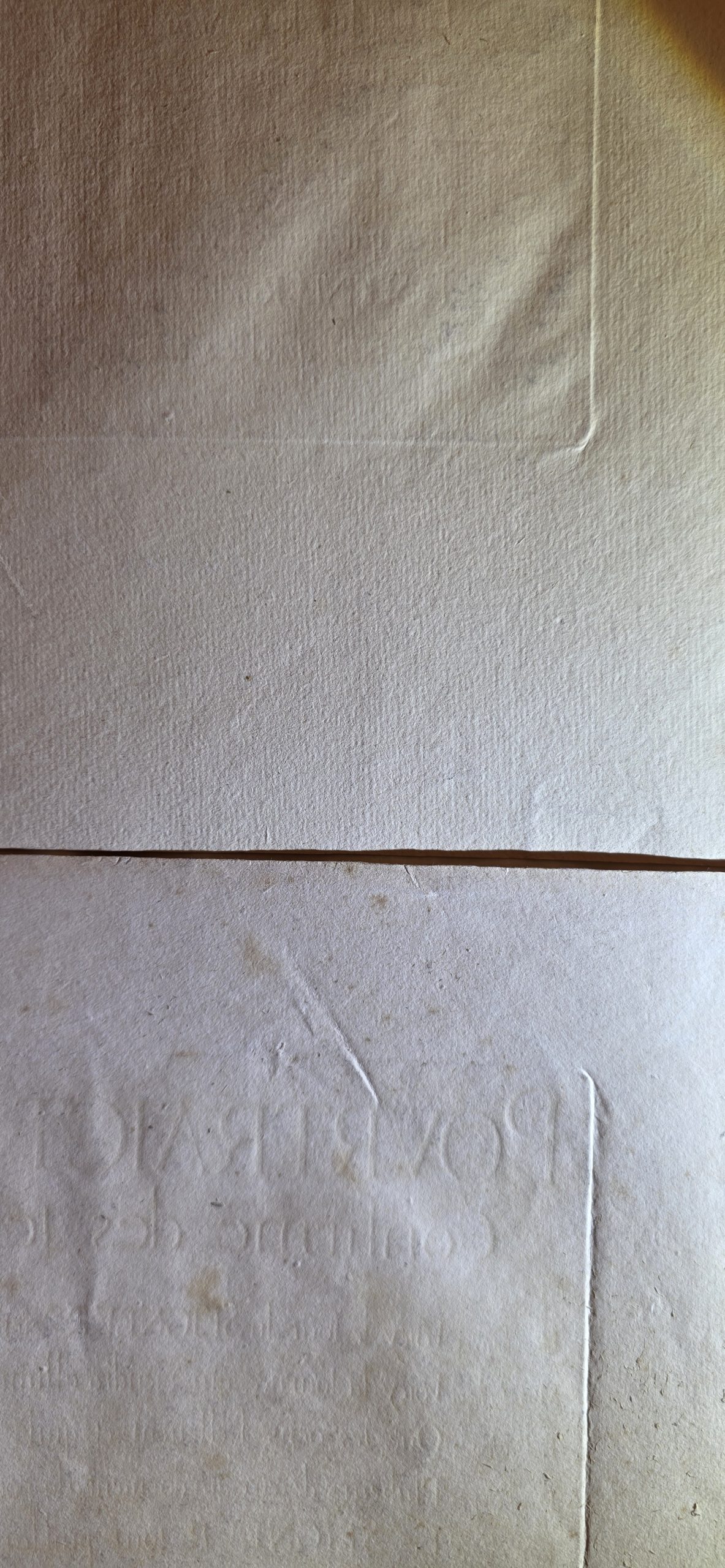
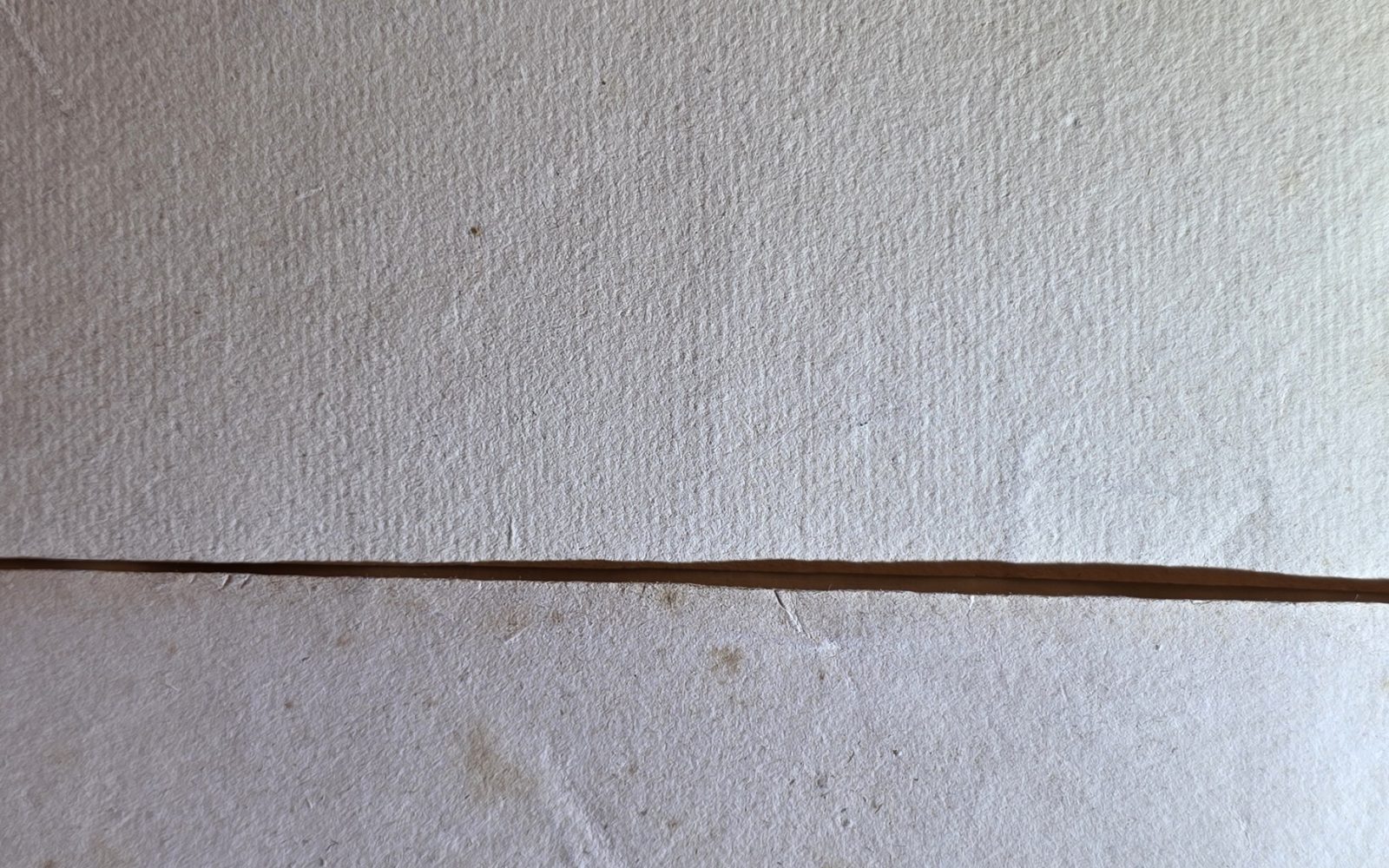
Gemini has so impressed us as part of our accessioning workflow that we now deploy it by default as an assistant reviewer during our intake process. Yesterday, as we were accessioning a multi-plate monumental Old Master engraving, we ourselves noticed that the plates appeared to be printed on two distinct papers, but before we could even look at the paper more closely, Gemini popped up with an incredible finding: it had identified the odd speckling in the margins as inclusions from poorly-crafted wove paper (tying it directly to the French revolution and the Napoleonic rag crisis) and that this engraving is not known to have been printed on wove paper, with the official state table and institutional copies recording only the chain/laid paper in use in the 1600s. We didn't tell Gemini any of this – it entirely on its own spotted that the paper appeared to be wove, identified the engraving, researched that engraving to determine that known copies were printed in the 1600s, knew from its knowledgebase that wove paper like this had not been invented at that point and flagged the discrepancy, then spent time researching across known institutional copies, auctions and sales and identified a single other copy that claimed to be on wove paper.
1. Identification of the Paper and Visual Reasoning
A close examination of the wide view and macro detail of your sheet reveals that this print is pulled on early French wove paper (papier vélin) containing heavy fibrous inclusions (shives and rag knots).
A. Why This is Wove Paper (Papier Vélin)
-
Absence of Laid and Chain Lines: Traditional handmade European paper made prior to the late 18th century is laid paper (papier vergé), formed on a mould of parallel brass wires (vergures) held together at intervals by perpendicular twisted chain wires (pontuseaux). Even in surface light, laid paper displays a directional, ribbed corduroy-like grid. In your photographs, the sheet shows a completely uniform, isotropic, felted fiber distribution with no laid or chain lines anywhere in the sheet. This texture is the unmistakable signature of wove paper, produced on a mould covered with a finely woven brass wire mesh screen.
-
Intaglio Platemark (Cuvette) and Differential Surface Compression: In the broader view, the rectangular corner of the copperplate indentation (the platemark) is clearly visible at the upper left, with its vertical bevel running straight down the left-center of the image. To the left of that boundary (inside the image/plate area), the high pressure of the intaglio rolling press has crushed and smoothed the dampened paper against the metal plate. To the right (the unpressed margin), the paper retains its natural, slightly loftier matte surface texture from the drying felts (feutres).
B. Identifying the Inclusions
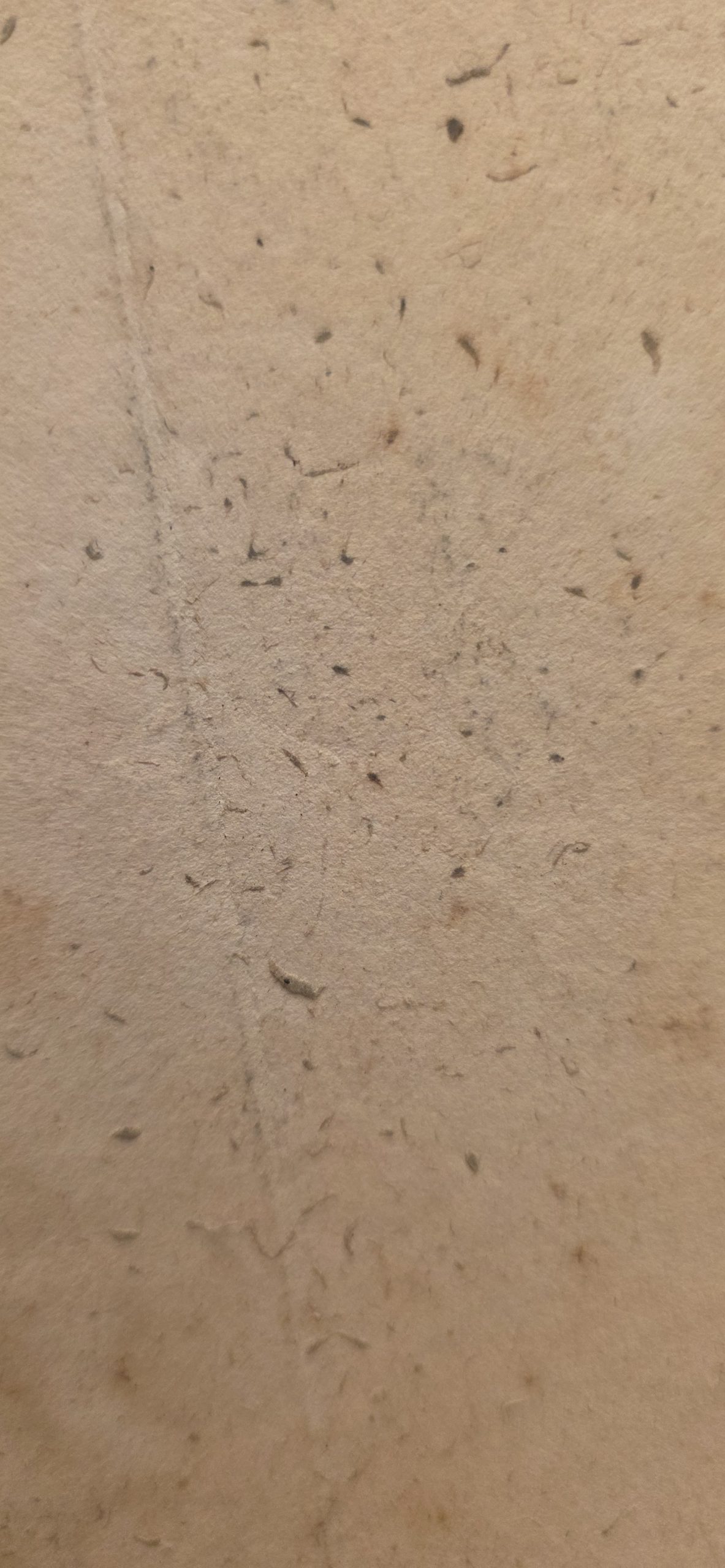
The dark flecks scattered across the sheet—and particularly noticeable along the vertical platemark zone—can be distinguished from ordinary age-related foxing (though a few soft, warm-brown circular foxing haloes are also faintly present in the sheet). The dark speckles are original physical inclusions embedded directly within the paper pulp during manufacture:
-
Flax and Hemp Shives (Chènevottes / Pailles): Many of the specks are tiny, elongated, rigid or slightly curved dark-brown slivers. In hand papermaking from bast fibers, these are shives—microscopic fragments of the woody inner core (boon/hurd) or outer bark of the flax (lin) or hemp (chanvre) plant that were not fully rotted away during retting (rouissage) and survived the beating process.
-
Rag Knots and Unbleached Bast Threads (Boutons / Nœuds): Closer inspection of several comma-shaped and hooked inclusions shows tiny twisted thread remnants and dark fiber bundles. These occur when lower-grade, imperfectly sorted, or unbleached linen and hemp rags (chiffons bulles or mi-blancs), coarse canvas, or old cordage are added to the vat.
-
Interaction with the Platemark: Notice that right along the vertical line of the plate bevel, several of these dark fibrous fragments have been physically flattened into the surface by the edge of the copperplate, confirming that they are intrinsic to the paper web rather than later surface contamination.
2. When Wove Paper First Started Being Used in France for Copperplate Intaglio Prints
While wove paper was invented in England in the mid-1750s by James Whatman the Elder for the printer John Baskerville (first used in Baskerville's 1757 Virgil), it took another quarter-century for the technology to cross the Channel and be adapted for French copperplate printing:
-
Introduction of Wove Paper to France (1777–1782):
-
Around 1777–1778, Benjamin Franklin showed samples of English wove paper in Paris to French printers and savants, including François-Ambroise Didot, the royal printer Philippe-Denis Pierres, and the Inspector General of Manufactures, Nicolas Desmarest.
-
Encouraged by Didot, the papermaker Mathieu Johannot of Annonay (Ardèche) began experimenting with woven wire-cloth moulds in 1778–1779, producing the first French papier vélin (for which Louis XVI awarded him a gold medal in 1781).
-
Almost simultaneously, Étienne Montgolfier (also in Annonay, working with Desmarest) and Jean-Baptiste Réveillon (at his royal paper mill at Courtalin-en-Brie) began manufacturing French wove paper between 1780 and 1782.
-
-
First Documented Copperplate Intaglio Print on French Wove Paper (December 1782):
-
Although French printmakers had long prized soft, lightly sized Auvergne laid papers for intaglio work (and Jean-Baptiste Le Prince's 1780 aquatint prospectus mentions smooth French paper imitating Chinese paper), the earliest documented copperplate engraving printed on French wove paper in France dates to late December 1782.
-
As recorded by Nicolas Desmarest in the Encyclopédie méthodique (Art de la papeterie) and cited in Ad Stijnman's chronology of intaglio printing papers, the Parisian printer Philippe-Denis Pierres issued a prospectus at the end of December 1782 for an edition of Plutarch's Œuvres, accompanied by an octavo copperplate engraving—a portrait of King Henry IV—printed on wove paper manufactured by Réveillon at Courtalin ("vers la fin de décembre de l'année 1782, le sieur Pierres, imprimeur de Paris, fit paraître le prospectus d'un livre intitulé Œuvres de Plutarque… le dit sieur Pierres imprimait, dans le format in-8°, un portrait du roi Henri IV").
-
By 1783–1784, the Didot press and Parisian marchands d'estampes began using wove paper regularly for book plates and fine reproductive engravings, and by the 1790s, wove paper largely superseded laid paper in Paris for copperplate printing.
-
3. What Can Be Deduced About This Specific Wove Paper
The combination of a wove mould structure with heavy dark shives, bast knots, and a warm buff/oatmeal cast allows us to pinpoint both the technical nature and the historical period of your sheet:
-
The French Revolutionary and Napoleonic Rag Crisis (ca. 1793–1815/1820):
Early French wove paper of the 1780s (made by Johannot, Montgolfier, and Réveillon) was a luxury product made from meticulously sorted, superfine white linen rags (chiffons super-fins) for royal and bibliophile editions. However, following the outbreak of the French Revolution and throughout the Napoleonic Wars, France experienced a severe rag shortage (pénurie de chiffons). Military requisitions of linen for hospital bandages, combined with trade blockades and massive state printing demands (such as assignats and administrative decrees), starved paper mills of clean white linen rags.
-
Adulteration with Coarse Hemp and Unbleached Rags:
To make large-format copperplate paper (Grand Aigle or Colombier formats required for multi-sheet wall prints), French mills mixed coarse, unbleached or semi-bleached hemp (chanvre), tow (étoupe), old rope, and grey rags (chiffons bulles) into the pulp.
-
The Effect of the Hollander Beater (Pile Hollandaise): In the late 18th century, French mills increasingly replaced traditional wooden stamping mills (piles à maillets)—which gently frayed rags after a period of fermentation/retting (pourrissage)—with metal-bladed Hollander beaters. When tough, unfermented hemp stalks and coarse rag seams were chopped in a Hollander beater without thorough sorting (délissage) or effective chemical bleaching, the metal blades sheared the woody shives and dark thread knots into short, curved flecks rather than dissolving them, leaving the exact speckled "oatmeal" inclusions visible in your macro photo.
-
Soft Sizing for Wove Intaglio Paper (Vélin Doux / Mi-Collé): Because Pieter de Jode's copperplates were nearly two centuries old by the time this impression was pulled, the engraved burin lines were worn and shallow. To pull ink out of worn grooves, the printer needed a soft, absorbent, waterleaf or lightly sized (sans colle or mi-collé) wove copperplate paper that could be heavily dampened and forced into the plate under high blanket pressure—which also explains why the platemark indentation is so deep and crisp while the paper pulp itself is utilitarian in grade.
4. Other Copies of Pieter de Jode's Last Judgement on Wove Paper
While 17th-century impressions (State I, 1615) and early 18th-century impressions pulled during Pierre Drevet's lifetime (1663–1738) are invariably printed on laid paper, other surviving impressions of the Drevet state (State IV) printed on wove paper are documented:
-
Arenberg Auctions (Brussels), December 8, 2022, Lot 106:
A complete 12-sheet set (9 engraved image sheets measuring ca. $47.6 \times 40.3\text{ cm}$ each, and 3 letterpress/engraved text sheets measuring ca. $25.3 \times 40.4\text{ cm}$ each; total mounted dimensions ca. $168 \times 122\text{ cm}$) of Pieter de Jode I after Jean Cousin the Younger, The Last Judgement. It carries the exact fourth-state address at lower left:
"IOANNES COUSIN SENONIEN / SIS INVENIT ET PINXIT. / Petrus de Iode in aes Incidit / a Paris chez P. Drevet aux Galleries"(New Hollstein 26.IV). The auction catalogue explicitly identifies the support as wove paper and dates this impression to ca. 1800. -
Two-Sheet Fragment in the North American Print Trade (Massachusetts):
A pair of sheets from the 9-plate image ensemble offered on the secondary market, described as a late impression on thick wove paper showing moderate plate wear.
5. Historical Explanation: How "Drevet" Copies Ended Up on Wove Paper and Why New Hollstein Doesn't Mention Them
At first glance, finding an impression bearing the imprint of Pierre Drevet (1663–1738) on wove paper seems like a chronological paradox, since Pierre Drevet died nearly twenty years before wove paper was invented in England and forty-four years before it was used for intaglio printing in France. Tracing the provenance of the twelve copperplates resolves the mystery completely:
A. The History of the Twelve Copperplates
-
Antwerp & Paris (1615–ca. 1700): Pieter de Jode I engraved the twelve plates in 1615 after Jean Cousin the Younger's 1585 painting for the Minimes of Vincennes (now in the Louvre, Inv. 3445), financed by Guillaume Wittenbroot and dedicated to Louis XIII. The plates were brought to Paris and acquired in the 17th century by the publisher Jean Le Blond.
-
Pierre Drevet's Acquisition and Reworking (ca. 1703–1738): Pierre Drevet purchased the plates from Le Blond, retouched them with the burin to restore their contrast ("qui les a retouché pour les rendre plus brillantes"), and first published them from his shop on the rue Saint-Jacques ("A Paris Chez Drevet rue St. Iacques a la Nonciation", State III, pre-1726). After Drevet was granted lodgings in the Galeries du Louvre in 1726, he updated the address on the lower-left plate to "a Paris chez P. Drevet aux Galleries" (State IV).
-
The Drevet Family Workshop (1738–1781): When Pierre Drevet died in 1738 and his son Pierre-Imbert Drevet died in 1739, the copperplates passed to their nephew/cousin Claude Drevet (1697–1781), who continued to occupy the logement in the Galeries du Louvre and print from the family stock without changing Pierre Drevet's address.
-
The 1782 Drevet Estate Sale and Post-1782 Restrikings: Claude Drevet died on December 23, 1781—just one year before wove paper was first used for copperplate printing in Paris (December 1782). In April 1782, the celebrated estate sale of the Drevet family's copperplates (Vente du fonds des Drevet) took place in Paris. While the French Royal Academy bought a handful of famous royal portrait plates, the bulk of the commercial copperplates were bought by Parisian print publishers and plate merchants (such as Pierre-François Basan and his successors along the rue Saint-Jacques).
-
Unaltered Plate, New Paper (ca. 1790–1820): The publisher who acquired the twelve massive copperplates of Cousin's Last Judgement after 1782 never erased or altered Pierre Drevet's prestigious Louvre address ("chez P. Drevet aux Galleries"). When they pulled fresh editions around 1795–1820, they naturally printed them on the standard French intaglio support of that era: wove paper—specifically the shive-flecked, Revolutionary/Empire-era wove paper seen in your photographs.
B. Why You Cannot Find This in New Hollstein
In The New Hollstein Dutch & Flemish Etchings, Engravings and Woodcuts 1450–1700: The De Jode Dynasty (Part I, cat. no. 26, States I–IV), there is no mention of wove paper impressions for three methodological reasons:
-
Definition of a "State": Print catalogues raisonnés define a state (état) solely by intentional physical alterations to the metal plate itself (new engraving, burnishing, or changes to lettering). Because the post-1782 publisher left the
"a Paris chez P. Drevet aux Galleries"inscription completely untouched, an impression pulled in 1730 on Auvergne laid paper and a posthumous restriking pulled in 1805 on speckled French wove paper are both catalogued identically as State IV (of IV) (New Hollstein 26.IV). -
Focus on Public Print Room Repositories: New Hollstein derives its state descriptions and repository lists from major European museum print rooms (such as the Bibliothèque nationale de France, Rijksmuseum, British Museum, and Albertina). Those institutions acquired their impressions of The Last Judgement early (mostly 17th- and early 18th-century impressions on laid paper) and rarely accessioned ca. 1800 commercial restrikings.
-
Omission of Late Posthumous Tirages: Unless a late publisher adds their own name or number to the plate, Hollstein entries for 17th-century Flemish engravers generally do not track late-18th- or 19th-century posthumous print runs (tirages tardifs) or list paper variations beyond early watermarks.
Consequently, your copy is a post-1782 (most likely ca. 1795–1815) Parisian restriking of State IV (New Hollstein 26.IV), pulled from the original 1615 copperplates after the dispersal of the Drevet workshop's fonds, on characteristic Revolutionary/Napoleonic-era French wove paper containing unbleached bast shives and rag knots.
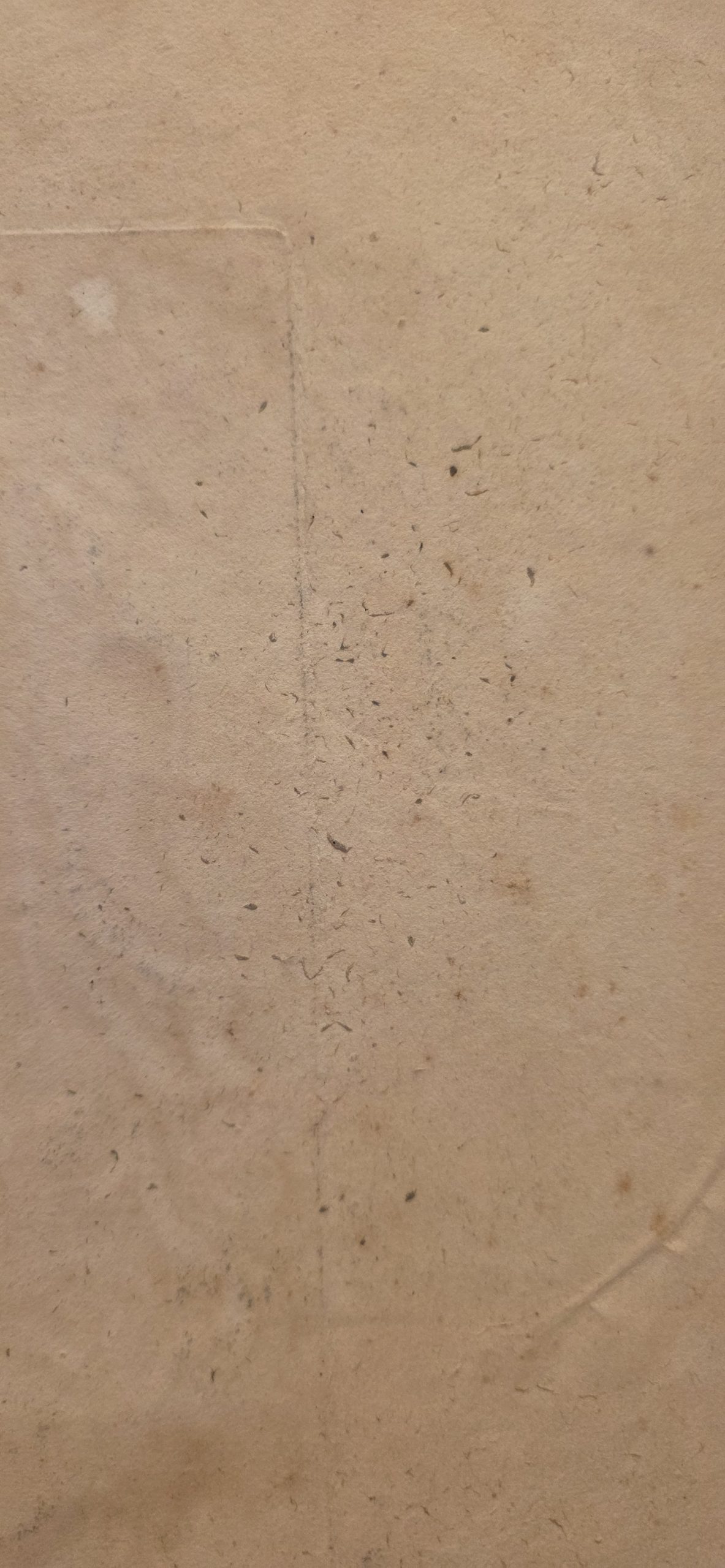
Here we can see those inclusions better:
Under raking light we can clearly see the chain/laid paper version at top and the wove version below it, both with strong plate marks, though we can see the wove paper shows damage around the impressions where it failed to withstand the pressure as well as the chain paper.