
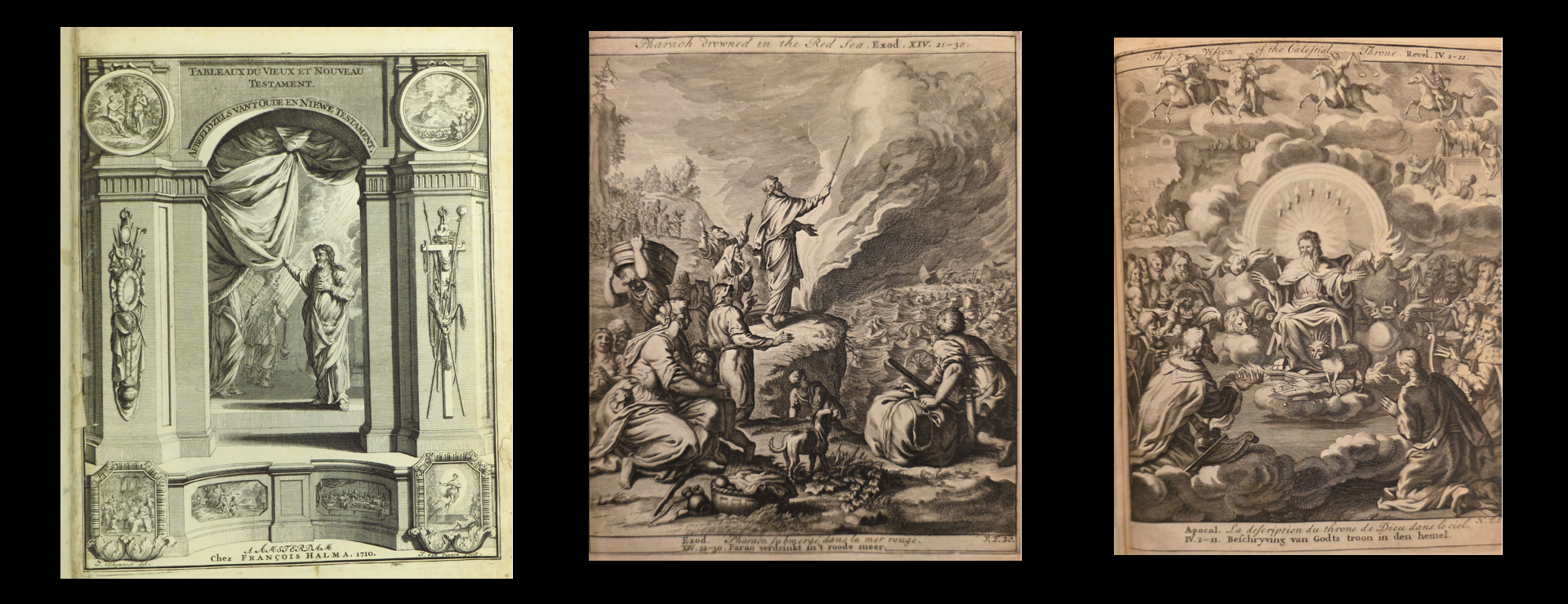
Our experiments to date have demonstrated Gemini as extremely adept at identifying unknown and obscure works. Today Gemini surprised us with something entirely unexpected: it flagged a strange anomaly with our 1710 Halma picture Bible. The 1710 Halma is a famous Amsterdam reprinting of the so-called "Scheits Bible" engravings. Our copy has the original title page and the complete set of engravings and was acquired from a prominent Dutch antiquarian dealer who had reviewed the copy to confirm its contents and completeness. Moreover, we sent photographs of both the title page and a number of the engravings to several art historians who confirmed the book's cataloging. Yet, earlier this morning we were running batches of images from the book through Gemini asking it to perform visual analyses of the engravings and just so happened to include the title page engraving in one of the batches. Instead of providing our requested visual analysis, Gemini flagged that something was wrong: the title page didn't match this exact state of the engravings.
What Gemini caught that all of the previous expert human reviews had missed: the title page was for the 1710 Halma which includes only Dutch and French captions at the bottom of each engraving, whereas these engravings had an additional English title atop each image that is most closely associated with the 1750-1760 Reinier & Ottens that has a different title page and descriptive text on the back of each image, which this does not. Gemini even tracked down the definitive academic reference to Wilco Poortman that alludes to this unknown print series and identified copies in several other printed works, but could not locate a single other standalone plate copy with this strange juxtaposition, which even includes a map not typically associated with this series.
Therein lies one of the greatest potentials of AI for institutional-scale cataloging of extremely rare works: AI models can catch the most subtle of clues that even an expert deeply familiar with a given work might miss when encountering a never-before-seen edition and track down various clues from across the entire web to help piece together a tapestry of evidence for further human evaluation. In fact, once Gemini flagged this anomaly, we used Gemini throughout every step of the analysis below to track down other copies and variants of each plate, to chase citations and identify references for us to consult.
Below we can see the title page of this picture Bible, which is from the 1710 Halma (Afbeeldzels van ‘t Oude en Niewe Testament. Tableaux du Vieux et Nouveau Testament). Halma's attribution can be seen clearly at the bottom of the image. Importantly, this title page is of the exact laid paper as the engravings and shows the same aging and edge soiling, indicating that it was not an insertion from some other work, but rather crafted as a single book from its inception:
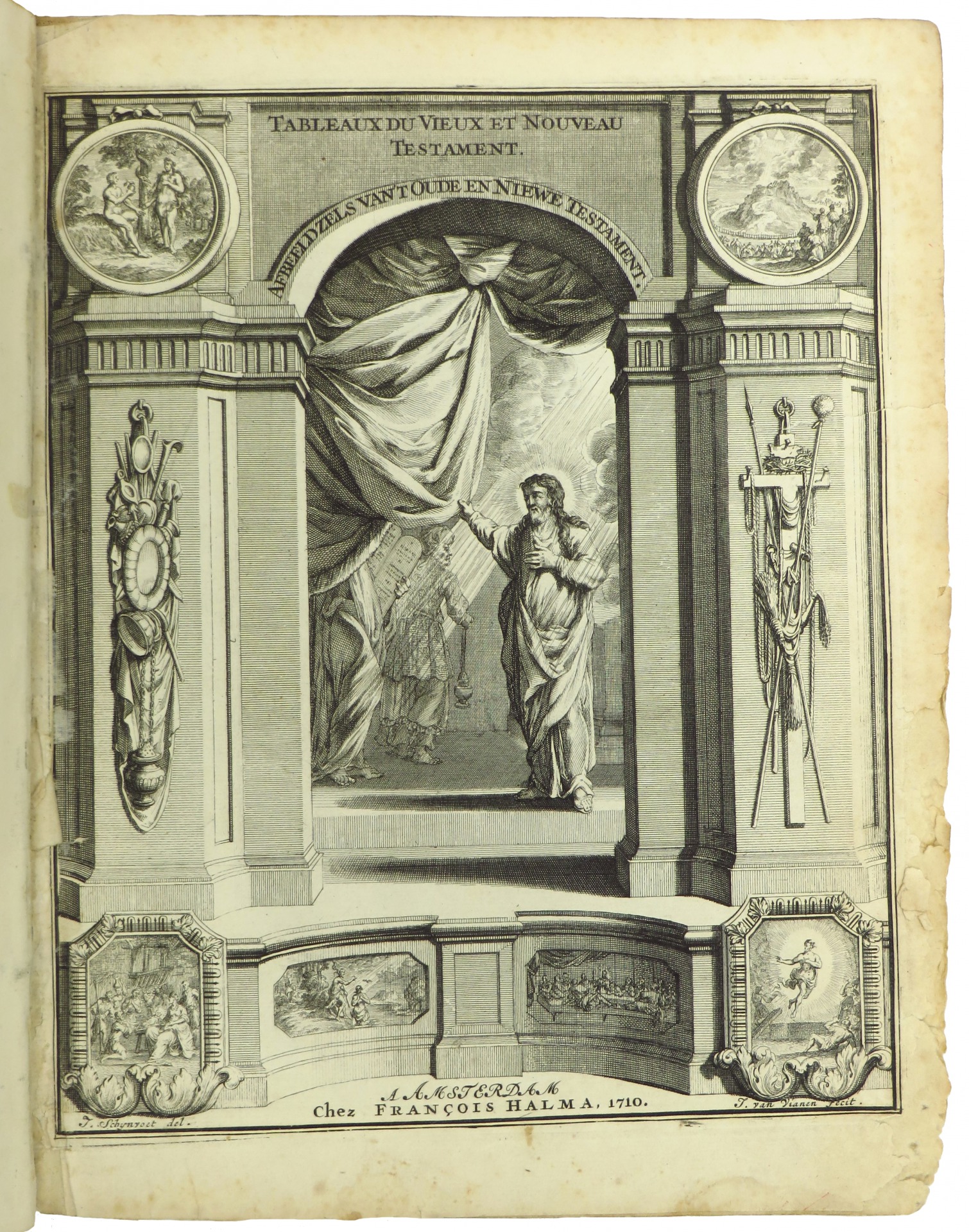 The base illustration itself is by Jacobus Schynvoet, engraved by Jan Van Vianen, "Christ removes the veil of the Temple", onto which the wording was added:
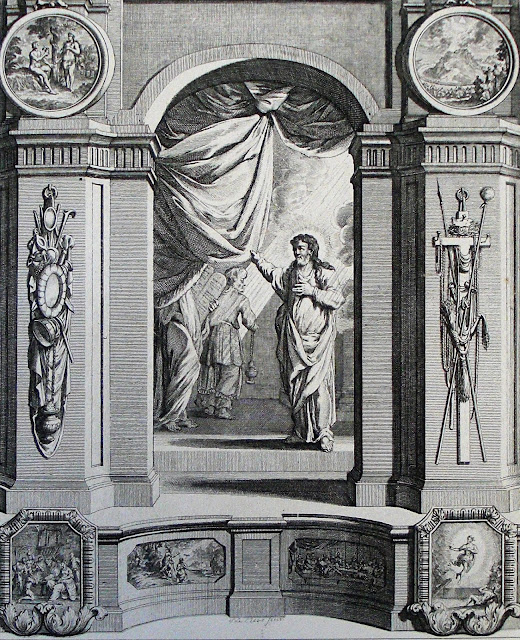
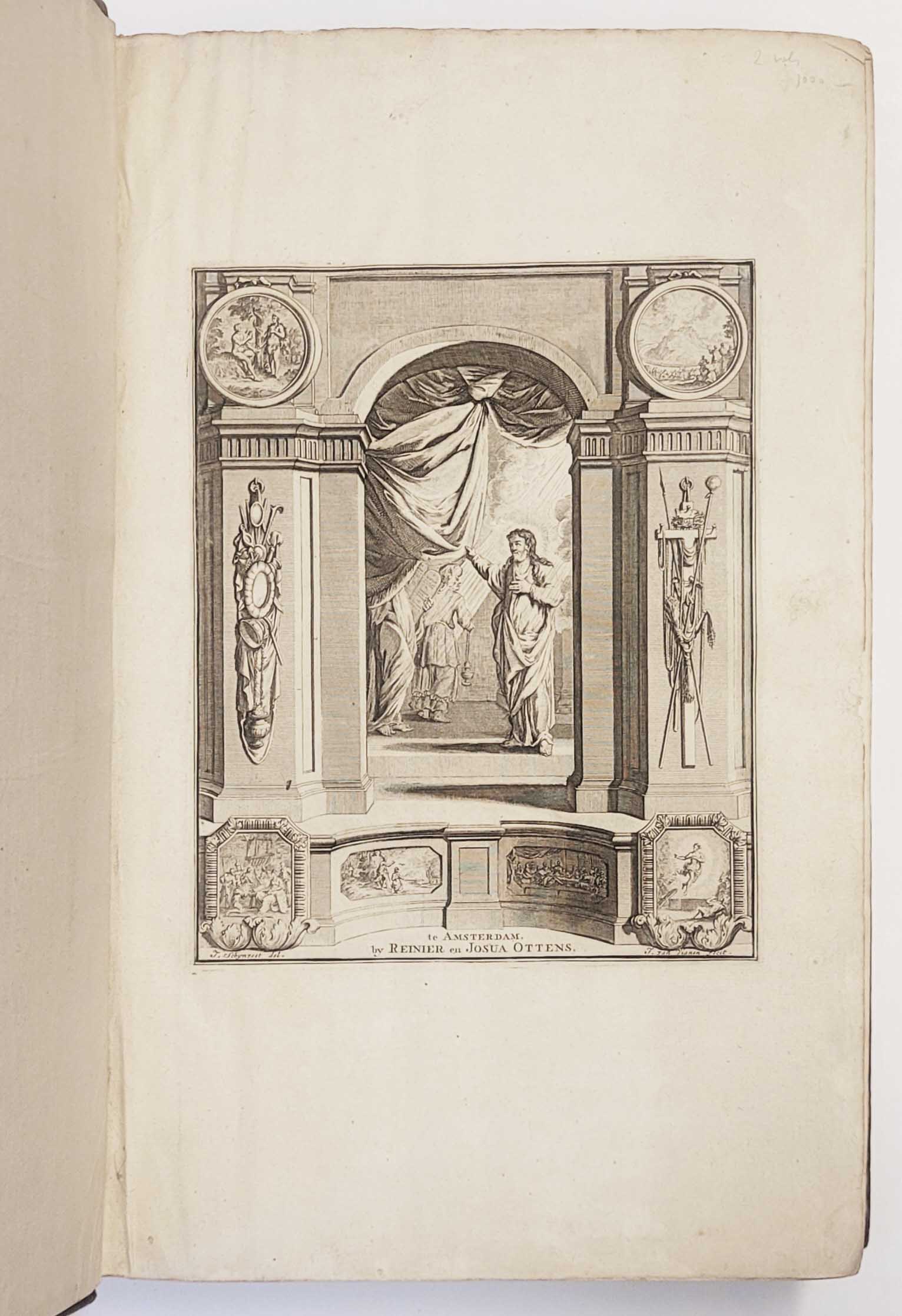
In comparison, the 1750-1760 Reinier & Ottens most commonly associated with English titles on the engravings has the same title page, but without the text over the arch and with their names at the bottom instead of Halma:
The Halma has only Latin and Dutch captions at the bottom of each engraving:
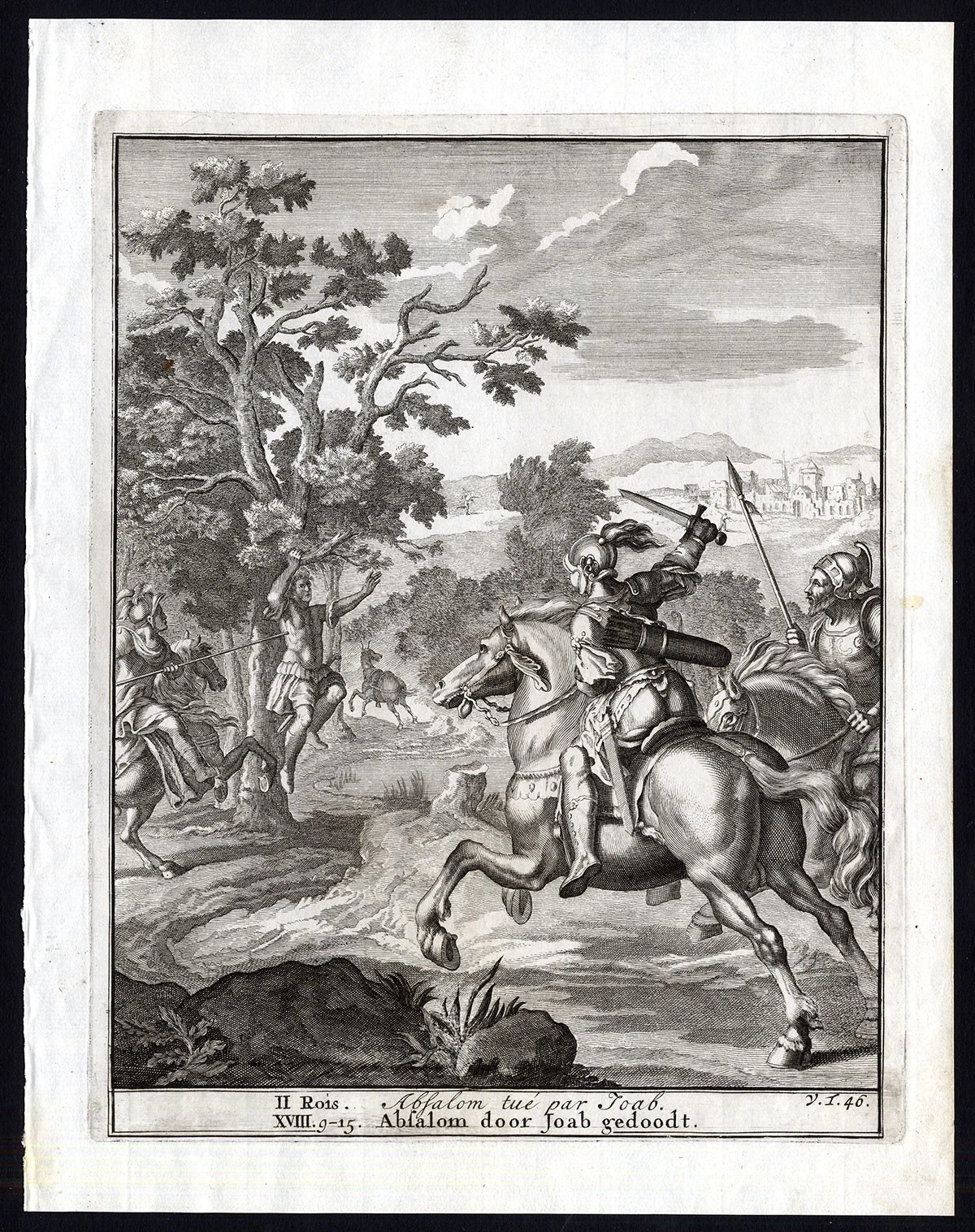
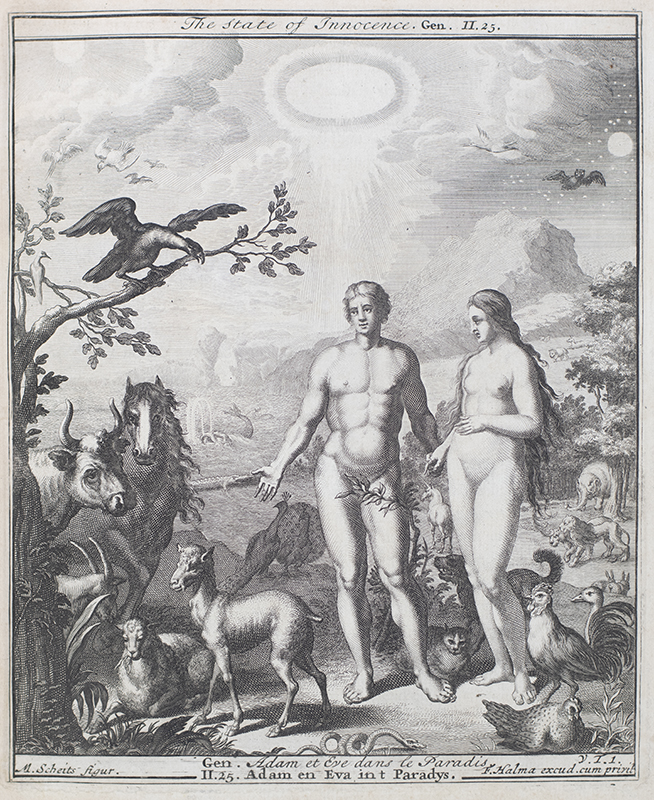
In contrast, our copy is the exact same image, but with an English title added at top. More interestingly, while the bottom platemark margin is the same in both, the right, left and top platemark margins are much smaller in ours, suggesting the copperplate has been chopped or the image transferred to a new copperplate. The title text at top is much larger than the platemark margin in the Halma, meaning it could not have simply been added to the empty margin on the original – the copperplate itself was either expanded, a title plate bolted to the top, or the entire image copied to a new plate with the new title:
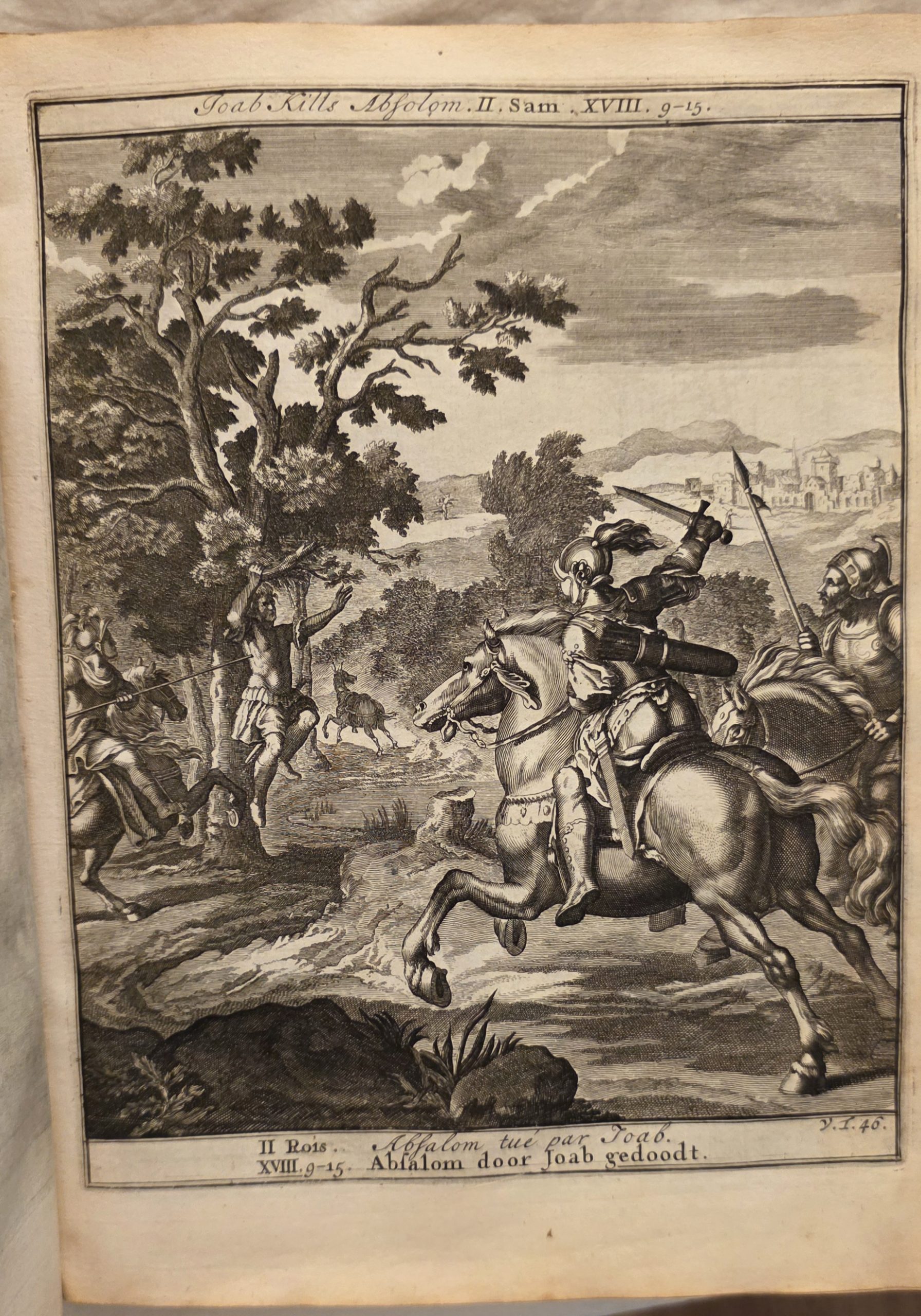
Most importantly, we can see that for a handful of the engravings, the imagery extends INTO the textblock at top, confirming this was not simply a bolt-on copperplate strip locked to the top of the existing plate, but likely either a copy to a new copperplate or an extension of the original plate:
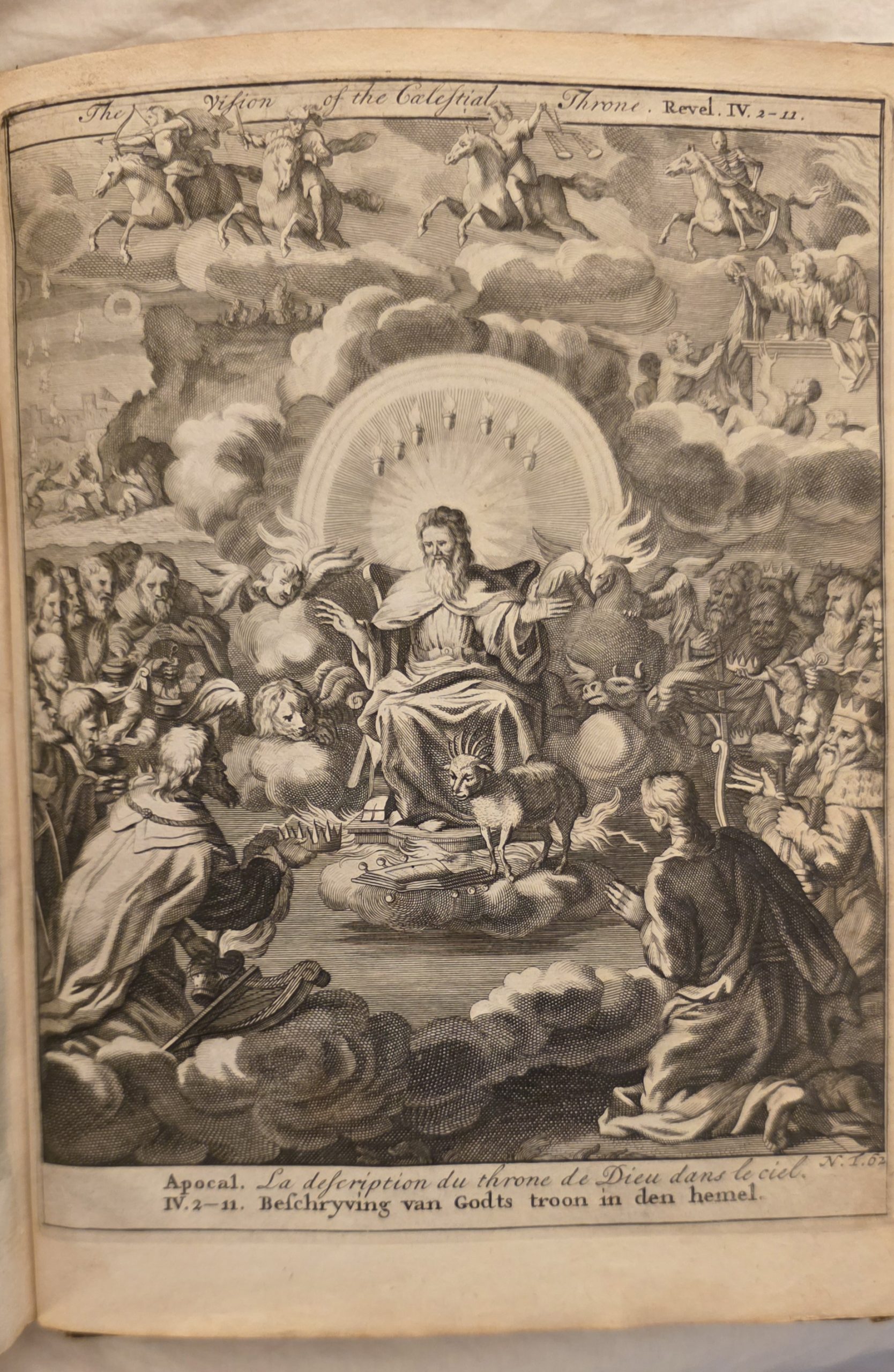
Could this simply be the Reinier & Ottens plates bound with the Halma title by a previous owner for unknown reasons? The second plate credits Halma as its publisher:
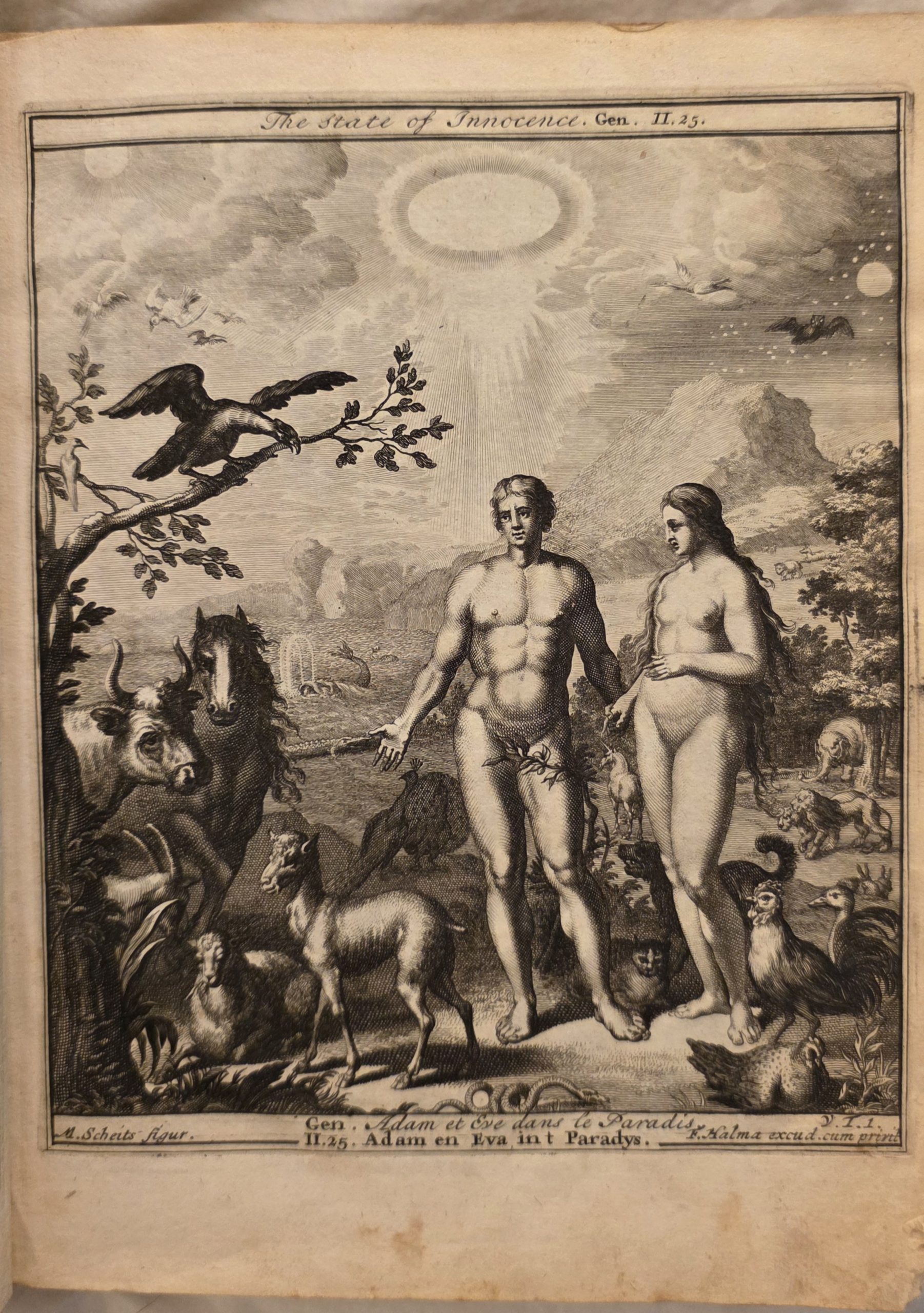
Yet, it turns out that the Reinier & Ottens edition also retained the Halma credit:
The double-page engravings in both series lack the English titles:
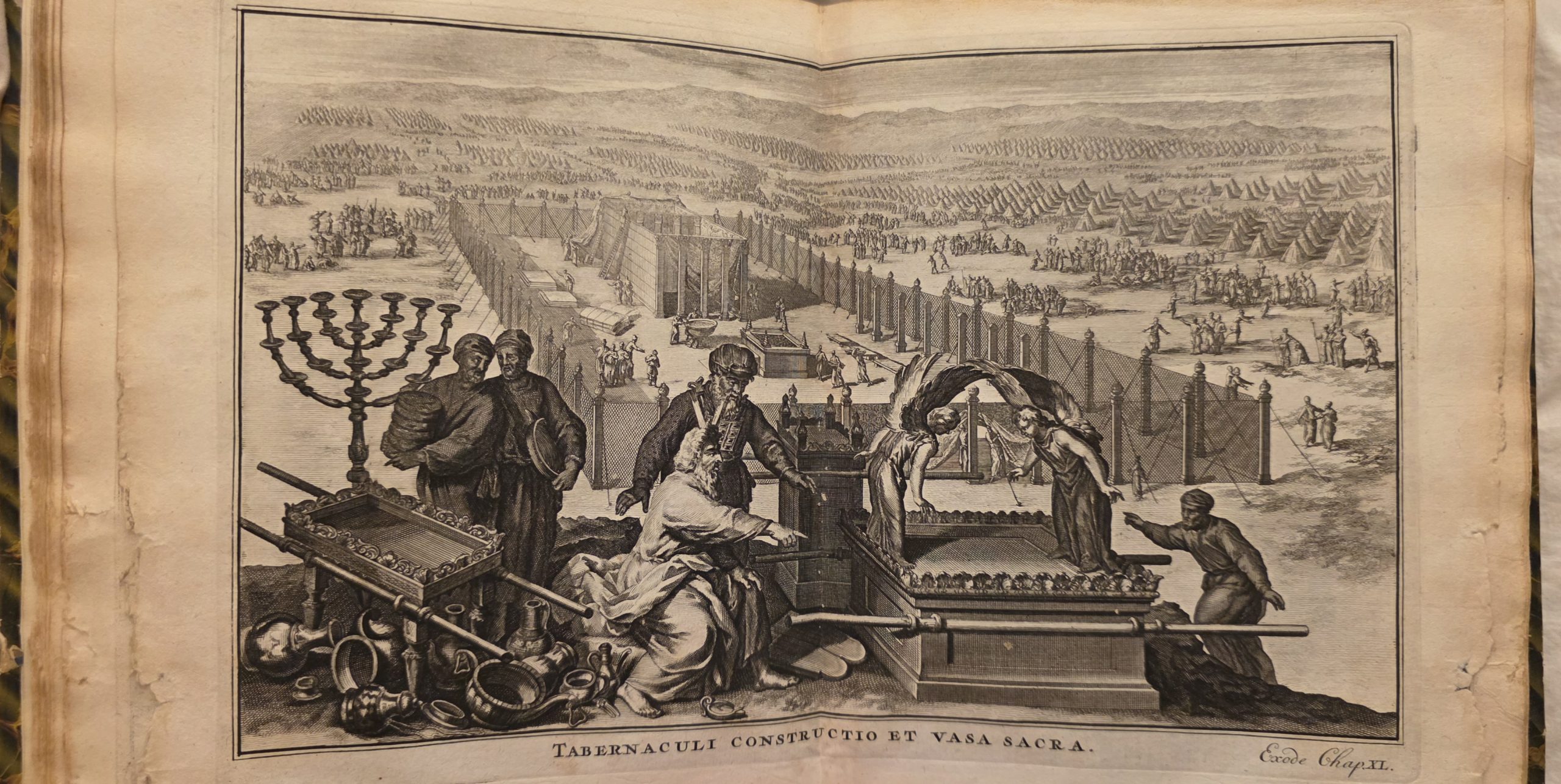
If we look very carefully, we can see that the platemarks of these engravings are actually perfectly matched to those of the Reinier & Ottens edition, suggesting they are the same copperplates. However, there is a problem. As can be seen on the left page below, the Reinier & Ottens edition included an additional parallel English and French descriptive text printed on the verso (backside) of each engraving. Ours lacks this additional descriptive text, meaning it could not be the Reinier & Ottens edition.
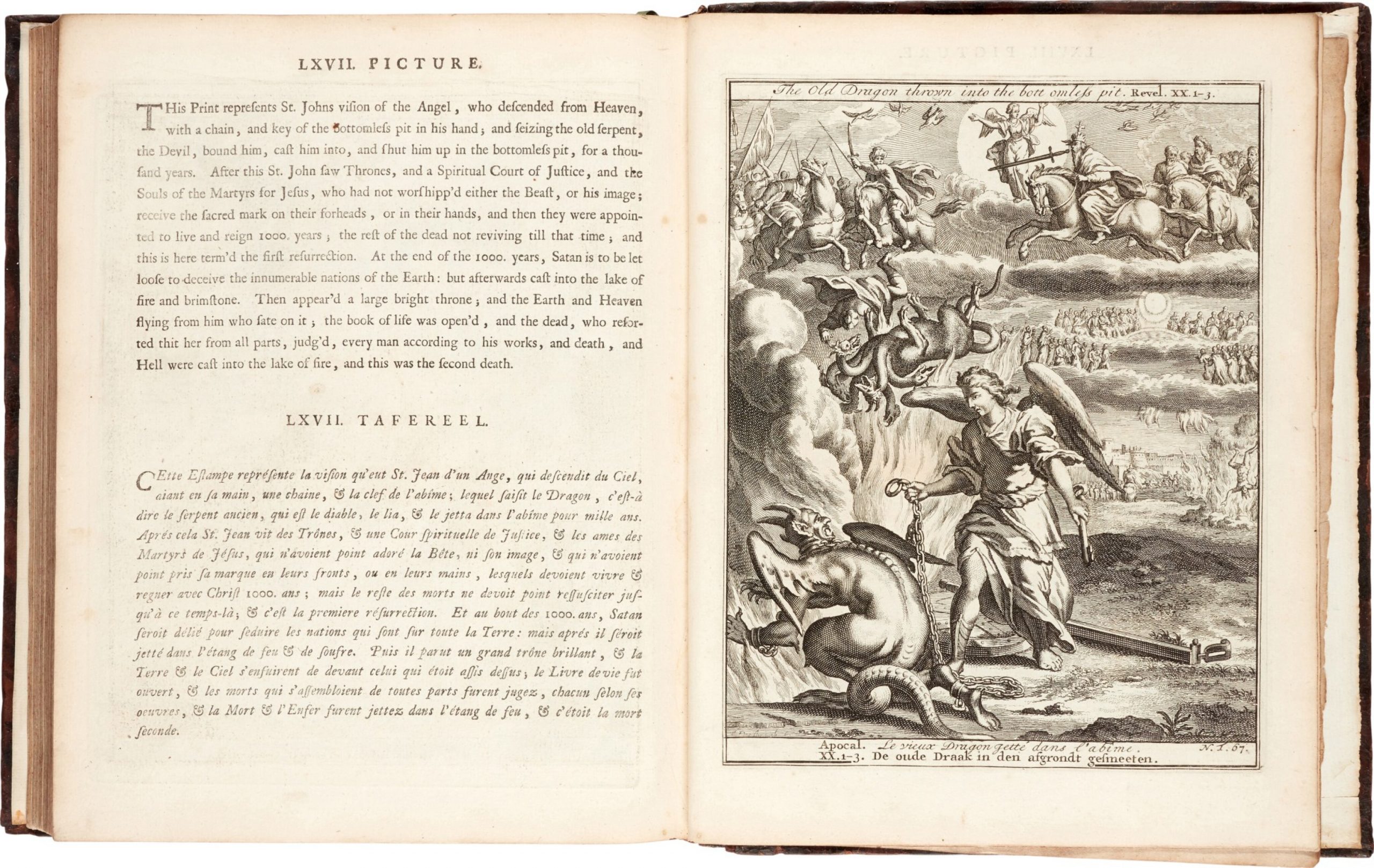
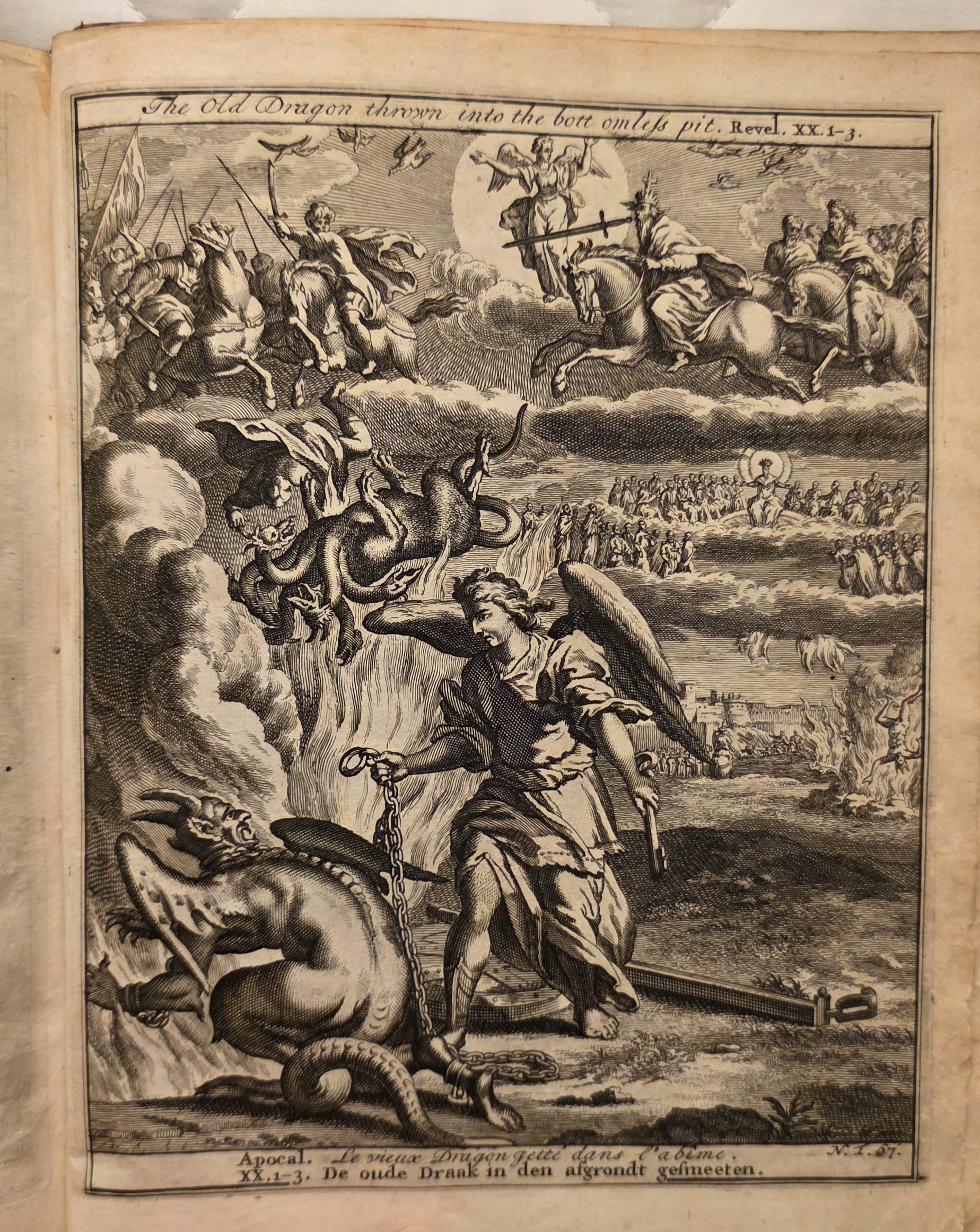
Muddying the Reinier & Ottens waters, however, are works like this one in which a large folio Bible contains the Reinier & Ottens title page and was interleaved with the same engravings as found in the Reinier & Ottens work, but printed on exceptionally large folio paper and with a single thin border, rather than the double-line border found on the actual Reinier & Ottens engravings. While the same copperplates could have been used with larger paper, the differing border and the vastly degraded quality of the details suggest these were printed with copies, rather than the original plates:
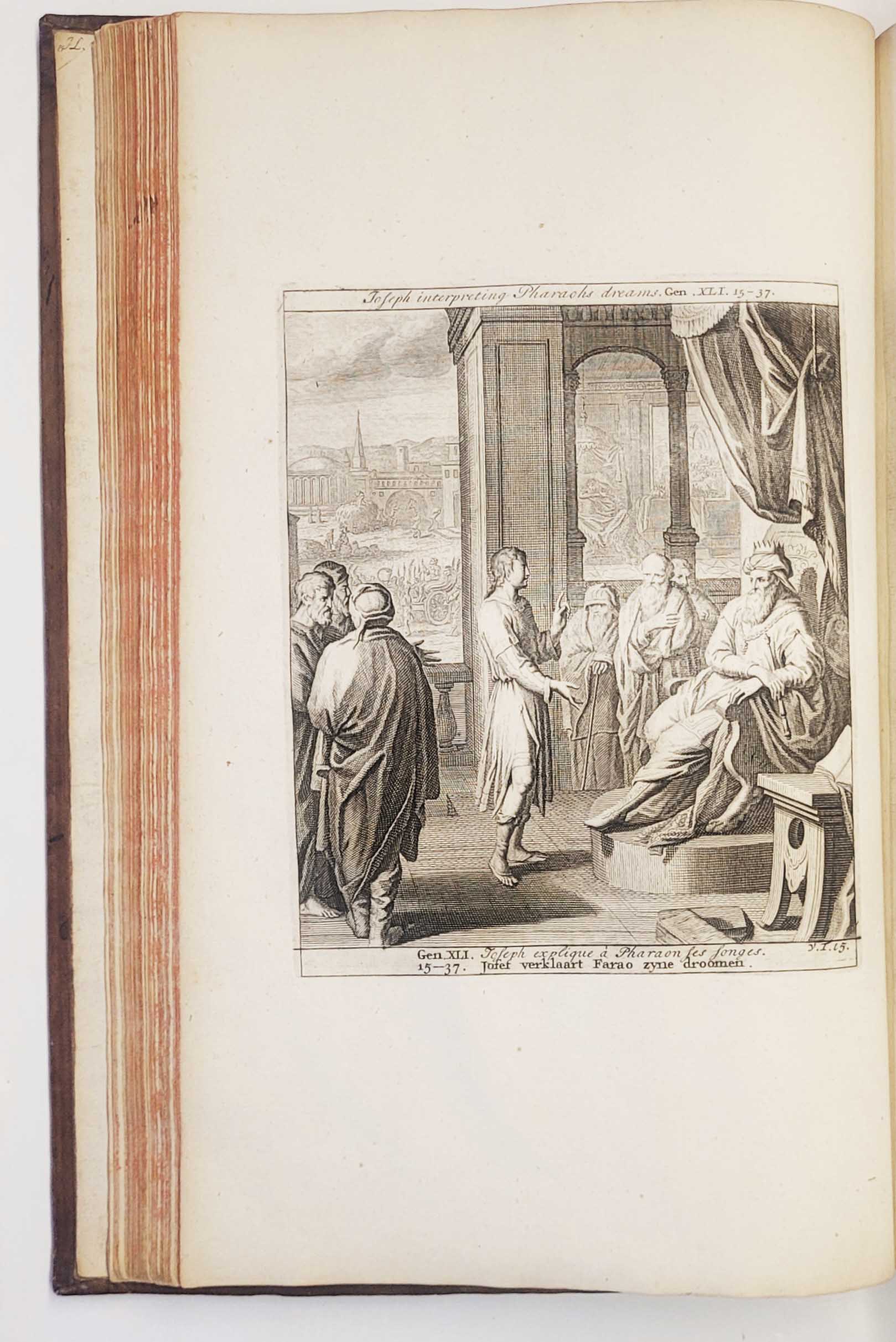
Of course, the most likely scenario is that Reinier & Ottens also offered "print suites" for embedding into other Bibles, much like many of the "print Bibles" of the era were sold. At the same time, however, we can find numerous examples of print Bibles with the engravings printed directly on the same paper as the rest of the Bible (versus being on different paper and thus indicating an insertion). Here we can see them bound into a 1739 Keur Bible. Look carefully and you will see that the platemarks match exactly with our copy, down to the precise curvature of the top right margin, but also that in the Keur copy the engraving and text pages are of the same paper. This suggests at the very least that these were not exclusively sold as suites to be bound in, but rather available to the original printer to print onto their own paper. Gemini notes that in his landmark reference work, Wilco Poortman makes note of these English-titled plates, but was unable to authoritatively determine their origin.
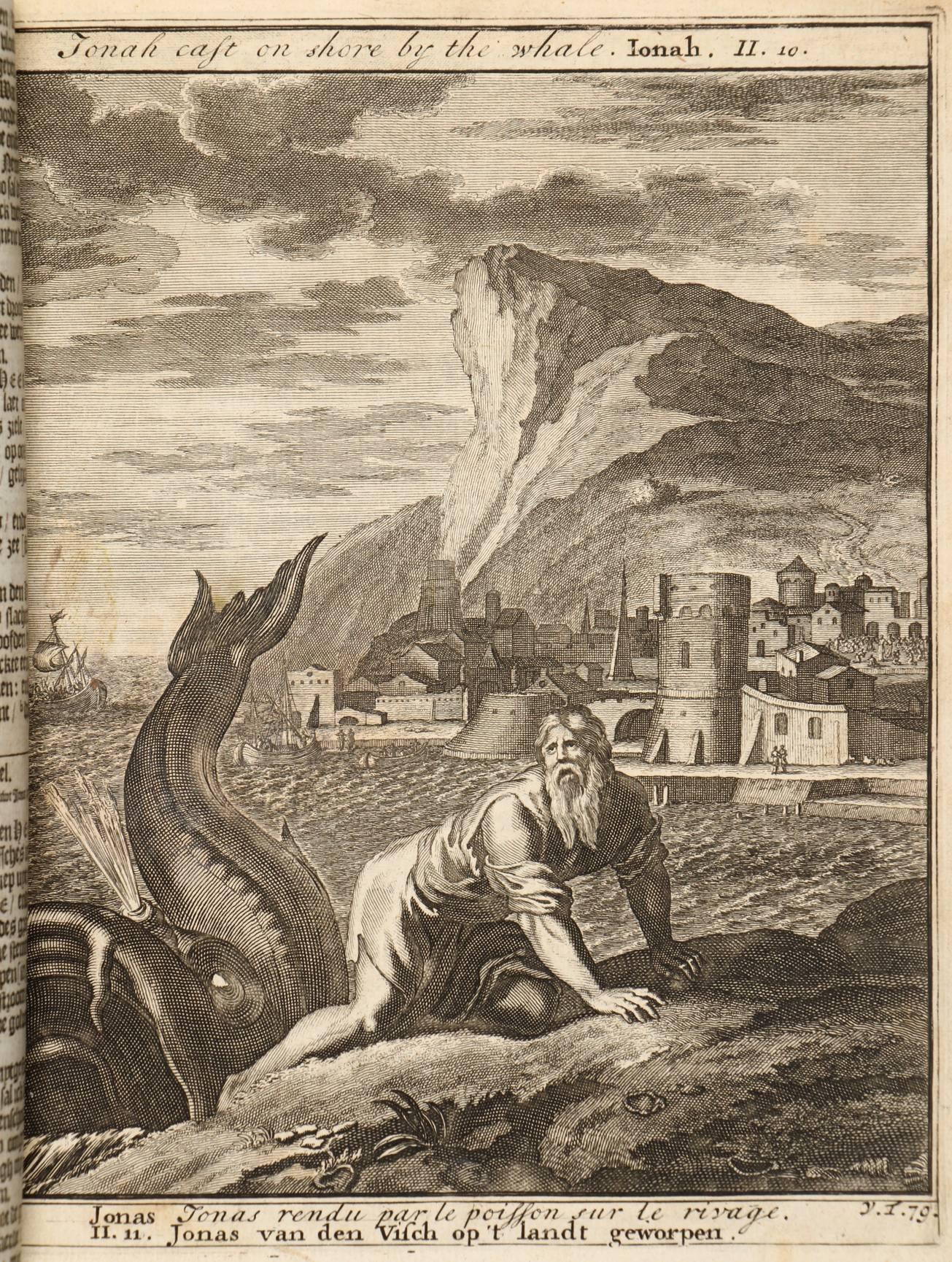
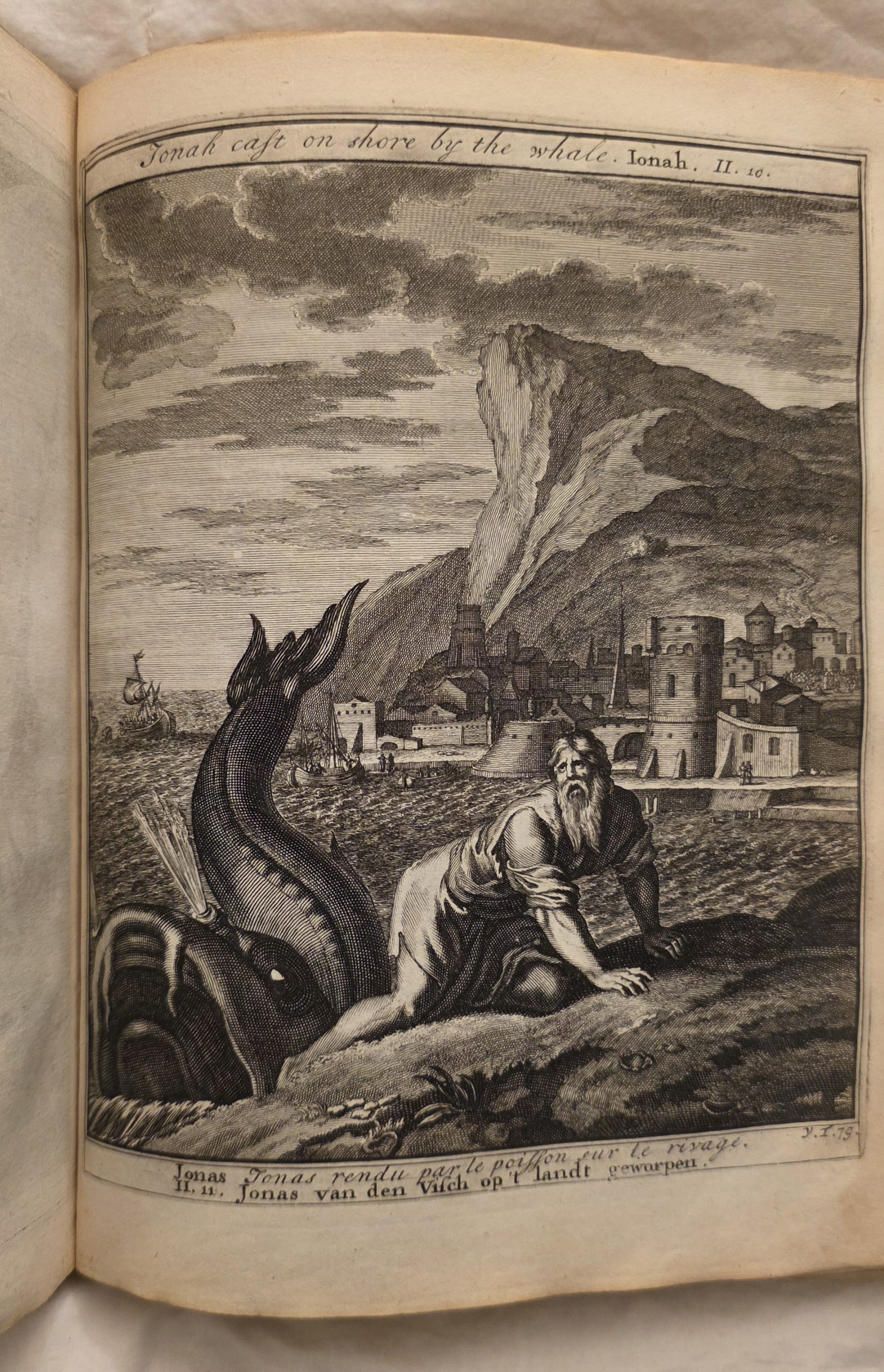
And a different copy of the Keur, again with the images bound into a textual Bible, but this time we can see that the imagery extending into the English title plate can be seen in this copy as well, confirming that the English titles were not simply bolted on top:
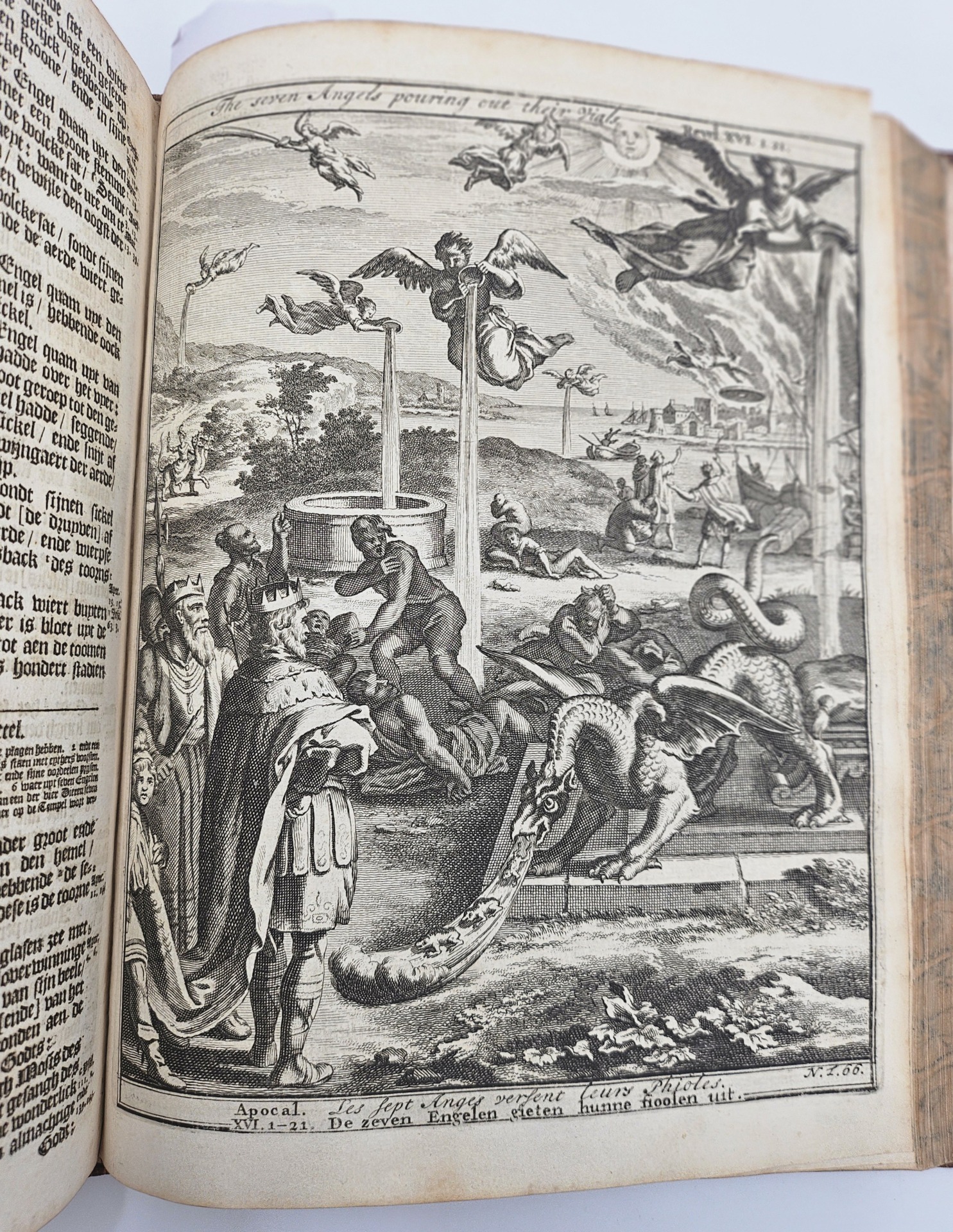
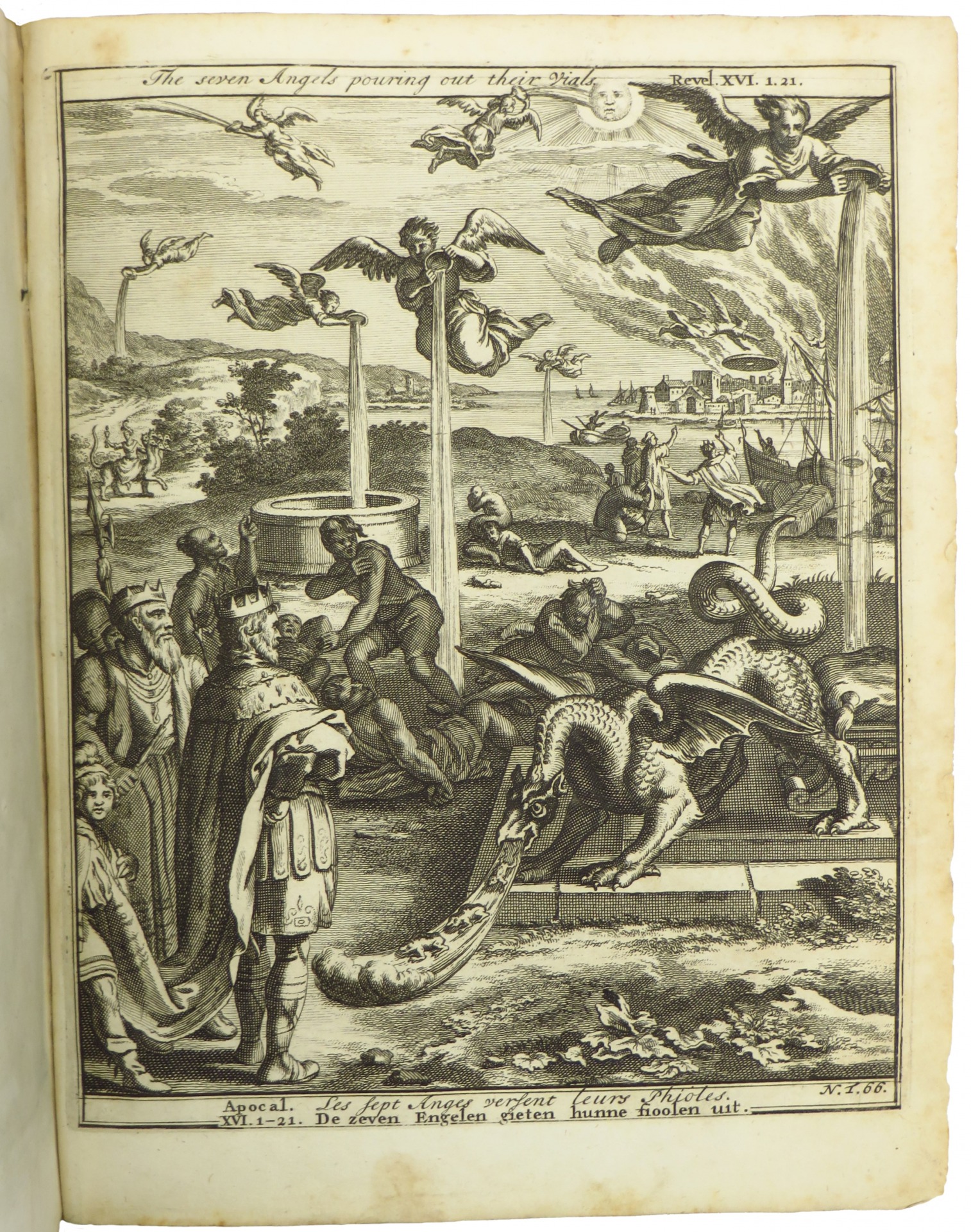
Indeed, most copies of these plates were embedded within grand textual Bibles (the plates were first published as part of the 1672 Stern Bible) and appear to have been rarely compiled as a standalone picture Bible. We have been unable to locate a single other work that contains only the Halma title plate and the English-titled Sheits engravings bound as a picture Bible without any additional text. At the same time, the Scheits imagery became so iconic that it appeared in countless almost-precise reproductions, such as this engraving that at first glance appears to be the exact image in reverse (suggesting a copied copperplate), but closer inspection of the faces and the stars at the top right/left, you can see the clear differences:
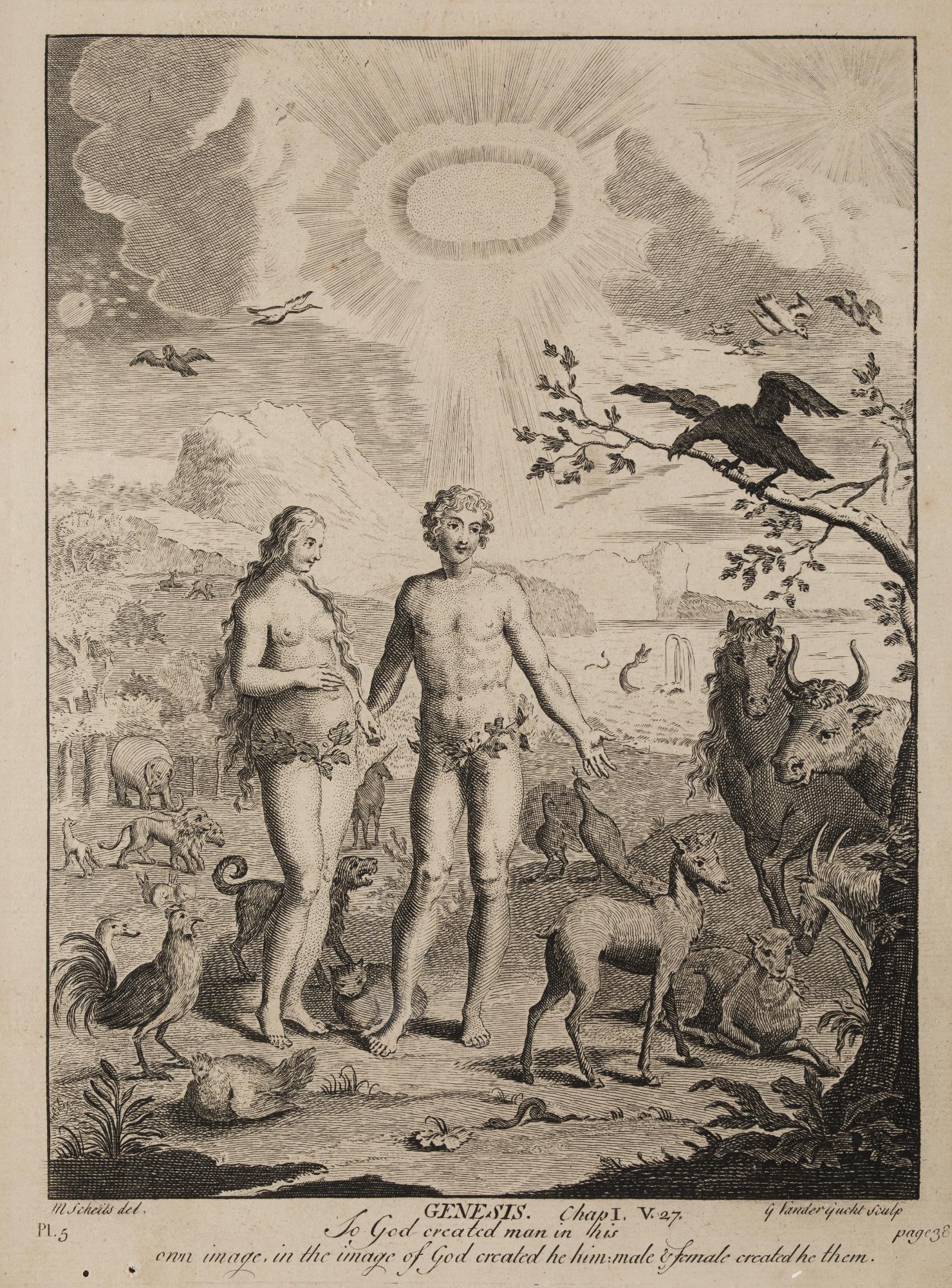
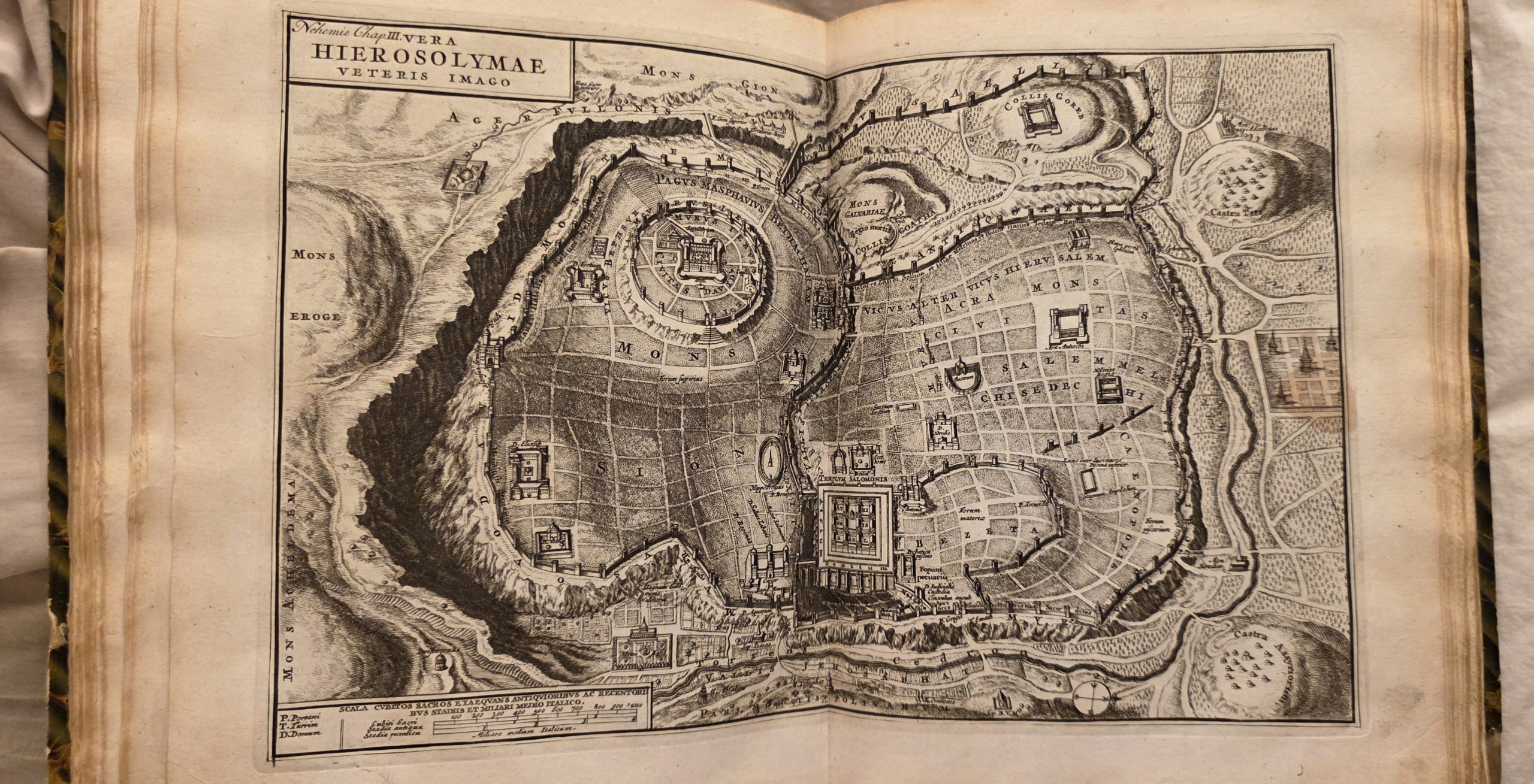
Ours also contains this map, which has a modified title at top left stating it was from "Chapter 3" of a work. We could not locate this specific customized version of this map's title, suggesting this was drawn from some other Bible, likely of Halma's, and used to customize this copy – lending support to the hypothesis that this was a bespoke collection made for a specific user rather than a standard-issue printing:
Recall that the 1710 Halma title page matches precisely the laid paper and edge soiling as the engravings, demonstrating that it was present from the beginning and was part of the same print run, rather than inserted from a separate print run. That it matches the wire dimensions to the mm of the engraving paper indicates that whomever printed the engravings also printed that title page or used the same paper manufacturer and bound them at the same time. This is a fascinating piece of evidence pointing to the printer being in possession of the Halma title page plate.
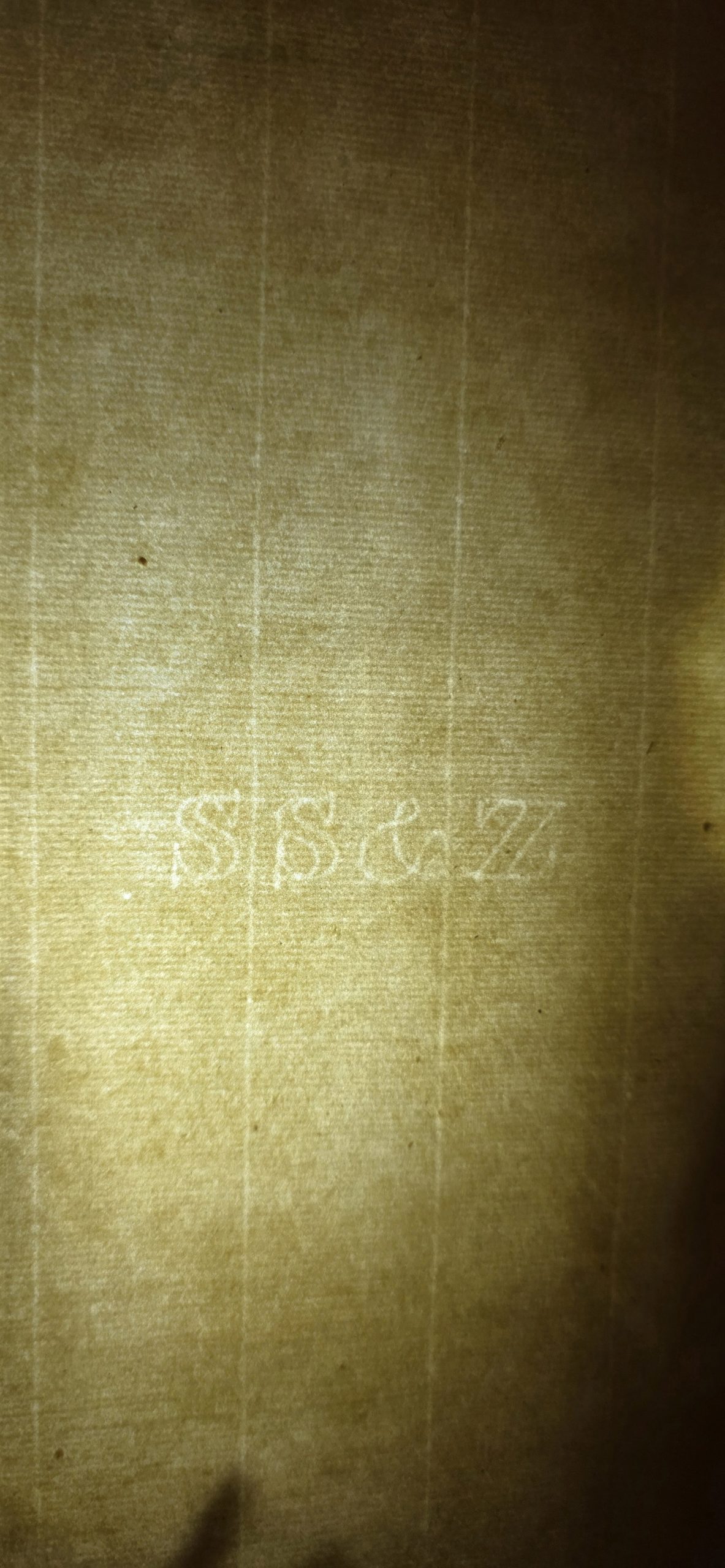
Of interest, however, is that the pastedown and endpapers of this copy are NOT the same as the engraving paper and appear to be newer. The title and engraving pages have no observable watermarks across the entire collection. The pastedown and endpapers are of a much thicker, completely clean (lacking any of the edge soiling and damage of the engraving pages) laid paper with a different grid dimension. The endpapers both have "SS & Z" watermarks, but the pastedown is harder to discern. Under raking light it is clear that it is a circular cartouche filled with wording with a crown device at top, surrounding a crowned lion, head high, holding a sword. The words appear to spell "Concordia res parvae crescunt", which would make this the Dutch Lion.
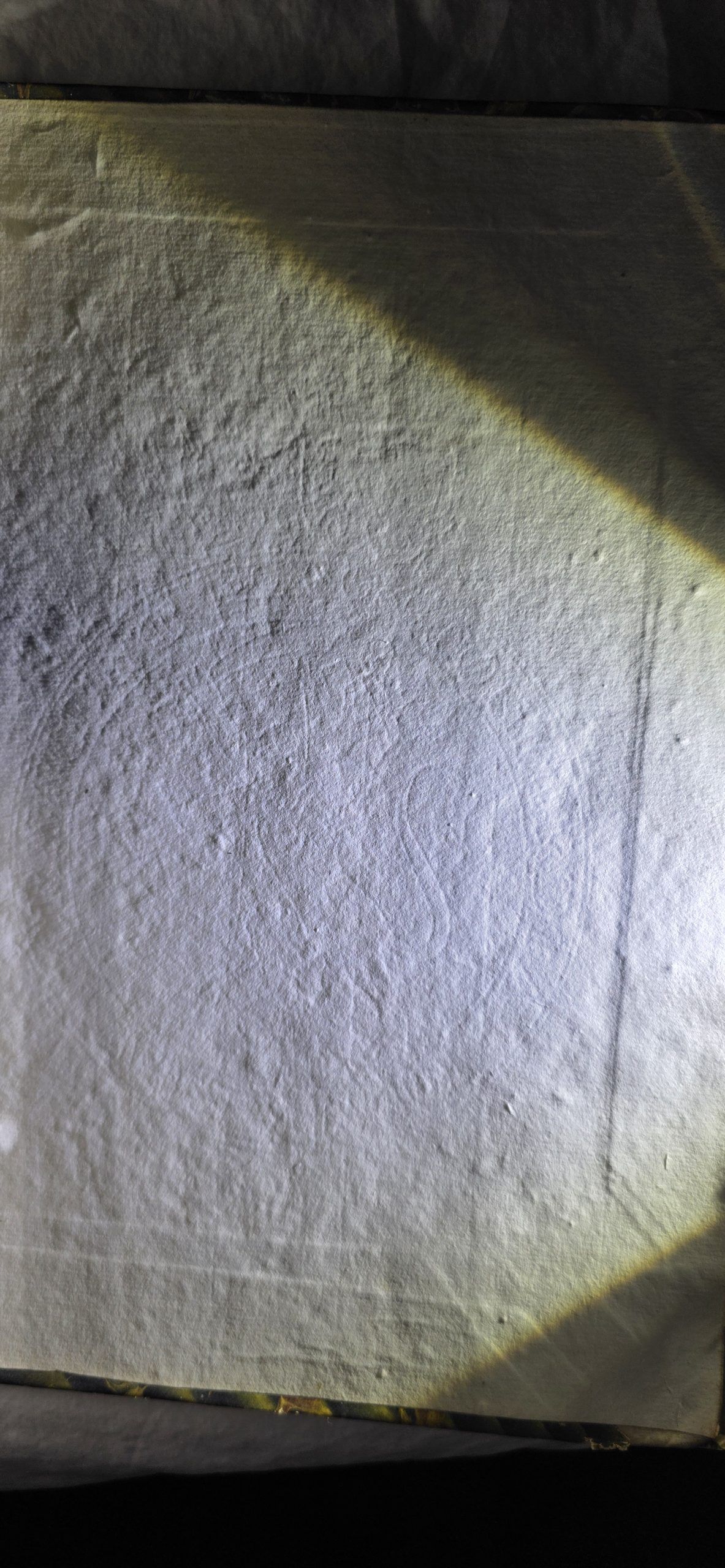
Look closely at the emblem image looks extremely similar (with a greatly simplified lion and bordering) to this image. In either case, this raises the intriguing question of when the work was rebound. That it was rebound with laid paper suggests it was rebound still in the 1700s or early 1800s.
.svg)