

In accessioning a 1777 Estonian law book recently, we uncovered two handwritten letters tucked inside its pages. While we could make out a few words here, including the dates 1671 and 1827, both notes were otherwise indecipherable, other than their handwriting being suggestive of 19th to 20th century, rather than earlier. It turns out that Gemini 4's handwriting analysis has advanced to the point that it was able to not only decipher both notes, but bring to bear extensive historical, contextual and paleographic knowledge to tell us more about the authors.
With transcriptions of this kind, how do we reach a point where we feel confident in the model's analysis? First, we ran both notes through Gemini 4 Medium Thinking multiple times to ensure we got the same results each time. This acts as a primitive measure of the model's "confidence" given that low-probability results will typically change wildly across runs. We then ran the notes through multiple other frontier models – none of which we were able to confidently decipher more than a scattering of passages, but whose passages they did transcribe matched Gemini's transcription. Finally, armed with Gemini's assessment of the handwriting style, we first manually confirmed that Gemini's identification of the scripts appeared accurate and then looked up known transcribed passages in those scripts to understand how various characters typically looked, then went word-by-word through the letter to see whether Gemini's transcription appeared reasonable for each word. In other words, we used Gemini like a powerful research assistant and then checked its work.
While there is always the risk of confirmation bias in such workflows, this is no different than checking the work of a human transcriptionist. In fact, the original expert human transcription of the second letter, performed by an expert in the field deeply familiar with the source material, proved to be entirely wrong – offering a reminder that human handwriting transcription is far from infallible and that AI handwriting analysis appears to have now reached a point where it is highly competitive with human transcription.
Let's start with this note written on blue laid paper:
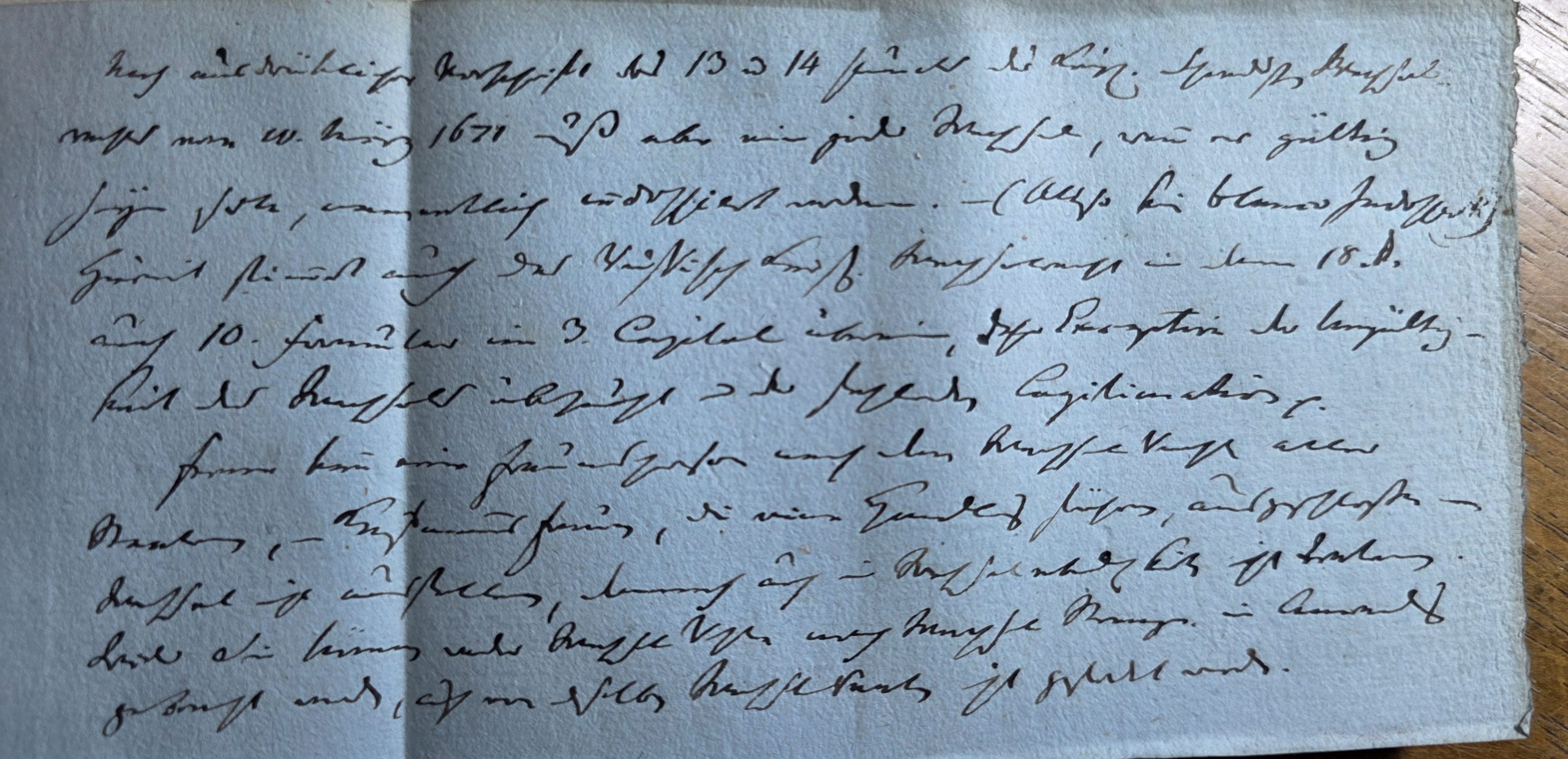
transcribe and translate this handwritten letter exactly.
do not summarize.
tell me which parts you are uncertain about.
what can you estimate about its age and anything about its author?
it is on laid paper.
This document is not a personal letter, but a German legal memorandum or defense brief note (Exceptions-Notiz) written in Kurrentschrift (with Latin cursive used for Romance/Latin legal loanwords).
1. Exact Line-by-Line Transcription
(Note: Original spelling, abbreviations, punctuation, and line breaks are preserved. Nasal doubling bars over m and n are expanded in brackets where helpful, and uncertain readings are marked with [?] and detailed in Section 3.)
Line 1: Nach ausdrücklicher Vorschrift des 13 u 14 Puncts des Königl. [?] Schwedisch. Wechsel- Line 2: rechts vom 10. März 1671 muß aber ein jeder Wechsel, wenn er gültig Line 3: seyn soll, namentlich indossirt werden. – (Also kein blanco Indossat.) Line 4: Hiemit stimmt auch das Russisch Kayl. Wechselrecht in dem 18. P. [?] Line 5: auch 10. Formular im 3. Capitel überein, daher [?] Exception der Ungültig- Line 6: keit des Wechsels überhaupt u der fehlenden Legitimation pp. Line 7: Ferner kann eine Frauensperson nach dem Wechselrecht aller Line 8: Staaten [?], – Kaufmannsfrauen [?], die einen Handel führen, ausgenommen – Line 9: Wechsel nicht ausstellen, demnach auch in Wechselverbindlichkeit nicht treten. Line 10: Wider sie kann weder Wechsel Recht noch Wechsel Strenge in Anwendg Line 11: gebracht werd[en], auch [?] wenn selber [?] Wechsel [Rechts?] [?] nicht gezahlt wird.
Clean Reading Text (Abbreviations Expanded)
Nach ausdrücklicher Vorschrift des 13. und 14. Puncts des Königlich Schwedischen Wechselrechts vom 10. März 1671 muß aber ein jeder Wechsel, wenn er gültig seyn soll, namentlich indossirt werden. – (Also kein blanco Indossat.) Hiemit stimmt auch das Russisch Kayserliche Wechselrecht in dem 18. Punct [oder §.] auch 10. Formular im 3. Capitel überein, daher Exception der Ungültigkeit des Wechsels überhaupt und der fehlenden Legitimation pp. [et cetera].
Ferner kann eine Frauensperson nach dem Wechselrecht aller Staaten [?], – Kaufmannsfrauen [?], die einen Handel führen, ausgenommen – Wechsel nicht ausstellen, demnach auch in Wechselverbindlichkeit nicht treten. Wider sie kann weder Wechselrecht noch Wechselstrenge in Anwendung gebracht werden, auch wenn selber Wechsel […] nicht gezahlt wird.
2. Exact Line-by-Line Translation
Line 1: According to the express provision of the 13th and 14th Point of the Royal Swedish Bill-of-Exchange
Line 2: Law of 10 March 1671, however, every bill of exchange, if it is to be valid,
Line 3: must be endorsed by name. – (Thus no blank endorsement.)
Line 4: Herewith agrees also the Russian Imperial Bill-of-Exchange Law in the 18th Point [or §]
Line 5: as well as the 10th Form in the 3rd Chapter, hence [the] exception [legal defense] of the invalid-
Line 6: ity of the bill of exchange in general and of the lacking standing/title [Legitimation], etc.
Line 7: Furthermore, a woman, according to the bill-of-exchange law of all
Line 8: states [?], – excepting merchants' wives [or widows and women], who conduct a trade –
Line 9: cannot issue bills of exchange, and accordingly also cannot enter into any bill-of-exchange liability.
Line 10: Against her, neither bill-of-exchange law nor bill-of-exchange strictness [summary execution] can be brought into
Line 11: application, even if that same bill of exchange […] is not paid.
3. Uncertain Readings & Paleographical Notes
Because the author writes in a rapid, heavily abbreviated legal Kurrentschrift, a few specific words are compressed or ambiguous:
-
Line 1 (
Königl.vs.Kayl.) & Line 2 (10.): The abbreviation beforeSchwedisch.is compressed and resemblesKayl.in Line 4, though historically the law cited is the Königlich Schwedisches Wechselrecht vom 10. März 1671 (King Charles XI's Swedish Bill of Exchange Statute of March 10, 1671). Similarly, the numerals10.in Line 2 are written closely together (resemblingW.or20.), but the historical enactment date of that statute confirms10. März 1671. -
Line 3 (
Indossat.): Written at the far right edge inside parentheses. In 18th- and early 19th-century commercial German, Indossat was frequently used as a synonym for Indossament (endorsement). -
Line 4 (
18. P.vs.18. §.or18. A.): The single capital letter at the end of Line 4 represents eitherP.(Punct, matchingPunctsin Line 1),§.(Paragraph), orA.(Artickel), referring to Chapter 1, Section 18 of the Russian Bill of Exchange Statute of 1729. -
Line 5 (
dahervs.diese): The word beforeExceptionis compressed (d-a-h-rord-i-e-s-e). Both readings make sense in context ("hence [the] exception" vs. "this exception"). -
Line 8 (
Staaten, – Kaufmannsfrauen):-
The first word of Line 8 (following
allerat the end of Line 7) appears to beStaaten,("of all states") orStände,/Banken,. -
The compound word immediately after the opening dash
–clearly ends in-frauen(compareFrauenspersondirectly above it in Line 7). The first half of the word has a nasal doubling bar and appears to readKaufmannsfrauen("merchants' wives / female merchants") or possiblyWittwen u Frauen("widows and wives"). In either case, it qualifies the subsequent relative clause:die einen Handel führen, ausgenommen("excepting those who conduct a trade/business").
-
-
Line 9 & Line 11 (
nicht): The short vertical-looped word beforeausstellen, beforetreten, and beforegezahlt wirdis the standard early-modern Kurrent legal shorthand fornicht. -
Line 11 (
auch wenn selber Wechsel [Rechts?]): The four words aftergebracht werd[en],are the most cursorily written on the page. The first two words readauch wennorals wenn("even if" / "when"), followed byselberorsolcher("that same" / "such"), thenWechsel, followed by a difficult word (Rechts,Valuta,Brief, orselbst) beforenicht gezahlt wird("is not paid").
4. Estimate of Age, Origin, and Author
Geographic Origin: Baltic Provinces of the Russian Empire (Livonia or Estonia)
The legal citations pinpoint the exact region where this was written:
-
It cites the Royal Swedish Bill of Exchange Act of March 10, 1671 (Königl. Schwedisches Wechselrecht vom 10. März 1671, Points 13 & 14).
-
It simultaneously cites the Russian Imperial Bill of Exchange Act of May 16, 1729 (Russisch Kayserl. Wechselrecht, Chapter 1, Point 18, and Chapter 3, Form 10).
The only place in Europe where German was the language of the courts and where the 1671 Swedish Bill of Exchange Law and the 1729 Russian Imperial Bill of Exchange Law were simultaneously in force was Livonia (Livland, e.g., Riga or Dorpat/Tartu) and Estonia (Estland, e.g., Reval/Tallinn). After Russia conquered the Swedish Baltic provinces in 1710 (formally ceded in 1721), Peter the Great and his successors guaranteed the provinces their existing Swedish laws and German court system (Ostseeprovinzialrecht), while the 1729 Russian Imperial Bill of Exchange Ordinance was introduced alongside it.
Estimated Age: c. 1780–1830
-
Earliest possible date (Terminus post quem): May 16, 1729, when the Russian Imperial Bill of Exchange Law cited in Line 4 was enacted under Tsar Peter II.
-
Paleographical and orthographical dating: Several features narrow the document to roughly 1780–1830:
-
Spelling: The author writes
März(rather than the earlier 18th-centuryMartiiorMertz, which began giving way toMärzaround 1775–1785), alongside older spellings that persisted into the 1820s–1830s (seynwith y,Puncts,Capitel,indossirt). -
Script: The dual-script convention—writing German words in fluent Kurrentschrift while switching to Latin script for Latin/French legal roots (blanco Indossat, Formular, Capitel, Exception, Legitimation)—is characteristic of late 18th- and early 19th-century university-educated jurists.
-
Paper: Blue-tinted laid rag paper (bläuliches Bütten-Konzeptpapier) was a staple of northern European and Baltic chancelleries, courts, and law offices between 1770 and 1835.
-
The Author and Purpose of the Note
The author was a Baltic German lawyer (Advokat or Ratsadvokat) or judge practicing in a Baltic commercial center such as Riga, Reval (Tallinn), or Dorpat (Tartu).
Rather than a letter, this is a lawyer's case-file note outlining two legal defenses (Exceptiones) on behalf of a female client who was being sued over an unpaid bill of exchange (Wechsel):
-
First Defense (Lines 1–6): The bill of exchange was endorsed in blank (blanco Indossat). Under both the 1671 Swedish law and the 1729 Russian law, a blank endorsement is invalid; every endorsement must name the endorsee (namentlich indossirt). Therefore, the lawyer notes the defense of formal invalidity of the bill and lack of standing (fehlende Legitimation) of the plaintiff holding it.
-
Second Defense (Lines 7–11): The client is a woman (Frauensperson) who is not a female merchant running her own business. Consequently, she lacked legal capacity to issue bills of exchange (Wechselunfähigkeit), could not incur bill-of-exchange liability, and could not be subjected to summary bill-of-exchange enforcement or debtor's arrest (Wechselstrenge) upon non-payment.
This is actually the first blue-tinted laid paper example in The Collection, so let's ask Gemini to tell us more about how common blue paper was at this time:
this handwritten note on blue laid paper was found in a late 1700s Livonian law book.
how common was this kind of paper back then?
Blue laid rag paper was very common across northern and eastern Europe from the mid-1700s into the early 1800s, especially for administrative, legal, and commercial writing. Finding a slip like this tucked inside a late 18th-century Livonian law book is completely authentic to the period.
Why Paper Was Blue in the Late 1700s
-
Optical Brightening ("Bluing"): Before the discovery of chlorine bleaching in the late 18th century, linen and hemp rags naturally produced an off-white, yellowish, or brownish pulp. Just as laundry was "blued" to make yellowing fabrics look whiter, papermakers added blue pigments—typically smalt (ground cobalt glass), indigo, or Prussian blue—to counteract the yellow tones.
-
Dyed Rag Stock: Lower-to-medium grade writing and wrapping papers were frequently made from pre-dyed blue rags (such as worn-out sailor uniforms, work clothes, and domestic linens) rather than expensive, sorted white rags. Rather than trying to bleach out the dye, mills embraced the tint and produced uniform blue sheets (Conceptpapier or Blaupapier).
-
Visual Comfort & Fashion: By the 1770s–1810s, distinctly blue-tinted writing paper became fashionable across the German-speaking world, Russia, and the Baltic provinces, prized both for its aesthetic appeal and because it was considered easier on the eyes when reading by candlelight.
Regional Context: Livonia & the Baltic Trade
In late 18th-century Livonia (then a governorate of the Russian Empire with a German-speaking legal and administrative elite), blue laid paper was a staple of daily bureaucracy:
-
Dutch and Local Mills: High-quality blue and white laid papers were heavily imported into Riga and Reval (Tallinn) from Dutch paper mills (particularly from the Zaan region, famous for its blue papers), while local Baltic and Russian mills (such as the Rappin/Räpina mill in Livonia) produced vast quantities of blue-tinted Conceptpapier (drafting paper) for local courts, estates, and merchants.
-
Legal and Administrative Use: In German and Baltic chancelleries, pure white rag paper was reserved for formal, fair-copy documents (Reinschriften), while blue or gray-blue laid paper was standard for legal notes, case summaries, receipts, and file covers.
How about this one?
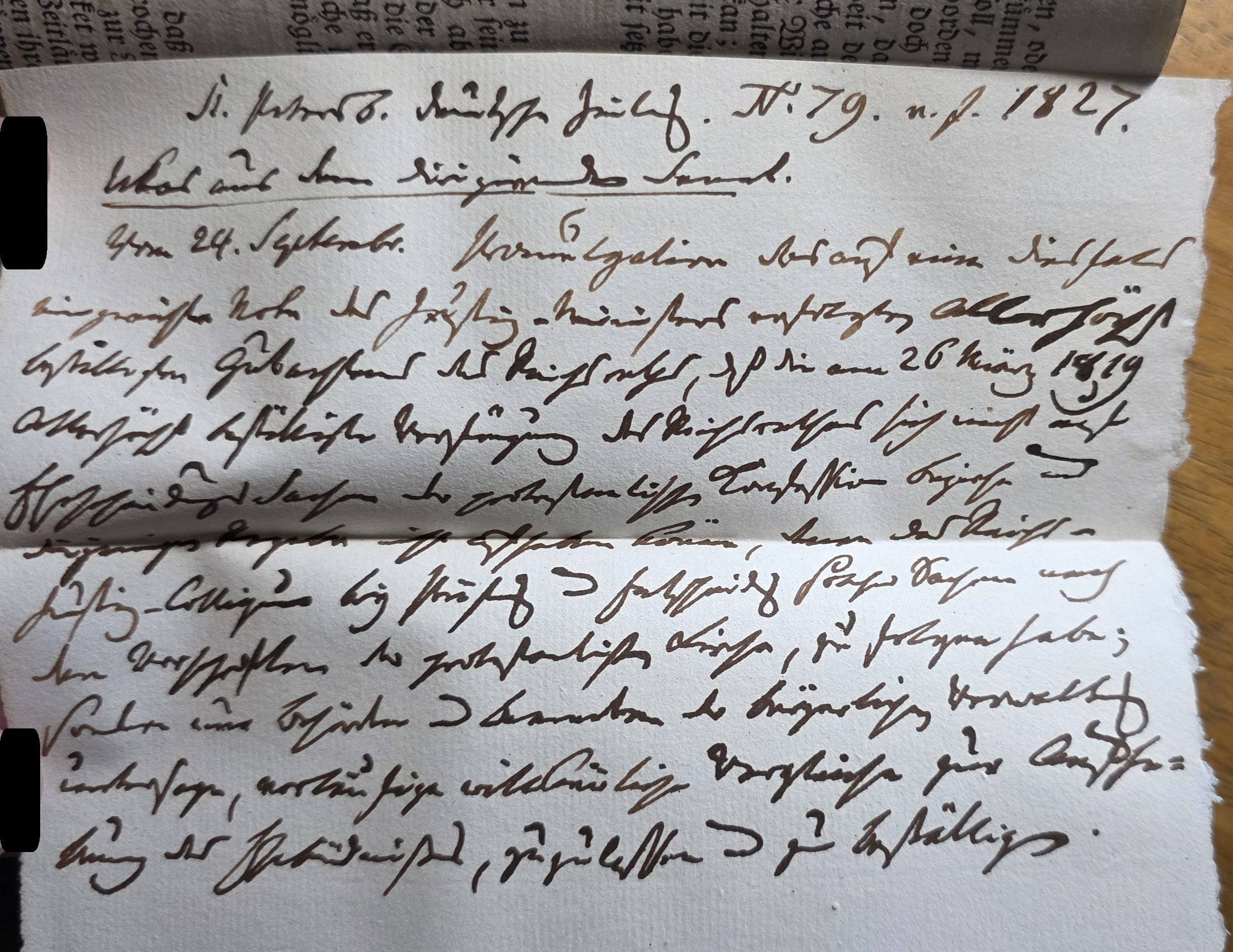
transcribe and translate this handwritten letter exactly.
do not summarize.
tell me which parts you are uncertain about.
what can you estimate about its age and anything about its author?
it is on laid paper.
This document is not a personal letter, but a handwritten legal or ecclesiastical reference note (an Exzerpt) copied from a 1827 issue of the St. Petersburger Zeitung (the German-language newspaper of record in the Russian Empire). It records an imperial decree (Ukase) clarifying that civil authorities cannot approve private divorce settlements and that Protestant divorce cases in the Russian Empire remain under the jurisdiction of the Imperial Justice College according to Protestant church law.
1. Exact Line-by-Line Transcription
The text is written in 19th-century German Kurrentschrift (old German cursive), following the period convention of switching into Latin cursive (Antiquakursive) for non-German loanwords, proper nouns, and legal terms (dirigirenden, Senat, Promulgation, Note, Ministers, protestantischen, Confession, Collegium). Original 19th-century spellings (such as dirigirenden, Reichsraths, bey, Ehebündnißes) and line-end double hyphens (=) are preserved exactly as written.
Line 1: St. Petersb. deutsche Zeitung. Nº. 79. v. J. 1827. Line 2: Ukas aus dem dirigirenden Senat. Line 3: Vom 24. Septembr. Promulgation des auf eine diesfals Line 4: eingereichte Note des Justiz-Ministers erfolgten Allerhöchst Line 5: bestätigten Gutachtens des Reichsraths, d[a]ß die am 26 März 1819 Line 6: Allerhöchst bestätigte Verfügung des Reichsraths sich nicht auf Line 7: Ehescheidungs-Sachen d[er] protestantischen Confession beziehe und Line 8: diejenige[n] Regeln nicht aufheben könne, denen das Reichs= Line 9: Justiz-Collegium bey Prüfung u[nd] Entscheidung solcher Sachen nach Line 10: den Vorschriften der protestantischen Kirche, zu folgen habe; Line 11: sondern nur Behörden u[nd] Beamten der bürgerlichen Verwaltung Line 12: untersage, vorläufige willkürliche Vergleiche zur Aufhe= Line 13: bung des Ehebündnißes, zuzulassen u[nd] zu bestätigen.
Abbreviations Used in the Original Text
-
St. Petersb. = Sankt Petersburger
-
Nº. 79. v. J. 1827. = Numero 79 vom Jahre 1827 ("No. 79 from the year 1827")
-
Septembr. = September
-
dß (Line 5) = standard Kurrent contraction for daß ("that")
-
d (Line 7) = compressed Kurrent contraction for der ("of the")
-
u (Lines 9, 11, 13) = written as a standalone curved hook, the standard Kurrent shorthand symbol for und ("and")
2. Exact English Translation
Line-by-Line Literal Translation
Line 1: St. Petersburg German Newspaper. No. 79 from the year 1827. Line 2: Ukase [Decree] from the Governing Senate. Line 3: From the 24th of September. Promulgation of the—upon a regarding-this-matter Line 4: submitted note of the Minister of Justice—ensuing, Most Highly [Imperially] Line 5: confirmed opinion of the State Council, that the on 26 March 1819 Line 6: Most Highly [Imperially] confirmed provision of the State Council does not to Line 7: divorce matters of the Protestant confession apply and Line 8: cannot repeal those rules which the Imperial Line 9: Justice College, in examining and deciding such matters according to Line 10: the regulations of the Protestant Church, has to follow; Line 11: but rather only authorities and officials of the civil administration Line 12: forbids, preliminary arbitrary settlements for the disso- Line 13: lution of the marriage bond, to permit and to confirm.
Complete Sentence in Natural English Legal Syntax (Unabridged)
St. Petersburg German Newspaper, No. 79 from the year 1827.
Ukase from the Governing Senate.
Of September 24. Promulgation of the Imperially confirmed opinion of the State Council—issued in response to a memorandum submitted on this matter by the Minister of Justice—stating that the Imperially confirmed decree of the State Council of March 26, 1819, does not apply to divorce cases of the Protestant confession and cannot repeal those rules which the Imperial Justice College is required to follow in examining and deciding such cases according to the regulations of the Protestant Church; rather, it only forbids authorities and officials of the civil administration from permitting and confirming preliminary, arbitrary [private] settlements for the dissolution of the bond of marriage.
3. Parts with Slight Paleographic Uncertainty
The handwriting is rapid, educated, and highly legible overall, with only a few minor points of ambiguity:
-
Line 1 (
v. J. 1827.): In Kurrent script, a lowercasevclosely resembles annoru. While the strokes visually look liken. J., in German bibliographic citationsv. J.(vom Jahre, "from the year") is the universal formula for citing past newspaper volumes. -
Line 3, last word (
diesfals/desfals): The word at the far right edge of Line 3 is cramped. There is ani-dot above the stroke afterd, pointing todiesfals(modern diesfalls, "in this case / on this matter"), though it could also be read as its synonymdesfals(desfalls). Both were standard 19th-century German chancery adverbs with identical meaning. -
Line 8 (
diejenige[n]andaufheben): This line runs directly along the horizontal fold in the paper.-
The final
-nofdiejenige[n]is either flattened into a straight stroke by the crease or omitted (writing pluraldiejenige Regelnwithout a final-nwas still common in early 19th-century German). -
The first half of
aufheben(auf-) is compressed into the shadow of the crease, though the ascenders of thefandhand the grammatical context ("cannot repeal those rules") makeaufhebencertain.
-
4. Age, Material, and Author Profile
Estimated Age: Late 1827 to the early 1830s
-
Terminus post quem (earliest possible date): October 1827. Until 1830, the St. Petersburger Zeitung was published twice weekly (Tuesdays and Fridays, totaling ~104 issues per year). Issue No. 79 of 1827 was printed in early October 1827 (Old Style), just days after the Senate Ukase of September 24, 1827.
-
Terminus ante quem (likely latest date): 1832–1835. In the Russian Empire, the body referenced here—the Reichs-Justiz-Collegium der liv- und estländischen Sachen (Imperial Justice College for Livonian and Estland Affairs, which oversaw Protestant consistorial and divorce appeals)—was reorganized when Tsar Nicholas I enacted the new Law for the Evangelical Lutheran Church in Russia on December 28, 1832, replacing the old Justice College oversight with the new Evangelical Lutheran General Consistory. Furthermore, citing the newspaper as
v. J. 1827("from the year 1827") indicates the note was written at least one calendar year after 1827 (i.e., 1828 or shortly thereafter), while that 1827 ruling was still active precedent. -
Paper, Ink, and Nib: The use of tear-cut laid paper (which remained standard in the Russian Empire and Baltic provinces well into the 1830s before machine-made wove paper dominated), iron gall ink, and a hand-cut quill pen (visible in the broader, softer downstrokes and the sudden darkening of the ink on
Allerhöchstin Line 4 where the writer freshly dipped the quill) all match an authentic c. 1828–1835 date.
Who Was the Author?
-
A Baltic German or St. Petersburg German Jurist, Consistory Official, or Lutheran Pastor: Within the Russian Empire, German-language legal notes concerning Protestant marriage law were written almost exclusively by members of the educated German-speaking elite in Livonia, Estland, Courland (modern Latvia and Estonia), or St. Petersburg. Because Lutheran pastors and consistories in the Russian Empire acted as first-instance marriage and divorce officials under the supervision of the Reichs-Justiz-Collegium, both clergymen and secular lawyers had to track Imperial Senate Ukases on marriage law.
-
University-Trained and Bureaucratically Experienced: The author writes a rapid, practiced, scholarly Kurrent hand with effortless code-switching into Latin script for Latin/French administrative roots, standard legal abbreviations (
dß,v. J.), and precise Russian-Imperial administrative terminology in German translation (dirigirender Senat, Reichsrath, Allerhöchst bestätigt, Reichs-Justiz-Collegium). -
Purpose of the Slip:
Before comprehensive legal digests of Russian laws were widely available in German, lawyers and pastors clipped or copied important decrees out of the St. Petersburger Zeitung onto small slips of laid paper (Exzerptzettel) to insert directly into their statute books, church law manuals, or case files to keep their reference works up to date.