


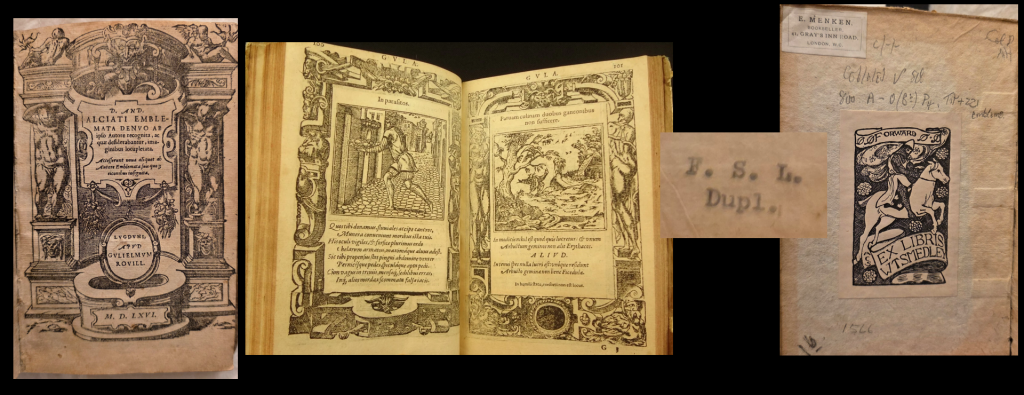
How can AI help museums better understand the provenance of the works in their collections? Last month we showcased how Gemini spotted and transcribed a handwritten dealer marginalia sales note in a 1539 Holbein Icones that led us to Maggs Bros who were generous enough to search their archives and send us photos of their original 1987 catalog entry for the book. Yesterday we showed how Gemini identified and tracked down two bookplates and a Folger Shakespeare Library deaccessioning stamp in a 1566 Alciato Emblemata (the origin of the emblems format) and used them to trace its history as part of the William Thomas Smedley collection that was sold to Henry Clay Folger as part of what became the Folger Shakespeare Library in 1924 and was deaccessioned and sold at auction by the Folger at Sotheby & Co in June 1964.
Gemini Deep Research identified that the book was sold at Sotheby & Co's June 22, 1964 sale, but was unable to track down further details. Folger Shakespeare Library Reference Librarian Erika Giddens was wonderful enough to track down the Sotheby & Co auction catalog for us and we now know that this copy was actually part of a set of five Emblemata editions sold as Lot #4 on the first day of the June 22, 1964 sale:
4 Alciatus (Andrea) Emblemata, printed within woodcut borders throughout, woodcut emblems, some headlines cropped, boards, bookplate of W. T. Smedley, Lyons, 1566; another edition, title within woodcut border, woodcut emblems, P₁ defective, boards, bookplate of W. T. Smedley, Antwerp, C. Plantin, 1577; another edition, title within woodcut border (cropped), woodcut emblems, calf, one cover detached, bookplate of R. C. A. Prior, id., 1580; another edition, woodcut emblems, G₇ lacking, contemporary calf gilt, a wreath of leaves in the centre of each cover, joints cracking [Antwerp], Ex Officina Plantiniana Raphelengii, 1608; another edition, woodcut emblems, some leaves badly wormed, stained, contemporary vellum, Lyons, 1614; sold not subject to return 8vo (5)
Most remarkably of all, from this auction catalog entry we were able to determine that the lot was sold to legendary antiquarian bookseller Marks & Co at 84 Charing Cross Road in London, the subject of the movie with Anthony Hopkins of the same name. Unfortunately, the store closed in December 1970 and the fate of its sales records are unknown. Worldwide digitized auction records show no further appearances at auction and the book appears to have remained in private ownership or trade until it was acquired last year.
Once again, we see the tremendous power and potential of AI as a cataloging assistant: Gemini entirely on its own with no human intervention scanned our cellphone photographs of the book's front and back inside pages, identified the bookplates and FSL deaccessioning stamp, researched and identified the date one of the former booksellers (E. Menken) moved locations in order to establish a "no later than" date of 1891 for their ownership of the work, and pointed us to the Folger Shakespeare Library who was generous enough to provide us the auction catalog information that in turn allowed us to trace another step in its 500-year journey!