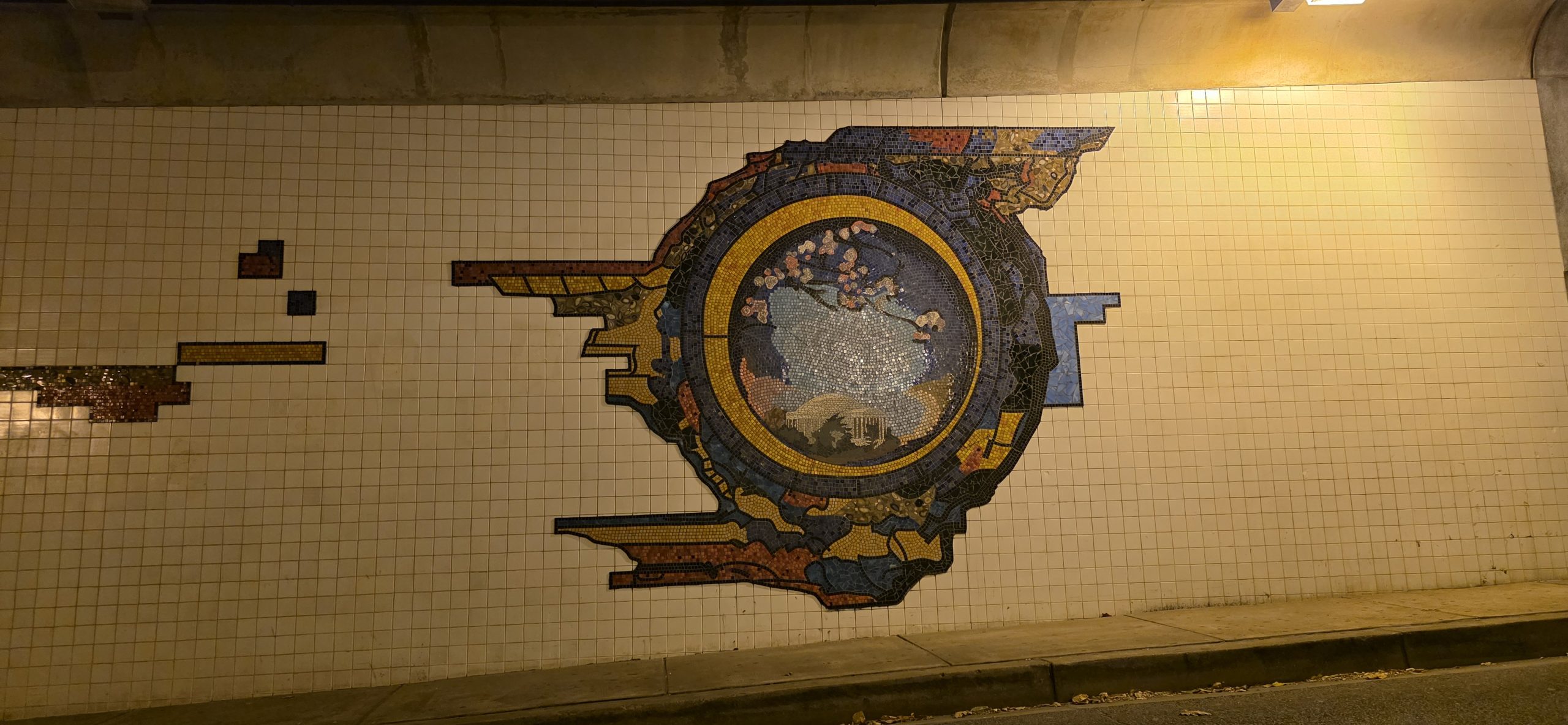
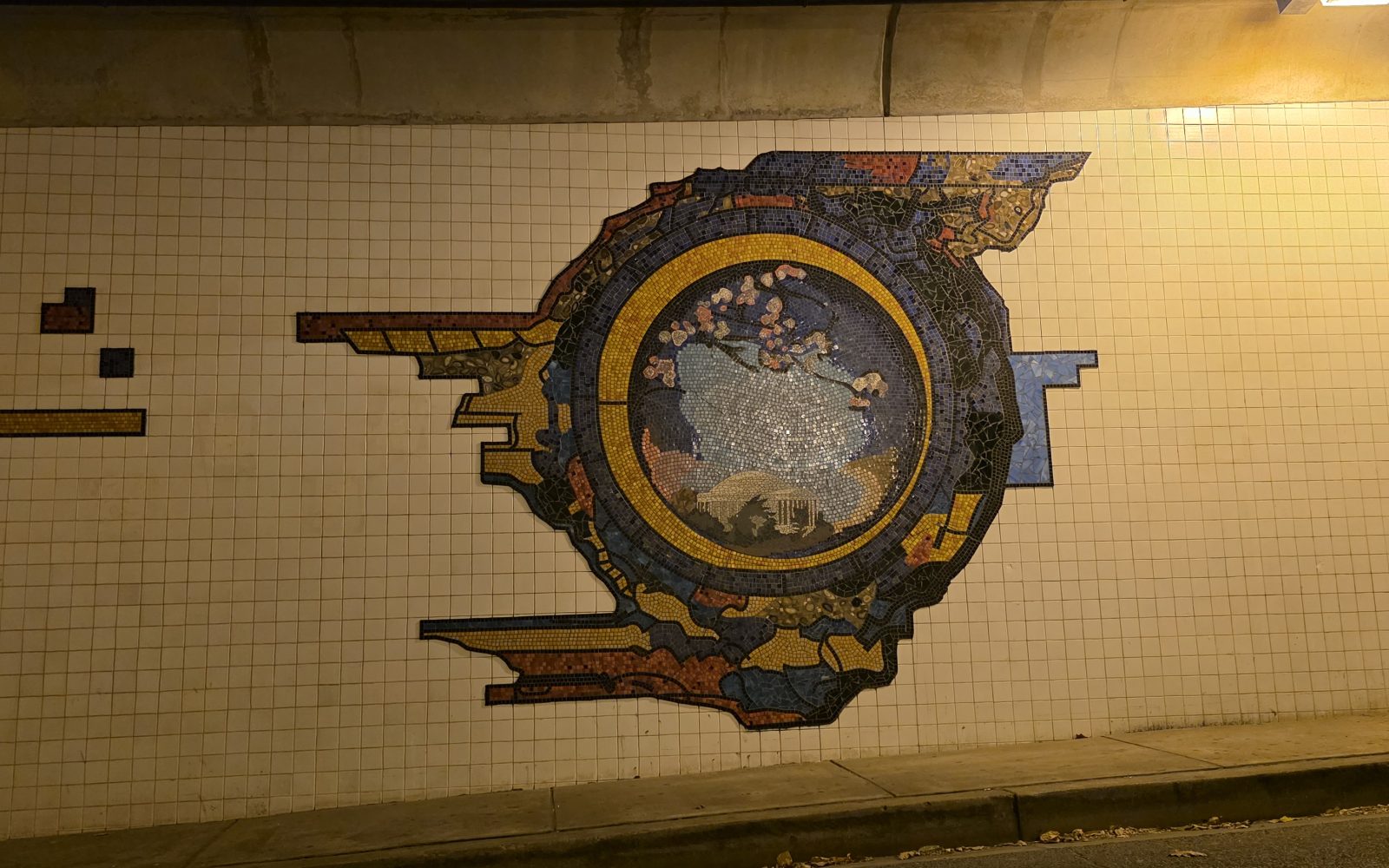
Riding home from an event last night here in DC, we spotted this striking tile mural adorning an underpass wall. We snapped a quick photo of it, but what is it, who did it and what does all of its symbolism mean? In the past, seeing a public roadway mural like this as you rode by meant enjoying its beauty for a few seconds, but never being able to learn more about it. In this case, we simply asked Gemini to tell us more about it as we continued our ride home.
Explain this in detail and its artistic symbolism.
When was it created and what's its name and artist?
This glass and ceramic tile medallion is part of Southwest Gateway, a public art installation created by Washington, D.C. muralist G. Byron Peck (in collaboration with students from Jefferson Junior High School) and completed in 2008. It is located inside the 12th Street SW tunnels passing beneath I-395 near Maine Avenue and the Southwest Waterfront in Washington, D.C.
Artwork Overview & Design The complete installation spans four 300-foot walls across the twin vehicular and pedestrian tunnels, embedding vibrant, serpentine bands and medallions of glass and ceramic tesserae directly into the preexisting white subway-tile walls of the underpass. In this specific section, a circular medallion framed in concentric rings of cobalt blue and bright gold acts as a porthole, surrounded by stepped, wing-like geometric extensions in terracotta, yellow, blue, and mirrored fragments that break out of the strict grid of the white tunnel tiles.
Artistic Symbolism & Visual Elements
-
The Tidal Basin Medallion: The central circular vignette depicts two of the most recognizable landmarks just outside the tunnel's exit: the neoclassical dome and portico of the Thomas Jefferson Memorial at the bottom, and overhanging branches of pink cherry blossoms at the top. Between them is a shimmering expanse of silver and mirrored tiles representing the Tidal Basin and Potomac River reflecting the sky and light.
-
A "Gateway" Porthole: Because the 12th Street tunnel serves as a primary conduit connecting the National Mall and the Tidal Basin to the Southwest Waterfront, the circular frame functions symbolically as a window or lens looking out onto the surrounding D.C. landscape.
-
Abstraction and Motion: Originally, Peck proposed realistic painted imagery for the tunnel, but the U.S. Commission of Fine Arts requested an approach that wouldn't distract passing motorists. Peck pivoted to mosaic abstraction, using dynamic, stepped horizontal lines and flowing ribbons of color that follow the grid of the tunnel tiles. These jagged, wing-like projections evoke speed, water currents, and the kinetic energy of commuters moving through the underpass.
-
Light in an Underground Space: The heavy use of iridescent, metallic, and mirrored glass tesserae at the center of the medallion is designed to catch the ambient yellow tunnel lighting and the headlights of passing cars, bringing a sense of daylight and shimmering water into an otherwise utilitarian concrete underpass.
find me a link that tells me more about it and shows the others
You can explore the other medallions, serpentine bands, and background details of the installation across these public art archives:
-
ArtAround: Southwest Gateway: Features a photo gallery of the other mosaic medallions and wall sections across the four 300-foot tunnel walls, along with an overview of how Byron Peck and local students created the piece.
-
Americans for the Arts: SW Gateway Database: Provides project details, commissioning history, budget ($285,000), and photography by John Woo showcasing the river themes and waterfront abstractions throughout the underpass.
-
DC Commission on the Arts and Humanities Mosaic Collection: Lists Southwest Gateway alongside G. Byron Peck's other public mosaics and murals across Washington, D.C. in the city's official eMuseum catalog.
-
The Washington Post: "The Mural of the Story": Profiles G. Byron Peck's career and explains the history behind the 12th Street SW tunnel project, including why the U.S. Commission of Fine Arts rejected his initial realist paintings in favor of non-distracting abstract mosaics for passing drivers.