
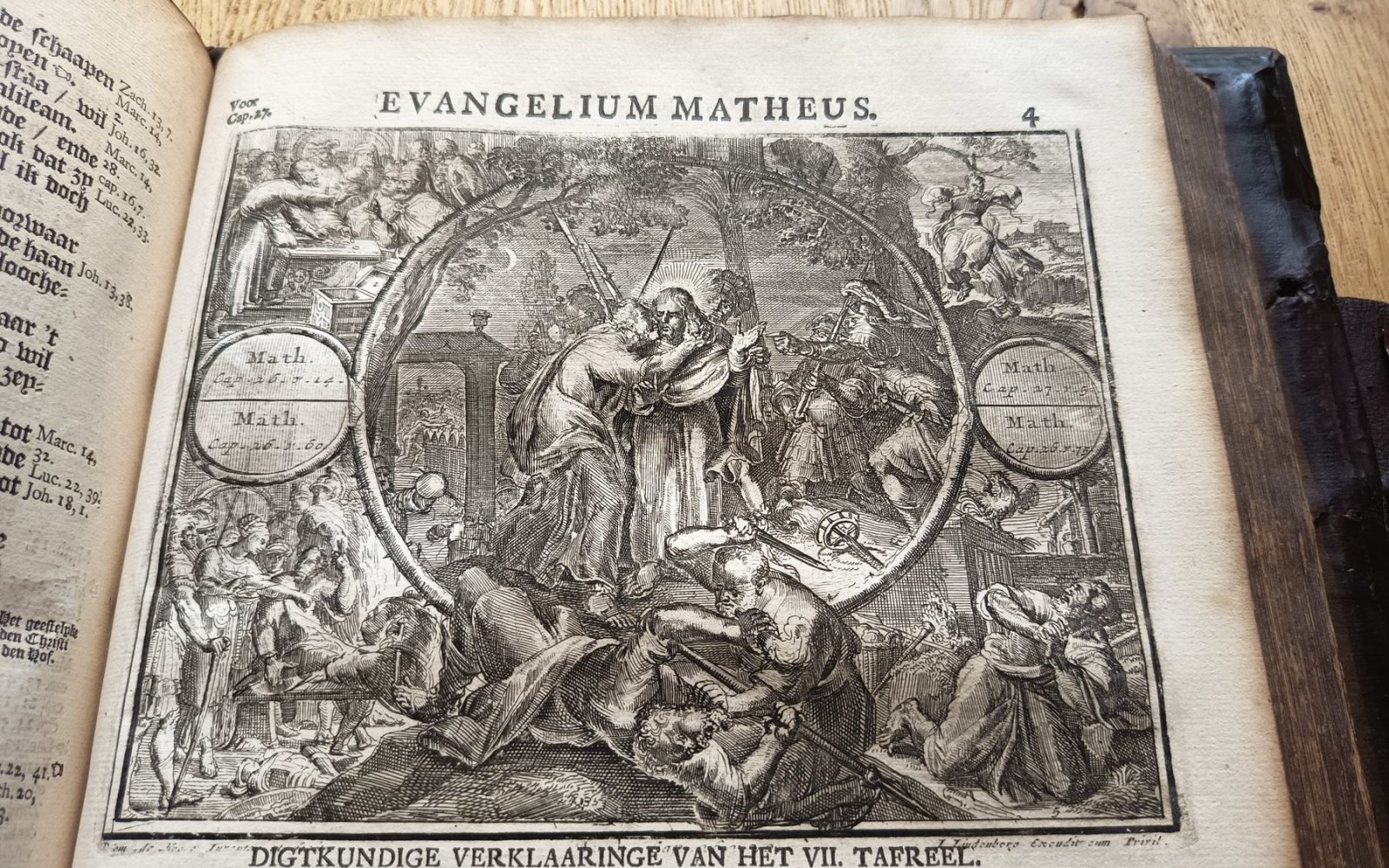
The Collection's 1702 Lindenberg Luther Bible, extra-illustrated with the Romeyn de Hooghe Biblical suite, contains 129 of his famed 136 Biblical engravings. The majority consist of unique five-scene views like the one below. Let's take a closer look at this engraving with Gemini and ask it to help us understand the five scenes and their individual and combined significance.
Let's see what Gemini makes of it:
Explain this image in detail.
Who drew it and what book is it from?
Help me understand the Biblical imagery.
Why are there five scenes?
Explain IN DETAIL the five scenes in the image.
Help me fully understand each of the FIVE scenes (center and four corners) and their significance indiviudally and together.
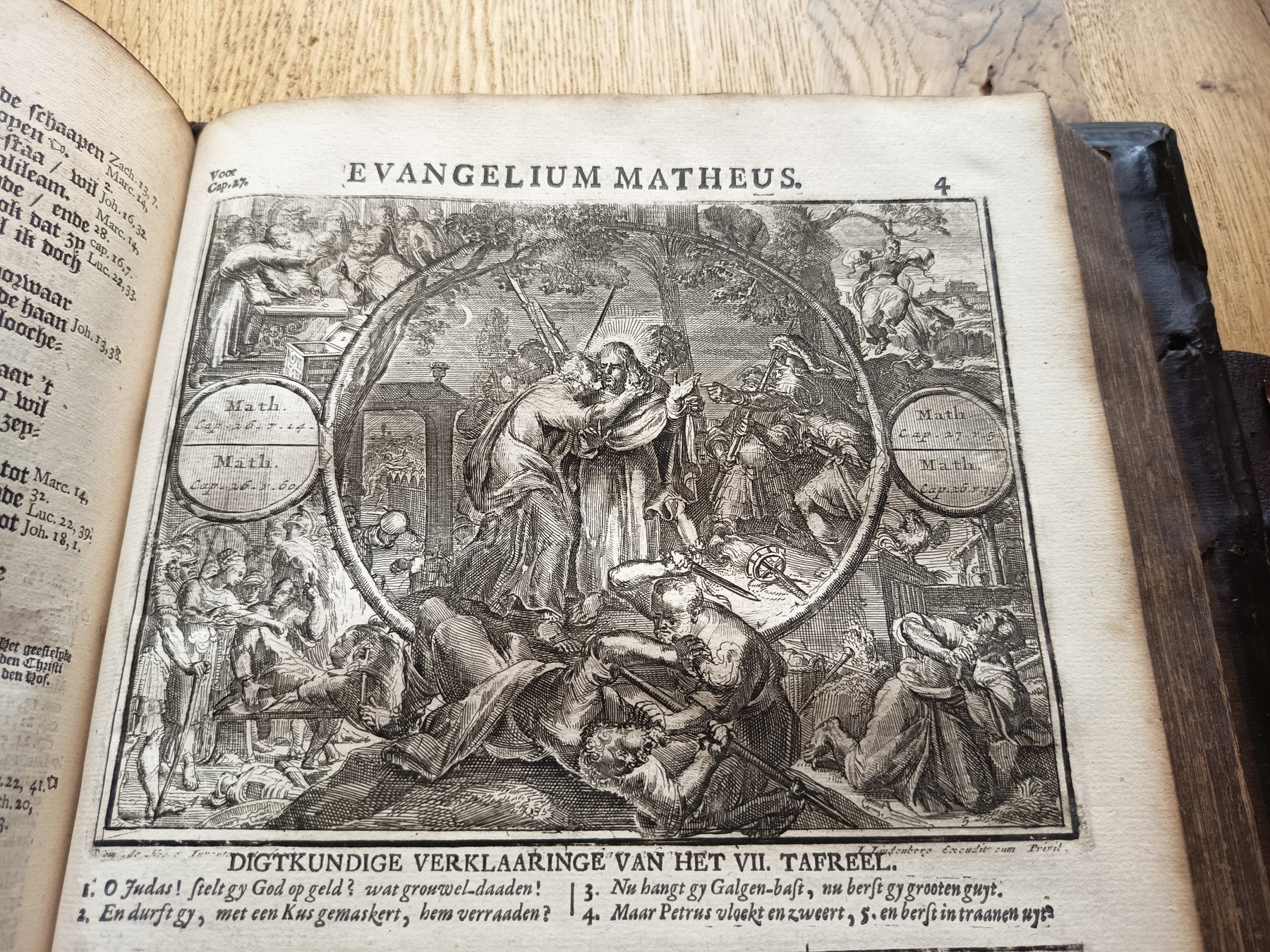
Artist and Origin The engraving was created by Romeyn de Hooghe (1645–1708), a prominent Dutch Golden Age printmaker and illustrator. This is confirmed by the very small text at the bottom left of the engraving which reads "Romeyn de Hooghe inv. et fec." (invented and made by Romeyn de Hooghe). The bottom right indicates it was published by J. Lindenberg ("J. Lindenberg Excudit cum Privil."). This illustration likely belongs to Lindenberg's heavily illustrated Bible histories from the early 1700s, designed to provide a rich, dramatic visual companion to scripture.
Why Five Scenes?
The artist utilizes a common Baroque engraving technique of combining a primary central event with related, sequential narrative vignettes in the corners. This allows the viewer to absorb an entire thematic arc—in this case, the Betrayal of Christ and the subsequent fates of the betrayers—on a single page. By contrasting Judas Iscariot and Simon Peter, the imagery explores themes of sin, remorse, despair, and repentance.
The Dutch poetic caption at the bottom ("DIGTKUNDIGE VERKLAARINGE VAN HET VII. TAFREEL.") directly references the numbered scenes to guide the reader through this narrative.
Detailed Breakdown of the Five Scenes
- Center Scene: The Betrayal and Arrest of Christ
-
Action: The large central focal point depicts Judas betraying Jesus in the Garden of Gethsemane with a kiss (Matthew 26:49). Jesus is surrounded by armed Roman soldiers and temple guards bearing torches and weapons.
-
Foreground Detail: At the very bottom of the central circle, the Apostle Peter is violently pinning down Malchus, the high priest's servant, and cutting off his ear with a sword to defend Jesus (John 18:10).
-
- Top Left (Scene 1): Judas Sells Out Christ
-
Action: A man (Judas) is seen negotiating and receiving coins at a table from the chief priests.
-
Significance: The adjacent medallion cites "Math. Cap. 26. v. 14.", which is the moment Judas agrees to betray Jesus for thirty pieces of silver. The Dutch caption reads: "O Judas! stelt gy God op geld? wat grouwel-daaden!" (Oh Judas! Do you put a price on God? what abominable deeds!).
-
- Top Right (Scene 3): The Suicide of Judas
-
Action: A gruesome depiction of Judas hanging from a tree, with his body bursting open and his entrails spilling out.
-
Significance: This combines Matthew 27:5 (Judas hanging himself) and Acts 1:18 (his body bursting open). The medallion cites "Math. Cap. 27. v. 5.". The caption notes: "Nu hangt gy Galgen-bast, nu berst gy grooten guyt." (Now you hang, gallows-bird, now you burst, great rogue). It represents ultimate despair and damnation.
-
- Bottom Left (Scene 4): Peter's Denial
-
Action: Peter is seated near a fire in the courtyard of the high priest, conversing with others and gesturing defensively.
-
Significance: The medallion cites "Math. Cap. 26. v. 69" (or similar), marking the moment Peter is accused of being with Jesus and denies knowing him. The caption begins: "Maar Petrus vloekt en zweert…" (But Peter curses and swears…).
-
- Bottom Right (Scene 5): Peter's Repentance
-
Action: Peter is shown alone on his knees, hands clasped, weeping bitterly while looking upward.
-
Significance: The adjacent text cites "Math. Cap. 26. v. 75", the moment Peter remembers Jesus's prophecy about the rooster crowing and weeps. The caption concludes: "…5. en berst in traanen uyt" (and bursts into tears).
-
Overall Significance
Together, these scenes form a powerful theological contrast. Both Judas and Peter committed grave sins against Jesus on the night of his arrest (betrayal and denial, respectively). However, the imagery highlights their divergent paths afterward: Judas’s guilt leads to fatalistic despair and a grisly suicide (top right), whereas Peter’s guilt leads to true contrition, weeping, and ultimate spiritual redemption (bottom right).