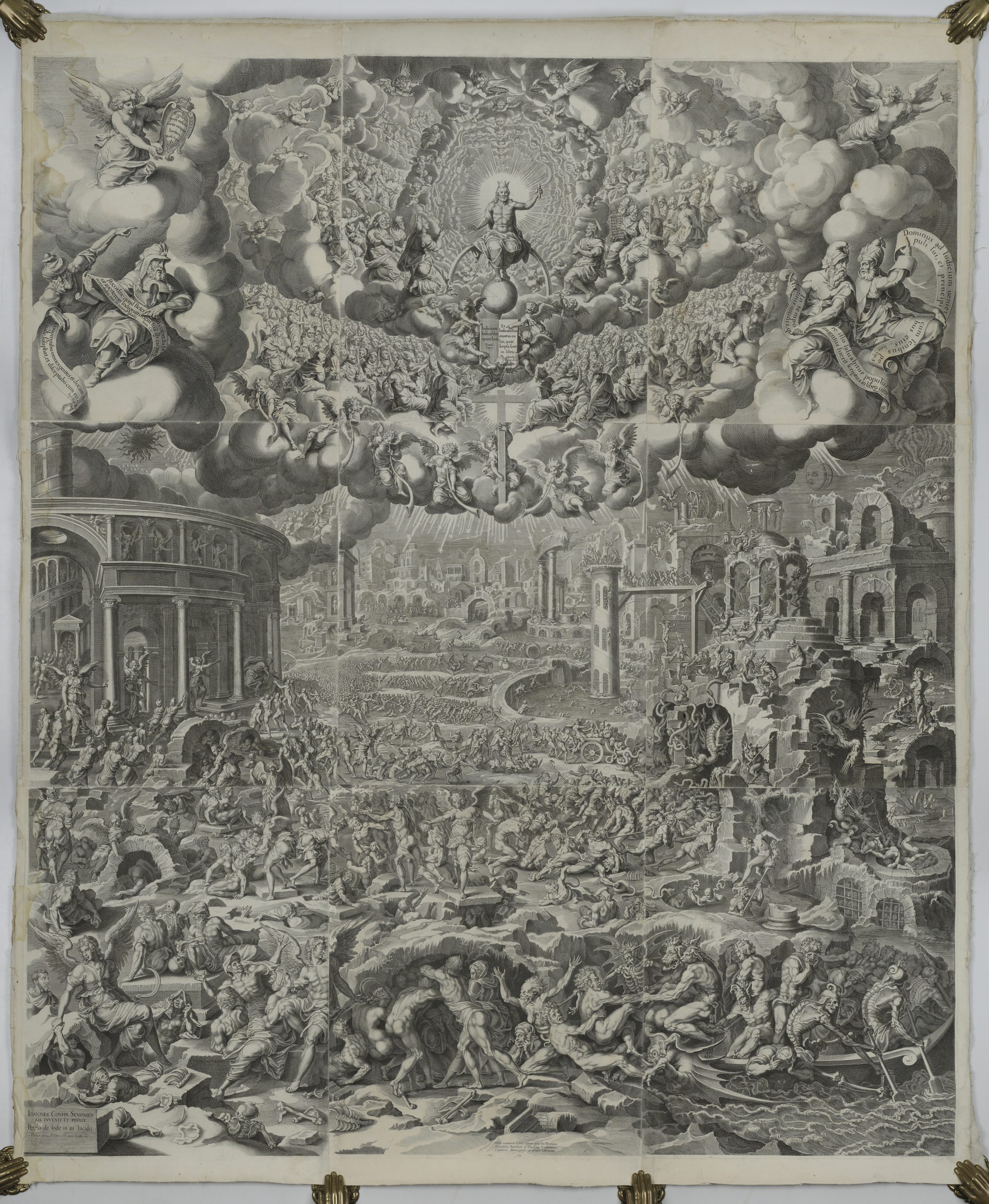
The New Hollstein series on the De Jode family is perhaps the definitive reference work on their engravings, with the Hollstein and New Hollstein state numbers being the standard cited in collections, auctions and sales. Much as we've used Gemini in the past to read map state tables to determine which edition of a given map we hold, could we do the same for a monumental Biblical engraving? Here we ask Gemini 4 to determine which edition of Pieter de Jode's Last Judgement engraving we hold by giving it a photo of the engraving and two cellphone photos of the New Hollstein state table for the engraving. It turns out Gemini does a perfect job, even citing all of the distinguishing details it used in its determination!
State tables for engravings are typically lengthy lists of known variants, each with a detailed list of the characteristics that both define it and distinguish it from the other variants of that engraving. For example, this is the entry for State II of Jode's Last Judgement:
State II: Dedication by Guillaume Wittenbroot to Louis XIII in seven lines of Latin added in rectangle at bottom right, waves visibly removed: D. LVDOVICO XIII. | GALLIÆ ET NAVAR. REGI CHRISTIANISS. | CATHOL. RELIG. PROPVGNATORI ACERR. | OMNIVMQ. ARTIVM ADMIRATORI EXIMIO | HOC VNIVERSALIS IVDICII PARADIGMA | GVLIELMVS WITTENBROOT BELGA | LIBENS MERITO DICAT CONSECRATQVE. Censorship approval by Laurens Beyerlinck in three lines of Latin added at bottom centre: Vidit, examinauit, et prælo dignum censuit hoc Paradigma | Laurentius Beyerlinck S. Theologiæ Licentiatus, | Canonicus Antuerpiensis; et Censor Librorum. This text removed from Latin and French text plates.
Let's see if Gemini can read through the four states New Hollstein defines for the engraving and determine which version ours is:
Using the attached list of states, which state is this specific engraving?
It is missing the title plates so you have to determine only from the engraving itself.
Explain your reasoning in detail.
Based on the catalogue descriptions provided, this specific engraving is State IV.
Even with the three separate lower text/title plates missing, you can definitively determine that this impression is State IV by examining four key diagnostic areas on the nine assembled image plates themselves:
1. Bottom Left Slab: Publisher Address and Decorative Pattern
-
-
What the catalogue states: In States I–III, the stone slab in the bottom-left corner contains the signatures of Jean Cousin the Younger and Pieter de Jode I, followed by the Antwerp address of the original publisher, Guillaume Wittenbroot, and the date 1615 (Giul.' Wittenbroot | Euulgauit Antuerpi[a]e | M.DC.XV.). In State IV, the catalogue notes: "At bottom left address and date removed and replaced by: a Paris chez P. Drevet aux Galleries. Decorative pattern added on front of slab".
-
What is visible in the engraving: Looking closely at the slab in the bottom-left corner:
-
The upper lines still read
IOANNES COVSIN SENONIEN / SIS INVENIT ET PINXIT. / Petrus de Iode in æs Incidit. -
Directly beneath Pieter de Jode's signature, Wittenbroot's multi-line address and the date
M.DC.XV.are gone, replaced by the single line of script:a Paris chez P. Drevet aux Galleries. -
Because Drevet's single-line address occupies less vertical space than Wittenbroot's original address and date, a horizontal band of decorative scrollwork/ornament has been engraved along the lower front face of the slab beneath the text.
-
-
2. Bottom Right Corner: Dedication Removed and Replaced by Waves
-
-
What the catalogue states:
-
In State I, the bottom-right corner depicted water/waves.
-
In State II (and carried over into State III), those waves were visibly removed to insert a rectangular box containing a seven-line Latin dedication by Guillaume Wittenbroot to Louis XIII (D. LVDOVICO XIII…).
-
In State IV, the catalogue specifies: "Dedication at bottom right removed and replaced by pattern of waves".
-
-
What is visible in the engraving: In the bottom-right corner below Charon's boat of skeletons and demons, there is no white rectangular dedication box. Instead, the corner is completely filled with an engraved pattern of waves. If you look closely at the water in the very bottom-right corner, you can even faintly discern the rectangular patch where the State II/III dedication was burnished out of the copperplate and re-hatched with wave lines.
-
3. Bottom Centre Margin: Laurens Beyerlinck Censorship Inscription
-
-
What the catalogue states: In State I, the censorship approval by Laurens Beyerlinck appeared only on the separate Latin and French text plates below the image. In State II, this three-line Latin censorship approval (Vidit, examinauit, et prælo dignum censuit hoc Paradigma | Laurentius Beyerlinck S. Theologiæ Licentiatus, | Canonicus Antuerpiensis; et Censor Librorum.) was added directly onto the bottom-center image plate, where it remained in subsequent states.
-
What is visible in the engraving: At the very bottom center of the middle-lower plate (in the light area of the ground between the two central bottom brass clips), the three lines of Beyerlinck's Latin censorship approval are clearly present. Even if one glanced only at the waves in the bottom-right corner, the presence of this three-line inscription at the bottom center immediately rules out State I.
-
4. Overall Reworking of the Plates
-
-
What the catalogue states: For State IV, the catalogue notes that the "Plate [was] reworked throughout" and cites Mariette's observation that the plates were reworked by Drevet "to make the dark parts stand out more".
-
What is visible in the engraving: The heavy, reinforced cross-hatching and pronounced dark tonal contrasts—particularly in the clouds surrounding Christ in Glory, the architecture, and the subterranean hell scenes at the bottom—reflect Drevet's late reworking of the copperplates.
-
Summary of How Each Alternative Is Ruled Out
-
-
Not State I: State I lacks the three-line Beyerlinck censorship text at the bottom center of the image plate, and its bottom-left slab features Wittenbroot's 1615 Antwerp address without the decorative band along the lower edge of the slab.
-
Not State II or State III: (Note: Without the separate title/text plates, States II and III are identical on the nine image plates, because State III only added Le Blond's Paris address to the central text plate.) Both States II and III have the seven-line rectangular dedication to Louis XIII in the bottom-right corner and Wittenbroot's 1615 address on the bottom-left slab, whereas this impression has waves at the bottom right and Drevet's address with the decorative pattern on the bottom-left slab.
-
Not the Frederick de Wit Copy: The nine-plate copy by Frederick de Wit has De Wit's Amsterdam address at the bottom left (Amstelodami | FREDERICUS DE WIT | excudebat), a seven-line dedication to Louis XIV (D. LVDOVICO XIIII…) in a rectangle at the bottom right, and plate numbers 1–9 in the bottom-right margins—none of which appear on this engraving.
-