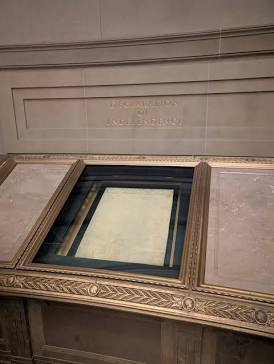
In processing our new 1926 Department of Interior Declaration of Independence pamphlet recently, we were struck by the image on the inside front cover of the Declaration of Independence being displayed in a permanent shrine in the Library of Congress – a piece of its history that few Americans likely know and for which there is not even a prominent historical marker in the Library today. This got us wondering about where else it has been on display over the years and what they looked like. We asked Gemini to quickly come up with the photo timeline below.
make me a photo/engraving timeline of how the original US Declaration of Independence has been displayed over the years.
Make it in chronological order and for each year/period, include a brief paragraph and an image of an
engraving or photo showing that display
We also asked Gemini Deep Research to produce a chronology using the same prompt, but its version lacked images:
The engrossed and signed parchment of the United States Declaration of Independence—written by Timothy Matlack in July and August 1776—survived decades of being rolled up in linen sacks, exposed to harsh sunlight, and carried around in mail trucks before reaching its modern protective encasement. Its display history traces the evolution of American archival preservation from informal 19th-century exhibitions to state-of-the-art conservation.
1776–1841: The Nomadic Years & the Stone Facsimile
During its first 65 years, the original parchment was rarely on formal public display. Kept as an administrative record by the Continental Congress and later the Department of State, it was frequently rolled and unrolled as it traveled between cities during the Revolutionary War and fled British troops in a coarse linen sack during the War of 1812. By 1820, the ink was already deteriorating from handling and rolling. Secretary of State John Quincy Adams commissioned engraver William J. Stone to create a full-size copperplate facsimile—completed in 1823—to satisfy public curiosity and shield the original parchment from constant handling in the State Department offices.
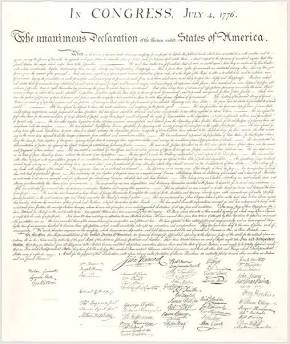
1823 Stone facsimile engraving. Source: National Archives
1841–1876: The U.S. Patent Office Display
In June 1841, Secretary of State Daniel Webster transferred the Declaration to the newly completed U.S. Patent Office building (now the Smithsonian's National Portrait Gallery) for its first long-term public exhibition. Mounted inside a single white-painted wooden frame alongside George Washington's commission as Commander-in-Chief, the parchment hung in the grand upper hall directly opposite a large south-facing window. For 35 years, baked by direct sunlight and fluctuating room temperatures, the iron gall ink faded dramatically until many of the signatures became nearly illegible.
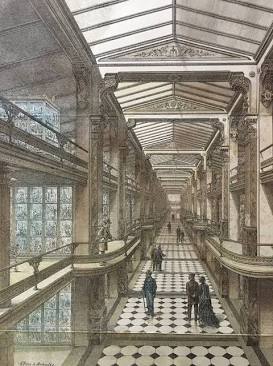
U.S. Patent Office Hall (1841–1876). Source: St. Croix Architecture
1876–1894: The Centennial & the State Department Library
After a brief return to Independence Hall in Philadelphia for the 1876 Centennial Exposition—where visitors expressed alarm at its faded state—the parchment was brought back to Washington in 1877 and placed on display in the Library of the State, War, and Navy Building (now the Eisenhower Executive Office Building). Although the building featured fireproof cast-iron architecture, the document remained exposed to ambient light and wood-smoke air until 1894, when the State Department finally removed it from public view, sealed it between two plates of glass, and locked it in a dark steel safe.
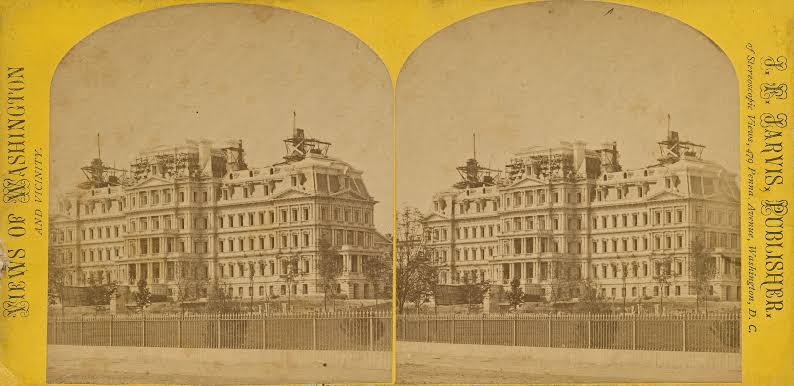
State, War, and Navy Building (1877–1894). Source: Ghosts of DC
1924–1941: The "Shrine" at the Library of Congress
In 1921, President Warren G. Harding ordered the Declaration transferred to the Library of Congress, where it arrived cushioned on a pile of leather mail sacks in a Library mail truck. In February 1924, President Calvin Coolidge dedicated a permanent marble "Shrine" on the second floor of the Library's Thomas Jefferson Building. Designed by architect Francis H. Bacon, the display encased the Declaration behind double panes of yellow-tinted celluloid film designed to filter out damaging ultraviolet rays while armed guards stood watch.
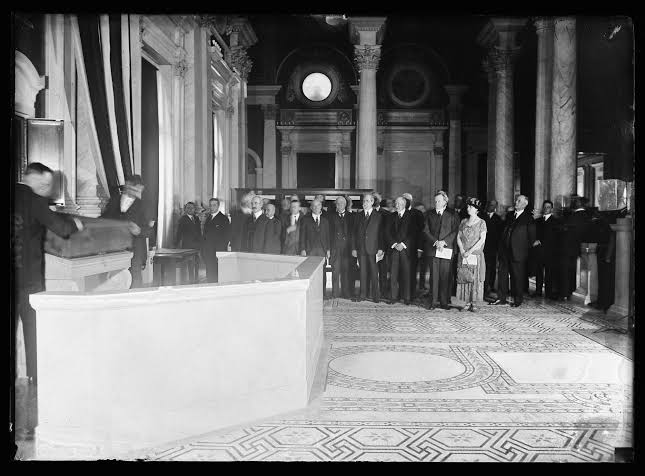
Library of Congress Shrine (1924). Source: Ghosts of DC
1941–1944: Wartime Evacuation & Inspection at Fort Knox
Weeks after the attack on Pearl Harbor in December 1941, the Declaration and the Constitution were packed into a bronze container totaling 150 pounds and transported via Pullman sleeper car under Secret Service guard to the U.S. Bullion Depository at Fort Knox, Kentucky. While hidden away in the subterranean vault in 1942, conservators from the Fogg Museum temporarily removed the parchment from its enclosure to mend tears in the upper-right corner and document its physical condition before returning it to the Library of Congress Shrine in October 1944.
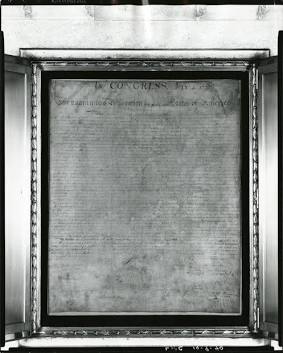
Conservation inspection at Fort Knox (1942). Source: National Archives
1951–1952: Helium Encasement & the National Archives Shrine
To prepare the Charters of Freedom for their permanent home in the National Archives Rotunda, the National Bureau of Standards sealed the Declaration in 1951 inside a thermopane glass enclosure filled with humidified, inert helium gas to prevent oxidation and microbial growth. On December 15, 1952, the documents were formally enshrined in the National Archives Rotunda. The Declaration was mounted upright in an ornate marble-and-bronze altar above the Constitution, fitted with a motorized scissor-jack mechanism that lowered the cases 22 feet into a bombproof steel-and-concrete vault every night.
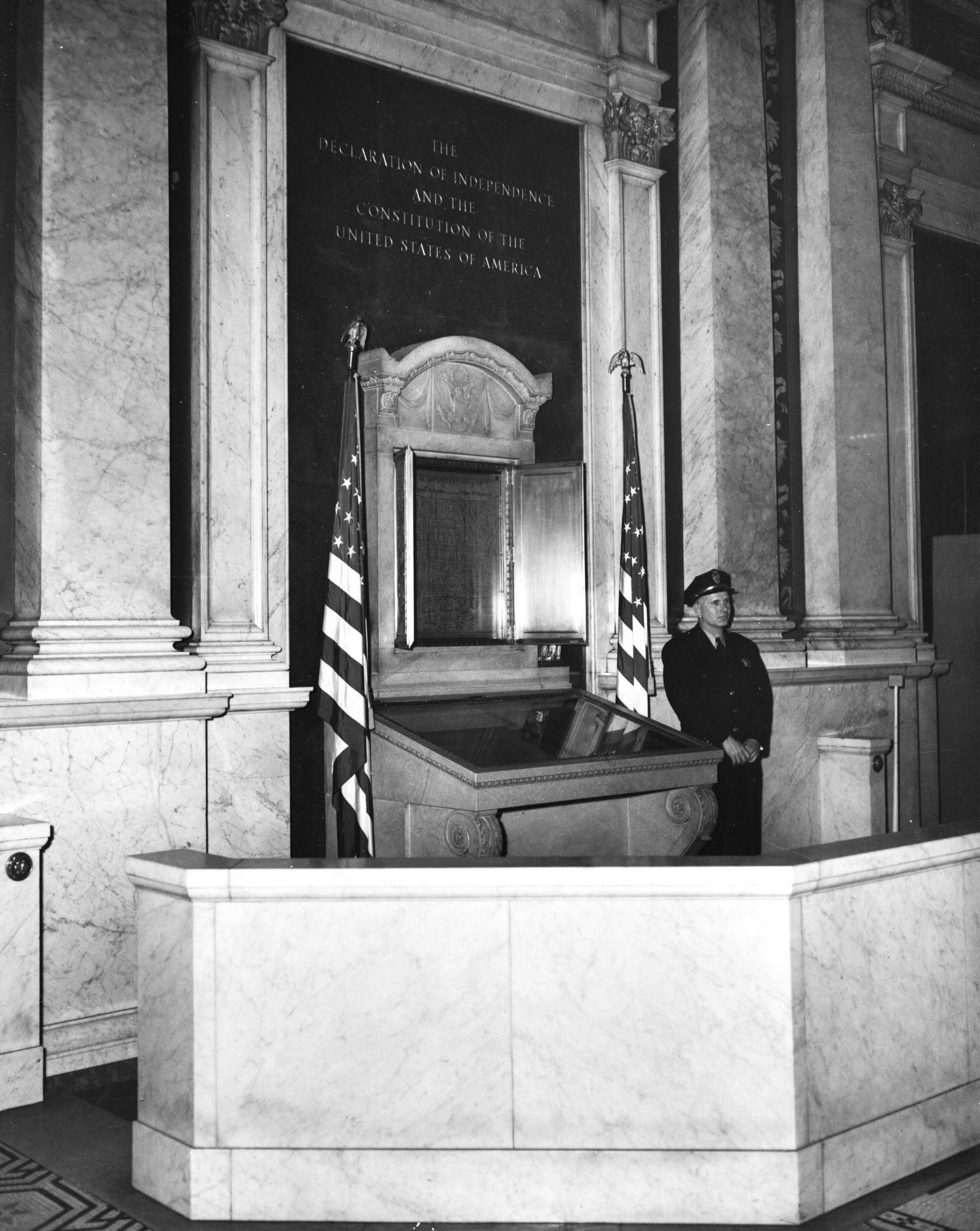
The Declaration of Independence and Constitution were moved from the Library of Congress to the National Archives on Dec 13, 1952. – guard at shrine. (Photo by: HUM Images/Universal Images Group via Getty Images)
2003–Present: Titanium-Argon Encasements in the Remodeled Rotunda
In 2001, the Declaration was removed from its 1951 helium case for comprehensive conservation treatment after tiny crystals were observed forming in the old glass. Rather than displaying the Declaration vertically—which placed gravitational stress on the parchment—the remodeled Rotunda that opened in September 2003 displays the Declaration at a gentle angle in a low, accessible platform. The parchment now rests on handmade cellulose paper inside a gold-plated titanium and aluminum frame filled with humidified argon gas, monitored continuously by laser-based optical sensors.