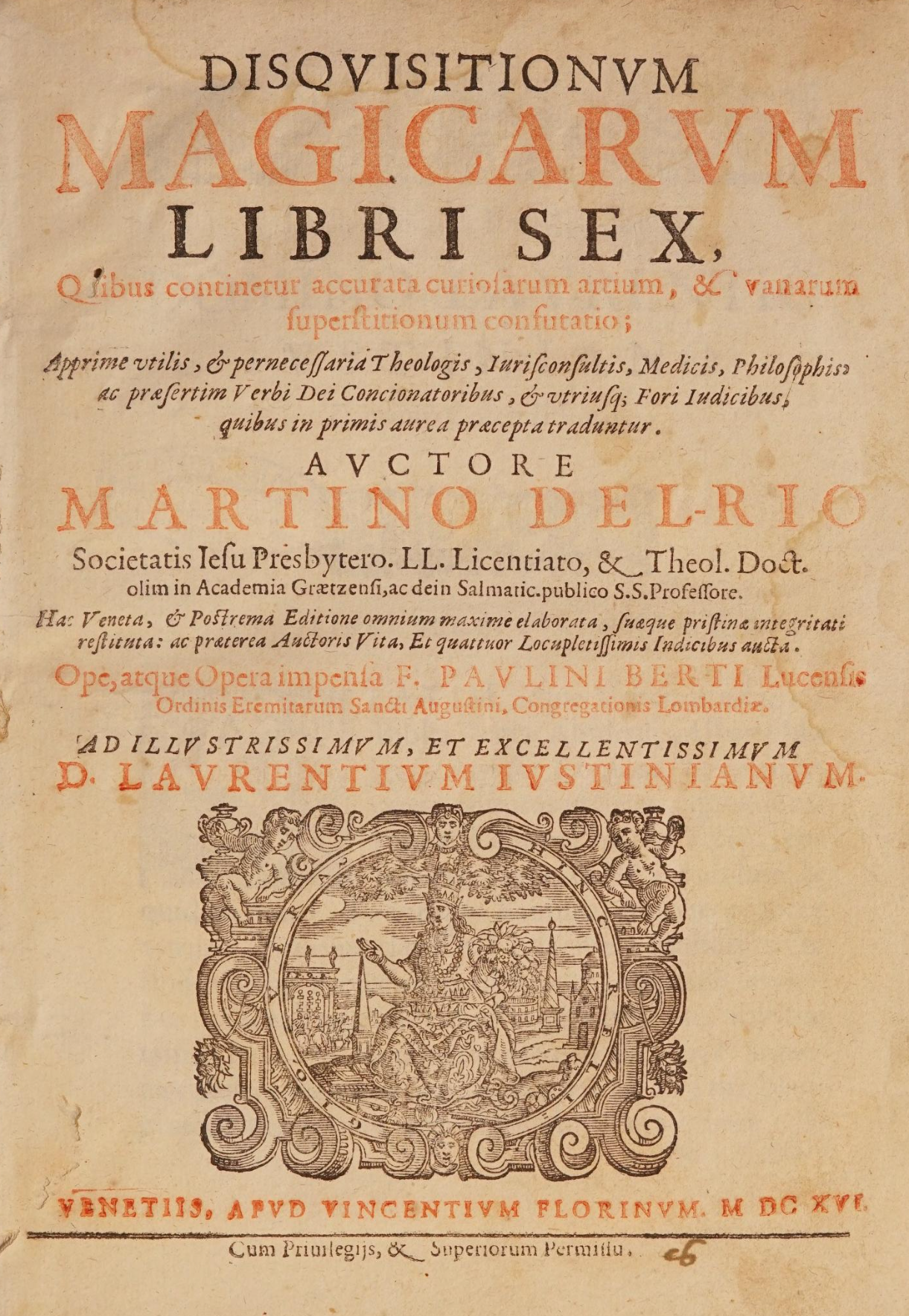
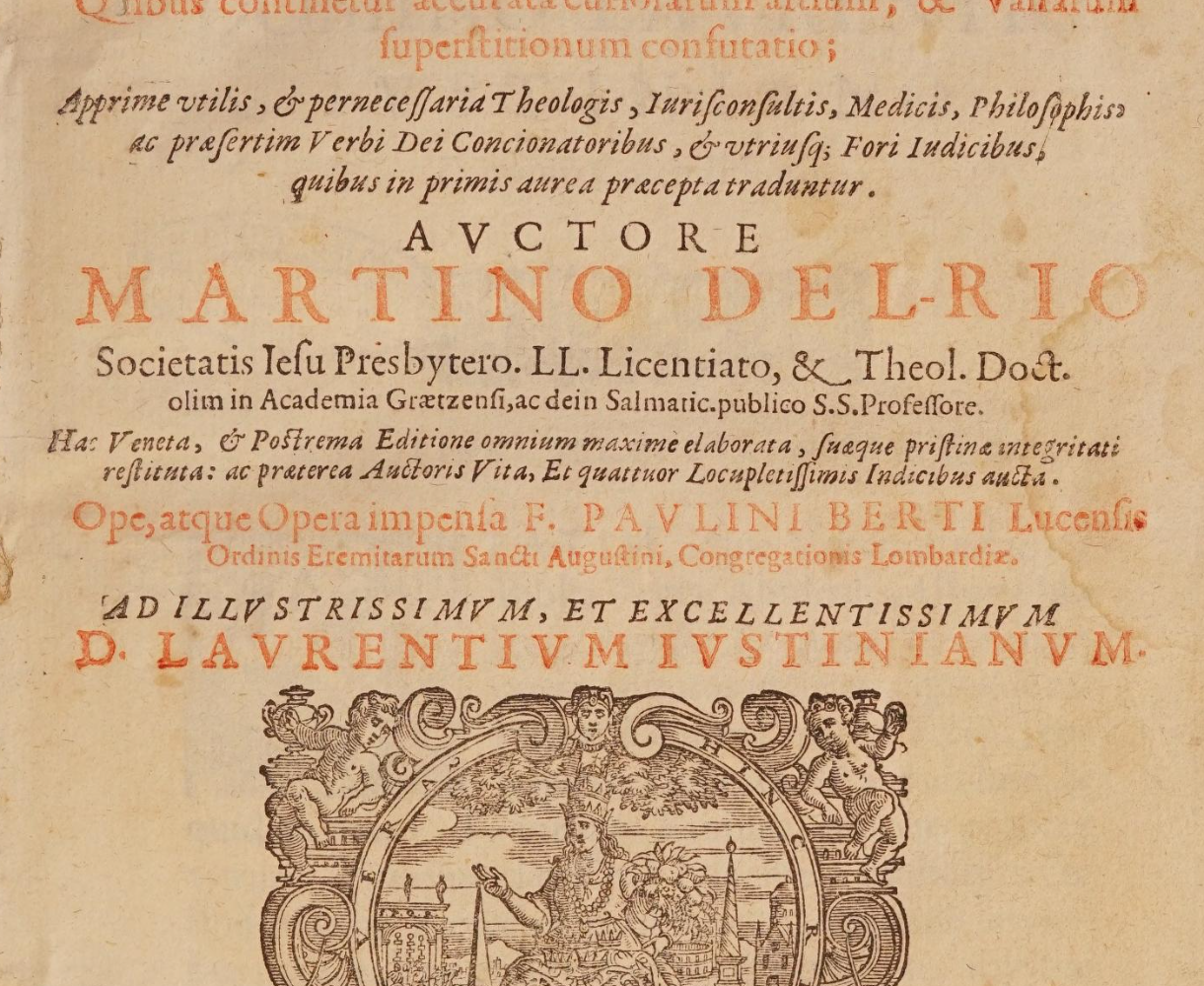
The most central and important task in all accession cataloging workflows is identifying the work(s) at hand. In our case, some of our earliest and rarest works predated or were never printed with title pages, others are missing their title pages, many are extra-illustrated with separate illustration and/or map suites, include selections from other works or are sammelbands, composed or multiple works bound together. Continuing our new collection-scale analysis workflow built on Gemini Carbon, we've added a new module that performs a page-by-page analysis of an entire digitized book and identifies every distinct work it can find, instantly identifying hidden sammelbands and known extra-illustrated suites. Here we examine a 1616 printing of Delrio's Disquisitionum Magicarum. We also ask Gemini to construct a formal citation for the work and provide a brief description and overview of its general significance. Most importantly of all, we ask Gemini to perform a complete collation of the work and, if a complete collation is known for this work, Gemini compares the collation of this work against the official complete collation to identify any missing pages or binding or digitization anomalies. The fully automated visual collation and completeness analysis alone is absolutely transformative.
Below is the raw JSON output of the model:
{
  "work_index": 1,
  "unit_type": "complete_or_primary_monograph",
  "pdf_page_start": 9,
  "pdf_page_end": 1082,
  "pdf_page_list_if_discontinuous": null,
  "title": "Disquisitionum magicarum libri sex, quibus continetur accurata curiosarum artium, & vanarum superstitionum confutatio; apprime utilis, & pernecessaria theologis, iurisconsultis, medicis, philosophis: ac praesertim Verbi Dei concionatoribus, & utriusq; fori iudicibus, quibus in primis aurea praecepta traduntur. Hac Veneta, & postrema editione omnium maxime elaborata, suaeque pristinae integritati restituta: ac praeterea auctoris vita, et quatuor locupletissimis indicibus aucta",
  "author_or_creator": "Del Rio, Martin Anton, S.J. (1551–1608); edited by Paolino Berti da Lucca, O.E.S.A. (fl. 1600–1621); proof-corrected in part by Girolamo Canini d'Anghiari (1551–1631)",
  "publisher_or_printer": "Vincentius Florinus (Vincenzo Fiorina)",
  "place_of_publication": "Venice (Venetiis)",
  "date_of_publication": "1616",
  "format_and_dimensions_note": "Quarto in 4s and 8s (4to); main text and indices printed in double columns.",
  "parent_work_if_extract_or_plates": null,
  "collation_formula": "4to: a–b⁴ c⁴(-c1) A–H⁴ I–Z⁸ Aa–Hhh⁸ Iii⁴, ²A–O⁸ ²P–R⁴ ($1–2 signed in 4-leaf gatherings, $1–4 signed in 8-leaf gatherings; KK signed with two capitals; ²D4 missigned 'E 4'; ²R4 blank). 539 leaves present (of 540): pp. [22] (of [24]), 1–289, 288–349, 400–856 [i.e. 808], 1–143, [105] (misprinting 239 as 229, 547 as 546, 549 as 542, 592 as 586, 689 as 690, 704 as 700, 769 as 779, and 847 as 845; repeating numbers 288–289 on Z1v–Z2r and omitting numbers 350–399 between Cc8r and Cc8v without loss of text).",
  "completeness_assessment": "Physically lacks one preliminary leaf, c1 (between b4v [PDF 24, concluding the Pindaric ode of Tertius Boullius] and c2r [PDF 25, beginning the 'Proloquium']), which was either excised or cancelled—likely having contained an earlier dedicatory epistle superseded by Paolino Berti's new 1616 dedication on a2, a privilege/imprimatur, or a blank; otherwise physically complete in all text and index gatherings, including the final integral blank leaf ²R4 (PDF 1081–1082; PDF 1–8 and 1083–1084 comprise the binding, edges, and endpapers). Three digitization omissions and one duplicate scan occur in the digital surrogate where physical leaves remain intact in the binding: (1) opening V7v–V8r (pp. 254–255, between PDF 283 [V7r, p. 253] and PDF 284 [V8v, p. 256]) was skipped during imaging; (2) opening X2v–X3r (pp. 260–261) was photographed twice (PDF 288–289 and PDF 290–291); (3) opening Z3v–Z4r (numbered pp. 292–293, including signature mark 'Z 4', between PDF 323 [Z3r, p. 291] and PDF 324 [Z4v, p. 294]) was skipped during imaging; and (4) opening ²M5v–M6r (unnumbered leaves in the 'Summaria Brevia' covering the end of Book IV and beginning of Book V, between PDF 1021 [²M5r] and PDF 1022 [²M6v]) was skipped during imaging.",
  "formal_citation": "Del Rio, Martin Anton. Disquisitionum magicarum libri sex, quibus continetur accurata curiosarum artium, & vanarum superstitionum confutatio ... Hac Veneta, & postrema editione omnium maxime elaborata, suaeque pristinae integritati restituta: ac praeterea auctoris vita, et quatuor locupletissimis indicibus aucta. Edited by Paolino Berti. Venice: Apud Vincentium Florinum, 1616. Reference: Sommervogel, Bibliothèque de la Compagnie de Jésus, II, col. 1899, no. 9.",
  "description": "An augmented Venetian quarto edition of Martin Del Rio's comprehensive six-book treatise on magic, demonology, divination, witchcraft, judicial procedure, and confessional practice, prepared for the press of Vincenzo Fiorina (Vincentius Florinus) by the Lucchese Augustinian friar Paolino Berti and dedicated to the Venetian patrician Lorenzo Giustiniani. The volume is organized into two distinct bibliographic registers within a single publishing unit. The preliminaries (gatherings a–c) contain Berti's 1616 dedicatory epistle, an anonymous biographical and bibliographical notice ('Vita, & Scripta Auctoris', condensed from Heribert Rosweyde's 1609 Antwerp biography), a synopsis of the six books, Greek and Latin commendatory poems by Justus Lipsius, Heribert Rosweyde, Frédéric Jamot, Joannes Gauda, Claude Dausque, Carolus Goossinus, and Tertius Boullius, and Del Rio's general 'Proloquium'. The first text sequence (A–Iii, numbered pp. 1–856 but comprising 808 true pages owing to the repetition of pp. 288–289 and a fifty-number pagination leap from 349 to 400 on Cc8v) encompasses Books I through V, concluding with two substantial appendices to Book V: excerpts from Petrus Oranus, Florimond de Raemond, and the recantation of Cornelius Loos (Appendix I), and Del Rio's forty-one responses to a Bavarian prince regarding witch-trial procedure as revised at Salamanca in July 1604 (Appendix II).\n\nThe second signature alphabet (²A–R) opens with a separate pagination sequence (pp. 1–143) for Book VI ('De officio confessarii'), concluding on ²I8v with Del Rio's formal submission of his work to Roman Catholic orthodoxy and a notable press-corrector's statement recording that Girolamo Canini ('Hieronymus Caninius') corrected a large portion of the text not at the press, but on proof sheets brought to his home ('non ad Typos, sed in schedulis ad se domum allatis'). Without interruption in the second signature alphabet, gatherings ²K–R supply the four apparatus sections announced on the title page: 'Summaria brevia' of all chapters, sections, and questions across Books I–VI (²K1r–²N7r); an alphabetical 'Elenchus auctorum' listing orthodox and heterodox authorities cited (²N7v–²O1v); an 'Elenchus locorum omnium Sacrae Scripturae' (²O2r–²O8v); and the 'Index generalis rerum, et verborum' (²P1r–²R3v), whose headnote explicitly instructs the reader that references to Book VI correspond to its separate pagination.\n\nThis copy is preserved in contemporary limp vellum with the manuscript title 'Del Rio.' lettered at the head of the spine. Early manuscript ownership inscriptions appear on the front free endpaper recto, handwritten foliation numbers ('24'–'35') are added in the upper margins of gatherings ²N–O, an institutional ink stamp ('BIBLIOTECA SALOMONE NICOSIA') appears at the foot of ²R3v, and an early shelfmark ('C : 3 / N : 2') is inscribed on the verso of the final blank leaf ²R4.",
  "importance": "First published in three volumes at Louvain between 1599 and 1600, Martin Del Rio's Disquisitiones magicae rapidly became the most learned and widely consulted Catholic encyclopedia of occult phenomena and witch-prosecution theory in seventeenth-century Europe, largely superseding the late-medieval Malleus maleficarum among Counter-Reformation theologians and magistrates. Drawing on his dual training in civil and canon law and in Jesuit scholastic theology, as well as humanistic philology cultivated alongside his friend Justus Lipsius, Del Rio systematically categorized occult operations across six books: natural and artificial magic (Book I, featuring an extensive disputation on the physical possibility and moral legality of metallic transmutation in alchemy), demonic magic and the diabolical pact (Book II), harmful sorcery or maleficium and vain superstitions (Book III), divine prophecy versuslicit conjecture and illicit divination (Book IV), inquisitorial and secular criminal procedure (Book V), and the pastoral and medicinal duties of confessors, including defenses of Catholic sacramentals and exorcisms against Protestant critics (Book VI).\n\nHistorically and legally, the treatise occupies a complex position in early modern debates over witchcraft and scientific skepticism. While Del Rio argued forcefully against skeptics such as Johann Weyer and Cornelius Loos—printing Loos's forced 1592 Trier abjuration in Appendix I to Book V—and defended the classification of witchcraft as an 'excepted crime' (crimen exceptum) permitting accomplice denunciations and judicial torture, he simultaneously condemned popular para-judicial ordeals, most notably devoting a lengthy refutation in Book IV to the cold water swimming test (proba aquae frigidae) advocated by Wilhelm Adolf Scribonius. Edited by Paolino Berti and corrected by the prolific Venetian scholar-translator Girolamo Canini d'Anghiari, this 1616 Venice edition reflects the adaptation of Del Rio's final Salamanca recension (1604) for Italian ecclesiastical, legal, and medical readers, consolidating the six books into a single indexed reference volume."
}
Reformatted to make it easier to read:
Disquisitionum magicarum libri sex, quibus continetur accurata curiosarum artium, & vanarum superstitionum confutatio; apprime utilis, & pernecessaria theologis, iurisconsultis, medicis, philosophis: ac praesertim Verbi Dei concionatoribus, & utriusq; fori iudicibus, quibus in primis aurea praecepta traduntur. Hac Veneta, & postrema editione omnium maxime elaborata, suaeque pristinae integritati restituta: ac praeterea auctoris vita, et quatuor locupletissimis indicibus aucta
Del Rio, Martin Anton. Disquisitionum magicarum libri sex, quibus continetur accurata curiosarum artium, & vanarum superstitionum confutatio … Hac Veneta, & postrema editione omnium maxime elaborata, suaeque pristinae integritati restituta: ac praeterea auctoris vita, et quatuor locupletissimis indicibus aucta. Edited by Paolino Berti. Venice: Apud Vincentium Florinum, 1616. Reference: Sommervogel, Bibliothèque de la Compagnie de Jésus, II, col. 1899, no. 9.
Publication & Physical Details
-
work_index: 1
-
unit_type: complete_or_primary_monograph
-
pdf_page_start: 9
-
pdf_page_end: 1082
-
pdf_page_list_if_discontinuous: null
-
author_or_creator: Del Rio, Martin Anton, S.J. (1551–1608); edited by Paolino Berti da Lucca, O.E.S.A. (fl. 1600–1621); proof-corrected in part by Girolamo Canini d'Anghiari (1551–1631)
-
publisher_or_printer: Vincentius Florinus (Vincenzo Fiorina)
-
place_of_publication: Venice (Venetiis)
-
date_of_publication: 1616
-
format_and_dimensions_note: Quarto in 4s and 8s (4to); main text and indices printed in double columns.
-
parent_work_if_extract_or_plates: null
-
collation_formula: 4to: a–b⁴ c⁴(-c1) A–H⁴ I–Z⁸ Aa–Hhh⁸ Iii⁴, ²A–O⁸ ²P–R⁴ ($1–2 signed in 4-leaf gatherings, $1–4 signed in 8-leaf gatherings; KK signed with two capitals; ²D4 missigned 'E 4'; ²R4 blank). 539 leaves present (of 540): pp. [22] (of [24]), 1–289, 288–349, 400–856 [i.e. 808], 1–143, [105] (misprinting 239 as 229, 547 as 546, 549 as 542, 592 as 586, 689 as 690, 704 as 700, 769 as 779, and 847 as 845; repeating numbers 288–289 on Z1v–Z2r and omitting numbers 350–399 between Cc8r and Cc8v without loss of text).
Description
An augmented Venetian quarto edition of Martin Del Rio's comprehensive six-book treatise on magic, demonology, divination, witchcraft, judicial procedure, and confessional practice, prepared for the press of Vincenzo Fiorina (Vincentius Florinus) by the Lucchese Augustinian friar Paolino Berti and dedicated to the Venetian patrician Lorenzo Giustiniani. The volume is organized into two distinct bibliographic registers within a single publishing unit. The preliminaries (gatherings a–c) contain Berti's 1616 dedicatory epistle, an anonymous biographical and bibliographical notice ('Vita, & Scripta Auctoris', condensed from Heribert Rosweyde's 1609 Antwerp biography), a synopsis of the six books, Greek and Latin commendatory poems by Justus Lipsius, Heribert Rosweyde, Frédéric Jamot, Joannes Gauda, Claude Dausque, Carolus Goossinus, and Tertius Boullius, and Del Rio's general 'Proloquium'. The first text sequence (A–Iii, numbered pp. 1–856 but comprising 808 true pages owing to the repetition of pp. 288–289 and a fifty-number pagination leap from 349 to 400 on Cc8v) encompasses Books I through V, concluding with two substantial appendices to Book V: excerpts from Petrus Oranus, Florimond de Raemond, and the recantation of Cornelius Loos (Appendix I), and Del Rio's forty-one responses to a Bavarian prince regarding witch-trial procedure as revised at Salamanca in July 1604 (Appendix II).
The second signature alphabet (²A–R) opens with a separate pagination sequence (pp. 1–143) for Book VI ('De officio confessarii'), concluding on ²I8v with Del Rio's formal submission of his work to Roman Catholic orthodoxy and a notable press-corrector's statement recording that Girolamo Canini ('Hieronymus Caninius') corrected a large portion of the text not at the press, but on proof sheets brought to his home ('non ad Typos, sed in schedulis ad se domum allatis'). Without interruption in the second signature alphabet, gatherings ²K–R supply the four apparatus sections announced on the title page: 'Summaria brevia' of all chapters, sections, and questions across Books I–VI (²K1r–²N7r); an alphabetical 'Elenchus auctorum' listing orthodox and heterodox authorities cited (²N7v–²O1v); an 'Elenchus locorum omnium Sacrae Scripturae' (²O2r–²O8v); and the 'Index generalis rerum, et verborum' (²P1r–²R3v), whose headnote explicitly instructs the reader that references to Book VI correspond to its separate pagination.
This copy is preserved in contemporary limp vellum with the manuscript title 'Del Rio.' lettered at the head of the spine. Early manuscript ownership inscriptions appear on the front free endpaper recto, handwritten foliation numbers ('24'–'35') are added in the upper margins of gatherings ²N–O, an institutional ink stamp ('BIBLIOTECA SALOMONE NICOSIA') appears at the foot of ²R3v, and an early shelfmark ('C : 3 / N : 2') is inscribed on the verso of the final blank leaf ²R4.
Importance
First published in three volumes at Louvain between 1599 and 1600, Martin Del Rio's Disquisitiones magicae rapidly became the most learned and widely consulted Catholic encyclopedia of occult phenomena and witch-prosecution theory in seventeenth-century Europe, largely superseding the late-medieval Malleus maleficarum among Counter-Reformation theologians and magistrates. Drawing on his dual training in civil and canon law and in Jesuit scholastic theology, as well as humanistic philology cultivated alongside his friend Justus Lipsius, Del Rio systematically categorized occult operations across six books: natural and artificial magic (Book I, featuring an extensive disputation on the physical possibility and moral legality of metallic transmutation in alchemy), demonic magic and the diabolical pact (Book II), harmful sorcery or maleficium and vain superstitions (Book III), divine prophecy versuslicit conjecture and illicit divination (Book IV), inquisitorial and secular criminal procedure (Book V), and the pastoral and medicinal duties of confessors, including defenses of Catholic sacramentals and exorcisms against Protestant critics (Book VI).
Historically and legally, the treatise occupies a complex position in early modern debates over witchcraft and scientific skepticism. While Del Rio argued forcefully against skeptics such as Johann Weyer and Cornelius Loos—printing Loos's forced 1592 Trier abjuration in Appendix I to Book V—and defended the classification of witchcraft as an 'excepted crime' (crimen exceptum) permitting accomplice denunciations and judicial torture, he simultaneously condemned popular para-judicial ordeals, most notably devoting a lengthy refutation in Book IV to the cold-water swimming test (proba aquae frigidae) advocated by Wilhelm Adolf Scribonius. Edited by Paolino Berti and corrected by the prolific Venetian scholar-translator Girolamo Canini d'Anghiari, this 1616 Venice edition reflects the adaptation of Del Rio's final Salamanca recension (1604) for Italian ecclesiastical, legal, and medical readers, consolidating the six books into a single indexed reference volume.
Completeness Assessment
Physically lacks one preliminary leaf, c1 (between b4v [PDF 24, concluding the Pindaric ode of Tertius Boullius] and c2r [PDF 25, beginning the 'Proloquium']), which was either excised or cancelled—likely having contained an earlier dedicatory epistle superseded by Paolino Berti's new 1616 dedication on a2, a privilege/imprimatur, or a blank; otherwise physically complete in all text and index gatherings, including the final integral blank leaf ²R4 (PDF 1081–1082; PDF 1–8 and 1083–1084 comprise the binding, edges, and endpapers). Three digitization omissions and one duplicate scan occur in the digital surrogate where physical leaves remain intact in the binding: (1) opening V7v–V8r (pp. 254–255, between PDF 283 [V7r, p. 253] and PDF 284 [V8v, p. 256]) was skipped during imaging; (2) opening X2v–X3r (pp. 260–261) was photographed twice (PDF 288–289 and PDF 290–291); (3) opening Z3v–Z4r (numbered pp. 292–293, including signature mark 'Z 4', between PDF 323 [Z3r, p. 291] and PDF 324 [Z4v, p. 294]) was skipped during imaging; and (4) opening ²M5v–M6r (unnumbered leaves in the 'Summaria Brevia' covering the end of Book IV and beginning of Book V, between PDF 1021 [²M5r] and PDF 1022 [²M6v]) was skipped during imaging.