

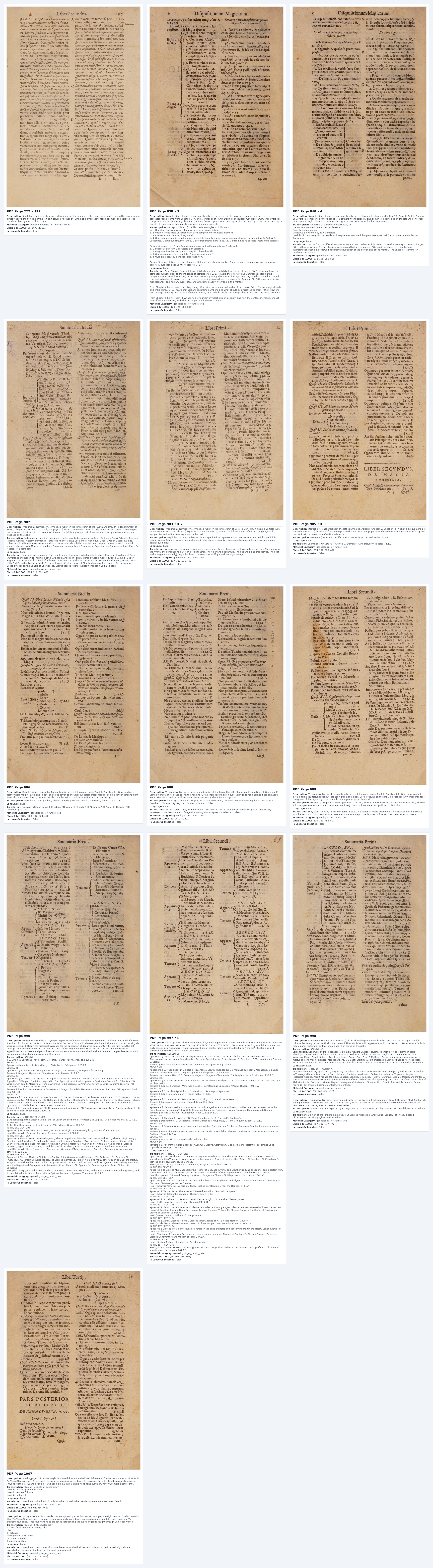
Continuing our new collection-scale analysis workflow built on Gemini Carbon, we've added a new module that scans every page for both ephemera and specialized apparatus (maps/charts/diagrams/music/etc), even providing a normalized bounding box for each. Here you can see what it identified in a 1616 printing of Delrio's Disquisitionum Magicarum. The majority were decision trees that it flagged, but incredibly, on page 197 it identified what appears to be the outline of a crushed insect from centuries past preserved on the page!
The raw JSON output:
{"pdf_page": 227, "book_page": "197", "item_index_on_page": 1, "material_category": "pressed_botanical_or_physical_insert", "bbox_0_to_1000": [20, 167, 51, 191], "is_loose_or_inserted": true, "description": "Small flattened reddish-brown arthropod/insect specimen crushed and preserved in situ in the upper margin directly above the first line of the left text column ('potabilis'), with head, oval segmented abdomen, and splayed legs clearly visible against the laid paper.", "transcription": null, "language": null, "translation": null}
{"pdf_page": 838, "book_page": "2", "item_index_on_page": 1, "material_category": "genealogical_or_ramist_tree", "bbox_0_to_1000": [120, 125, 868, 505], "is_loose_or_inserted": false, "description": "Synoptic Ramist-style typographic bracketed outline in the left column summarizing the topics a confessor-judge learns from Chapters 3, 4, and 5 of Book I of Martin Del Rio's Disquisitionum Magicarum. Three vertical composite printer's braces ('{') branch rightward from chapter stems ('Ex cap. 3. discet.', 'Ex cap. 4. discet. in', 'Ex cap. 5. discet.') to enumerate their constituent questions and subjects.", "transcription": "Ex cap. 3. discet. { Qui libri ratione magiæ prohibiti sunt.\nq. 1. Quantum Astrologorum influxui citra errorem possit tribui.\nq. 2. Vitare errores male Christianorum circa complexiones temperamentum.\nq. 3. Errores vitare circa vim imaginandi.\nq. 4. Quid sentiendum de sanatione per aspectu[m], contactum, vocem, de salutatoribus, de gentilibus S. Pauli & S. Catherinæ, & similibus circumforaneis, & de curationibus militaribus, &c. & quæ in hac re peccata interuenire soleant?\n\nEx cap. 4. discet. in { Princ. Quæ peccata occurrant in Magia naturali & artificiali.\nq. 1. Peccata sigillorum & caracterum magicorum.\nq. 2. Magorum fraudes de Numeris, & quid tribuendum illis.\nq. 3. Quomodo peccetur credulitate, & vsu incantationum?\nq. 4. Quæ amuleta, seu periapta licita, quæ non?\n\nEx cap. 5. discet. { Quæ in pirotechnia seu alchimia peccata reperiantur, & quo se pacto cum alchimicis confessarius gerere, & quæ illos debeat interrogare? q. 3. & 4.", "language": "Latin", "translation": "From Chapter 3 he will learn: { Which books are prohibited by reason of magic. / Q. 1. How much can be attributed without error to the influence of astrologers. / Q. 2. To avoid the errors of bad Christians regarding the temperament of complexions. / Q. 3. To avoid errors regarding the power of imagination. / Q. 4. What should be thought concerning healing by gaze, touch, or voice, concerning saludadores, the race of St. Paul and St. Catherine, and similar mountebanks, and military cures, etc., and what sins usually intervene in this matter?\n\nFrom Chapter 4 he will learn, in: { Beginning: What sins occur in natural and artificial magic. / Q. 1. Sins of magical seals and characters. / Q. 2. Frauds of magicians regarding numbers, and what should be attributed to them. / Q. 3. How one sins through credulity and the use of incantations? / Q. 4. Which amulets or periapt charms are licit, and which are not?\n\nFrom Chapter 5 he will learn: { What sins are found in pyrotechnics or alchemy, and how the confessor should conduct himself with alchemists, and what he ought to ask them? Q. 3 & 4."}
{"pdf_page": 840, "book_page": "4", "item_index_on_page": 1, "material_category": "genealogical_or_ramist_tree", "bbox_0_to_1000": [572, 155, 850, 518], "is_loose_or_inserted": false, "description": "Synoptic Ramist-style typographic bracket in the lower left column under item 10 (Book III, Part II, Section 8). A vertical composite printer's brace ('}') gathers five theological and demonological topics on the left and converges them onto a single polemical target on the right ('Contra Felicem Malleolum Tigurinum').", "transcription": "De formula, si Deus sit incarnatus, &c.\nDæmonum ministerio an ad bonum liceat vti.\nDe rythmo, seu versu.\nDe ritibus & cærimoniis, quæ adhibitæ.\nDe dubio in quo benignior sequenda sit interpretatio, tam de dubio personæ, quam rei. } Contra Felicem Malleolum Tigurinum.", "language": "Latin", "translation": "On the formula, 'if God became incarnate,' etc. / Whether it is lawful to use the ministry of demons for good. / On rhythm, or verse. / On the rites and ceremonies that are employed. / On doubt in which the more benign interpretation should be followed, regarding doubt both of the person and of the matter. } Against Felix Hemmerlin [Malleolus] of Zurich."}
{"pdf_page": 982, "book_page": null, "item_index_on_page": 1, "material_category": "genealogical_or_ramist_tree", "bbox_0_to_1000": [284, 118, 591, 491], "is_loose_or_inserted": false, "description": "Typographic Ramist-style synoptic bracket in the left column of the 'Summaria Breuia' (index/summary of Book I, Chapter III, 'De Magia naturali, seu physica'), using a composite vertical curly brace to link a general heading on the judgment of licit and illicit magical writings on the left to a grouped list of medieval and early modern authors and treatises on the right.", "transcription": "Iudiciũ de scriptis q̃ in hoc genere edita, quæ licita, quæ illicita, &c. { Guilhelm. Pari & Robertus Triezius, Picatrix, Agrippa, Anselm. Parmensis, Petrus de Abono. Cichus Esculanus : Alchindus, Geber , Roger. Bacon, Raimũd. Lullus, Arnol. Villanouan. Poncetus & Ardoinus. / Cardanus de subtilit. & Variet. Ioan. Baptist. Portæ, & Anton. Misardi Magiæ naturalis . Alb. Magni libri quidam. Pomponat. de incantatio. Esculanus in Sphæram de Sacrobosco. Ioan. Fran. Pici Magica. Io. Bodini libri.", "language": "Latin", "translation": "Judgment concerning writings published in this genre, which are licit, which illicit, etc. { William of Paris [Auvergne] and Robertus Triezius, Picatrix, Agrippa, Anselm of Parma, Pietro d'Abano. Cecco d'Ascoli: Al-Kindi, Geber, Roger Bacon, Ramon Llull, Arnald of Villanova, Poncetus and Ardoinus. / Cardano On Subtlety and Variety. Giambattista della Porta's and Antonius Misardus's Natural Magic. Certain books of Albertus Magnus. Pomponazzi On Incantations. Cecco d'Ascoli on the Sphere of Sacrobosco. Gianfrancesco Pico's Magical works. Jean Bodin's books."}
{"pdf_page": 983, "book_page": "K 2", "item_index_on_page": 1, "material_category": "genealogical_or_ramist_tree", "bbox_0_to_1000": [197, 121, 336, 491], "is_loose_or_inserted": false, "description": "Typographic Ramist-style synoptic bracket in the left column of Book I ('Libri Primi'), using a vertical curly brace to connect a stem phrase ('Explicãtur varię experientiæ, de') on the left with a list of natural-magical/occult sympathies and antipathies explained in the text.", "transcription": "Explicãtur varię experientiæ, de { torpedine icta. hyænæ vmbra, Serpente & querno folio, vel ibidis penna. vipera, & fagina virgula. vespertilione & foliis platani. capra & cringio. aquilæ pennis. lepore marino. lupinis agninisque fidibus.", "language": "Latin", "translation": "Various experiences are explained, concerning { being struck by the torpedo [electric ray]. The shadow of the hyena, the serpent and oak leaf, or ibis feather. The viper and beech twig. The bat and plane-tree leaves. The goat and eryngium [sea-holly]. Eagle feathers. The sea-hare. Wolf-gut and lamb-gut strings."}
{"pdf_page": 985, "book_page": "K 3", "item_index_on_page": 1, "material_category": "genealogical_or_ramist_tree", "bbox_0_to_1000": [514, 150, 585, 492], "is_loose_or_inserted": false, "description": "Ramist divisional bracket in the left column under Book I, Chapter V, Question III ('Alchimia ad quam Magiæ speciem pertineat?'), branching from 'Exempla' on the left via a typographic curly brace into the four species of magic on the right, with a page/column/section reference.", "transcription": "Exempla { Naturalis, / Artificiosæ, / Dæmoniacæ, / Et Delusoriæ. 74.1.B", "language": "Latin", "translation": "Examples { Of Natural, / Artificial, / Demonic, / And Delusory [magic]. 74.1.B"}
{"pdf_page": 986, "book_page": null, "item_index_on_page": 1, "material_category": "genealogical_or_ramist_tree", "bbox_0_to_1000": [503, 102, 624, 466], "is_loose_or_inserted": false, "description": "Double-sided typographic Ramist bracket in the left column under Book II, Question III ('Quæ sit diuisio dæmoniacæ magiæ, & de eius libris'), enclosing seven spurious/pseudepigraphical magical books between left and right vertical curly braces, linking 'Item fictitij libri.' on the left to the locus citation '87.1.C' on the right.", "transcription": "Item fictitij libri . { Adæ. / Abelis. / Enoch. / Abrahę. / Pauli. / Cypriani. / Honorij . } 87.1.C", "language": "Latin", "translation": "Likewise fictitious books { Of Adam. / Of Abel. / Of Enoch. / Of Abraham. / Of Paul. / Of Cyprian. / Of Honorius. } 87.1.C"}
{"pdf_page": 988, "book_page": null, "item_index_on_page": 1, "material_category": "genealogical_or_ramist_tree", "bbox_0_to_1000": [59, 98, 174, 471], "is_loose_or_inserted": false, "description": "Typographic Ramist-style synoptic bracket at the top of the left column (continuing Book II, Question IX), using a vertical curly brace to link the heading 'De aliis famosis Magis singulis' (alongside regional headings on Lapps, Finns, Biarmians, and Tartars) to seven named ancient and medieval magicians.", "transcription": "De Lappis, Finnis, Biarmijs. / De Tartaris quibusdã. / De aliis famosis Magis singulis. { Zoroastre. / Dositheo. / Simone. / Pythagora. / Orpheo. / Baiano. / Ollero.", "language": "Latin", "translation": "On the Lapps, Finns, and Biarmians. / On certain Tartars. / On other famous Magicians individually. { Zoroaster. / Dositheus. / Simon [Magus]. / Pythagoras. / Orpheus. / Baianus. / Ollerus."}
{"pdf_page": 989, "book_page": null, "item_index_on_page": 1, "material_category": "genealogical_or_ramist_tree", "bbox_0_to_1000": [615, 139, 756, 507], "is_loose_or_inserted": false, "description": "Typographic Ramist divisional bracket in the left column under Book II, Question XII ('Quid magi valeant circa externa seu fortunæ bona?'), branching from the modal verb 'Possunt' on the left via a vertical curly brace into four categories of damage magicians can inflict upon property and livestock.", "transcription": "Possunt { Greges & armenta perimere. 128.2.C / Messes alio traducere , vt Saga Treuirensis lac. / Messes & fructus perdere, & sterilitatem inducere. Modi varij. / Domos incendere , vt oppidum Schiltochium.", "language": "Latin", "translation": "They can { Destroy flocks and herds. 128.2.C / Transfer harvests elsewhere, as a witch of Trier did milk. / Ruin harvests and fruits, and induce barrenness. Various ways. / Set houses on fire, such as the town of Schiltach."}
{"pdf_page": 996, "book_page": null, "item_index_on_page": 1, "material_category": "genealogical_or_ramist_tree", "bbox_0_to_1000": [374, 105, 922, 882], "is_loose_or_inserted": false, "description": "Multi-part chronological synoptic apparatus of Ramist curly braces spanning the lower two-thirds of column 1 and all of column 2 under Book II, Question XXVI, Section V ('Probatio ab exemplis & auctoritate scriptorum, qui singulis sæculis vixerunt'). Organizes historical evidence for the apparition of departed souls century by century from the 1st through the 5th century ('SECVLO I.'–'SECVLO V.'), bifurcating each century via vertical braces into documented apparitions ('Apparuere') and patristic/ecclesiastical authors who upheld the doctrine ('Tenuere' / 'Apparuisse testantur'), including a nested double brace under Century I.", "transcription": "SECVLO I.\n{ B. Virginis / Christi Do- / mini semel. { Petro. / Carpo. / B. Valeriæ. pag.225.2.D\nSECVLO II.\nApparuisse testantur { Iustinus Martyr. / Tertullianus. / Origenes . 226.2.E\nSECVLO III.\nApparuere { S. Potamiena , & alij. / S. Maria virgo , & B. Ioannes. / Martyres Africani varij.\nTenuere { Gregorius Nyssenus . / Cyprianus . / Ambrosius . 227.2.C\nSECVLO IV.\nApparuere { B. Petrus . / B. Agnes . / B. Agatha . / Christus Dominus. / Petrus & Paulus . / B. Virgo Maria . / Spiridiõ & Triphyllius. / Filia patri Spiridioni respondit. / Duo Episcopi mortui subscripsere . / Explicatus Canon Cõc. Eliberitani. / B. Virgo iterum cum S. Mercurio . / Item S. Artemius . / S. Febronia . B. Ammon. / Iterum B. Virgo , & anima Latronis . / B. Cæsarius . B. Paulus . / S. Mamantes.\nTenuere { Basilius . Nazianzenus . / Damascenus. Gregor. Turonẽsis. Nemesius. / Socrates . Ruffinus . / Nicephorus, & alij . / pag.228.1.B.\nSECVLO V.\nApparuere { B. Martinus . / S. Ioannes Baptista . / S. Geruas. & Protas. / S. Ambrosius . / S. Eulalia . / S. Fructuosus . / Latro quidã insepultus. / B. Germano. Felix Nolanus, & alij multi, vt Basilius Mart. Euagr. Philos. Gamaliel. S. Stephanus, Michæas & Habacuch. S. Zacharias, Euthymiꝰ. / B. Virgo cum SS. Ioanne Baptista & Euangelista. / S. Ianuarius . S. Apollinar. S. Cyprianus. S. Eulalia. iterum S. Petr. S. Leo. S. Barnab.\nTenuere { B. Hieron. & explicatur. / B. Chrysostomus , & explicatur . / B. Augustinus , & explicatur . / Auctor epist. ad Cyrill. de morte Hieron. Theodoretus . 230.1.B", "language": "Latin", "translation": "IN THE 1ST CENTURY.\n{ [Apparitions] of the Blessed Virgin [and] of Christ the Lord once { to Peter. / to Carpus. / Of Blessed Valeria. p. 225.2.D\nIN THE 2ND CENTURY.\nTestify that they appeared { Justin Martyr. / Tertullian. / Origen. 226.2.E\nIN THE 3RD CENTURY.\nAppeared { St. Potamiena, and others. / St. Mary the Virgin, and Blessed John. / Various African Martyrs.\nHeld [this view] { Gregory of Nyssa. / Cyprian. / Ambrose. 227.2.C\nIN THE 4TH CENTURY.\nAppeared { Blessed Peter. / Blessed Agnes. / Blessed Agatha. / Christ the Lord. / Peter and Paul. / Blessed Virgin Mary. / Spiridion and Triphyllius. / His daughter answered her father Spiridion. / Two deceased Bishops signed. / Canon of the Council of Elvira explained. / Blessed Virgin again with St. Mercurius. / Likewise St. Artemius. / St. Febronia. Blessed Ammon. / Again the Blessed Virgin, and the soul of the Thief. / Blessed Caesarius. Blessed Paul. / St. Mamantes.\nHeld [this view] { Basil. Nazianzen. / Damascene. Gregory of Tours. Nemesius. / Socrates. Rufinus. / Nicephorus, and others. p. 228.1.B.\nIN THE 5TH CENTURY.\nAppeared { Blessed Martin. / St. John the Baptist. / Sts. Gervasius and Protasius. / St. Ambrose. / St. Eulalia. / St. Fructuosus. / A certain unburied robber. / To Blessed Germanus. Felix of Nola, and many others, such as Basil the Martyr, Evagrius the Philosopher, Gamaliel, St. Stephen, Micah and Habakkuk, St. Zechariah, Euthymius. / Blessed Virgin with Sts. John the Baptist and Evangelist. / St. Januarius. St. Apollinaris. St. Cyprian. St. Eulalia. Again St. Peter. St. Leo. St. Barnabas.\nHeld [this view] { Blessed Jerome, and it is explained. / Blessed Chrysostom, and it is explained. / Blessed Augustine, and it is explained. / Author of the epistle to Cyril on the death of Jerome. Theodoret. 230.1.B"}
{"pdf_page": 997, "book_page": "L", "item_index_on_page": 1, "material_category": "genealogical_or_ramist_tree", "bbox_0_to_1000": [58, 108, 889, 895], "is_loose_or_inserted": false, "description": "Full-page two-column chronological synoptic apparatus of Ramist curly braces continuing Book II, Question XXVI, Section V across centuries 6 through 15 ('SECVLO VI.'–'SECVLO XV.'). Each century heading subdivides via vertical curly braces into 'Apparuere' (historical apparitions of saints, rulers, and the dead) and 'Tenuere' (theologians and chroniclers upholding the reality of apparitions).", "transcription": "SECVLO VI.\nApparuere { Damnatus quidã. B. M. Virgo sæpiùs. S. Ioan. Silentiarius. B. Bartholomæus . Macedonius Patriarcha . Theodoricus rex: Nestorius, & alij hęretici. Princeps Apostolorum . S. Stephanus . S. Eutichius . S. Tetricus & socij Episcop. S. Sergius.\nTenuere { Hoc seculo hanc sententiam , Procopius , Euagrius, & alij . 236.2.D\nSECVLO VII.\nApparuere { B. Musę apparuit Deipara S. Iuuenalis & Eleuth. Theodor. Rex, & monialis quædam . Paschasius, & balnei dominus . Iustus monachus . Deipara apparuit S. Ildephonso. S. Leocadia .\nTenuere hanc sententiam. { B. Gregorius Magnus. / Gregorius Turonensis . / S. Ildephonsus . / S. Isidorus . 238.2.C\nSECVLO VIII.\nApparuere { S. Suibertus. Deipara. B. Sabinus . SS. Euphemia, & Glyceria . B. Tharasius. S. Andræas . / S. Gertrudis . / B. Iacobus maior .\nTenuere { Iulianus Pomerius . Venerabilis Beda . / Constantinus Episcopus. / Paulus Diaconꝰ. 240.1.A\nSECVLO IX.\nApparuere { B. Iacobus Apostolus . / B. Maurilius . / Pandulphus tyrannus .\nTenuere { Iulian. Toletan. iunior. / Theophilactus. 241.1.B\nSECVLO X.\nApparuere { S. Lybuinus. SS. Petrus & Paulus. B. Virgo . / S. Mauricius. B. Iacob.\nTenuere { Euthimius Monachus . / Hugo Ætherianꝰ. 241.2.D\nSECVLO XI.\nApparuere { Christus, Deipara, BB. Apostoli, & multi Angeli. B. Andr. B. Adimarus. Quidam amicus Dunstani . B. Odilo. Fauentini duo. Benedictus VIII. & IX. B. Gregorius. Canonicus Parisiensis . Anno Episcopus Coloniensis . S. Benno.\nTenuere { Petrus Damianus. / Guilhelmus Tyrius . / pag.242.1.C\nSECVLO XII.\nApparuere { Christus. B. Isidorus. / B. Virgo. Benedictus X. / B. Nortbertꝰ. Gualdricꝰ.\nTenuere { Dodechinus . B. Bernardus . Petrus Cluniacẽsis. / Rupertus, & Honor. Augustodunens. 243.1.B\nSECVLO XIII.\nApparuere { B. Vrsula & innumeri apud auctores citatos. & de Martino Presbytero Canonico Regulari Legionensi, eiusq. scriptis .\nTenuere { Vincentius Belluacens. / Cæsarius Cisterciensis . / Helinãdus. Thomas Cantiprat. B. Thomas. B. Bonauent. & Guilhelm. Paris. 244.1.A\nSECVLO XIV.\nTenuere { Scotus. Richar. de Mediauilla. Paludan. ibid.\nSECVLO XV.\nTenuere { S. Antoninus. Gerson. Iacobus Cusanus . Dionys. Carthusian. & epis. Abulens. Tostatus , qui omnes varia suppeditant exempla . 244.2.A", "language": "Latin", "translation": "IN THE 6TH CENTURY.\nAppeared { A certain damned man. Blessed Virgin Mary often. St. John the Silent. Blessed Bartholomew. Patriarch Macedonius. King Theodoric: Nestorius, and other heretics. Prince of the Apostles [Peter]. St. Stephen. St. Eutychius. St. Tetricus and fellow Bishops. St. Sergius.\nHeld { In this century this opinion, Procopius, Evagrius, and others. 236.2.D\nIN THE 7TH CENTURY.\nAppeared { To Blessed Musa appeared the Mother of God. Sts. Juvenal and Eleutherius. King Theodoric, and a certain nun. Paschasius, and the bath-master. Justus the monk. The Mother of God appeared to St. Ildephonsus. St. Leocadia.\nHeld this opinion. { Blessed Gregory the Great. / Gregory of Tours. / St. Ildephonsus. / St. Isidore. 238.2.C\nIN THE 8TH CENTURY.\nAppeared { St. Suitbert. Mother of God. Blessed Sabinus. Sts. Euphemia and Glyceria. Blessed Tarasius. St. Andrew. / St. Gertrude. / Blessed James the Greater.\nHeld { Julianus Pomerius. Venerable Bede. / Bishop Constantine. / Paul the Deacon. 240.1.A\nIN THE 9TH CENTURY.\nAppeared { Blessed James the Apostle. / Blessed Maurilius. / Pandulf the tyrant.\nHeld { Julian of Toledo the Younger. / Theophylact. 241.1.B\nIN THE 10TH CENTURY.\nAppeared { St. Lebuin. Sts. Peter and Paul. Blessed Virgin. / St. Maurice. Blessed James.\nHeld { Euthymius the Monk. / Hugh Eteriano. 241.2.D\nIN THE 11TH CENTURY.\nAppeared { Christ, the Mother of God, Blessed Apostles, and many Angels. Blessed Andrew. Blessed Adimarus. A certain friend of Dunstan. Blessed Odilo. Two men of Faenza. Benedict VIII and IX. Blessed Gregory. The Canon of Paris. Anno, Bishop of Cologne. St. Benno.\nHeld { Peter Damian. / William of Tyre. p. 242.1.C\nIN THE 12TH CENTURY.\nAppeared { Christ. Blessed Isidore. / Blessed Virgin. Benedict X. / Blessed Norbert. Gaudry.\nHeld { Dodechinus. Blessed Bernard. Peter of Cluny. / Rupert, and Honorius of Autun. 243.1.B\nIN THE 13TH CENTURY.\nAppeared { Blessed Ursula and countless others in the cited authors; and concerning Martin the Priest, Canon Regular of León, and his writings.\nHeld { Vincent of Beauvais. / Caesarius of Heisterbach. / Helinand. Thomas of Cantimpré. Blessed Thomas [Aquinas]. Blessed Bonaventure and William of Paris. 244.1.A\nIN THE 14TH CENTURY.\nHeld { Scotus. Richard of Middleton. Paludanus. ibid.\nIN THE 15TH CENTURY.\nHeld { St. Antoninus. Gerson. Nicholas [James] of Cusa. Denys the Carthusian and Tostado, Bishop of Ávila, all of whom supply various examples. 244.2.A"}
{"pdf_page": 998, "book_page": null, "item_index_on_page": 1, "material_category": "genealogical_or_ramist_tree", "bbox_0_to_1000": [59, 107, 456, 476], "is_loose_or_inserted": false, "description": "Concluding section ('SECVLO XVI.') of the chronological Ramist bracket apparatus at the top of the left column, featuring nested vertical curly braces linking 'Variis tẽporib. apparuere multi.' on the left to 16th-century Catholic theologians, historians, and historical apparition cases on the right.", "transcription": "SECVLO XVI.\nVariis tẽporib. apparuere multi . { Tenuere & exempla retulere Catholici plurimi, iidemque viri doctissimi, in libris Theologic. Domin. Sotus, Peltanus, Canis. Maldonat. Bellarmin. Valencia , Tyræus, Angles in scriptis Historicis, Alb. Krantzius, Marul. Egnat. Sabellic. Ful- { gos. Iouius, Baron. Sigo. Osor. & Maffæus. Senior quidam excommunicatus, sed martyr. Historia Vdonis Episcopi Magdeburgens. & Galeatij Sfortiæ. Alcdifij Imolensis pater. Ferdinãdus rex Neapolitan. locus Guicciardini Ioan. Picus Mirandulæ Comes . Marsilius Ficinus . Petrus de Paz, tribunus . Catharinæ Indæ exempla }", "language": "Latin", "translation": "IN THE 16TH CENTURY.\nAt various times many appeared. { Very many Catholics, and those most learned men, held [this] and related examples: in Theological books, Domingo de Soto, Peltanus, Canisius, Maldonado, Bellarmine, Valencia, Thyraeus, Angles; in Historical writings, Albert Krantz, Marullus, Egnazio, Sabellicus, Fulgoso, { Giovio, Baronius, Sigonio, Osório, and Maffei. A certain excommunicated elder, yet a martyr. History of Udo, Archbishop of Magdeburg, and Galeazzo Sforza. The father of Alidosi of Imola. Ferdinand, King of Naples, passage of Guicciardini. Giovanni Pico, Count of Mirandola. Marsilio Ficino. Pedro de Paz, tribune. Examples of Catherine of India }"}
{"pdf_page": 998, "book_page": null, "item_index_on_page": 2, "material_category": "genealogical_or_ramist_tree", "bbox_0_to_1000": [707, 102, 777, 472], "is_loose_or_inserted": false, "description": "Typographic Ramist-style synoptic bracket in the lower left column under Book II, Question XXVI, Section VI, linking 'Sentẽtia Patrum explicata.' via a vertical curly brace to five Church Fathers whose testimonies on souls of the dead are expounded against Protestant adversaries.", "transcription": "Sentẽtia Patrum explicata. { B. Augustini, Anastasij Niseni , B. Chrysostomi , & Theophilacti , & Tertulliani .", "language": "Latin", "translation": "Opinion of the Fathers explained. { Of Blessed Augustine, Anastasius [Gregory] of Nyssa, Blessed Chrysostom, and Theophylact, and Tertullian."}
{"pdf_page": 1007, "book_page": null, "item_index_on_page": 1, "material_category": "genealogical_or_ramist_tree", "bbox_0_to_1000": [784, 94, 854, 465], "is_loose_or_inserted": false, "description": "Small typographic Ramist-style bracketed division in the lower left column (under 'Pars Posterior Libri Tertii. De Vana Observatione', Question II), using a composite printer's brace to converge three left-hand classifications of sin ('Quando lethale', 'Quando veniale', 'Quando nullum') into a single right-hand summary note ('Exempla singulorum').", "transcription": "Quæst. II. Quale sit peccatum ?\nQuando lethale. } Exempla singu-\nQuando veniale. } lorum .\nQuando nullum.  }", "language": "Latin", "translation": "Question II. What kind of sin is it? When mortal; when venial; when none: Examples of each."}
{"pdf_page": 1007, "book_page": null, "item_index_on_page": 2, "material_category": "genealogical_or_ramist_tree", "bbox_0_to_1000": [56, 518, 166, 885], "is_loose_or_inserted": false, "description": "Typographic Ramist-style dichotomous/quadripartite bracket at the top of the right column (under Question III of 'De Vana Observatione'), using a vertical composite curly brace opening from a single left-hand condition ('Si exspectentur bona.') into four right-hand branches categorizing the types of goods sought through vain observance.", "transcription": "Quæst. III. Quotuplex sit ?\nA causa finali ostenditur esse quadru-\nplex .\n              { Fortunæ .\nSi exspecten- { corporis .\ntur bona .    { animi .\n              { supernaturalia .", "language": "Latin", "translation": "Question III. How many kinds are there? From the final cause it is shown to be fourfold. If goods are expected: of fortune; of the body; of the soul; supernatural."}