

The Collection holds an incredible collection of loose individual botanical prints tracing the evolution of scientific, medicinal, practical and artistic botanical illustration over the centuries, incompassing at least one print from many of the major milestones in botanical illustration of the copperplate era, beginning with a first edition print from Besler's Hortus Eystettensis. While there are basic records for each print transferred as part of the aquisition process, many are little more than generic descriptions of the underlying series the prints came from, with little information on the depicted plant itself. Could Gemini Carbon examine the collection and precisely label each individual print, identifying the plant, the work and the significance of the work in the history of botanical illustration? Here we explore Shaw & Nodder's famous 1790 hand-colored Venus Flytrap illustration and a 1791 plate from Curtis’s The Botanical Magazine, both of which Gemini instantly recognizes.
Explain this image in detail, its history and significance.
What is its importance in the landscape of botanical illustration?
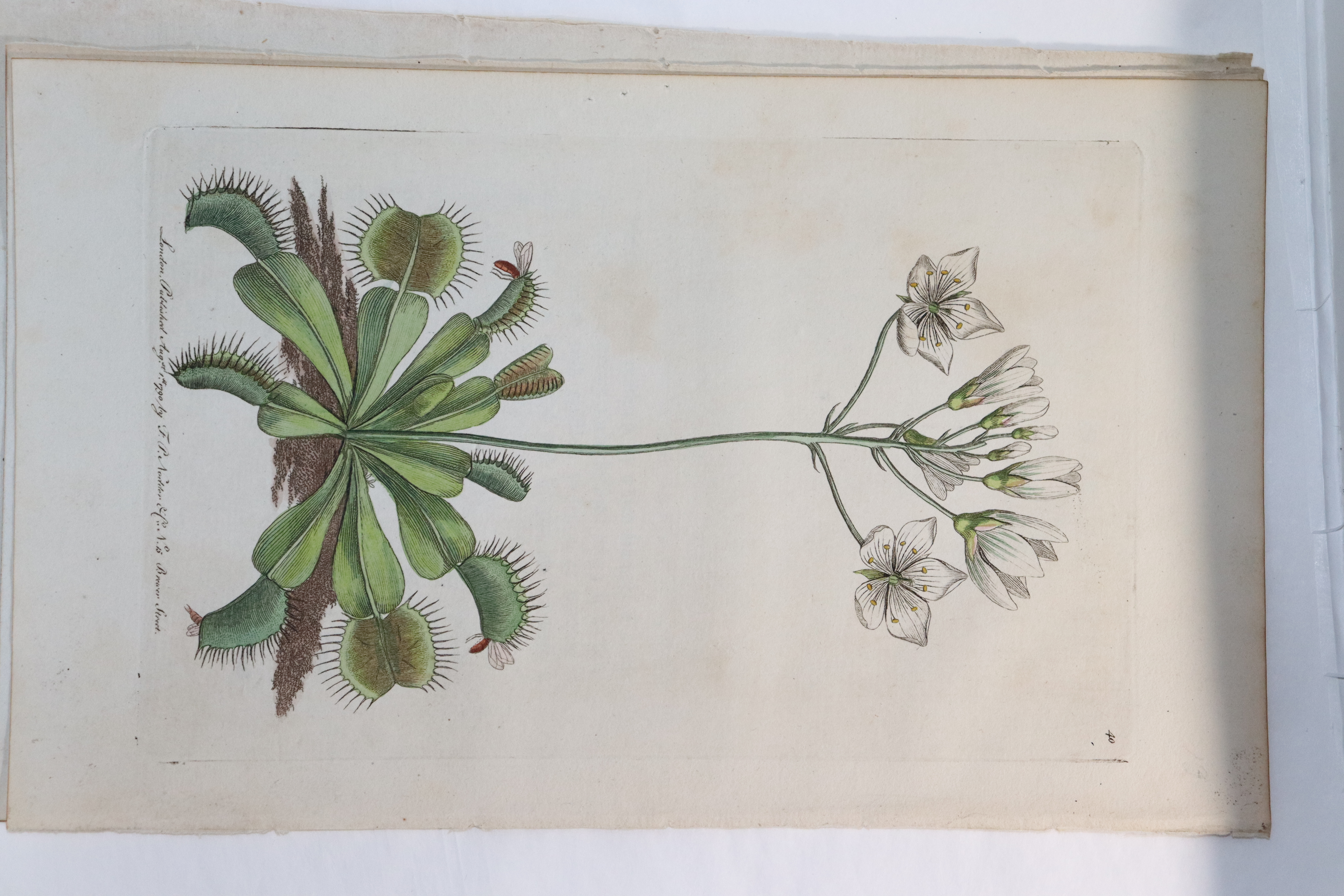
This print is Plate 40 from The Naturalist’s Miscellany, depicting the Venus flytrap (Dionaea muscipula). Engraved and published in London on August 1, 1790, by Frederick Polydore Nodder & Co. (No. 13 Brewer Street), it accompanied scientific descriptions by British naturalist George Shaw.
Visual & Technical Details
-
Medium & Imprint: A hand-colored copperplate engraving on rag paper featuring a distinct rectangular plate mark, the plate number
40at upper right, and Nodder’s publication line engraved in script along the bottom edge. -
Basal Rosette: Winged, spatulate green petioles radiate from a patch of brown soil, each ending in a hinged, bilobed trap fringed with stiff marginal bristles.
-
Carnivorous Action: The traps appear in multiple functional states—two lie fully open to reveal reddish interior surfaces, while others on the upper left, upper right, and lower right are snapped shut around visible insects.
-
Inflorescence: A tall, slender scape rises centrally above the foliage, topped by an umbel-like cluster of five-petaled white flowers showing delicate venation, stamens, and unopened buds.
History & Scientific Significance
-
Colonial Discovery: Native solely to the bogs of North and South Carolina, the Venus flytrap astonished European botanists when specimens reached England in the late 1760s.
-
Challenging the Scala Naturae: Its rapid movement and insect-trapping habit disrupted Enlightenment taxonomy, blurring the rigid Aristotelian boundary between passive plants and sentient animals. Carl Linnaeus famously called it miraculum naturae ("miracle of nature"), though he initially doubted it actually digested prey.
-
Iconographic Lineage: Nodder’s 1790 plate adapts the foundational 1768/1770 illustration commissioned by merchant-naturalist John Ellis (who first formally described the species), re-engraving its iconic trapped-insect motif for a broader late-18th-century readership.
Importance in Botanical Illustration
-
Illustrating Behavior Over Static Form: Unlike traditional herbarium-style portraits, the plate synthesizes an entire life cycle and behavioral sequence in one frame—simultaneously displaying buds, open blooms, armed traps, and captured prey. It also captures the plant's evolutionary architecture, showing flowers held high above the traps so pollinators are not eaten.
-
Golden Age Precision: Produced by Nodder ("Botanic Painter to Queen Charlotte"), the print exemplifies late-18th-century British scientific art, combining anatomical clarity against clean negative space with expressive hand-coloring.
-
Accessible Science: Issued in affordable monthly parts between 1789 and 1813, The Naturalist’s Miscellany moved botanical illustration beyond aristocratic folios, bringing exotic flora into wider public and scholarly circulation.
give me a bibliographic citation for this image and a one paragraph description that captures all of the above for an item description
Bibliographic Citation (Chicago Style) Nodder, Frederick Polydore, artist and engraver. [Dionaea muscipula, or Venus’s Fly-Trap], Plate 40. In Vivarium Naturæ, or The Naturalist’s Miscellany: or Coloured Figures of Natural Objects; Drawn and Described Immediately from Nature, by George Shaw, vol. 2, pl. 40. London: F. P. Nodder & Co., No. 15 Brewer Street, August 1, 1790. Hand-colored copperplate engraving on rag paper.
Catalog / Archival Tombstone Frederick Polydore Nodder (British, active 1773–ca. 1800), text by George Shaw (British, 1751–1813). Dionaea muscipula (Venus’s Fly-Trap), Plate 40 from Vivarium Naturæ, or The Naturalist’s Miscellany, Vol. 2 (London: F. P. Nodder & Co., No. 15 Brewer Street, August 1, 1790). Hand-colored copperplate engraving on rag paper.
Item Description Originally issued in Volume 2 of George Shaw’s Vivarium Naturæ, or The Naturalist’s Miscellany, this print of the Venus flytrap (Dionaea muscipula) was drawn, engraved, and published by Frederick Polydore Nodder—Botanic Painter to Queen Charlotte—for an influential serial work (1789–1813) whose affordable monthly parts carried exotic natural history beyond aristocratic folios to a wide public and scholarly readership. Executed as a hand-colored copperplate engraving on rag paper within a distinct rectangular plate mark, the sheet is numbered 40 at upper right and bears the engraved script imprint along the lower margin reading London Published Augst. 1st. 1790 by F. P. Nodder & Co. No. 15 Brewer Street. Set against clean negative space, the composition depicts a basal rosette of winged, spatulate green petioles radiating from a patch of brown soil, capturing the hinged, bilobed, bristle-fringed traps in multiple functional states—both splayed open to expose their reddish interiors and snapped shut around visible insects—while a tall, slender central scape elevates an umbel-like cluster of delicately veined, five-petaled white flowers, stamens, and unopened buds high above the foliage. Adapting John Ellis’s foundational iconography of this North and South Carolina bog endemic—which astonished European botanists upon reaching England in the late 1760s and prompted Carl Linnaeus to dub it miraculum naturae as its rapid carnivory disrupted the Enlightenment boundary between passive plants and sentient animals—the plate exemplifies Golden Age British botanical illustration by uniting anatomical precision with a complete life cycle, active predatory behavior, and pollinator-sparing evolutionary architecture in a single frame.
Archival collation of The Naturalist’s Miscellany places Plate 40 near the opening of Volume 2 (1790–1791). Closer inspection of the cursive numeral in the lower-margin inscription also confirms Nodder’s shop address reads No. 15 Brewer Street rather than No. 13.
What about this one?
Explain this image in detail, its history and significance.
What is its importance in the landscape of botanical illustration?
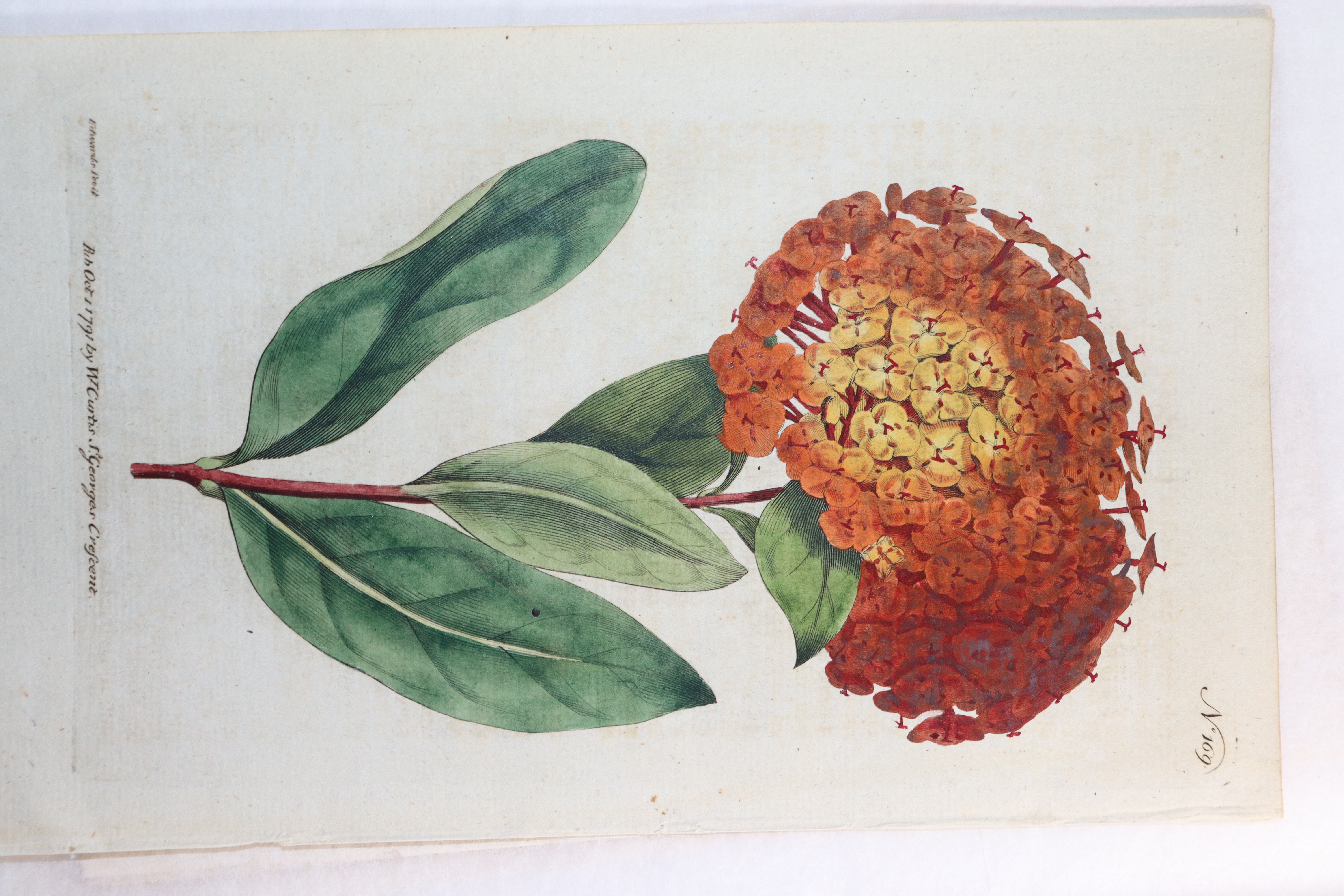
Plate No. 169 from William Curtis’s The Botanical Magazine; or, Flower-Garden Displayed is an original hand-colored copperplate engraving published in London on October 1, 1791. Drawn by the 23-year-old botanical artist Sydenham Edwards (signed "Edwards del." at bottom left) and issued from Curtis’s premises at St. George’s Crescent (inscribed "Pub. Oct. 1 1791 by W Curtis, St. George's Crescent." at bottom center), the plate appeared in Volume 5 of what is today Curtis’s Botanical Magazine—the longest-running continuously published color-illustrated botanical periodical in the world.
Visual, Botanical, and Printmaking Analysis
-
The Botanical Subject (Ixora coccinea vs. Ixora chinensis): Curtis published this plate under the Linnaean name Ixora coccinea ("Scarlet Ixora," family Rubiaceae). However, Sydenham Edwards’s faithful rendering reveals rounded, broadly obovate four-parted petals rather than the narrow, sharply pointed petals of true Indian Ixora coccinea L. Because of this precision, modern taxonomists (including the Royal Botanic Gardens, Kew) identify the specimen depicted in Plate 169 as Ixora chinensis Lam. (Chinese Ixora), a tropical evergreen shrub native to southern China and Southeast Asia that 18th-century English horticulturists had conflated with its Indian relative.
-
Floral Architecture and Lighting: The composition centers on a dense, hemispherical terminal corymb of tubular flowers. Rather than painting the cluster a flat red, the colorist uses a luminous gradient—from pale yellow-ochre and apricot in the sunlit center to fiery vermilion and deep shaded crimson along the right edge—to model a convincing sphere in space. Along the top rim of the cluster, individual flowers are shown in crisp side profile, exposing their long, slender red corolla tubes and protruding four-parted reproductive organs (placing the plant in Linnaeus’s class Tetrandria Monogynia: four stamens and one pistil).
-
Foliage and Spatial Turn: A woody, reddish-brown stem bears smooth-edged, leathery green leaves arranged in opposite pairs. Edwards turns each leaf at a distinct angle to convey full botanical character: the right leaf displays its glossy dark-green upper surface and pale central midrib, the left leaf curls inward along its margin, and the central upright leaf twists to expose its paler sage-green underside and fine parallel-pinnate venation.
-
Physical Print Characteristics: The octavo-sized rag paper preserves a distinct rectangular plate mark—the indented border pressed into damp paper by the beveled edge of the copperplate on a rolling press. Faint reverse letterpress offsetting is also visible in the blank cream paper just above and to the left of the flower head, left over from centuries of being bound facing its accompanying printed description leaf.
Historical Context
William Curtis and the One-Shilling Revolution
Before launching The Botanical Magazine in February 1787, William Curtis (1746–1799)—an apothecary and former Praefectus Horti at the Chelsea Physic Garden—had spent a decade producing Flora Londinensis (1777–1798), a monumental folio survey of wild plants around London. While scientifically acclaimed, Flora Londinensis lost money because few buyers could afford grand folios. Curtis noticed that wealthy and middle-class Britons were far more eager to read about flashy exotic plants arriving from abroad than native weeds. He pivoted to a compact octavo periodical, offering three hand-colored plates and accessible cultivation notes per monthly issue for just one shilling. Circulation quickly reached roughly 3,000 copies a month, turning botanical publishing into a viable commercial enterprise.
Sydenham Edwards’s Early Mastery
The signature "Edwards del." (delineavit, "drew it") marks an early milestone in the career of Sydenham Teast Edwards (1768–1819). Born in Wales, Edwards had taught himself by copying plates from Curtis’s books as a teenager; impressed by the boy’s talent, Curtis brought him to London around 1788 and trained him directly in botany and illustration. By October 1791, Edwards had become the magazine’s principal artist, going on to illustrate nearly 1,700 plates for the journal over 27 years before departing in 1815 to establish the rival Botanical Register.
Georgian "Stove" Culture and Global Plant Trade
In 1791, keeping a tropical Asian Ixora alive through an English winter was a feat of high-status horticultural engineering requiring a "stove"—a coal- or tanbark-heated brick glasshouse. In his text accompanying Plate 169, Curtis recorded that this plant first flowered in England in the celebrated hothouse collection of the Quaker physician Dr. John Fothergill at Upton in Essex. After an accident destroyed Fothergill’s specimen, the Brompton nurseryman Mr. Thoburn successfully raised new plants from imported seeds, producing the luxuriant summer blooms in London nurseries that allowed Edwards to paint this specimen from life.
Importance in the Landscape of Botanical Illustration
-
Democratizing the "Golden Age" of Botanical Art: Prior to Curtis, museum-quality color botanical plates—such as those by Georg Dionysius Ehret or Pierre-Joseph Redouté—were luxury objects commissioned for royalty, aristocrats, and major libraries. Plate 169 represents a watershed shift in scale and audience: proving that octavo-sized prints could retain high scientific fidelity and jewel-like color while reaching amateur gardeners, nurserymen, and women readers fueled by the late-18th-century craze for "botanomania."
-
Synthesizing Engraving and Workshop Hand-Coloring: Produced decades before chromolithography, each impression required a two-stage craft system. First, an engraver (typically Curtis’s chief engraver, Francis Sansom) translated Edwards’s drawing into fine burin lines on copper—clearly visible here in the delicate cross-hatching that gives shadow and curvature to the leaves. Next, teams of colorists worked assembly-line style from a master pattern painted by Edwards, laying translucent watercolor washes over the black ink lines on the foliage while building rich, semi-opaque pigments across the petals.
-
Visualizing Science Without Clutter: Unlike 19th-century plates in the magazine—which routinely crowded margins with magnified floral dissections under William Jackson Hooker and Walter Hood Fitch—early Georgian plates like No. 169 embedded diagnostic details directly into a clean, self-contained portrait against bare paper. By combining frontal blossoms, profile corolla tubes, upper and lower leaf surfaces, and stem attachment in a single living sprig, Edwards satisfied Linnaean botanists and drawing-room aesthetes alike.
-
Enduring Taxonomic Voucher: Because fragile 18th-century greenhouse plants were not always preserved as pressed herbarium sheets, early Botanical Magazine plates frequently serve modern science as historical vouchers or iconotypes. Without Edwards’s exact rendering of the rounded corolla lobes and compact corymb, botanists would have struggled to verify which species of Ixora was actually circulating through London’s hothouses in the 1790s.
give me a bibliographic citation for this image and a one paragraph description that captures all of the above for an item description
Bibliographic Citation
Edwards, Sydenham, artist. [Ixora coccinea / Scarlet Ixora], Plate No. 169. In William Curtis, The Botanical Magazine; or, Flower-Garden Displayed, vol. 5, pl. 169. London: Published by W. Curtis, No. 3, St. George’s Crescent, October 1, 1791 (bound volume printed by Stephen Couchman, 1792). Hand-colored copperplate engraving.
Item Description
An original hand-colored copperplate engraving (inscribed "No. 169"), drawn by Sydenham Edwards ("Edwards del.") and published in London on October 1, 1791 ("Pub. Oct. 1 1791 by W Curtis, St. George's Crescent."), this octavo plate was issued in Volume 5 of William Curtis’s The Botanical Magazine; or, Flower-Garden Displayed—the world’s longest-running continuously published color-illustrated botanical periodical, for which the 23-year-old Edwards had just emerged as principal artist. Originally published under the Linnaean name Ixora coccinea ("Scarlet Ixora") from tropical Asian shrubs coaxed into bloom inside Georgian heated "stoves" at Dr. John Fothergill’s Upton estate and London’s Brompton nurseries, the print serves today as a valuable taxonomic voucher: Edwards’s faithful rendering of broadly rounded, four-parted petals allows modern botanists to reidentify the depicted plant as Chinese Ixora (Ixora chinensis Lam.). Set cleanly against bare cream paper without marginal dissections, the composition models a dense hemispherical corymb in three dimensions through watercolor washes graded from sunlit yellow-ochre to deep shaded crimson, displaying slender profile corolla tubes, protruding four-parted floral organs, and a woody stem with opposite leathery leaves angled to reveal glossy upper surfaces, pale midribs, and finely cross-hatched undersides. Retaining a crisp rectangular copperplate mark and faint reverse letterpress offsetting from its original facing text leaf, this impression exemplifies Curtis’s landmark one-shilling monthly publishing revolution, which united master burin engraving with disciplined workshop hand-coloring to democratize Golden Age botanical illustration beyond aristocratic folios for amateur gardeners, nurserymen, and Georgian drawing rooms.