

The Collection's copy of the 1584 second edition of Balthasar Russow’s famed Chronicle of Livonia, one of the earliest printed histories of Estonia, is saturated with handwritten marginalia and annotations throughout nearly the entire work. Unlike many of our other works, these annotations are especially difficult to discern, written in an ancient Germanic using transitional forms and with a later rebinding physically slicing off a portion of the left margin of the pages. Here we compare Gemini Carbon High Thinking run directly against Carbon run with the Gemini Deep Research harness to give it a much longer reasoning horizon and access to internet search for context and to consult the academic literature and other sources to help it with disambiguation and research. We have consistently found that Gemini Deep Research yields considerably enhanced results using the same Gemini model and thinking level as when the model is run directly. To test this, we run the Russow page below through Gemini Carbon High Thinking twice and through Gemini Deep Research Carbon High Thinking. Both direct Gemini runs assert that the left and right annotations are by different hands, while Gemini Deep Research argues they are by the same hand "whose stroke density varied simply as the quill ran low on ink and was re-dipped".
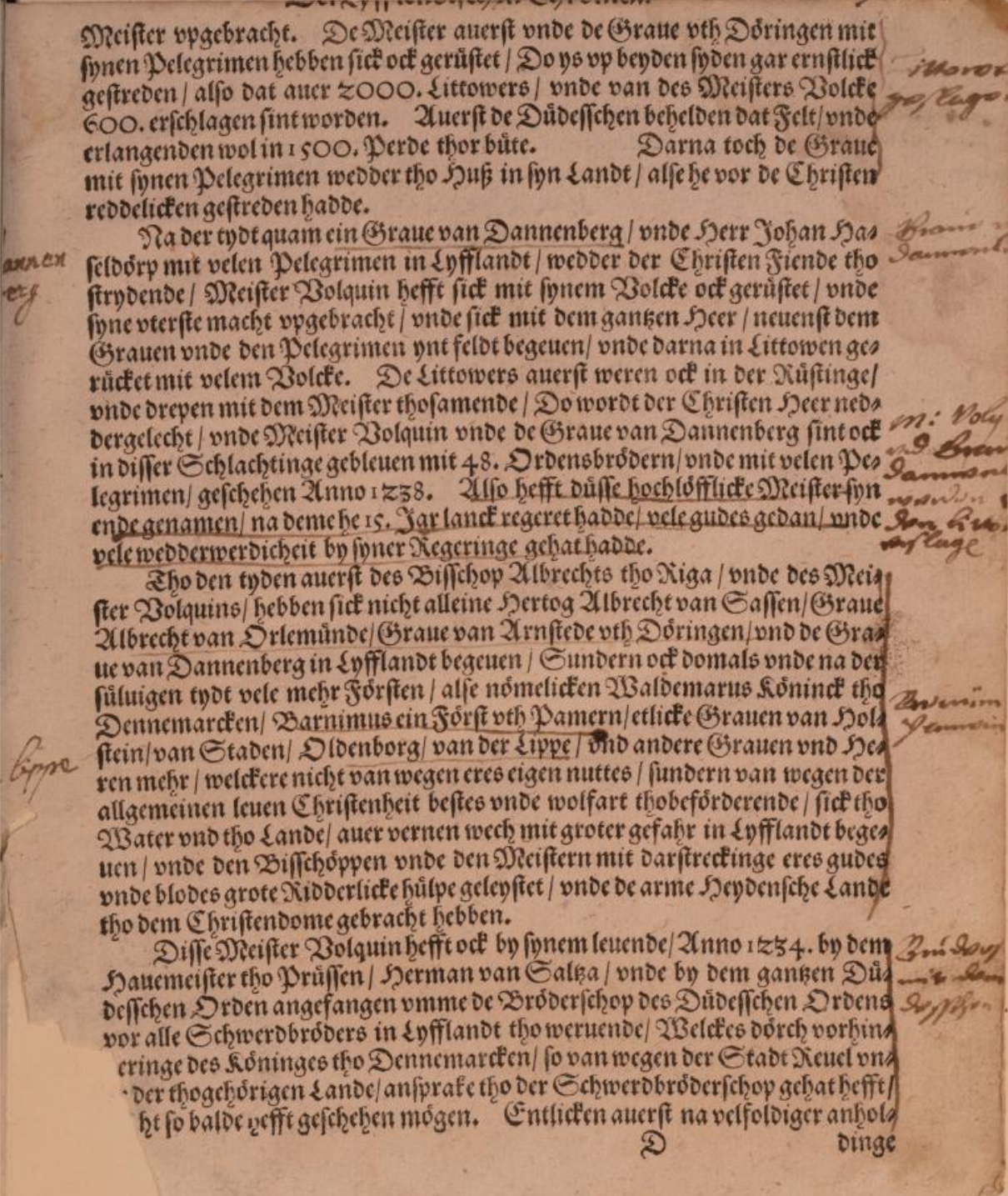
We provided Gemini with the image above and the following prompt:
Transcribe and translate those handwritten notes in the margins on both sides of the page.
What language are they in? Use paleographic analysis to estimate who wrote them and when.
Also, how do they relate to the passages they annotate?
First, we can see Gemini Deep Research's report:
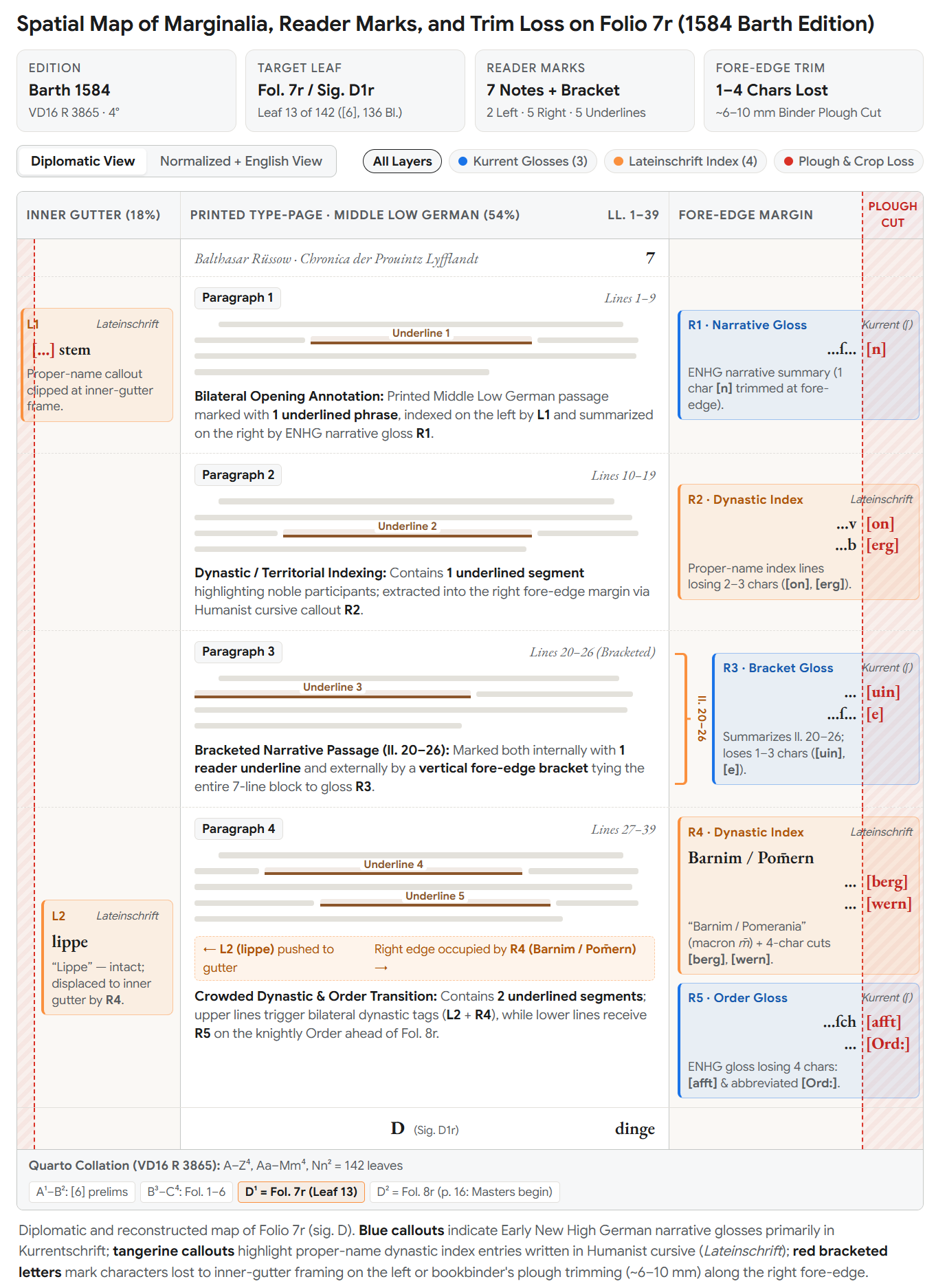
Which includes this diagram:
Running Gemini directly we get this analysis:
The printed leaf is signature D1r from Part I of Balthasar Russow’s Chronica der Prouintz Lyfflandt (first published in Rostock, 1578; revised second edition in Barth, 1584), a foundational Middle Low German (Mittelniederdeutsch) history of medieval and early modern Livonia. Across its inner (left) and outer (right) margins sit seven handwritten annotations—two in the left margin and five in the right—accompanied by brown-ink underlinings and vertical marginal brackets.
1. Transcription and Translation of the Marginalia
Letters lost where the inner left margin curves into the tight spine gutter or where a bookbinder’s plough trimmed the outer right fore-edge are reconstructed in square brackets [...]. Line breaks in the manuscript are marked with a slash /.
| Location | Diplomatic / Restored Transcription | English Translation |
| Left Margin 1 (lines 9–10) | [D]annen / [b]erg |
Dannenberg |
| Left Margin 2 (line 26) | Lippe |
Lippe |
| Right Margin 1 (lines 3–4) | [L]ittower / geschlage[n] |
Lithuanians defeated [lit. beaten/slain] |
| Right Margin 2 (lines 8–9) | Graue v[on] / Dannenb[erg] |
Count of Dannenberg |
| Right Margin 3 (lines 15–19) | M: Volq[uin] / u. Grau[e v.] / Dannenb[erg] / werden v[on] / den Litto[wern] / erschlage[n] |
M[aster] Volquin and [the] Count [of] Dannenberg are slain by the Lithuanians |
| Right Margin 4 (lines 25–26) | Barnim / Pommern (or Pomern) |
Barnim [of] Pomerania |
| Right Margin 5 (lines 33–35) | Brüdersch[afft] / mit den / Teutschen |
Fraternity [union/brotherhood] with the Teutonic [Knights] (lit. "with the Germans") |
2. Language Identification
While Russow’s printed chronicle is in Middle Low German (Mittelniederdeutsch), the marginalia are written in Early New High German (Frühneuhochdeutsch). Every non-onomastic gloss systematically translates Russow’s Low German forms into High German phonology, morphology, and syntax:
-
-
Brüdersch[afft]vs. printedBröderschop(line 35): Replaces Low German lowered ö and unshifted suffix -schop with High German ü and High German Consonant Shift suffix -schafft (Brüderschaft). -
Teutschenvs. printedDüdesschen(lines 34–35): Replaces Low German monophthong ü, initial D-, and -desschen with the classic Upper/Early New High German diphthong eu, initial T-, and affricate/fricative -tsch- (Teutschen). -
Pommern/Pomernvs. printedPamern(line 25): Restores High German o against the characteristic Middle Low German lowering of o > a before labials (Pamern). Similarly, LatinizedBarnimusis normalized to vernacular GermanBarnim. -
werden v[on] den Litto[wern] erschlage[n]vs. printedsint ock in disser Schlachinge gebleuen(lines 15–16): Uses standard High German passive syntax (werden + von + dative plural). -
Left-margin entries (
[D]annen[b]erg,Lippe): German dynastic/territorial proper names shared across Low and High German.
-
3. Paleographic Analysis: Dating and Scribal Profile
Dating: ca. 1580–1660 (most likely early-to-mid 17th century)
-
-
Chronological bounds: Publication of Russow’s Chronica sets a terminus post quem of 1578 (or 1584 if from the Barth edition). Codicological evidence establishes a clear terminus ante quem prior to the volume’s later rebinding: the binder’s plough shaved off the printed running header at the very top edge (
Der Lyff[lendischen Chronica]) and sliced through the rightmost letters of four outer-margin notes, while tight resewing pulled[D]annen[b]erginto the inner gutter. -
Script features (Right Margin — Deutsche Kurrentschrift): The five right-margin notes are written in a fluent, practiced early modern German Kurrent hand. Diagnostic late-16th- to mid-17th-century features include:
-
Single-looped Kurrent
dwhose ascender curls leftward back over the bowl (werden,den,Brüdersch[afft]). -
Baseline V-hook
r(Graue,werden,erschlage[n]) and narrow twin-stroke Kurrente. -
Consistent curved U-Bogen swoop over
u(Graŭe,ŭ.,Teŭtschen) to distinguish minims, alongside conservative Early New High German spellings (Grauewith consonantal medial u alongside initialT-inTeutschen, and colon suspensionM:for Meister). -
Prominent long
ſwith a deep, slightly left-curving descender paired with a compactchinſchclusters (geschlage[n],erschlage[n],Brüdersch[afft],Teutschen).
-
-
Script features (Left Margin — Humanist Cursive / Lateinschrift): Both left-margin notes (
[D]annen[b]erg,Lippe) are written in a clean, rightward-slanting Renaissance/Baroque humanist italic hand: single-compartment rounda, smooth archednn(rather than angular Kurrent minims), eyede, straight-stemmed italicppwith round lobes, open-tailedg, and a sweeping looped capitalL. -
Linguistic horizon: Between roughly 1580 and 1650, High German displaced Middle Low German as the written scholarly and administrative language across Northern Germany and Baltic Livonia/Estonia. Annotating a 1578/1584 Low German chronicle in Early New High German is a hallmark of early-17th-century North German and Baltic readership.
-
Who Wrote Them?
-
-
Evidence for two hands (or two distinct reading campaigns): Although educated German writers of this era practiced digraphia—switching between Kurrentschrift for German prose and Lateinschrift for Latin words and proper names (visible even in the slightly Latinate
M: Volqon the right)—several material clues point strongly to two different early modern readers:-
Duplication: Line 8’s
Graue van Dannenbergis annotated twice—once in Kurrent in the outer margin (Graue v[on] Dannenb[erg]) and once in humanist cursive in the inner margin ([D]annen[b]erg). A single reader indexing a page in one pass would have no reason to write the same name in both margins of the same sentence. -
Spatial displacement: At lines 25–26, the outer margin was already occupied by
Barnim / Pommern, prompting the writer ofLippeto place that note in the open inner margin next tovan der Lippe. -
Pen and ink: The right-margin Kurrent hand uses a broader, softer quill nib with darker grey-brown iron-gall ink and heavier shading; the left-margin italic hand uses a finer nib with a warmer, lighter brown ink.
-
-
Reader profile:
-
Primary annotator (Right Margin): Likely a university-educated Lutheran pastor, jurist, municipal councillor, or historian in Northern Germany (such as Pomerania or Mecklenburg) or German-speaking Livonia, systematically digesting Russow’s political-military narrative into High German marginal heads.
-
Secondary annotator (Left Margin): A 17th-century reader—likely an aristocrat, genealogist, or territorial official from Lower Saxony/Westphalia—scanning the chronicle specifically to extract references to North-West German comital families (Dannenberg, Lippe) who participated in the Livonian Crusades.
-
-
4. Relationship Between the Notes and the Annotated Passages
Rather than offering polemical commentary or disputing Russow’s facts, the annotations operate together with the page’s underlinings and vertical pen brackets as a structured system of marginal lemmata (index catchwords) and argumenta (concise plot summaries):
-
-
Contrasting Military Fortunes against the Lithuanians (Right Notes 1 & 3):
-
Lines 1–7 (bracketed on the right): Russow recounts how Master Volquin of the Livonian Brothers of the Sword and the Count from Thuringia fought a pitched battle against the Lithuanians, killing over 2,000 Lithuanians against 600 Christian dead and capturing 1,500 horses. Right Note 1 (
[L]ittower / geschlage[n]) distills the paragraph into a two-word victory heading. -
Lines 8–19 (underlined at lines 8 and 17–19): Russow narrates the disastrous campaign culminating in the Battle of Saule (historically 1236, dated
Anno 1238by Russow), where the Lithuanians routed the crusader army and killed Master Volquin, the Count of Dannenberg, and 48 Order knights. Right Note 3 (M: Volq[uin] u. Grau[e v.] Dannenb[erg] werden v[on] den Litto[wern] erschlage[n]) directly mirrors Note 1’s phrasing (geschlage[n]vs.erschlage[n]) to highlight the reversal of fortune, while the reader’s underlining at lines 17–19 marks Russow’s closing epitaph on Volquin’s 15-year rule and hardships.
-
-
Indexing Noble Crusaders from the Holy Roman Empire (Right Notes 2 & 4; Left Notes 1 & 2):
-
Line 8 (
Graue van Dannenbergunderlined): Flagged both by Right Note 2 (Graue v[on] Dannenb[erg]) upon the Count’s arrival in Livonia with Johann Hasseldörp and by Left Note 1 ([D]annen[b]erg). -
Lines 20–32 (double-ruled bracket on the right; names underlined in lines 25–26): Russow praises the foreign princes and counts who risked their wealth and blood at sea and overland to aid Bishop Albert of Riga and Master Volquin—naming King Valdemar II of Denmark, "Barnimus, a prince from Pomerania" (Duke Barnim I), and counts of Holstein, Stade, Oldenburg, and Lippe (such as Bernhard II of Lippe). Right Note 4 (
Barnim / Pommern) indexes the Pomeranian duke, while Left Note 2 (Lippe) pulls out the Westphalian House of Lippe.
-
-
Institutional Merger of the Military Orders (Right Note 5):
-
Lines 33–39 (vertical line on the right): Russow explains that in
Anno 1234, during his lifetime, Volquin opened negotiations with Teutonic Grand Master Hermann von Salza in Prussia to incorporate the Livonian Swordbrothers into the Teutonic Order (vmme de Bröderschop des Düdesschen Ordens)—a union initially delayed by the King of Denmark’s territorial claims to Reval (Tallinn). Right Note 5 (Brüdersch[afft] mit den Teutschen) extracts the core constitutional event of Livonian history: the Swordbrothers’ bid for union with the Teutonic Knights.
-
-
And run a second time:
This page is leaf D1r from Balthasar Russow’s Chronica der Prouintz Lyfflandt (Chronicle of the Province of Livonia), first printed in Rostock by Augustin Ferber in 1578. The margins preserve annotations from two distinct early modern readers: a primary annotator writing Middle Low German in late 16th- or early 17th-century German Kurrentschrift along the outer (right) margin, and a secondary reader indexing German noble names in Latin cursive along the inner (left) margin.
1. Transcription and Translation of the Marginalia
Square brackets [ ] indicate letters lost where the bookbinder’s plough trimmed the outer right edge (or where the left inner margin disappears into the binding gutter/image crop); parentheses ( ) expand scribal abbreviations.
(Note: Thin brown ink underlinings also highlight Graue van Dannenberg in line 8, Master Volkwin’s obituary in lines 16–19, Barnimus ein Först vth Pamern in line 22, and Lippe in line 24.)
2. Language Identification
-
-
Right-margin notes (R1–R5): Middle Low German (Mittelniederdeutsch / early modern Niederdeutsch). Several diagnostic phonological and lexical features separate these notes from Early New High German (Frühneuhochdeutsch):
-
Unshifted
sl-cluster: R1 writesgeslage[n]and R3 writeserslage[n](Middle Low German slân), preserving native Low Germansl-where High German—and even Russow’s Rostock printer in lines 4 (erschlagen) and 16 (Schlachtinge)—had already adoptedschl-. -
Unshifted consonantism and monophthongs: R2/R3 retain Low German
Graue(High German Graf), and R5 retains unshifteddüdschen/dütschen(High German deutschen) alongsideBrödersch[op](matching printedBröderschopin line 32; High German Brüderschaft). -
Open-syllable lowering (o > a): R4 writes
Pamern("Pomerania"), matching the Low German printed form in line 22 against High German Pommern. -
Prepositions: R2 and R3 use
v[an](van) rather than High German von.
-
-
Left-margin notes (L1–L2): German proper names (
Dannenberg,Lippe). Both are Northern German dynastic toponyms (Lower Saxony and Westphalia) whose standard spellings are identical in Low and High German (Dannenbergretains Low GermanD-universally as a place-name).
-
3. Paleographic and Codicological Analysis (Who & When)
Hand 1: The Right-Margin Annotator (R1–R5) — ca. 1578–1620
-
-
Paleographic features: Written in an upright, practiced late 16th- or early 17th-century North German Kurrentschrift using a moderately broad-cut quill and dark grey-brown iron-gall ink:
-
Minuscules: Classic two-stroke parallel Kurrent
e(werden,Pamern); single-bowleddwith an arched ascender looping briskly back to the left (werden,den,düdschen); sharp minim sequences inn/m; and heavily shaded diagonal longſplunging well below the baseline inſlandſchligatures (geslage[n],erslage[n],Brödersch[op]). -
Majuscules & punctuation: Characteristic late-Renaissance Kurrent capitals—pouch-bowled
Dwith a sweeping top arch (Dannenberg), upright loopedG(Graue), double-lobedB(Barnim,Brödersch[op]), long left-curvingP(Pamern), and three-archMfollowed by an early modern scholarly colon abbreviation (M:).
-
-
Codicological dating evidence (pre-binding trim): Across R1, R2, R3, and R5, a uniform strip of roughly 5–8 mm (1 to 4 letters) was sliced off the right edge by a bookbinder’s plough. Because 16th-century buyers typically purchased books in unbound sheets or temporary wrappers before commissioning permanent bindings (or rebindings), Hand 1 demonstrably annotated the leaves prior to the volume’s trimming.
-
Estimated writer: An educated native Low German speaker in Livonia/Estonia (such as Reval or Riga) or the Hanseatic coast (Rostock, Lübeck, Pomerania)—most likely a town councillor (Ratsherr), merchant-burgher, jurist, or Lutheran clergyman. Between roughly 1580 and 1620, High German rapidly replaced Low German as the written chancellery and scholarly idiom of Northern Europe; the fact that this reader spontaneously wrote traditional Low German
geslagenanderslagenwhile looking directly at printederschlagenpoints to someone raised in the final generation of active Low German literacy, trained in humanist study habits of extracting concise marginal lemmata.
-
Hand 2: The Left-Margin Annotator (L1–L2) — 17th to early 18th century
-
-
Paleographic features: Written with a finer nib, warmer reddish-brown ink (matching the thin underlinings in the text), and a pronounced ~60° rightward slant in fluent Latin / Humanist cursive (humanistische Kursive): single-stroke looped
e(annen,erg,Lippe), rounded arches onn, soft-shouldered cursiver, narrow-loopedg, tall loopedL, and straight-descender Latinps with closed right bowls (Lippe). -
Why this is a second, later hand rather than script-switching: While early modern German scribes frequently used Latin script for proper names (Digraphie), Hand 1 consistently wrote proper names (
Littower,Graue,Dannenberg,Volquin,Barnim,Pamern) in Kurrent. More decisively,Dannenbergis annotated twice on opposite sides of lines 8–9. Because Hand 1’sGraue v[an] Dannenb[erg]on the right had been rubbed and truncated by the binder’s plough, a subsequent reader underlined key phrases in the text, re-wrote[D]annenbergcleanly in the inner left margin (where its initial letters curve into the tight gutter/scan edge rather than a plough cut), and addedLippe, which Hand 1 had omitted. -
Estimated writer: A 17th- or early 18th-century genealogically minded German reader or antiquarian, likely with ties to Lower Saxony / Westphalia (the home territories of the Counts of Dannenberg and Lords/Counts of Lippe) or a Baltic German tracing ancestral crusading lineages.
-
4. Relationship to the Annotated Passages
Russow’s blackletter prose runs continuously without section headers or printed marginalia. Together, these notes turn leaf D1r—which recounts the final campaigns of Volkwin, second and last Master of the Livonian Brothers of the Sword (r. 1209–1236)—into a scannable historical index tracking military reversals, dynastic participants, and Livonia’s constitutional reorganization:
-
-
R1 (
Littowe[r] geslage[n]) & lines 1–7: Summarizes the victorious battle fought by Master Volkwin and a crusading Count from Thuringia (Graue vth Döringen) with his "pilgrims" (Pelegrimen), in which over 2,000 Lithuanians and 600 Christians fell and the Germans captured 1,500 horses. The vertical bracket and two-word note reduce seven lines of battle narrative to its military result. -
R2 (
Graue v[an] Dannenb[erg]) & L1 ([D]annenberg) & lines 8–10: Flags the arrival in Livonia of a Count of Dannenberg and Johann von Haseldorf (Johan Hasseldorp) with fresh crusaders. R2 marks the new narrative actor; L1 indexes the comital family. -
R3 (
M: Volq[uin] v. Graue [v.] Dannen[berg] werden v[an] den Litto[wern] erslage[n]) & lines 10–19: Marks the catastrophic Battle of Saule (historically 22 September 1236, misdated by Russow toAnno 1238), where the Lithuanians crushed the Christian army and killed Master Volkwin, the Count of Dannenberg, 48 Sword Brothers, and numerous crusaders. Paired with R1 above, R3 highlights the dramatic reversal of fortune on this single page (Littower geslagen → Volquin … van den Littowern erslagen), while the text underlining marks Russow’s eulogy of Volkwin’s reign. -
R4 (
Barnim / Pamern) & L2 (Lippe) & lines 20–29: Extracts specific dynasties from Russow’s roll-call of Northern European princes who crusaded in Livonia under Bishop Albert of Riga and Master Volkwin. Out of nine rulers and houses named in the paragraph, Hand 1 singles out Duke Barnim I of Pomerania (converting the printed LatinateBarnimusinto vernacularBarnim—notably aligning with Pomeranian/Baltic readership, as Russow studied in Stettin and published the second edition in Pomeranian Barth), whereas Hand 2 singles out Lippe (famous in Livonian history through Bernhard II of Lippe, co-founder of the Livonian mission’s episcopate). -
R5 (
Brödersch[op] mit den düdschen) & lines 30–36: Captures the pivotal institutional turning point of medieval Livonia: Volkwin’s negotiations (begun in1234) with Teutonic Grand Master Hermann von Salza (Herman van Saltza) to affiliate the Livonian Sword Brothers (Schwerdbröders) with the Teutonic Order—delayed by King Valdemar II of Denmark’s claims to Reval (Stadt Reuel), but fulfilled after Saule in 1237 with the creation of the Livonian Order.
-